


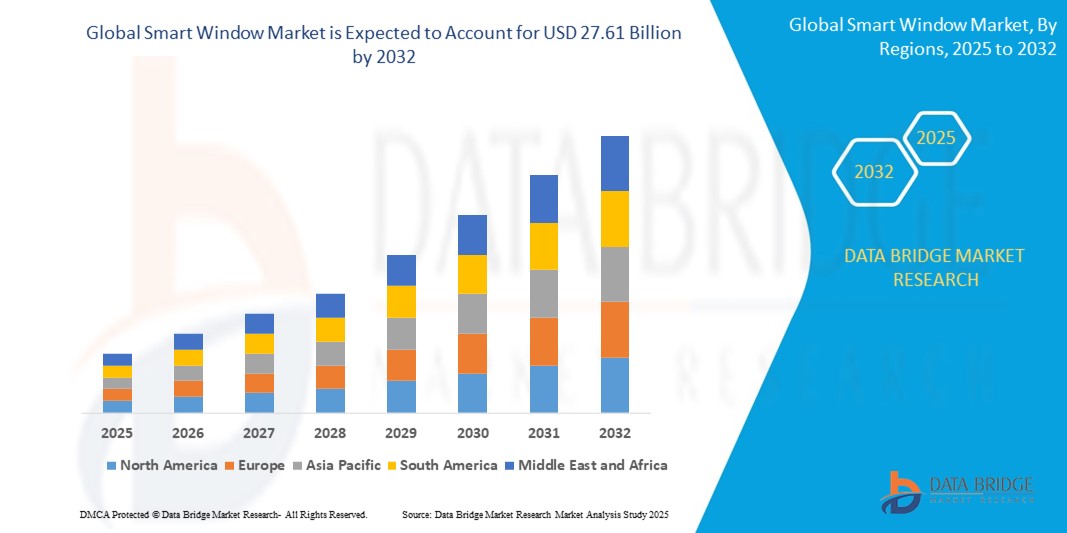
Smart Window Market Size
- The global smart window market size was valued at USD 7.44 billion in 2024 and is expected to reach USD 27.61 billion by 2032, at a CAGR of 17.80% during the forecast period
- The market growth is primarily driven by the increasing adoption of energy-efficient and smart building technologies, coupled with advancements in connected home and commercial automation systems, leading to greater digitalization in residential, commercial, and industrial settings
- Rising consumer demand for sustainable, energy-saving, and aesthetically appealing window solutions for homes, offices, and transportation is positioning smart windows as a preferred choice for modern architectural and design applications. These factors are significantly accelerating the adoption of smart window solutions, fueling industry growth
Smart Window Market Analysis
- Smart windows, which provide dynamic control over light, heat, and privacy through electronic or automated mechanisms, are increasingly integral to modern building design and energy management systems in residential, commercial, industrial, and transportation applications. They offer enhanced energy efficiency, user convenience, and seamless integration with smart building ecosystems
- The growing demand for smart windows is driven by the widespread adoption of green building technologies, increasing concerns about energy conservation, and a rising preference for automated and customizable window solutions
- North America dominated the smart window market with the largest revenue share of 41.5% in 2024, driven by early adoption of smart building technologies, high disposable incomes, and a strong presence of key industry players
- Asia-Pacific is expected to be the fastest-growing region in the smart window market during the forecast period due to rapid urbanization, increasing construction activities, and rising disposable incomes
- The self-dimming window segment dominated the largest market revenue share of 47.2% in 2024, driven by its widespread adoption in residential and commercial applications for privacy control, glare reduction, and energy efficiency
Report Scope and Smart Window Market Segmentation
|
Attributes |
Smart Window Key Market Insights |
|
Segments Covered |
|
|
Countries Covered |
North America
Europe
Asia-Pacific
Middle East and Africa
South America
|
|
Key Market Players |
|
|
Market Opportunities |
|
|
Value Added Data Infosets |
In addition to the insights on market scenarios such as market value, growth rate, segmentation, geographical coverage, and major players, the market reports curated by the Data Bridge Market Research also include in-depth expert analysis, geographically represented company-wise production and capacity, network layouts of distributors and partners, detailed and updated price trend analysis and deficit analysis of supply chain and demand. |
Smart Window Market Trends
“Increasing Integration of AI and IoT Technologies”
- The global smart window market is experiencing a significant trend toward the integration of Artificial Intelligence (AI) and Internet of Things (IoT) technologies
- These technologies enable advanced control and automation, providing real-time adjustments to light transmission and energy efficiency based on environmental conditions and user preferences
- AI-powered smart window systems analyze data such as sunlight intensity, temperature, and occupancy patterns to optimize tint levels, reducing energy consumption for heating, cooling, and lighting
- For instance, companies are developing AI-driven platforms that integrate with building management systems to dynamically adjust window opacity, enhancing occupant comfort and supporting sustainable building practices
- This trend is increasing the appeal of smart windows for both residential and commercial applications, offering seamless integration with smart home and building ecosystems
- IoT connectivity allows remote control via smartphone apps or voice assistants, enabling users to customize settings and monitor energy savings in real time
Smart Window Market Dynamics
Driver
“Rising Demand for Energy-Efficient Buildings and Smart Infrastructure”
- The increasing consumer and regulatory demand for energy-efficient buildings, driven by sustainability goals and rising energy costs, is a major driver for the global smart window market
- Smart windows enhance building efficiency by dynamically controlling light and heat transmission, reducing reliance on HVAC systems and artificial lighting
- Government initiatives, such as green building certifications and energy efficiency mandates in regions such as Europe and North America, are promoting the adoption of smart window technologies
- The proliferation of IoT and advancements in 5G technology enable faster data processing and connectivity, supporting sophisticated smart window applications such as automated shading and real-time energy monitoring
- Manufacturers are increasingly offering factory-integrated smart window systems as standard features in new constructions to meet market demands and enhance building value
Restraint/Challenge
“High Initial Costs and Data Privacy Concerns”
- The high upfront costs of smart window systems, including advanced materials, installation, and integration with IoT platforms, pose a significant barrier to adoption, particularly in cost-sensitive markets such as Asia-Pacific and Latin America
- Retrofitting existing buildings with smart windows can be complex and expensive, requiring specialized labor and infrastructure upgrades
- Data privacy and security concerns are a major challenge, as smart windows collect and transmit data on environmental conditions and user preferences, raising risks of breaches or misuse
- The fragmented regulatory landscape across countries, with varying data protection laws, complicates compliance for manufacturers and service providers operating globally
- These factors may deter adoption in regions with high cost sensitivity or strong data privacy awareness, potentially slowing market growth
Smart Window Market Scope
The market is segmented on the basis of type, product type, technology, and applications.
- By Type
On the basis of type, the global smart window market is segmented into OLED Glass, Self-Dimming Window, and Self-Repairing. The Self-Dimming Window segment dominated the largest market revenue share of 47.2% in 2024, driven by its widespread adoption in residential and commercial applications for privacy control, glare reduction, and energy efficiency. Self-dimming windows utilize technologies that allow dynamic light and heat management, reducing the need for traditional window treatments such as blinds.
The OLED Glass segment is expected to witness the fastest growth rate from 2025 to 2032, driven by its exceptional visual clarity, vibrant color reproduction, and high contrast ratios. The increasing demand for interactive displays and advanced aesthetics in commercial and automotive applications is fueling the adoption of OLED glass technology.
- By Product Type
On the basis of product type, the global smart window market is segmented into Motorized Roller Shades, Motorized Zebra Shades, Motorized Drapery Systems, and Other Product Types. The Motorized Roller Shades segment is expected to hold the largest market revenue share of 40.5% in 2024, primarily due to their ease of integration with smart home systems, energy efficiency, and widespread use in residential and commercial settings for automated light control.
The Motorized Drapery Systems segment is anticipated to experience the fastest growth rate of 15.8% from 2025 to 2032, driven by rising consumer demand for stylish, automated solutions that offer seamless integration with smart home platforms such as Amazon Alexa, Apple Home, and Google Home. Their ability to provide privacy and energy savings while enhancing aesthetic appeal is accelerating adoption.
- By Technology
On the basis of technology, the global smart window market is segmented into Suspended Particle Devices Light Modulator (SPD), Polymer Dispersed Liquid Crystal Devices Scanner (PDLC), and Electrochromic. The Electrochromic segment dominated the market with a revenue share of 43.8% in 2024, attributed to its energy efficiency, rapid response time, and ability to control light and heat transmission. Electrochromic windows are widely adopted in commercial buildings and luxury vehicles for their dynamic tinting capabilities.
The Suspended Particle Devices Light Modulator (SPD) segment is expected to witness significant growth from 2025 to 2032, with a projected CAGR of 10.5%. SPD technology offers fast switching times and excellent UV protection, making it ideal for transport and high-end architectural applications. Its ability to block over 99% of visible light enhances its appeal for privacy and glare control.
- By Applications
On the basis of applications, the global smart window market is segmented into Residential, Commercial, Industrial, and Transport. The Commercial segment held the largest market revenue share of 37.8% in 2024, driven by the increasing adoption of smart windows in office buildings, hospitals, and retail spaces for energy savings, privacy control, and aesthetic enhancement. Smart windows reduce operational costs by minimizing the need for artificial lighting and HVAC systems.
The Transport segment is anticipated to witness the fastest growth rate of 13.2% from 2025 to 2032, fueled by rising demand for smart windows in automotive, aerospace, and marine applications. The integration of smart glass in luxury vehicles and aircraft for glare reduction, UV protection, and passenger comfort is a key growth driver.
Smart Window Market Regional Analysis
- North America dominated the smart window market with the largest revenue share of 41.5% in 2024, driven by early adoption of smart building technologies, high disposable incomes, and a strong presence of key industry players
- Consumers prioritize smart windows for enhancing energy efficiency, improving indoor comfort, and providing automated light and privacy control, particularly in regions with varied climatic conditions
- Growth is supported by advancements in smart window technologies, such as electrochromic and suspended particle devices, alongside rising adoption in residential, commercial, industrial, and transport applications
U.S. Smart Window Market Insight
The U.S. smart window market captured the largest revenue share of 85.6% in 2024 within North America, fueled by strong demand in both residential and commercial sectors and growing awareness of energy-saving and privacy benefits. The trend toward smart home integration and sustainable building practices further boosts market expansion. The incorporation of smart windows in new constructions and retrofit projects, combined with supportive green building regulations, creates a dynamic market ecosystem.
Europe Smart Window Market Insight
The European smart window market is expected to witness significant growth, supported by stringent regulations promoting energy efficiency and sustainable construction. Consumers seek smart windows that enhance thermal insulation, reduce glare, and improve building aesthetics. Growth is prominent in both new installations and retrofit projects, with countries such as Germany and France showing substantial adoption due to environmental concerns and urban development.
U.K. Smart Window Market Insight
The U.K. market for smart windows is expected to witness rapid growth, driven by demand for energy-efficient solutions and enhanced indoor comfort in urban and suburban settings. Increased interest in smart home technologies and rising awareness of energy-saving benefits encourage adoption. Evolving building regulations balancing energy efficiency with occupant comfort further influence consumer preferences.
Germany Smart Window Market Insight
Germany is expected to witness the fastest growth rate in the European smart window market, attributed to its advanced construction sector and strong consumer focus on sustainability and energy efficiency. German consumers prefer technologically advanced smart windows, such as electrochromic and polymer-dispersed liquid crystal devices, that reduce energy consumption and enhance building performance. Integration in premium buildings and aftermarket solutions supports sustained market growth.
Asia-Pacific Smart Window Market Insight
The Asia-Pacific region is expected to witness the fastest growth rate in the global smart window market, driven by rapid urbanization, expanding construction activities, and rising disposable incomes in countries such as China, India, and Japan. Increasing awareness of energy efficiency, privacy control, and aesthetic appeal boosts demand. Government initiatives promoting sustainable construction and smart city development further encourage the adoption of advanced smart window technologies.
Japan Smart Window Market Insight
Japan’s smart window market is expected to witness rapid growth due to strong consumer preference for high-quality, technologically advanced smart windows that enhance building comfort and energy efficiency. The presence of major construction and automotive manufacturers, along with the integration of smart windows in new buildings and vehicles, accelerates market penetration. Rising interest in aftermarket smart window solutions also contributes to growth.
China Smart Window Market Insight
China holds the largest share of the Asia-Pacific smart window market, propelled by rapid urbanization, increasing building construction, and growing demand for energy-efficient and privacy-enhancing solutions. The country’s expanding middle class and focus on smart city initiatives support the adoption of advanced smart windows, such as OLED glass and self-dimming technologies. Strong domestic manufacturing capabilities and competitive pricing enhance market accessibility.
Smart Window Market Share
The smart window industry is primarily led by well-established companies, including:
- Inter IKEA Group (Netherlands)
- SpringBlinds (South Korea)
- Lutron (U.S.)
- Somfy (France)
- Griesser AG (Switzerland)
- Hunter Douglas (Netherlands)
- SAGE Electrochromics, Inc. (U.S.)
- Research Frontiers (U.S.)
- GENTEX CORPORATION (U.S.)
- Polytronix, Inc. (U.S.)
- Pleotint LLC. (U.S.)
- Smartglass International Limited (Ireland)
- AGP America S.A (Colombia)
- INNOVATIVE GLASS CORPORATION (U.S.)
- Showa Denko Materials Co., Ltd (Japan)
- SPD Control Systems Corporation (U.S.)
- Fuyao Group (China)
- Taiwan Glass IND. CORP. (Taiwan)
What are the Recent Developments in Global Smart Window Market?
- In January 2024, Gauzy Ltd. unveiled its latest smart glass technologies and Advanced Driver Assistance System (ADAS) solutions at CES 2024. The company introduced dynamic glazing solutions for automotive and architectural applications, alongside next-generation ADAS and Cabin Monitoring Systems (CMS) for improved safety and efficiency. These innovations highlight Gauzy's commitment to enhancing visibility, privacy, and energy efficiency across multiple industries
- In December 2023, Saint-Gobain's subsidiaries, SageGlass and Vetrotech, collaborated to equip Geneva's Alto Pont-Rouge building with advanced glazing solutions. The SageGlass Harmony smart double glazing is integrated with Contraflex fireproof safety glass. This combination optimizes natural light, reduces glare and heat, and meets stringent fire protection standards. The project underwent two years of development, including rigorous testing, and has been certified by TUV Rheinland Nederland BV
- In December 2023, PPG Industries, Inc. partnered with a leading electric vehicle manufacturer to explore integrating transparent photovoltaic film into smart car sunroofs. This collaboration aims to enable on-site energy generation, highlighting a significant trend toward embedding power-generating capabilities directly into automotive glass. This innovation contributes to enhancing vehicle energy efficiency and autonomy, aligning with the broader industry drive for sustainable and advanced smart window technologies
- In August 2023, Gauzy Ltd. partnered with Kolbe Windows & Doors to introduce an innovative privacy solution for homes. Their collaboration unveiled switchable privacy glass, integrating Gauzy's Premium Polymer Dispersed Liquid Crystal (PDLC) films laminated between dual glass panes. This technology allows homeowners to instantly transition between transparent and opaque states, offering a flexible and modern approach to residential privacy
- In May 2023, Miru Smart Technologies and ODL Inc. embarked on a two-year collaboration to innovate electrochromic doorglass and patio doors. This partnership aims to integrate tintable, electrochromic glass into smart doors, offering an energy-efficient, comfortable, and affordable solution. The technology provides modern aesthetics alongside enhanced light and privacy control. This initiative reflects a commitment to advancing smart home features with innovative, user-centric design

- Interactive Data Analysis Dashboard
- Company Analysis Dashboard for high growth potential opportunities
- Research Analyst Access for customization & queries
- Competitor Analysis with Interactive dashboard
- Latest News, Updates & Trend analysis
- Harness the Power of Benchmark Analysis for Comprehensive Competitor Tracking
Global Smart Window Market, Supply Chain Analysis and Ecosystem Framework
To support market growth and help clients navigate the impact of geopolitical shifts, DBMR has integrated in-depth supply chain analysis into its Global Smart Window Market research reports. This addition empowers clients to respond effectively to global changes affecting their industries. The supply chain analysis section includes detailed insights such as Global Smart Window Market consumption and production by country, price trend analysis, the impact of tariffs and geopolitical developments, and import and export trends by country and HSN code. It also highlights major suppliers with data on production capacity and company profiles, as well as key importers and exporters. In addition to research, DBMR offers specialized supply chain consulting services backed by over a decade of experience, providing solutions like supplier discovery, supplier risk assessment, price trend analysis, impact evaluation of inflation and trade route changes, and comprehensive market trend analysis.
Data collection and base year analysis are done using data collection modules with large sample sizes. The stage includes obtaining market information or related data through various sources and strategies. It includes examining and planning all the data acquired from the past in advance. It likewise envelops the examination of information inconsistencies seen across different information sources. The market data is analysed and estimated using market statistical and coherent models. Also, market share analysis and key trend analysis are the major success factors in the market report. To know more, please request an analyst call or drop down your inquiry.
The key research methodology used by DBMR research team is data triangulation which involves data mining, analysis of the impact of data variables on the market and primary (industry expert) validation. Data models include Vendor Positioning Grid, Market Time Line Analysis, Market Overview and Guide, Company Positioning Grid, Patent Analysis, Pricing Analysis, Company Market Share Analysis, Standards of Measurement, Global versus Regional and Vendor Share Analysis. To know more about the research methodology, drop in an inquiry to speak to our industry experts.
Data Bridge Market Research is a leader in advanced formative research. We take pride in servicing our existing and new customers with data and analysis that match and suits their goal. The report can be customized to include price trend analysis of target brands understanding the market for additional countries (ask for the list of countries), clinical trial results data, literature review, refurbished market and product base analysis. Market analysis of target competitors can be analyzed from technology-based analysis to market portfolio strategies. We can add as many competitors that you require data about in the format and data style you are looking for. Our team of analysts can also provide you data in crude raw excel files pivot tables (Fact book) or can assist you in creating presentations from the data sets available in the report.













