


Global Remote Sensing Technology for Agriculture Market, By Component (Hardware, Software, and Service), Application (Yield Monitoring, Field Mapping, Crop Scouting, Weather Tracking & Forecasting, Irrigation Management, Inventory Management, Farm Labour Management, and Others) – Industry Trends and Forecast to 2030.
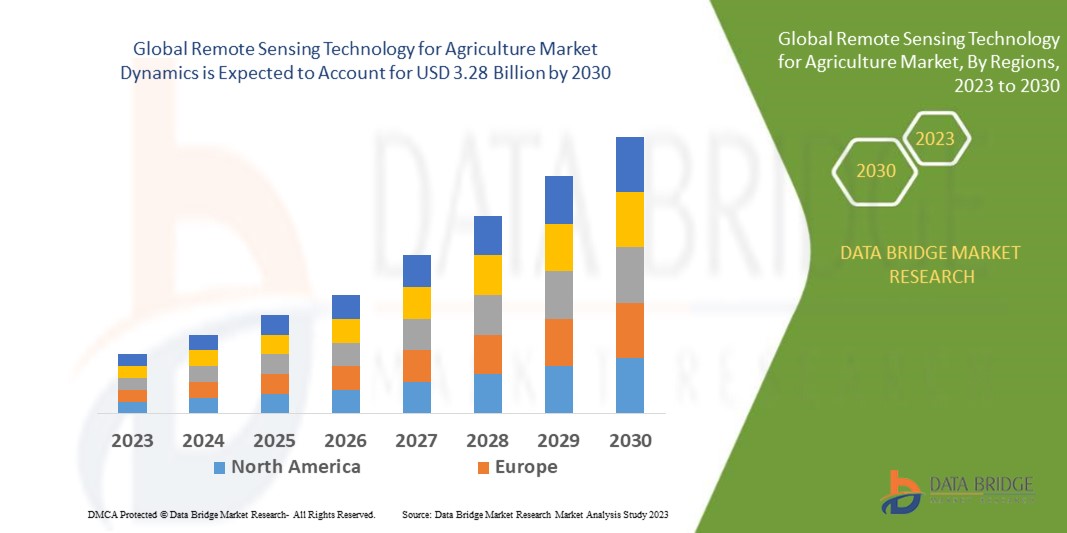
Remote Sensing Technology for Agriculture Market Analysis and Size
A modern farm and agriculture management approach that employs information technology to ensure that crops and soil receive exactly what they require for optimum health and productivity. Remote sensing technologies in agriculture aims to ensure profitability, sustainability, and environmental protection. The market is also benefiting from access to real-time data on crop, soil, and ambient air conditions, as well as other relevant information such as hyper-local weather forecasts, which is expected to grow the market which will raise revenues during the forecast period 2023-2030.
Data Bridge Market Research analyses that the global remote sensing technology for agriculture market was valued at USD 1.81 billion in 2022 and is expected to reach the value of USD 3.28 billion by 2030, at a CAGR of 7.70% during the forecast period of 2023 to 2030. “Hardware segment” is expected to dominate the market due to driving farming communities to use efficient agricultural methods. In addition to the insights on market scenarios such as market value, growth rate, segmentation, geographical coverage, and major players, the market reports curated by the Data Bridge Market Research also include in-depth expert analysis, geographically represented company-wise production and capacity, network layouts of distributors and partners, detailed and updated price trend analysis and deficit analysis of supply chain and demand.
Remote Sensing Technology for Agriculture Market Scope and Segmentation
|
Report Metric |
Details |
|
Forecast Period |
2023 to 2030 |
|
Base Year |
2022 |
|
Historic Years |
2021 (Customizable to 2015-2020) |
|
Quantitative Units |
Revenue in USD Million, Volumes in Units, Pricing in USD |
|
Segments Covered |
Component (Hardware, Software, and Service), Application (Yield Monitoring, Field Mapping, Crop Scouting, Weather Tracking & Forecasting, Irrigation Management, Inventory Management, Farm Labour Management, and Others) |
|
Countries Covered |
U.S., Canada and Mexico in North America, Germany, France, U.K., Netherlands, Switzerland, Belgium, Russia, Italy, Spain, Turkey, Rest of Europe in Europe, China, Japan, India, South Korea, Singapore, Malaysia, Australia, Thailand, Indonesia, Philippines, Rest of Asia-Pacific (APAC) in the Asia-Pacific (APAC), Saudi Arabia, U.A.E, Israel, Egypt, South Africa, Rest of Middle East and Africa (M.E.A.) as a part of Middle East and Africa (M.E.A.), Brazil, Argentina and Rest of South America as part of South America |
|
Market Players Covered |
Yara (Norway), Koch AG & Energy Solutions LLC (U.S.), Coromandel International Limited (India), AGRICULTURE SOLUTIONS INC. (Canada), Hafia Groups (Israel), Sapec Agro S.A. (Portugal), Kugler Company (U.S.), ICL (Israel), Van Iperen International (Netherlands), U.S. AG LLC (U.S.), Levant Power Corporation (U.S.), Honeywell International, Inc. (U.S.), Green Peak Technologies (Netherlands), Fujitsu (Japan), ABB(Switzerland), Texas Instruments Inc. (U.S.), ST Microelectronics (Switzerland) |
|
Market Opportunities |
|
Market Definition
Access to real-time data on crop, soil, and ambient air conditions, as well as other relevant information such as hyper-local weather forecasts, labour costs, and equipment availability, is part of the approach. Data is used by predictive analytics software to advise farmers on crop rotation, optimal planting and harvesting times, and soil management. Sensors in the field measure the moisture content and temperature of the soil as well as the surrounding air. Images can be processed and integrated with sensor and other data to provide guidance for immediate and future decisions, such as which fields to water and when or where to plant a specific crop.
Global Remote Sensing Technology for Agriculture Market Dynamics
Drivers
- Remote Sensing Technology for Agriculture
The primary factor driving farming communities to use efficient agricultural methods is a labour shortage in agricultural practises. High-value crops such as apples, strawberries, and sweet peppers are becoming less economically viable due to rising labour costs and a decrease in the number of skilled workers. Farmers of such fruits are increasingly turning to crop sensing solutions to facilitate effective plucking without causing physical damage to the crop.
- Implementation of Smart Agricultural Practices to Meet Rising Food Demand Globally
Rapid population growth is putting pressure on the agricultural sector around the world to increase productivity in order to meet rising food demand. Farmers are increasingly implementing smart harvest technologies such as harvesting robots, automation, control systems, sensors, and imaging systems to increase profitability and output in less time and at a lower cost. The scarcity of arable land is a major factor driving demand for indoor farming activities and the increased use of remote sensing technologies to reduce labour costs.
Opportunity
- Business growth
Firms in the target industry focuses on business growth through strategies such as advanced product launches, capacity expansion, and heavy production investments in their facilities, which are expected to flourish in the near future as the global remote sensing technology for agriculture market grows. Furthermore, site-specific nutrient management with precision agriculture, increased demand for industrial crops, and investment in agricultural operations in developing countries provide profitable opportunities to market participants.
Restraint/Challenge
- Large investment
The requirement for large initial investments in the production of numerous components is impeding the growth of the remote sensing technology market. Market participants must manufacture components and encrypt data content that meet regulatory organisation standards. This limits market growth opportunities for companies.
Recent Development
- In March 2021, China planned to launch a new satellite with a LiDAR (light detection and ranging) system to monitor CO2 levels in the atmosphere. Since 2016, China has launched three satellites into orbit for CO2 monitoring and research, all equipped with passive optical remote sensing technology.
Global Remote Sensing Technology for Agriculture Market Scope
The global remote sensing technology for agriculture market is on the basis of components and application. The growth amongst these segments will help you analyse meagre growth segments in the industries and provide the users with a valuable market overview and market insights to help them make strategic decisions for identifying core market applications.
Components
- Hardware
- Software
- Services
Application
- Yield Monitoring
- Field Mapping
- Crop Scouting
- Weather Tracking & Forecasting
- Irrigation Management
- Inventory Management
- Farm Labour Management
- Others
Global Remote Sensing Technology for Agriculture Market Regional Analysis/Insights
The global remote sensing technology for agriculture market is analyzed and market size insights and trends are provided by country, components and application as referenced above.
The countries covered in the global remote sensing technology for agriculture market report are U.S., Canada and Mexico in North America, Germany, France, U.K., Netherlands, Switzerland, Belgium, Russia, Italy, Spain, Turkey, Rest of Europe in Europe, China, Japan, India, South Korea, Singapore, Malaysia, Australia, Thailand, Indonesia, Philippines, Rest of Asia-Pacific (APAC) in the Asia-Pacific (APAC), Saudi Arabia, U.A.E, South Africa, Egypt, Israel, Rest of Middle East and Africa (M.E.A.) as a part of Middle East and Africa (M.E.A.), Brazil, Argentina and Rest of South America as part of South America.
North America had the largest market share, accounting for 38.10%. This share is accounted for by the presence of significant market players such as Lockheed Martin Corporation, Esri, and General Dynamics Mission Systems, Inc., among others.
The country section of the report also provides individual market impacting factors and changes in regulation in the market domestically that impacts the current and future trends of the market. Data points like down-stream and upstream value chain analysis, technical trends and porter's five forces analysis, case studies are some of the pointers used to forecast the market scenario for individual countries. Also, the presence and availability of global brands and their challenges faced due to large or scarce competition from local and domestic brands, impact of domestic tariffs and trade routes are considered while providing forecast analysis of the country data.
Competitive Landscape and Global Remote Sensing Technology for Agriculture Market Share Analysis
The global remote sensing technology for agriculture market competitive landscape provides details by competitor. Details included are company overview, company financials, revenue generated, market potential, investment in research and development, new market initiatives, global presence, production sites and facilities, production capacities, company strengths and weaknesses, product launch, product width and breadth, application dominance. The above data points provided are only related to the companies' focus related to global remote sensing technology for agriculture market .
Some of the major players operating in the global remote sensing technology for agriculture market are:
- Yara (Norway)
- Koch AG & Energy Solutions LLC (U.S.)
- Coromandel International Limited (India)
- AGRICULTURE SOLUTIONS INC. (Canada)
- Hafia Groups (Israel)
- Sapec Agro S.A. (Portugal)
- Kugler Company (U.S.)
- ICL (Israel)
- Van Iperen International (Netherlands)
- U.S. AG LLC (U.S.)
- Levant Power Corporation (U.S.)
- Honeywell International, Inc. (U.S.)
- Green Peak Technologies (Netherlands)
- Fujitsu (Japan)
- ABB(Switzerland)
- Texas Instruments Inc. (U.S.)
- ST Microelectronics (Switzerland)
SKU-
Obtenha acesso online ao relatório sobre a primeira nuvem de inteligência de mercado do mundo

- Painel interativo de análise de dados
- Painel de análise da empresa para oportunidades de elevado potencial de crescimento
- Acesso de analista de pesquisa para personalização e customização. consultas
- Análise da concorrência com painel interativo
- Últimas notícias, atualizações e atualizações Análise de tendências
- Aproveite o poder da análise de benchmark para um rastreio abrangente da concorrência
Índice
1. INTRODUÇÃO
1.1 OBJETIVOS DO ESTUDO
1.2 DEFINIÇÃO DE MERCADO
1.3 VISÃO GERAL DA TECNOLOGIA GLOBAL DE SENSORIAMENTO REMOTO PARA O MERCADO AGRÍCOLA
1.4 MOEDA E PREÇOS
1.5 LIMITAÇÃO
1.6 MERCADOS COBERTOS
2. SEGMENTAÇÃO DE MERCADO
2.1 PRINCIPAIS CONCLUSÕES
2.2 CHEGANDO AO MERCADO GLOBAL DE TECNOLOGIA DE SENSORIAMENTO REMOTO PARA AGRICULTURA
2.2.1 GRADE DE POSICIONAMENTO DE FORNECEDORES
2.2.2 CURVA DA LINHA DE VIDA DA TECNOLOGIA
2.2.3 GUIA DE MERCADO
2.2.4 GRADE DE POSICIONAMENTO DA EMPRESA
2.2.5 ANÁLISE DA PARTICIPAÇÃO DE MERCADO DA EMPRESA
2.2.6 MODELAGEM MULTIVARIADA
2.2.7 ANÁLISE DE CIMA PARA BAIXO
2.2.8 PADRÕES DE MEDIÇÃO
2.2.9 ANÁLISE DA PARTICIPAÇÃO DO FORNECEDOR
2.2.10 PONTOS DE DADOS DAS ENTREVISTAS PRIMÁRIAS PRINCIPAIS
2.2.11 PONTOS DE DADOS DE BASES DE DADOS SECUNDÁRIAS PRINCIPAIS
2.3 TECNOLOGIA GLOBAL DE SENSORIAMENTO REMOTO PARA O MERCADO AGRÍCOLA: RESUMO DA PESQUISA
2.4 PREMISSAS
3. VISÃO GERAL DO MERCADO
3.1 MOTORISTAS
3.2 RESTRIÇÕES
3.3 OPORTUNIDADES
3.4 DESAFIOS
4. RESUMO EXECUTIVO
5. VISÃO PREMIUM
5.1 AS CINCO FORÇAS DE PORTERS
5.2 NORMAS REGULAMENTARES
5.3 TENDÊNCIAS TECNOLÓGICAS
5.4 ANÁLISE DE PATENTES
5.5 ESTUDO DE CASO
5.6 ANÁLISE DA CADEIA DE VALOR
5.7 ANÁLISE COMPARATIVA DE EMPRESAS
5.8 BENEFÍCIOS DO USO DA TECNOLOGIA DE SENSORIAMENTO REMOTO NA AGRICULTURA
5.9 FUTURO DO SENSORIAMENTO REMOTO NA AGRICULTURA
6. TECNOLOGIA GLOBAL DE SENSORIAMENTO REMOTO PARA O MERCADO AGRÍCOLA, POR TECNOLOGIA
6.1 VISÃO GERAL
6.2 ATIVO
6.2.1 RADAR
6.2.2 SONAR
6.2.3 LASER
6.3 PASSIVO
6.3.1 ENERGIA TÉRMICA INFRAVERMELHA
6.3.2 VISÍVEL
6.3.3 INFRAVERMELHO PRÓXIMO
7. TECNOLOGIA GLOBAL DE SENSORIAMENTO REMOTO PARA O MERCADO AGRÍCOLA, POR TIPO DE SISTEMA
7.1 VISÃO GERAL
7.2 SENSOR ÓPTICO
7.3 SENSORES MULTI-ESPECTAIS
7.4 SENSAÇÃO HIPERESPECTRAL
7.5 SENSOR TÉRMICO
7.6 SENSOR DE RADAR
7.7 DETECÇÃO DE LIDAR
7.8 VEÍCULOS AÉREOS NÃO TRIPULADOS (VANTs)
7.9 OUTROS
8. TECNOLOGIA GLOBAL DE SENSORIAMENTO REMOTO PARA O MERCADO AGRÍCOLA, POR MECANISMO DE PRODUTO
8.1 VISÃO GERAL
8.2 IMAGENS FOTOGRÁFICAS
8.3 IMAGENS DIGITAIS
9. TECNOLOGIA GLOBAL DE SENSORIAMENTO REMOTO PARA O MERCADO AGRÍCOLA, POR RESOLUÇÃO DE IMAGEM
9.1 VISÃO GERAL
9.2 RECURSO DE BAIXA RESOLUÇÃO ESPACIAL (>30 METROS)
9.3 SATÉLITE DE MÉDIA RESOLUÇÃO (5-30 METROS)
9.4 INDÚSTRIA DE ALTA RESOLUÇÃO (1-5 METROS)
9.5 INDÚSTRIA DE ALTA RESOLUÇÃO (< 1 METRO)
10. TECNOLOGIA GLOBAL DE SENSORIAMENTO REMOTO PARA O MERCADO AGRÍCOLA, POR APLICAÇÃO
10.1 VISÃO GERAL
10.2 MONITORAMENTO DE RENDIMENTO
10.3 MAPEAMENTO DE CAMPO
10.4 OBSERVAÇÃO DE CULTURAS
10.5 RASTREAMENTO E PREVISÃO DO TEMPO
10.6 GESTÃO DA IRRIGAÇÃO
10.7 GESTÃO DE ESTOQUE
10.8 GESTÃO DA MÃO DE OBRA NA FAZENDA
10.9 OBSERVAÇÃO DAS CONDIÇÕES DO SOLO
10.10 MANEJO DE ERVAS DANINHAS
10.11 OUTROS
11. TECNOLOGIA GLOBAL DE SENSORIAMENTO REMOTO PARA O MERCADO AGRÍCOLA, POR GEOGRAFIA
TECNOLOGIA GLOBAL DE SENSORIAMENTO REMOTO PARA O MERCADO AGRÍCOLA (TODA A SEGMENTAÇÃO FORNECIDA ACIMA É REPRESENTADA NESTE CAPÍTULO POR PAÍS)
11.1 AMÉRICA DO NORTE
11.1.1 EUA
11.1.2 CANADÁ
11.1.3 MÉXICO
11.2 EUROPA
11.2.1 ALEMANHA
11.2.2 FRANÇA
11.2.3 Reino Unido
11.2.4 ITÁLIA
11.2.5 ESPANHA
11.2.6 RÚSSIA
11.2.7 TURQUIA
11.2.8 BÉLGICA
11.2.9 HOLANDA
11.2.10 NORUEGA
11.2.11 FINLÂNDIA
11.2.12 SUÍÇA
11.2.13 DINAMARCA
11.2.14 SUÉCIA
11.2.15 POLÔNIA
11.2.16 RESTO DA EUROPA
11.3 ÁSIA-PACÍFICO
11.3.1 JAPÃO
11.3.2 CHINA
11.3.3 COREIA DO SUL
11.3.4 ÍNDIA
11.3.5 AUSTRÁLIA
11.3.6 NOVA ZELÂNDIA
11.3.7 SINGAPURA
11.3.8 TAILÂNDIA
11.3.9 MALÁSIA
11.3.10 INDONÉSIA
11.3.11 FILIPINAS
11.3.12 TAIWAN
11.3.13 VIETNÃ
11.3.14 RESTO DA ÁSIA-PACÍFICO
11.4 AMÉRICA DO SUL
11.4.1 BRASIL
11.4.2 ARGENTINA
11.4.3 RESTO DA AMÉRICA DO SUL
11.5 ORIENTE MÉDIO E ÁFRICA
11.5.1 ÁFRICA DO SUL
11.5.2 EGITO
11.5.3 ARÁBIA SAUDITA
11.5.4 Emirados Árabes Unidos
11.5.5 OMÃ
11.5.6 BAHREIN
11.5.7 ISRAEL
11.5.8 KUWAIT
11.5.9 CATAR
11.5.10 RESTANTE DO ORIENTE MÉDIO E ÁFRICA
11.6 PRINCIPAIS INSIGHTS: POR PAÍSES PRINCIPAIS
12. TECNOLOGIA GLOBAL DE SENSORIAMENTO REMOTO PARA O MERCADO AGRÍCOLA, PAISAGEM DA EMPRESA
12.1 ANÁLISE DE AÇÕES DA EMPRESA: GLOBAL
12.2 ANÁLISE DE AÇÕES DA EMPRESA: AMÉRICA DO NORTE
12.3 ANÁLISE DE AÇÕES DA EMPRESA: EUROPA
12.4 ANÁLISE DE AÇÕES DA EMPRESA: ÁSIA-PACÍFICO
12.5 FUSÕES E AQUISIÇÕES
12.6 DESENVOLVIMENTO E APROVAÇÕES DE NOVOS PRODUTOS
12.7 EXPANSÕES
12.8 ALTERAÇÕES REGULAMENTARES
12.9 PARCERIA E OUTROS DESENVOLVIMENTOS ESTRATÉGICOS
13. TECNOLOGIA GLOBAL DE SENSORIAMENTO REMOTO PARA ANÁLISE DE MERCADO AGRÍCOLA, SWOT E DBMR
14. TECNOLOGIA GLOBAL DE SENSORIAMENTO REMOTO PARA O MERCADO AGRÍCOLA, PERFIL DA EMPRESA
14.1 NORTHROP GRUMMAN.
14.1.1 RESUMO DA EMPRESA
14.1.2 ANÁLISE DE RECEITA
14.1.3 PRESENÇA GEOGRÁFICA
14.1.4 PORTFÓLIO DE PRODUTOS
14.1.5 DESENVOLVIMENTO RECENTE
14.2 EMPRESA KUGLER
14.2.1 RESUMO DA EMPRESA
14.2.2 ANÁLISE DE RECEITA
14.2.3 PRESENÇA GEOGRÁFICA
14.2.4 PORTFÓLIO DE PRODUTOS
14.2.5 DESENVOLVIMENTO RECENTE
14.3 ICL
14.3.1 RESUMO DA EMPRESA
14.3.2 ANÁLISE DE RECEITA
14.3.3 PRESENÇA GEOGRÁFICA
14.3.4 PORTFÓLIO DE PRODUTOS
14.3.5 DESENVOLVIMENTO RECENTE
14.4 TECNOLOGIAS HUMMINGBIRD LIMITADA
14.4.1 RESUMO DA EMPRESA
14.4.2 ANÁLISE DE RECEITA
14.4.3 PRESENÇA GEOGRÁFICA
14.4.4 PORTFÓLIO DE PRODUTOS
14.4.5 DESENVOLVIMENTO RECENTE
14.5 SATYUKT ANALYTICS PRIVATE LIMITED
14.5.1 RESUMO DA EMPRESA
14.5.2 ANÁLISE DE RECEITA
14.5.3 PRESENÇA GEOGRÁFICA
14.5.4 PORTFÓLIO DE PRODUTOS
14.5.5 DESENVOLVIMENTO RECENTE
14.6 HONEYWELL INTERNATIONAL INC
14.6.1 RESUMO DA EMPRESA
14.6.2 ANÁLISE DE RECEITA
14.6.3 PRESENÇA GEOGRÁFICA
14.6.4 PORTFÓLIO DE PRODUTOS
14.6.5 DESENVOLVIMENTO RECENTE
14.7 FARMERS EDGE INC
14.7.1 RESUMO DA EMPRESA
14.7.2 ANÁLISE DE RECEITA
14.7.3 PRESENÇA GEOGRÁFICA
14.7.4 PORTFÓLIO DE PRODUTOS
14.7.5 DESENVOLVIMENTO RECENTE
14.8 AIRBUS
14.8.1 RESUMO DA EMPRESA
14.8.2 ANÁLISE DE RECEITA
14.8.3 PRESENÇA GEOGRÁFICA
14.8.4 PORTFÓLIO DE PRODUTOS
14.8.5 DESENVOLVIMENTO RECENTE
14.9 LEICA GEOSYSTEMS AG (PARTE DA HEXAGON)
14.9.1 RESUMO DA EMPRESA
14.9.2 ANÁLISE DE RECEITA
14.9.3 PRESENÇA GEOGRÁFICA
14.9.4 PORTFÓLIO DE PRODUTOS
14.9.5 DESENVOLVIMENTO RECENTE
14.10 TECNOLOGIAS MAXAR
14.10.1 RESUMO DA EMPRESA
14.10.2 ANÁLISE DE RECEITA
14.10.3 PRESENÇA GEOGRÁFICA
14.10.4 PORTFÓLIO DE PRODUTOS
14.10.5 DESENVOLVIMENTO RECENTE
14.11 GRUPO SCANEX
14.11.1 RESUMO DA EMPRESA
14.11.2 ANÁLISE DE RECEITA
14.11.3 PRESENÇA GEOGRÁFICA
14.11.4 PORTFÓLIO DE PRODUTOS
14.11.5 DESENVOLVIMENTO RECENTE
14.12 CORPORAÇÃO DE IMAGEM POR SATÉLITE
14.12.1 RESUMO DA EMPRESA
14.12.2 ANÁLISE DE RECEITA
14.12.3 PRESENÇA GEOGRÁFICA
14.12.4 PORTFÓLIO DE PRODUTOS
14.12.5 DESENVOLVIMENTO RECENTE
14.13 PLANET LABS PBC
14.13.1 RESUMO DA EMPRESA
14.13.2 ANÁLISE DE RECEITA
14.13.3 PRESENÇA GEOGRÁFICA
14.13.4 PORTFÓLIO DE PRODUTOS
14.13.5 DESENVOLVIMENTO RECENTE
14.14 SKY LAND MANAGEMENT PTY LTD
14.14.1 RESUMO DA EMPRESA
14.14.2 ANÁLISE DE RECEITA
14.14.3 PRESENÇA GEOGRÁFICA
14.14.4 PORTFÓLIO DE PRODUTOS
14.14.5 DESENVOLVIMENTO RECENTE
14.15 CORPORAÇÃO DE IMAGEM POR SATÉLITE
14.15.1 RESUMO DA EMPRESA
14.15.2 ANÁLISE DE RECEITA
14.15.3 PRESENÇA GEOGRÁFICA
14.15.4 PORTFÓLIO DE PRODUTOS
14.15.5 DESENVOLVIMENTOS RECENTES
14.16 ESRI AGRICULTURA
14.16.1 RESUMO DA EMPRESA
14.16.2 ANÁLISE DE RECEITA
14.16.3 PRESENÇA GEOGRÁFICA
14.16.4 PORTFÓLIO DE PRODUTOS
14.16.5 DESENVOLVIMENTOS RECENTES
14.17 CORTEVA
14.17.1 RESUMO DA EMPRESA
14.17.2 ANÁLISE DE RECEITA
14.17.3 PRESENÇA GEOGRÁFICA
14.17.4 PORTFÓLIO DE PRODUTOS
14.17.5 DESENVOLVIMENTOS RECENTES
14.18 SYNGENTA
14.18.1 RESUMO DA EMPRESA
14.18.2 ANÁLISE DE RECEITA
14.18.3 PRESENÇA GEOGRÁFICA
14.18.4 PORTFÓLIO DE PRODUTOS
14.18.5 DESENVOLVIMENTOS RECENTES
14.19 BAYER AG
14.19.1 RESUMO DA EMPRESA
14.19.2 ANÁLISE DE RECEITA
14.19.3 PRESENÇA GEOGRÁFICA
14.19.4 PORTFÓLIO DE PRODUTOS
14.19.5 DESENVOLVIMENTOS RECENTES
14.20 CARGILL, INCORPORADA
14.20.1 RESUMO DA EMPRESA
14.20.2 ANÁLISE DE RECEITA
14.20.3 PRESENÇA GEOGRÁFICA
14.20.4 PORTFÓLIO DE PRODUTOS
14.20.5 DESENVOLVIMENTOS RECENTES
14.21 SEMIOS
14.21.1 RESUMO DA EMPRESA
14.21.2 ANÁLISE DE RECEITA
14.21.3 PRESENÇA GEOGRÁFICA
14.21.4 PORTFÓLIO DE PRODUTOS
14.21.5 DESENVOLVIMENTOS RECENTES
14.22 CLIMA LLC.
14.22.1 RESUMO DA EMPRESA
14.22.2 ANÁLISE DE RECEITA
14.22.3 PRESENÇA GEOGRÁFICA
14.22.4 PORTFÓLIO DE PRODUTOS
14.22.5 DESENVOLVIMENTOS RECENTES
14,23 METROS
14.23.1 RESUMO DA EMPRESA
14.23.2 ANÁLISE DE RECEITA
14.23.3 PRESENÇA GEOGRÁFICA
14.23.4 PORTFÓLIO DE PRODUTOS
14.23.5 DESENVOLVIMENTOS RECENTES
14.24 SENTRA
14.24.1 RESUMO DA EMPRESA
14.24.2 ANÁLISE DE RECEITA
14.24.3 PRESENÇA GEOGRÁFICA
14.24.4 PORTFÓLIO DE PRODUTOS
14.24.5 DESENVOLVIMENTOS RECENTES
15. CONCLUSÃO
16. QUESTIONÁRIO
17. RELATÓRIOS RELACIONADOS

Metodologia de Investigação
A recolha de dados e a análise do ano base são feitas através de módulos de recolha de dados com amostras grandes. A etapa inclui a obtenção de informações de mercado ou dados relacionados através de diversas fontes e estratégias. Inclui examinar e planear antecipadamente todos os dados adquiridos no passado. Da mesma forma, envolve o exame de inconsistências de informação observadas em diferentes fontes de informação. Os dados de mercado são analisados e estimados utilizando modelos estatísticos e coerentes de mercado. Além disso, a análise da quota de mercado e a análise das principais tendências são os principais fatores de sucesso no relatório de mercado. Para saber mais, solicite uma chamada de analista ou abra a sua consulta.
A principal metodologia de investigação utilizada pela equipa de investigação do DBMR é a triangulação de dados que envolve a mineração de dados, a análise do impacto das variáveis de dados no mercado e a validação primária (especialista do setor). Os modelos de dados incluem grelha de posicionamento de fornecedores, análise da linha de tempo do mercado, visão geral e guia de mercado, grelha de posicionamento da empresa, análise de patentes, análise de preços, análise da quota de mercado da empresa, normas de medição, análise global versus regional e de participação dos fornecedores. Para saber mais sobre a metodologia de investigação, faça uma consulta para falar com os nossos especialistas do setor.
Personalização disponível
A Data Bridge Market Research é líder em investigação formativa avançada. Orgulhamo-nos de servir os nossos clientes novos e existentes com dados e análises que correspondem e atendem aos seus objetivos. O relatório pode ser personalizado para incluir análise de tendências de preços de marcas-alvo, compreensão do mercado para países adicionais (solicite a lista de países), dados de resultados de ensaios clínicos, revisão de literatura, mercado remodelado e análise de base de produtos . A análise de mercado dos concorrentes-alvo pode ser analisada desde análises baseadas em tecnologia até estratégias de carteira de mercado. Podemos adicionar quantos concorrentes necessitar de dados no formato e estilo de dados que procura. A nossa equipa de analistas também pode fornecer dados em tabelas dinâmicas de ficheiros Excel em bruto (livro de factos) ou pode ajudá-lo a criar apresentações a partir dos conjuntos de dados disponíveis no relatório.











