


Global Search and Rescue Equipment Market, By Type (Search Equipment, Communication Equipment, Rescue Equipment, Technical Equipment, Logistics Equipment, Medical Equipment, Planning Equipment, and Others), Platform (Airtime, Maritime, and Ground), Application (Rugged Terrains, Urban and Suburban Locations, and Combat Sites), End User (Defense, Police and Homeland Security, Disaster Management, Fire Departments, Healthcare/EMS, and Others) - Industry Trends and Forecast to 2030.
Search and Rescue Equipment Market Analysis and Insights
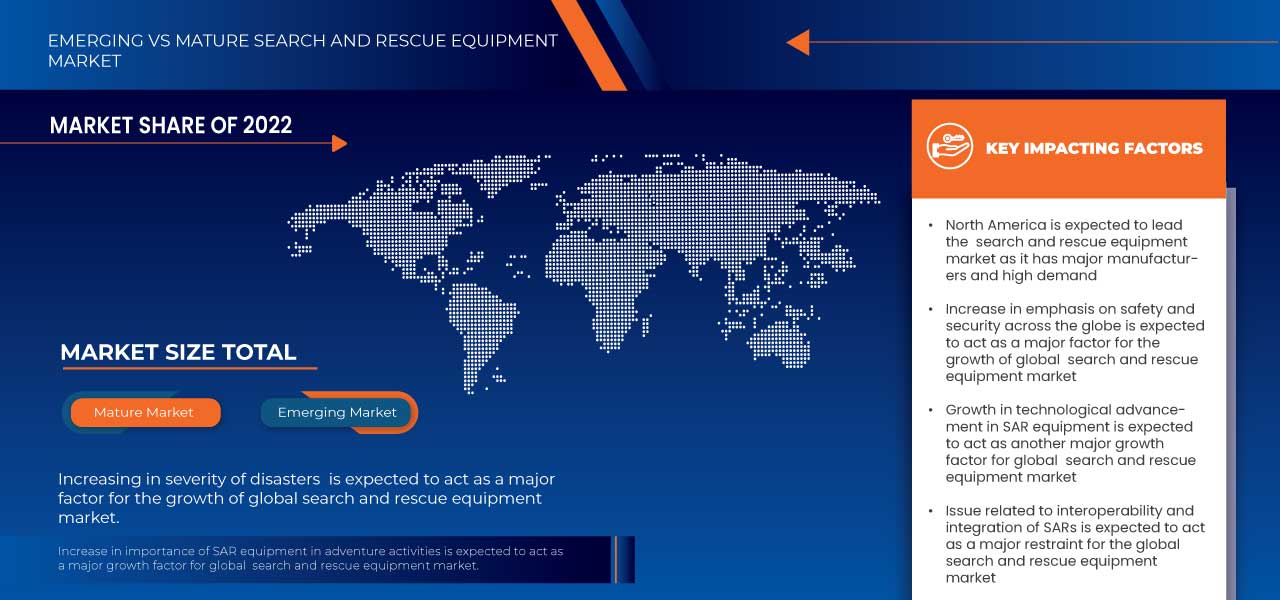
The global search and rescue equipment market is fragmented in nature, as it consists of many global players and regional players as well. The presence of these companies produces competitive SAR equipment, solutions, technological development, and services with various features and characteristics at a competitive price. Due to the presence of these players at regional and international levels, suppliers and manufacturers offer products and services for different budgets. The increase in emphasis on safety and security across the globe and growth in technological advancement in SAR equipment is expected to boost the market growth. Moreover, the increased severity of disasters and rapid product development, and growing contract associated with SAR equipment is further fueling the growth in the market. However, the high cost associated with advanced SAR equipment and various issue related to interoperability and integration of SARs is expected to restrain market growth and act as major market restraints.
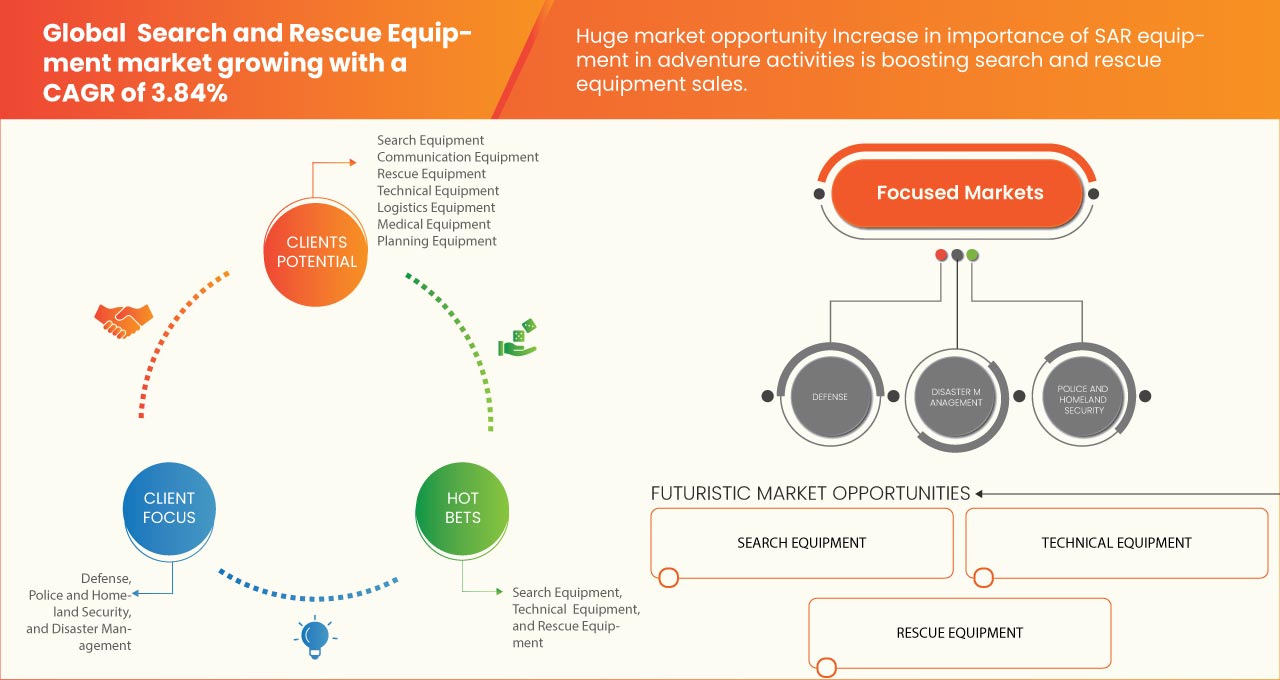
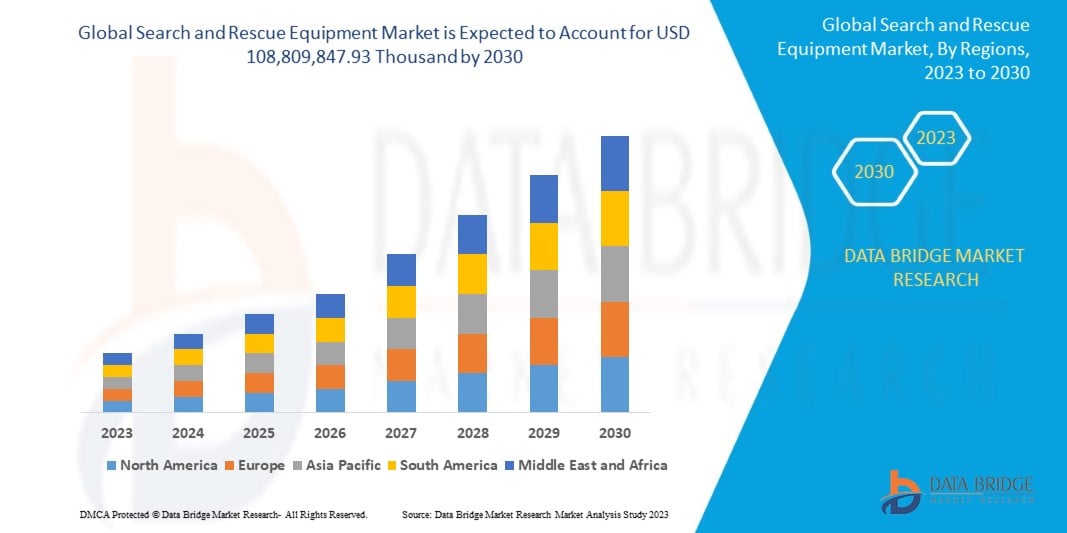
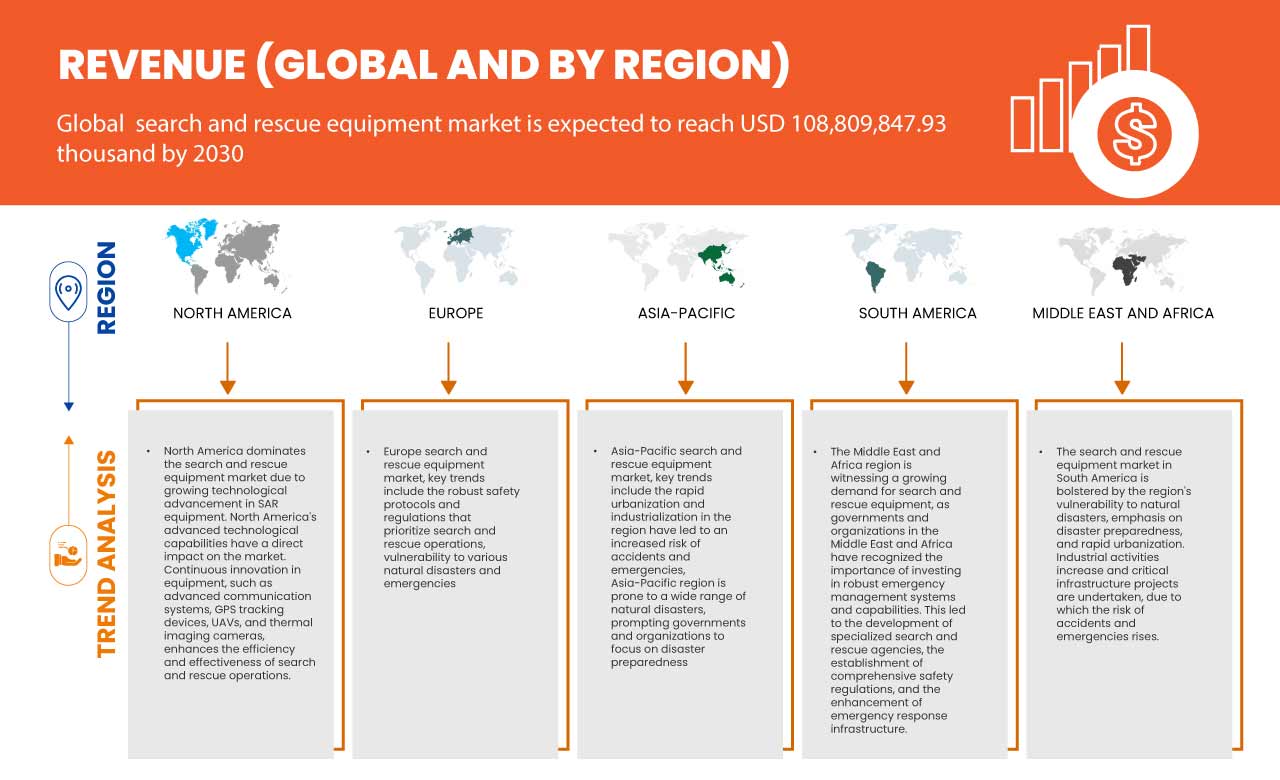
Data Bridge Market Research analyzes that the global search and rescue equipment market is expected to reach a value of USD 108,809,847.93 thousand by 2030, at a CAGR of 3.84% during the forecast period.
|
Report Metric |
Details |
|
Forecast Period |
2023 to 2030 |
|
Base Year |
2022 |
|
Historic Years |
2021 (Customizable to 2015 – 2020) |
|
Quantitative Units |
Revenue in Thousand, Pricing in USD |
|
Segments Covered |
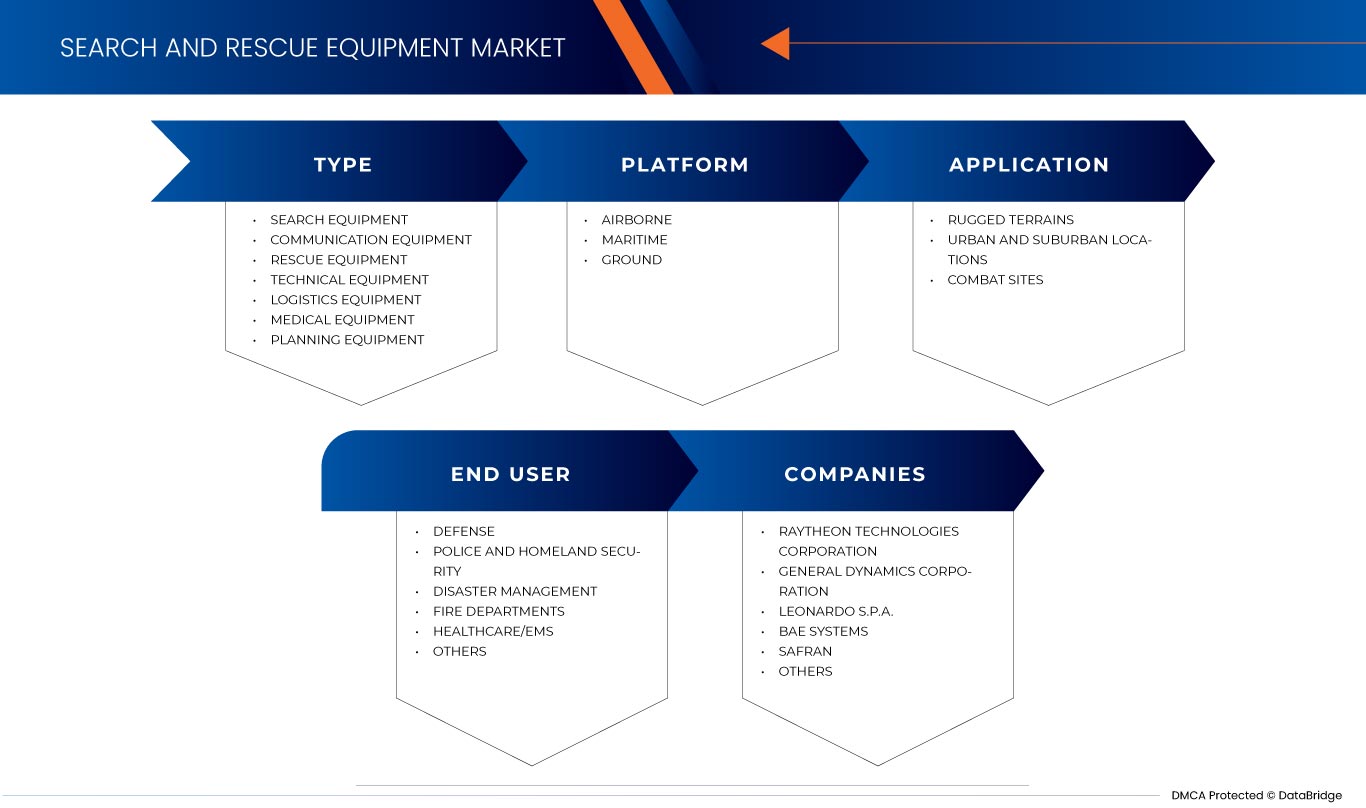
Type (Search Equipment, Communication Equipment, Rescue Equipment, Technical Equipment, Logistics Equipment, Medical Equipment, Planning Equipment, and Others), Platform (Airborne, Maritime, and Ground), Application (Rugged Terrains, Urban and Suburban Locations, and Combat Sites), End User (Defense, Police and Homeland Security, Disaster Management, Fire Departments, Healthcare/EMS, and Others) |
|
Countries Covered |
U.S., Canada, Mexico, Germany, U.K., France, Spain, Italy, Netherlands, Russia, Switzerland, Denmark, Sweden, Poland, Belgium, Turkey, Norway, Finland, Rest of Europe, China, Japan, South Korea, India, Malaysia, Taiwan, Australia, Singapore, Indonesia, Thailand, New Zealand, Philippines, Vietnam, Rest of Asia-Pacific, Brazil, Argentina, Rest of South America, South Africa, Saudi Arabia, Bahrain, U.A.E., Kuwait, Oman, Qatar, Egypt, Israel, and Rest of Middle East and Africa |
|
Market Players Covered |
Cubic Corporation, Honeywell International Inc., ACR Electronics, Inc., Textron Inc., Leonardo S.p.A., Elbit Systems Ltd., Aeromarine SRT, Thales, General Dynamics Corporation, Petzl, Raytheon Technologies Corporation, Savox Communications, Drägerwerk AG & Co. KGaA, BAE Systems, Teledyne FLIR LLC, Life Support International, Inc., Safran, Becker Avionics GmbH, General Atomics, MRT, Avon Protection, LALIZAS, Cohort plc, Jotron, and JW FISHERS |
Market Definition
The market deals in specialized tools, devices, and equipment used in search and rescue operations. It encompasses the manufacturing, distribution, and sale of various search and rescue equipment, including but not limited to communication devices, personal protective gear, navigation systems, medical kits, drones, thermal imaging cameras, and other related products. The market is driven by the demand from search and rescue organizations, military forces, law enforcement agencies, and other entities involved in emergency response and safety operations worldwide.
Global Search and Rescue Equipment Market Dynamics
This section deals with understanding the market drivers, advantages, opportunities, restraints, and challenges. All of this is discussed in detail below:
Drivers
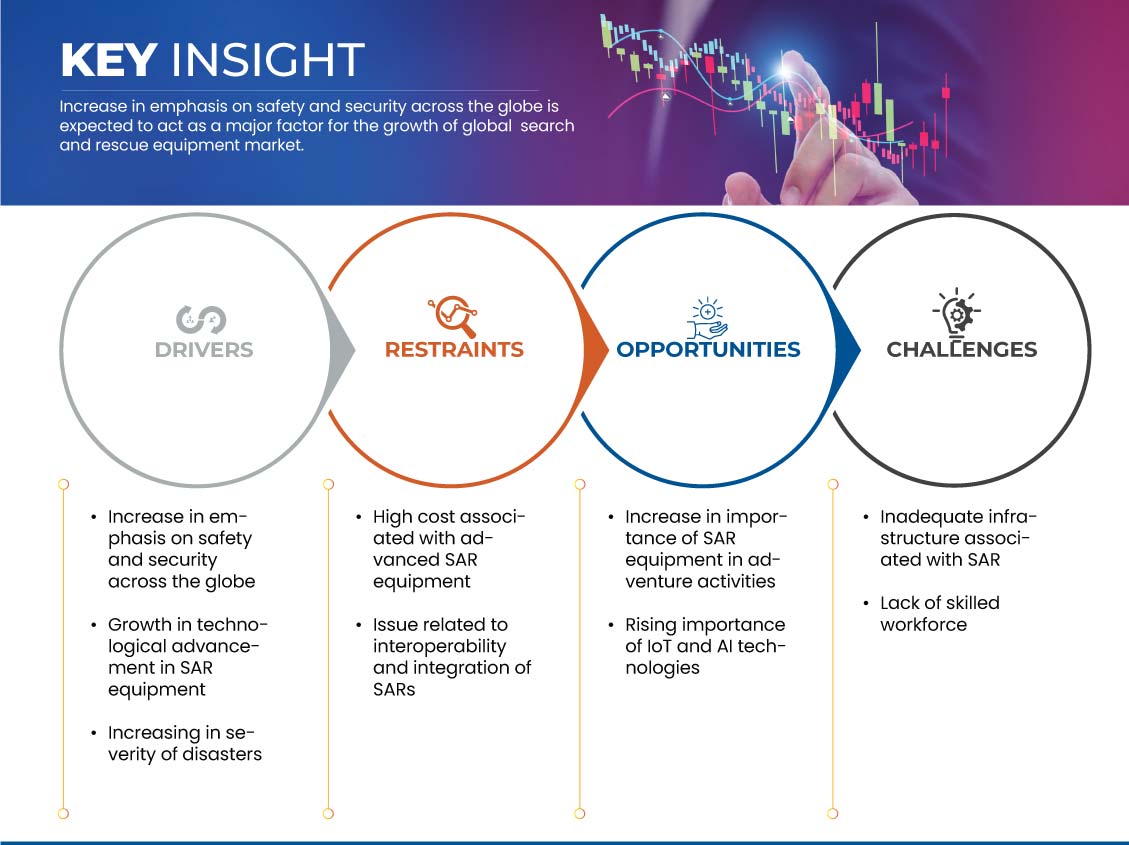
- Increase in the emphasis on safety and security across the globe
Over the last decade, there is an increase in the emphasis on safety and security worldwide; this can be attributed to factors, including evolving threats, and the growing recognition of the importance of preparedness and emergency response. The evolving threat landscape, characterized by terrorism, and criminal activities, has significantly contributed to the increase in emphasis on safety and security. Governments and organizations worldwide recognize the need to enhance security measures to safeguard their citizens, critical infrastructure, and assets.
- Growth in the technological advancement in SAR equipment
Technological advancements are the development and implementation of new or improved technologies that bring significant improvements in the product, solution, and services associated with the products. In the context of search and rescue equipment, technological advancements have revolutionized the capabilities and effectiveness of these tools, enabling better detection, communication, and response.
Opportunity
- Increase in importance of SAR equipment in the adventure activities
The search and rescue equipment plays a crucial role in adventure activities, providing safety and support for participants engaged in various pursuits such as kayaking, climbing, and other outdoor sports. Components such as harnesses, connectors, descenders, pulleys, and headlamps are essential for ensuring the well-being of adventure enthusiasts.
Challenges/ Restraints
- High cost associated with the advanced SAR equipment
While advanced technology and innovative features enhance the capabilities of search and rescue equipment, the cost of development, production, and maintenance can pose challenges for widespread adoption. As developing advanced search and rescue equipment requires substantial investment in research and development (R&D). Manufacturers need to allocate significant financial resources to design and test new technologies, improve existing equipment, and ensure compliance with safety regulations. The high R&D expenses can contribute to the overall cost of the equipment, making it expensive for end-users.
- Inadequate infrastructure associated with SAR
Infrastructure is the physical and organizational systems necessary to support SAR operations, including communication networks, transportation facilities, and command centers. Insufficient infrastructure can hinder the effective deployment and utilization of SAR equipment, limiting its growth potential.
Recent Developments
- In June 2023, General Atomics announces the recognition received by three of its senior engineers from the San Diego section of the American Institute of Aeronautics and Astronautics (AIAA). This recognition highlights GA-ASI's commitment to innovation and technical excellence in the development of UAS platforms crucial to global search and rescue operations. The expertise and pioneering work of these engineers have led to advancements in technologies such as Automatic Takeoff and Landing Capability (ATLC) and the successful management of projects for the U.S. Marine Corps. These achievements further solidify GA-ASI's position as a leader in unmanned systems and reinforce its dedication to delivering state-of-the-art solutions for search and rescue missions worldwide
- In May 2021, Teledyne Technologies finalized the acquisition of FLIR Systems, resulting in the formation of Teledyne FLIR LCC. Teledyne FLIR has offered a comprehensive range of imaging technologies, from X-ray to infrared, along with unmanned systems and imaging payloads. The transaction, valued at approximately USD 8.2 billion, positions Teledyne FLIR as a leading provider of search and rescue equipment worldwide
Global Search and Rescue Equipment Market Scope
The global search and rescue equipment market is segmented into four notable segments based on type, platform, application, and end user. The growth among segments helps you analyze niche pockets of growth and strategies to approach the market and determine your core application areas and the difference in your target markets.
Type
- Search Equipment
- Communication Equipment
- Rescue Equipment
- Technical Equipment
- Logistics Equipment
- Medical Equipment
- Planning Equipment
On the basis of type, the market is segmented into search equipment, communication equipment, rescue equipment, technical equipment, logistics equipment, medical equipment, and planning equipment.
Platform
- Airborne
- Maritime
- Ground
On the basis of platform, the market has been segmented into airborne, maritime, and ground.
Application
- Rugged Terrains
- Urban and Suburban Locations
- Combat Sites
On the basis of application, the market segmented into rugged terrains, urban and suburban locations, and combat sites.
End User
- Defense
- Police and Homeland Security
- Disaster Management
- Fire Departments
- Healthcare/EMS
- Others
On the basis of end user, the market has been segmented into defense, police and homeland security, disaster management, fire departments, healthcare/EMS, and others.
Global Search and Rescue Equipment Market Regional Analysis/Insights
The global search and rescue equipment market is segmented into type, platform, application, and end user.
The countries covered in this market report U.S., Canada, Mexico, Germany, U.K., France, Spain, Italy, Netherlands, Russia, Switzerland, Denmark, Sweden, Poland, Belgium, Turkey, Norway, Finland, rest of Europe, China, Japan, South Korea, India, Malaysia, Taiwan, Australia, Singapore, Indonesia, Thailand, New Zealand, Philippines, Vietnam, rest of Asia-Pacific, Brazil, Argentina, rest of South America, South Africa, Saudi Arabia, Bahrain, U.A.E., Kuwait, Oman, Qatar, Egypt, Israel, and rest of Middle East and Africa.
The U.S. is the leading country in the North America search and rescue equipment market owing to increasing investments in public safety and technological developments in equipment technology. Germany is the second major country in this market because of rise in participation in recreational activities. The country also has adequate rescue agencies in place to help those in distress. China is the dominating country in the Asia-Pacific search and rescue equipment market as the country has experienced rapid urbanization leading to an increase in construction and infrastructure development, this has increased the demand for search and rescue equipment to handle potential accidents.
The country section of the report also provides individual market-impacting factors and changes in regulation in the market domestically that impact the current and future trends of the market. Data points such as new sales, replacement sales, country demographics, regulatory acts, and import-export tariffs are some of the major pointers used to forecast the market scenario for individual countries. Also, the presence and availability of global brands and their challenges faced due to large or scarce competition from local and domestic brands, and the impact of sales channels are considered while providing forecast analysis of the country data.
Competitive Landscape and Global Search and Rescue Equipment Market Share Analysis
The global search and rescue equipment market competitive landscape provides details of competitors. Details included are company overview, company financials, revenue generated, market potential, investment in R&D, new market initiatives, production sites and facilities, company strengths and weaknesses, product launch, product approvals, product width and breadth, application dominance, and product type lifeline curve. The above data points provided are only related to the company’s focus on the market.
Some of the major market players operating in the global search and rescue equipment market are Cubic Corporation, Honeywell International Inc., ACR Electronics, Inc., Textron Inc., Leonardo S.p.A., Elbit Systems Ltd., Aeromarine SRT, Thales, General Dynamics Corporation, Petzl, Raytheon Technologies Corporation, Savox Communications, Drägerwerk AG & Co. KGaA, BAE Systems, Teledyne FLIR LLC, Life Support International, Inc., Safran, Becker Avionics GmbH, General Atomics, MRT, Avon Protection, LALIZAS, Cohort plc, Jotron, and JW FISHERS among others.
SKU-
Obtenha acesso online ao relatório sobre a primeira nuvem de inteligência de mercado do mundo

- Painel interativo de análise de dados
- Painel de análise da empresa para oportunidades de elevado potencial de crescimento
- Acesso de analista de pesquisa para personalização e customização. consultas
- Análise da concorrência com painel interativo
- Últimas notícias, atualizações e atualizações Análise de tendências
- Aproveite o poder da análise de benchmark para um rastreio abrangente da concorrência
Metodologia de Investigação
A recolha de dados e a análise do ano base são feitas através de módulos de recolha de dados com amostras grandes. A etapa inclui a obtenção de informações de mercado ou dados relacionados através de diversas fontes e estratégias. Inclui examinar e planear antecipadamente todos os dados adquiridos no passado. Da mesma forma, envolve o exame de inconsistências de informação observadas em diferentes fontes de informação. Os dados de mercado são analisados e estimados utilizando modelos estatísticos e coerentes de mercado. Além disso, a análise da quota de mercado e a análise das principais tendências são os principais fatores de sucesso no relatório de mercado. Para saber mais, solicite uma chamada de analista ou abra a sua consulta.
A principal metodologia de investigação utilizada pela equipa de investigação do DBMR é a triangulação de dados que envolve a mineração de dados, a análise do impacto das variáveis de dados no mercado e a validação primária (especialista do setor). Os modelos de dados incluem grelha de posicionamento de fornecedores, análise da linha de tempo do mercado, visão geral e guia de mercado, grelha de posicionamento da empresa, análise de patentes, análise de preços, análise da quota de mercado da empresa, normas de medição, análise global versus regional e de participação dos fornecedores. Para saber mais sobre a metodologia de investigação, faça uma consulta para falar com os nossos especialistas do setor.
Personalização disponível
A Data Bridge Market Research é líder em investigação formativa avançada. Orgulhamo-nos de servir os nossos clientes novos e existentes com dados e análises que correspondem e atendem aos seus objetivos. O relatório pode ser personalizado para incluir análise de tendências de preços de marcas-alvo, compreensão do mercado para países adicionais (solicite a lista de países), dados de resultados de ensaios clínicos, revisão de literatura, mercado remodelado e análise de base de produtos . A análise de mercado dos concorrentes-alvo pode ser analisada desde análises baseadas em tecnologia até estratégias de carteira de mercado. Podemos adicionar quantos concorrentes necessitar de dados no formato e estilo de dados que procura. A nossa equipa de analistas também pode fornecer dados em tabelas dinâmicas de ficheiros Excel em bruto (livro de factos) ou pode ajudá-lo a criar apresentações a partir dos conjuntos de dados disponíveis no relatório.











