


Thermal Imaging Cameras Market Size
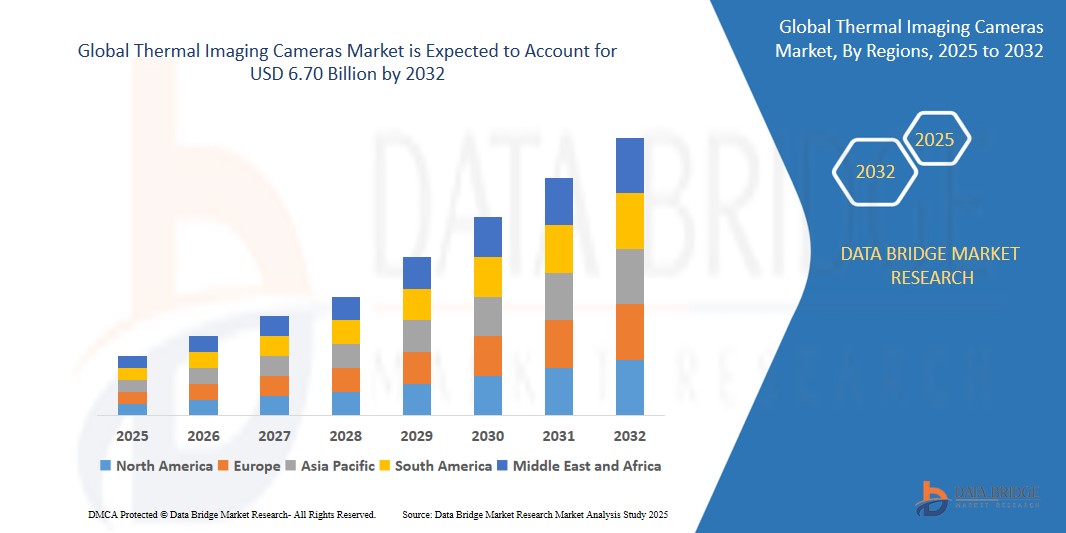
- The global Thermal Imaging Cameras market size was valued at approximately USD 4.12 billion in 2024 and is expected to reach USD 6.7 billion by 2032, growing at a CAGR of 6.4% during the forecast period
- This growth is driven by factors such as the rising demand for enhanced surveillance, industrial diagnostics, and predictive maintenance across sectors like defense, manufacturing, healthcare, and automotive. Additionally, advancements in infrared sensor technology, AI-based image processing, and the integration of thermal imaging in smart infrastructure, autonomous vehicles, and wearable devices are fueling market expansion
Thermal Imaging Cameras Market Analysis
- Thermal imaging technique is generally used in the dark environment to form the images of the objects. Thermal imaging cameras incorporate the use of thermal energy and infrared radiations coupled with the radiations emitted by the object. Thermal imaging camera is basically a kind of thermo graphic camera which is used for a wide range of applications
- Rising expenditure for research and development activities and increased focus on the adoption of advanced technologies is creating lucrative growth opportunities for the thermal imaging cameras market. Rising technological advancements in the surveillance technology and growth and expansion of security and surveillance industry will further induce growth in the thermal imaging cameras market value
- North America holds a prominent share in the global thermal imaging cameras market, accounting for approximately 34.2% of the market in 2024. This is due to the availability of adequate infrastructure and strong demand for thermal imaging devices across law enforcement, border control, and industrial inspection activities
- Asia-Pacific, on the other hand, is projected to register the highest CAGR of 10.4% during the forecast period, driven by rising defense and military expenditure, growing infrastructure projects, and increasing adoption of thermal imaging in industrial automation, surveillance, and public safety applications
- The Surveillance is expected to dominate the Thermal Imaging Cameras market, accounting for approximately 28.7% of the global market share in 2024. The widespread use of thermal cameras in border security, critical infrastructure monitoring, public safety, and law enforcement drives this segment's dominance.
Report Scope and Thermal Imaging Cameras Market Segmentation
|
Attributes |
Thermal Imaging Cameras Key Market Insights |
|
Segments Covered |
|
|
Countries Covered |
North America
Europe
Asia-Pacific
Middle East and Africa
South America
|
|
Key Market Players |
|
|
Market Opportunities |
|
|
Value Added Data Infosets |
In addition to the insights on market scenarios such as market value, growth rate, segmentation, geographical coverage, and major players, the market reports curated by the Data Bridge Market Research also include import export analysis, production capacity overview, production consumption analysis, price trend analysis, climate change scenario, supply chain analysis, value chain analysis, raw material/consumables overview, vendor selection criteria, PESTLE Analysis, Porter Analysis, and regulatory framework. |
Thermal Imaging Cameras Market Trends
“Thermal Imaging Cameras Integrate with Smart Monitoring Systems”
- The Thermal Imaging Cameras market is evolving with the integration of smart technologies, driven by increasing demand for real-time surveillance, predictive maintenance, and environmental monitoring. These cameras now feature AI-powered image analytics, IoT connectivity, and cloud-based data management for enhanced accuracy and operational efficiency
- Industries such as defense, automotive, and industrial manufacturing are adopting smart thermal imaging for early fault detection, intrusion monitoring, and condition-based maintenance, reducing downtime and improving safety
- For instance, in March 2025, Hanwha Vision introduced a new line of AI-integrated thermal cameras designed for industrial applications. These cameras offer advanced features such as real-time analytics, automated alerts, and seamless integration with existing security systems, marking a significant step forward in thermal imaging technology.
- Governments and private sectors are also investing heavily in thermal imaging systems to comply with stricter safety regulations and sustainability standards. As a result, smart thermal solutions are becoming standard across a variety of sectors, particularly in critical infrastructure and defense
Thermal Imaging Cameras Market Dynamics
Driver
“Rising demand for non-invasive monitoring technologies”
- The growing need for accurate, non-invasive monitoring in various sectors such as military, industrial, automotive, and healthcare is driving the adoption of thermal imaging cameras. These cameras provide real-time data on temperature variations, enabling early detection of issues like overheating, equipment failure, or health problems without the need for physical contact
- In military and defense applications, thermal imaging systems are critical for surveillance, search and rescue missions, and border security, where traditional cameras cannot operate effectively in low light or adverse weather conditions
- The increasing demand for smart, connected devices in industrial settings is also pushing the adoption of thermal imaging cameras for predictive maintenance, as they can quickly detect potential faults in machinery before they lead to costly breakdowns
For instance,
- In January 2025, FLIR Systems launched a new line of portable thermal cameras with advanced AI features designed to improve predictive maintenance in industrial operations. The devices use machine learning to analyze temperature data, predict equipment failures, and optimize maintenance schedules.
- The rising emphasis on preventive measures in industrial and commercial sectors is expected to significantly boost the market for thermal imaging cameras
Opportunity
“Rising demand in emerging markets”
- Emerging economies are presenting significant opportunities for the Thermal Imaging Cameras market. As industries like military, automotive, healthcare, and security modernize in regions such as Asia, Africa, and Latin America, the demand for advanced thermal imaging technology is growing
- Government initiatives and private sector investments in these regions are facilitating the adoption of thermal imaging solutions for various applications such as surveillance, industrial monitoring, and security, particularly in urbanizing areas
- Companies offering affordable, adaptable thermal imaging solutions can tap into these developing markets, where the need for efficient, cost-effective thermal systems is rising
For instance,
- In 2025, FLIR Systems announced an affordable thermal camera series designed for emerging markets, targeting industrial and security sectors in Asia and Latin America, which are undergoing rapid technological advancements.
- With ongoing infrastructure development, urban security, and defense modernization in these regions, thermal imaging cameras will continue to play a vital role in surveillance and safety applications, fueling market growth.
Restraint/Challenge
“High Costs of Thermal Imaging Cameras”
- One of the significant challenges in the widespread adoption of thermal imaging cameras is their high upfront cost. While these cameras offer significant benefits in terms of precision and efficiency, the initial investment can be a barrier, especially for small businesses and farmers in developing regions
- Additionally, the maintenance and technical expertise required to operate and manage these advanced systems may not be readily available in rural or underdeveloped areas, further hindering adoption
- The cost factor, coupled with the complexity of integrating thermal imaging systems into existing operations, slows the rate of market penetration, especially in price-sensitive sectors
For instance,
- On April 2025, According to the Fire and Safety Journal Americas, despite the growing demand for thermal imaging solutions, many businesses are still struggling with the steep investment required to implement these technologies at scale. The financial burden continues to be a major barrier to broader adoption in certain industries
- To foster broader adoption, manufacturers are focusing on offering more affordable and modular solutions, as well as exploring financing options for small-scale farmers and businesses to lower the initial financial burden
Thermal Imaging Cameras Market Scope
The market is segmented on the basis component, application, types, and end user.
|
Segmentation |
Sub-Segmentation |
|
By Component |
|
|
By Application |
|
|
By Type |
|
|
By End User |
|
In 2025, the Surveillance is projected to dominate the market with a largest share in by application segment
In 2025, the Surveillance segment is projected to dominate the Thermal Imaging Cameras market, holding the largest share of 28.7%. This is driven by the increasing adoption of smart city surveillance, perimeter security in commercial facilities, and critical infrastructure monitoring. Thermal imaging’s ability to function in complete darkness and harsh weather conditions makes it a preferred technology in next-generation surveillance systems
The Military and Defense is expected to account for the largest share during the forecast period in Thermal Imaging Cameras market
The Military and Defense segment is expected to secure the second-largest share of the Thermal Imaging Cameras market in 2025, with a projected market share of 24.5%. This dominance is attributed to rising investments in defense modernization, border surveillance, and tactical equipment requiring thermal capabilities. The deployment of advanced infrared imaging technologies for enhanced night vision, target acquisition, and reconnaissance operations continues to strengthen this segment's lead
Thermal Imaging Cameras Market Regional Analysis
“North America Holds the Largest Share in the Thermal Imaging Cameras Market”
-
North America dominates the Thermal Imaging Cameras Market, accounting for approximately 34.2% of the global market share in 2024, driven by the widespread adoption of thermal imaging technology in defense, border surveillance, law enforcement, industrial inspection, and healthcare applications
- The region's robust technological infrastructure and strong presence of leading thermal imaging camera manufacturers contribute significantly to market leadership
- Increasing demand from the security and firefighting sectors, along with the integration of thermal imaging into smart home systems and autonomous vehicles, continues to support North America’s dominance
- Additionally, favorable government initiatives and substantial R&D investments in thermal and infrared sensing technologies further reinforce North America’s position in the global market
“Asia Pacific is Projected to Register the Highest CAGR in the Thermal Imaging Cameras Market”
-
The Asia-Pacific region is expected to register the highest growth rate, with a projected CAGR of 10.4% from 2024 to 2032, driven by rising defense budgets, growing industrialization, and the increasing adoption of thermal cameras in public safety, automotive, and building diagnostics
- Countries like China, India, Japan, and South Korea are making substantial investments in surveillance and smart city infrastructure, contributing to strong market expansion
- Rapid urbanization, increasing demand for contactless temperature screening, and expanding manufacturing sectors are also accelerating the deployment of thermal imaging solutions
- The surge in awareness about workplace safety, coupled with favorable government support for security enhancements and disaster preparedness, is expected to drive the region’s exceptional growth in the coming years
Thermal Imaging Cameras Market Share
The market competitive landscape provides details by competitor. Details included are company overview, company financials, revenue generated, market potential, investment in research and development, new market initiatives, global presence, production sites and facilities, production capacities, company strengths and weaknesses, product launch, product width and breadth, application dominance. The above data points provided are only related to the companies' focus related to market.
The Major Market Leaders Operating in the Market Are:
- Xenics (Belgium)
- Lynred (France)
- FLIR Systems, Inc. (U.S.)
- Fortive (U.S.)
- United Technologies (U.S.)
- Leonardo S.p.A. (Italy)
- L3Harris Technologies, Inc. (U.S.)
- Axis Communications AB (Sweden)
- BAE Systems (United Kingdom)
- Testo SE & Co. KGaA (Germany)
- Fluke Corporation (U.S.)
- JENOPTIK AG (Germany)
- HT Italia S.r.l. (Italy)
- Allied Vision Technologies GmbH (Germany)
- Zhejiang Dali Technology Co., Ltd. (China)
- FluxData Inc. (U.S.)
- CorDEX Instruments (United Kingdom)
- IRCameras LLC (U.S.)
Latest Developments in Global Thermal Imaging Cameras Market
- On March 2025, SNS Insider reported that AI-powered thermal imaging solutions are improving accuracy and efficiency across various sectors, including manufacturing, energy, utilities, and security. The integration of AI, IoT, and real-time analytics supports predictive maintenance and smart energy management, driving the growth of the thermal imaging market
- On November 2024, a study explored the use of ultra-low-resolution thermal cameras for rotational odometry measurements in navigational devices like drones and rovers. The approach demonstrated robustness to lighting conditions and cost-effectiveness compared to higher-resolution thermal cameras, offering a novel application of thermal imaging in autonomous navigation.
- On May 2024, the VisTA-SR method was introduced to enhance the temperature accuracy and image quality of low-cost thermal imaging cameras for agricultural applications. By combining RGB and thermal images using deep learning networks, this method addresses challenges of image enhancement in agriculture, paving the way for more accessible and efficient thermal imaging solutions in the field.
- On February 2025, researchers introduced an end-to-end pipeline that combines deep learning-based temperature estimation and super-resolution techniques to enhance the performance of low-cost uncooled infrared cameras. This advancement enables high-quality thermal information from affordable devices, facilitating applications in precision agriculture such as irrigation monitoring and crop health assessment

- Interactive Data Analysis Dashboard
- Company Analysis Dashboard for high growth potential opportunities
- Research Analyst Access for customization & queries
- Competitor Analysis with Interactive dashboard
- Latest News, Updates & Trend analysis
- Harness the Power of Benchmark Analysis for Comprehensive Competitor Tracking
Data collection and base year analysis are done using data collection modules with large sample sizes. The stage includes obtaining market information or related data through various sources and strategies. It includes examining and planning all the data acquired from the past in advance. It likewise envelops the examination of information inconsistencies seen across different information sources. The market data is analysed and estimated using market statistical and coherent models. Also, market share analysis and key trend analysis are the major success factors in the market report. To know more, please request an analyst call or drop down your inquiry.
The key research methodology used by DBMR research team is data triangulation which involves data mining, analysis of the impact of data variables on the market and primary (industry expert) validation. Data models include Vendor Positioning Grid, Market Time Line Analysis, Market Overview and Guide, Company Positioning Grid, Patent Analysis, Pricing Analysis, Company Market Share Analysis, Standards of Measurement, Global versus Regional and Vendor Share Analysis. To know more about the research methodology, drop in an inquiry to speak to our industry experts.
Data Bridge Market Research is a leader in advanced formative research. We take pride in servicing our existing and new customers with data and analysis that match and suits their goal. The report can be customized to include price trend analysis of target brands understanding the market for additional countries (ask for the list of countries), clinical trial results data, literature review, refurbished market and product base analysis. Market analysis of target competitors can be analyzed from technology-based analysis to market portfolio strategies. We can add as many competitors that you require data about in the format and data style you are looking for. Our team of analysts can also provide you data in crude raw excel files pivot tables (Fact book) or can assist you in creating presentations from the data sets available in the report.













