



Global Second Generation Biofuels Market, By Feedstock (Simple Lignocellulose, Complex Lignocellulose, Syngas, Algae, and Others), Application (Transportation, Power Generation and Others), Type (Cellulosic Ethanol, Biodiesel, Bio Butanol, Bio Dme, and Others), and Process (Biochemical Process and Thermochemical Process) – Industry Trends and Forecast to 2029
Market Analysis and Size
In the ensuing decades, advanced biofuels will play a crucial role in national policies. They are a viable renewable energy source that can significantly contribute to developing nations' transportation and other systems de-carbonized. Separate from first-generation biofuels, second-generation biofuels have developed. Instead, they are cases of new industrial dynamics that are now a part of the so-called bio-economy, which has seen a rise in the availability of biomass-based goods for use as food, feed, energy, and biomaterials.
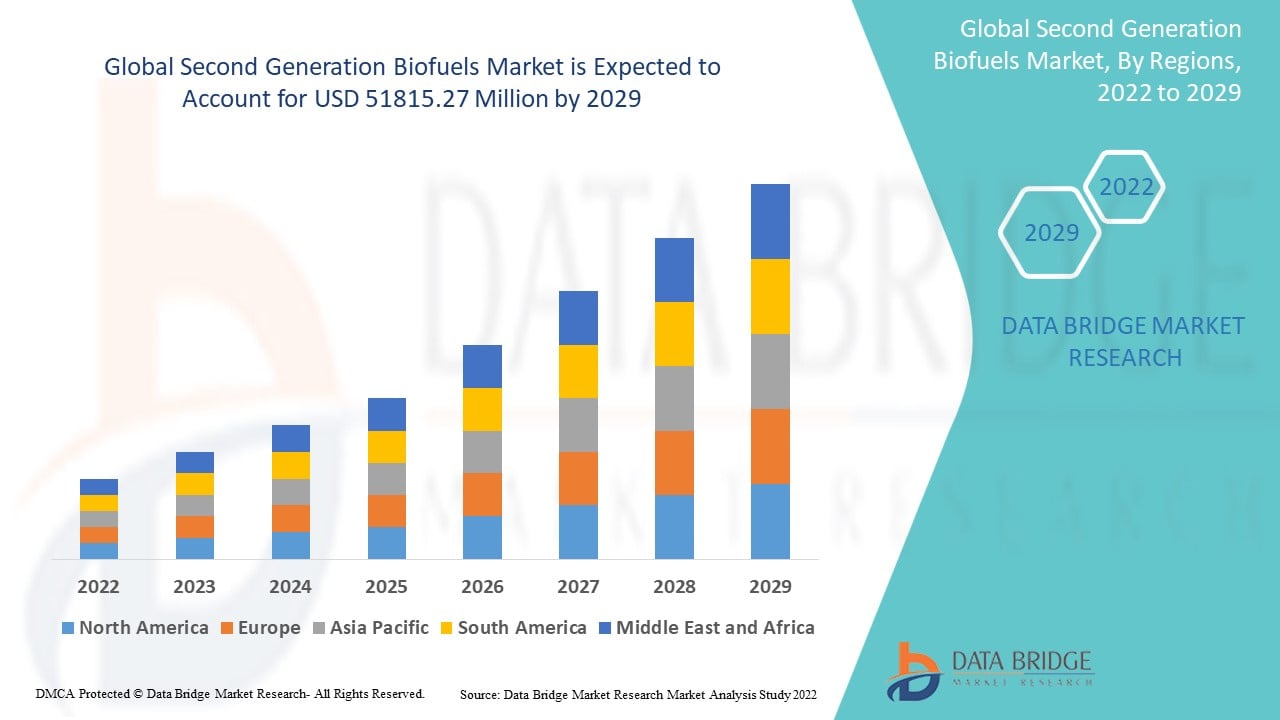
Global second generation biofuels market was valued at USD 6970.00 million in 2021 and is expected to reach USD 51815.27 million by 2029, registering a CAGR of 28.50% during the forecast period of 2022-2029. The market report curated by the Data Bridge Market Research team includes technological advancements, regulatory framework, PESTEL, porter's five forces analysis, industry standards-at a glance, raw material costs/ operational expenditure-overview, supply chain analysis, vendor selection criteria, pricing analysis, production analysis, and climate chain scenario.
Report Scope and Market Segmentation
|
Report Metric |
Details |
|
Forecast Period |
2022 to 2029 |
|
Base Year |
2021 |
|
Historic Years |
2020 (Customizable to 2014 - 2019) |
|
Quantitative Units |
Revenue in USD Million, Volumes in Units, Pricing in USD |
|
Segments Covered |
Feedstock (Simple Lignocellulose, Complex Lignocellulose, Syngas, Algae, and Others), Application (Transportation, Power Generation and Others), Type (Cellulosic Ethanol, Biodiesel, Bio Butanol, Bio Dme, and Others), and Process (Biochemical Process and Thermochemical Process) |
|
Countries Covered |
U.S., Canada, Mexico, Brazil, Argentina, Rest of South America, Germany, France, Italy, U.K., Belgium, Spain, Russia, Turkey, Netherlands, Switzerland, Poland, Norway, Finland, Rest of Europe, Japan, China, India, South Korea, Australia, Singapore, Malaysia, Thailand, Indonesia, Philippines, Rest of Asia-Pacific, U.A.E, Saudi Arabia, Egypt, South Africa, Israel, Nigeria, Algeria, Angola, Ghana, Rest of Middle East and Africa |
|
Market Players Covered |
Poet, LLC (U.S.), ADM (U.S.), Flint Hills Resources (U.S.), The Andersons, Inc. (U.S.), Raizen (Brazil), Copersucar (Brazil), Abengoa, (Spain), Advanced Enzyme Technologies (India), Tropical Agro (India), China Petrochemical Coporation (China), Total Energies (Netherlands), Novamont S.p.a. (Italy), Fkur (Germany), DuPont (U.S.) |
|
Market Opportunities |
Favourable Regulatory Environment Innovation and Development of Technologies |
Market Definition
The biofuels are made through modern biological processes like anaerobic digestion unlike traditional fuels made through geological processes. Second-generation biofuels, also referred to as cellulosic ethanol or olive-green fuel, are basically acquired from nonfood yields such as wood, vegetable oil, forest waste, industrial waste, food crop waste and ecological biomass crops.
Second Generation Biofuels Market Dynamics
This section deals with understanding the market drivers, advantages, opportunities, restraints and challenges. All of this is discussed in detail as below:
Drivers
- High Usage of Biofuels due to Environmental Benefits
The market for porous electrodes for electrolysis is expected to benefit from the production of biofuels through the aerobic/anaerobic digestion of biomass, which helps to reduce the use of fossil fuels for power generation or fueling vehicles. The International Energy Agency (IEA) estimates that if biofuels are produced sustainably in an amount equal to the net carbon dioxide absorbed by the oceans, they will likely replace enough petroleum products to prevent the annual emission of gigatons of carbon dioxide. As a result, the second generation biofuels’ demand will accelerate further, thus propelling the overall market growth.
Furthermore, the expanding installation of biofuels generation facilities or bio-refineries across the globe is projected to be aided by the growing awareness of the harmful impacts of greenhouse gas (GHG) emissions, which are mostly brought on by the combustion of fossil fuels into the environment. The growing environmental concerns about fossil fuel-based power generation is further anticipated to boost the adoption of second generation biofuels.
Opportunities
- Favourable Regulatory Environment
The favorable regulatory environment on SOx and NOx in addition to GHG emissions are estimated to further extend profitable opportunities to the market players in the forecast period of 2022 to 2029.
- Innovation and Development of Technologies
Furthermore, the Increase in innovation and development of commercially viable technology to enable the generation of cellulosic ethanol from some agricultural waste and municipal solid waste are estimated to further provide growth opportunities for the second generation biofuels market.
Restraints/Challenges
- High Feedstock Costs
The purchase of affordable feedstock is the biggest obstacle to second-generation biofuels' market expansion. Feedstock cost is essential to the economic viability of second generation biofuels because it contributes 80 to 90 percent to the final fuel price for various processes. Feedstock costs are still high, which is frequently caused by handling, transporting, and processing (such as shredding, densifying, pulverizing, and handling) rather not necessarily by the production of the feedstock itself.
- Drawbacks of Second Generation Biofuels
Furthermore, the second generation biofuels possess various complications such as sophisticated downstream processes as well as the land and water use competition. These complications further pose as a serious challenge to the growth of the second generation biofuels market.
This second generation biofuels market report provides details of new recent developments, trade regulations, import-export analysis, production analysis, value chain optimization, market share, impact of domestic and localized market players, analyses opportunities in terms of emerging revenue pockets, changes in market regulations, strategic market growth analysis, market size, category market growths, application niches and dominance, product approvals, product launches, geographic expansions, technological innovations in the market. To gain more info on the second generation biofuels market contact Data Bridge Market Research for an Analyst Brief, our team will help you take an informed market decision to achieve market growth.
COVID-19 Impact on Second Generation Biofuels Market
The coronavirus pandemic had an adverse impact on the second generation biofuels market. This effect is mostly attributable to the large delays in the delivery of raw materials, the availability of low-wage workers, which caused the closure of many manufacturing firms and decreased demand for second-generation biofuels during this time. The unanticipated outbreak led to many levels of lockdowns and the stoppage of activities in several industrial sectors. Nearly all industries have been impacted by the pandemic, which has also significantly hindered numerous industrial processes and affected the supply chain. The labor shortage directly impacted the production and manufacturing operations, which significantly restrained market growth and expansion. Moreover, the decline in demand for a number of non-essential goods and the suspension of construction have affected the growth of the worldwide market. Therefore, it is anticipated that the aforementioned reasons will negatively affect the expansion of the global market for second-generation biofuels during the pandemic.
On the plus side, the second generation biofuels market continued to recover from the COVID-19 epidemic in the second half of 2021.
Global Second Generation Biofuels Market Scope
The second generation biofuels market is segmented on the basis of feedstock, application, type and process. The growth amongst these segments will help you analyze meagre growth segments in the industries and provide the users with a valuable market overview and market insights to help them make strategic decisions for identifying core market applications.
Feedstock
- Simple Lignocellulose
- Complex Lignocellulose
- Syngas
- Algae
- Others
Application
- Transportation
- Power Generation
- Others
Type
- Cellulosic Ethanol
- Biodiesel
- Bio Butanol
- Bio Dme
- Others
Process
- Biochemical Process
- Thermochemical Process
Second Generation Biofuels Market Regional Analysis/Insights
The second generation biofuels market is analyzed and market size insights and trends are provided by country, feedstock, application, type and process as referenced above.
The countries covered in the second generation biofuels market report are U.S., Canada and Mexico in North America, Germany, France, U.K., Netherlands, Switzerland, Belgium, Russia, Italy, Spain, Turkey, Poland, Norway, Finland, Rest of Europe in Europe, China, Japan, India, South Korea, Singapore, Malaysia, Australia, Thailand, Indonesia, Philippines, Rest of Asia-Pacific (APAC) in the Asia-Pacific (APAC), Saudi Arabia, U.A.E, Israel, Egypt, South Africa, Nigeria, Algeria, Angola, Ghana, Rest of Middle East and Africa (MEA) as a part of Middle East and Africa (MEA), Brazil, Argentina and Rest of South America as part of South America.
North America dominates the second generation biofuels market in terms of market share and market revenue and will continue to flourish its dominance during the forecast period. The increased demand of the biofuels within the region in the forecast period of 2022 to 2029.
Asia-Pacific on the other hand, is estimated to show lucrative growth over the forecast period of 2022 to 2029 due to the increased efforts toward sustainable development and larger paying capacities within the region.
The country section of the report also provides individual market impacting factors and changes in market regulation that impact the current and future trends of the market. Data points like down-stream and upstream value chain analysis, technical trends and porter's five forces analysis, case studies are some of the pointers used to forecast the market scenario for individual countries. Also, the presence and availability of global brands and their challenges faced due to large or scarce competition from local and domestic brands, impact of domestic tariffs and trade routes are considered while providing forecast analysis of the country data.
Competitive Landscape and Second Generation Biofuels Market Share Analysis
The second generation biofuels market competitive landscape provides details by competitor. Details included are company overview, company financials, revenue generated, market potential, investment in research and development, new market initiatives, global presence, production sites and facilities, production capacities, company strengths and weaknesses, product launch, product width and breadth, application dominance. The above data points provided are only related to the companies' focus related to second generation biofuels market.
Some of the major players operating in the second generation biofuels market are
- Poet, LLC (U.S.)
- ADM (U.S.)
- Flint Hills Resources (U.S.)
- The Andersons, Inc. (U.S.)
- Raizen (Brazil)
- Copersucar (Brazil)
- Abengoa, (Spain)
- Advanced Enzyme Technologies (India)
- Tropical Agro (India)
- China Petrochemical Coporation (China)
- Total Energies (Netherlands)
- Novamont S.p.a. (Italy)
- Fkur (Germany)
- DuPont (U.S.)
SKU-
Obtenha acesso online ao relatório sobre a primeira nuvem de inteligência de mercado do mundo

- Painel interativo de análise de dados
- Painel de análise da empresa para oportunidades de elevado potencial de crescimento
- Acesso de analista de pesquisa para personalização e customização. consultas
- Análise da concorrência com painel interativo
- Últimas notícias, atualizações e atualizações Análise de tendências
- Aproveite o poder da análise de benchmark para um rastreio abrangente da concorrência
Metodologia de Investigação
A recolha de dados e a análise do ano base são feitas através de módulos de recolha de dados com amostras grandes. A etapa inclui a obtenção de informações de mercado ou dados relacionados através de diversas fontes e estratégias. Inclui examinar e planear antecipadamente todos os dados adquiridos no passado. Da mesma forma, envolve o exame de inconsistências de informação observadas em diferentes fontes de informação. Os dados de mercado são analisados e estimados utilizando modelos estatísticos e coerentes de mercado. Além disso, a análise da quota de mercado e a análise das principais tendências são os principais fatores de sucesso no relatório de mercado. Para saber mais, solicite uma chamada de analista ou abra a sua consulta.
A principal metodologia de investigação utilizada pela equipa de investigação do DBMR é a triangulação de dados que envolve a mineração de dados, a análise do impacto das variáveis de dados no mercado e a validação primária (especialista do setor). Os modelos de dados incluem grelha de posicionamento de fornecedores, análise da linha de tempo do mercado, visão geral e guia de mercado, grelha de posicionamento da empresa, análise de patentes, análise de preços, análise da quota de mercado da empresa, normas de medição, análise global versus regional e de participação dos fornecedores. Para saber mais sobre a metodologia de investigação, faça uma consulta para falar com os nossos especialistas do setor.
Personalização disponível
A Data Bridge Market Research é líder em investigação formativa avançada. Orgulhamo-nos de servir os nossos clientes novos e existentes com dados e análises que correspondem e atendem aos seus objetivos. O relatório pode ser personalizado para incluir análise de tendências de preços de marcas-alvo, compreensão do mercado para países adicionais (solicite a lista de países), dados de resultados de ensaios clínicos, revisão de literatura, mercado remodelado e análise de base de produtos . A análise de mercado dos concorrentes-alvo pode ser analisada desde análises baseadas em tecnologia até estratégias de carteira de mercado. Podemos adicionar quantos concorrentes necessitar de dados no formato e estilo de dados que procura. A nossa equipa de analistas também pode fornecer dados em tabelas dinâmicas de ficheiros Excel em bruto (livro de factos) ou pode ajudá-lo a criar apresentações a partir dos conjuntos de dados disponíveis no relatório.











