


What is the Vegetable Oil Market Size and Growth Rate?
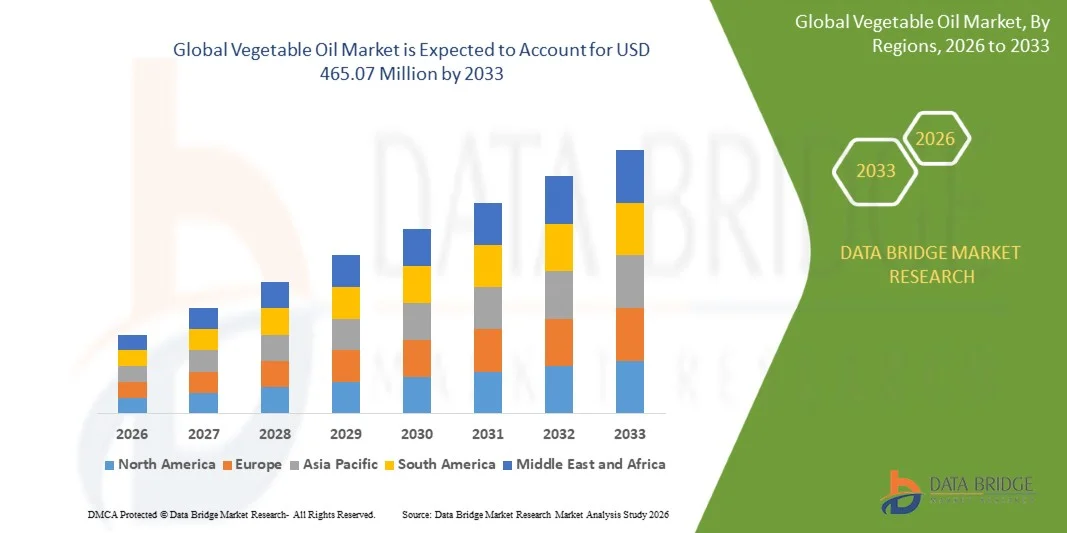
- As per Data Bridge Market Research analysis, the vegetable oil market was valued at USD 318.40 million in 2025 and is projected to reach USD 465.07 million by 2033, growing at a CAGR of 4.85% from 2026 to 2033.
- The market is experiencing steady growth driven by rising global food demand, expanding food processing and packaged foods industries, and increasing use of vegetable oils as feedstock for biodiesel and renewable diesel production.
- Growing population, rising disposable incomes in emerging economies, and shifting dietary patterns toward packaged, convenience, and bakery foods are compelling manufacturers to scale refining, crushing, and processing capacities. Expanding regulatory mandates for renewable fuel blending in North America, Europe, Indonesia, and Brazil are further widening industrial demand beyond traditional food applications.
Market Size & Forecast
- Global Market Value (2025): USD 318.40 Million
- Expected Market Value (2033): USD 465.07 Million
- Forecast CAGR (2026–2033): 4.85%
- Leading Region in 2025: Asia-Pacific
- Fastest Growing Region: North America
What are the Major Takeaways of the Vegetable Oil Market?
- Asia-Pacific dominated the vegetable oil market with the largest revenue share of 38.60% in 2025, supported by high per-capita consumption growth, large-scale refining capacity, and strong demand from India, China, and Indonesia.
- North America is expected to be the fastest-growing region at a CAGR of 6.10% from 2026 to 2033, fueled by expanding renewable diesel and sustainable aviation fuel (SAF) mandates that are driving industrial demand for soybean and canola oil.
- The palm oil segment led the market with a 33.80% share in 2025, driven by its cost-effectiveness, high per-hectare yield, and widespread use across food and industrial applications.
- Rapeseed & Canola oil is the fastest-growing oil type, projected to register a CAGR of 6.40%, reflecting rising demand for heart-healthy cooking oils and its growing role as a biodiesel feedstock in Europe and North America.
- The food application segment dominated with a 61.50% revenue share in 2025, led by rising consumption of cooking oils, bakery products, snacks, and convenience foods worldwide.
- The industrial application segment, comprising biodiesel, renewable fuel, and oleochemicals, is the fastest-growing application category, with a CAGR of 7.10%, driven by expanding renewable fuel blending mandates globally.
- The refined oil segment accounted for 77.90% of the market share in 2025, preferred for its extended shelf life, neutral taste, and suitability for large-scale food manufacturing.
- The B2B distribution channel dominated with a 66.40% share in 2025, reflecting bulk procurement by food manufacturers, foodservice operators, and biodiesel producers.
Report Scope and Vegetable Oil Market Segmentation
|
Attributes |
Vegetable Oil Key Market Insights |
|
Segments Covered |
|
|
Countries Covered |
North America
Europe
Asia-Pacific
Middle East and Africa
South America
|
|
Key Market Players |
|
|
Market Opportunities |
|
|
Value Added Data Infosets |
In addition to the insights on market scenarios such as market value, growth rate, segmentation, geographical coverage, and major players, the market reports curated by the Data Bridge Market Research also include in-depth expert analysis, geographically represented company-wise production and capacity, network layouts of distributors and partners, detailed and updated price trend analysis and deficit analysis of supply chain and demand. |
What is the Key Trend in the Vegetable Oil Market?
- Renewable fuel programs across major economies are increasingly using vegetable oils as feedstock for biodiesel, renewable diesel, and sustainable aviation fuel (SAF), reshaping industrial demand for palm, soybean, and canola oil.
- For instance, in 2025, Indonesia maintained its B40 biodiesel blending mandate heading into 2026 while evaluating a further increase to B50, sustaining strong industrial demand for palm oil as a renewable fuel feedstock and reinforcing the country's role as a key supply hub.
- Consumer preference is shifting toward organic, cold-pressed, and single-origin vegetable oils, as health-conscious buyers seek products perceived as less processed and more traceable to source.
- Retailers and specialty brands are expanding premium olive oil, avocado oil, and cold-pressed sunflower oil ranges, supported by clean-label packaging and origin-based marketing.
- Regulatory frameworks such as the European Union Deforestation Regulation (EUDR) are pushing manufacturers to invest in certified, traceable, and deforestation-free supply chains, particularly for palm and soybean oil sourcing.
- As sustainability commitments intensify and biofuel mandates expand, vegetable oil producers are increasingly aligning refining capacity, certification (such as RSPO), and traceability systems with both food-grade and industrial-grade demand, reinforcing vegetable oil's position as a dual-purpose food and energy commodity.
What are the Key Drivers of the Vegetable Oil Market?
- Rising global population and changing dietary patterns are significantly increasing demand for vegetable oils in cooking, food processing, and packaged food manufacturing, particularly across emerging economies in Asia-Pacific and Africa.
- For instance, according to the Food and Agriculture Organization (FAO), per capita vegetable oil consumption continues to rise at approximately 3% annually, with India remaining the world's largest importer of vegetable oil, underscoring the scale of food-driven demand growth.
- Consolidation among leading agribusinesses is expanding global crushing, refining, and logistics capacity, strengthening supply chain resilience and enabling companies to serve growing food, feed, and fuel demand simultaneously.
- For instance, in July 2025, Bunge Global SA completed its USD 8.2 million merger with Viterra Limited, forming a combined agribusiness with 125 crushing and refining facilities and more than 55 port terminals worldwide, reinforcing global vegetable oil supply capacity across food, feed, and fuel value chains.
- Expanding use of vegetable oils in personal care, cosmetics, and oleochemical applications such as soaps, surfactants, and lubricants is widening the addressable market for producers beyond traditional food and feed uses.
- With renewable fuel mandates and food demand both accelerating simultaneously, vegetable oil producers are expected to remain central to global agricultural and energy value chains through the forecast period.
Which Factors are Challenging the Growth of the Vegetable Oil Market?
- Vegetable oil prices remain highly volatile due to weather-dependent crop yields, geopolitical trade disruptions, and fluctuations in crude oil prices, which directly affect biodiesel economics and downstream pricing.
- For instance, in 2025, crude palm oil (CPO) prices declined by nearly 18% during the year before rebounding in the third quarter on revived demand and Indonesia's proposed B50 biodiesel plan, illustrating the sector's sensitivity to policy shifts and weather-driven supply swings.
- Regulatory pressure from deforestation and sustainability mandates, including the European Union Deforestation Regulation (EUDR), is increasing compliance costs and documentation requirements, particularly burdening smallholder producers in palm oil-growing regions of Southeast Asia and West Africa.
- Health concerns around saturated fat content in tropical oils, combined with trans-fat regulations in several developed markets, are gradually shifting some consumer demand toward specialty and unsaturated oils, creating margin pressure on producers reliant on lower-cost commodity oils.
- These combined pricing, regulatory, and health-driven pressures continue to constrain margin visibility for vegetable oil producers, particularly smaller processors operating with limited diversification across oil types and end-use applications.
How is the Vegetable Oil Market Segmented?
The vegetable oil market is segmented on the basis of type, nature, application, processing, distribution channel, end user, and packaging.
- By Type
On the basis of type, the global vegetable oil market is segmented into palm oil, soybean oil, sunflower oil, rapeseed & canola oil, olive oil, corn oil, and others. The palm oil segment dominated the market with a 33.80% share in 2025, owing to its high per-hectare yield, cost-effectiveness relative to other vegetable oils, and extensive use across food processing, bakery, and industrial applications in Asia-Pacific.
The rapeseed & canola oil segment is projected to register the fastest growth at a CAGR of 6.40% from 2026 to 2033, driven by rising demand for heart-healthy cooking oils in North America and Europe and its expanding role as a low-carbon biodiesel feedstock.
- By Nature
On the basis of nature, the global vegetable oil market is segmented into conventional and organic. The conventional segment dominated the market with a share of 91.20% in 2025 due to its widespread availability, lower cost, and established large-scale processing infrastructure across major producing countries.
The organic segment is expected to witness the fastest CAGR of 7.60% from 2026 to 2033, driven by rising health consciousness, growing willingness among consumers to pay a premium for certified organic products, and expanding organic farmland dedicated to oilseed cultivation.
- By Application
On the basis of application, the global vegetable oil market is segmented into food, animal feed, industrial, and personal care & cosmetics. The food segment dominated the market with a 61.50% share in 2025 due to widespread use in household cooking, food processing, bakery and confectionery manufacturing, and sauces and dressings production, supported by growing global consumption of packaged and convenience foods.
The industrial segment, comprising biodiesel, renewable fuel, and oleochemicals, is expected to witness the fastest CAGR of 7.10% from 2026 to 2033, driven by expanding renewable fuel blending mandates across North America, the European Union, Indonesia, and Brazil.
- By Processing
On the basis of processing, the global vegetable oil market is segmented into refined oil, crude oil, and cold-pressed oil. The refined oil segment dominated the market with a share of 77.90% in 2025 due to its extended shelf life, neutral flavor profile, and suitability for large-scale food manufacturing and foodservice applications.
The cold-pressed oil segment is expected to witness the fastest CAGR of 7.30% from 2026 to 2033, driven by rising consumer demand for minimally processed, nutrient-retentive oils positioned as premium, clean-label alternatives to conventionally refined oils.
- By Distribution Channel
On the basis of distribution channel, the global vegetable oil market is segmented into B2B and B2C. The B2B segment dominated the market with a share of 66.40% in 2025 due to bulk procurement by food processing companies, foodservice operators, and biodiesel producers requiring consistent, large-volume supply.
The B2C segment is expected to witness the fastest CAGR of 6.20% from 2026 to 2033, driven by the expansion of e-commerce grocery platforms, rising at-home cooking trends, and growing retail availability of premium and specialty oil brands.
- By End User
On the basis of end user, the global vegetable oil market is segmented into household, foodservice & HORECA, food processing industry, and industrial & biofuel producers. The food processing industry segment dominated the market with a share of 39.70% in 2025 due to its extensive use of vegetable oils as a core raw material across packaged foods, snacks, bakery, and confectionery manufacturing.
The industrial & biofuel producers segment is expected to witness the fastest CAGR of 7.40% from 2026 to 2033, driven by rapidly expanding renewable diesel and sustainable aviation fuel production capacity across North America and Europe.
- By Packaging
On the basis of packaging, the global vegetable oil market is segmented into bottles & jars, pouches & sachets, bulk & drums, and cans & tins. The bottles & jars segment dominated the market with a share of 44.60% in 2025 due to their widespread use in retail household packaging, ease of handling, and strong shelf visibility for branded oils.
The bulk & drums segment is expected to witness the fastest CAGR of 6.50% from 2026 to 2033, driven by rising institutional, foodservice, and industrial biodiesel demand that favors large-volume, cost-efficient packaging formats.
Which Region Holds the Largest Share of the Vegetable Oil Market?
- Asia-Pacific dominated the vegetable oil market and accounted for the largest revenue share of 38.60% in 2025, supported by high population density, rising per-capita oil consumption, and large-scale refining and processing infrastructure across India, China, Indonesia, and Malaysia.
- The region also benefits from its position as a leading producer of palm, soybean, and rapeseed oil, extensive government support for edible oil self-sufficiency programs, and growing use of vegetable oil in expanding food processing and biodiesel industries. Rising urbanization and increasing packaged food consumption continue to strengthen Asia-Pacific's leadership position in the global market.
India Vegetable Oil Market Insight
The India vegetable oil market is expanding steadily, supported by the country's position as the world's largest importer of vegetable oil and rising per-capita consumption driven by population growth and changing dietary habits. Government initiatives promoting domestic oilseed cultivation and edible oil self-sufficiency, alongside growing demand from the packaged food and foodservice sectors, are contributing to consistent market growth.
China Vegetable Oil Market Insight
The China vegetable oil market is growing due to the country's large population base, expanding food processing industry, and rising demand for soybean and rapeseed oil in both household and industrial applications. Increasing investment in oilseed crushing capacity and government policies supporting agricultural supply chain resilience are further supporting market expansion.
North America Vegetable Oil Market Insight
The North America vegetable oil market is expected to witness rapid growth, driven by expanding renewable diesel and sustainable aviation fuel (SAF) production capacity, rising soybean and canola oil crushing investments, and steady household and foodservice demand across the U.S. and Canada. Growing regulatory support for low-carbon fuel standards and continued agribusiness consolidation are accelerating industrial demand for vegetable oil feedstocks across the region.
U.S. Vegetable Oil Market Insight
The U.S. vegetable oil market is witnessing strong growth due to rising renewable diesel and sustainable aviation fuel production, expanding soybean crushing capacity, and continued investment by leading agribusinesses in refining and logistics infrastructure. Growing consumer preference for heart-healthy cooking oils and increasing use of vegetable oil in food manufacturing are further supporting market growth.
Canada Vegetable Oil Market Insight
The Canada vegetable oil market is growing steadily, supported by the country's position as a leading canola oil producer and exporter, expanding crushing and refining capacity, and rising demand for canola-based biodiesel and renewable diesel feedstocks. Continued investment in agricultural infrastructure and export-oriented processing facilities is further strengthening market growth.
Which are the Top Companies in Vegetable Oil Market?
The vegetable oil industry is primarily led by well-established companies, including:
- Cargill, Incorporated (U.S.)
- ADM (U.S.)
- Bunge Global SA (U.S.)
- Wilmar International Limited (Singapore)
- Louis Dreyfus Company B.V. (Netherlands)
- Sime Darby Plantation Berhad (Malaysia)
- IOI Corporation Berhad (Malaysia)
- Golden Agri-Resources Ltd (Singapore)
- Musim Mas Holdings Pte Ltd (Singapore)
- Kuala Lumpur Kepong Berhad (Malaysia)
- AAK AB (Sweden)
- COFCO Corporation (China)
- Marico Limited (India)
- AWL Agri Business Limited (India)
- Patanjali Foods Limited (India)
- Emami Agrotech Limited (India)
- Richardson International Limited (Canada)
- Viterra Limited (Canada)
- Olam Agri Pte Ltd (Singapore)
- CHS Inc. (U.S.)
- Fuji Oil Holdings Inc. (Japan)
- J-Oil Mills, Inc. (Japan)
- Deoleo S.A. (Spain)
- Sovena Group (Portugal)
- Avril Group (France)
What are Latest Developments in Vegetable Oil Market?
- In July 2025, Bunge Global SA completed its USD 8.2 million merger with Viterra Limited, forming a combined global agribusiness with 125 crushing and refining facilities, more than 55 port terminals, and over 350 grain storage facilities worldwide. The combination strengthens Bunge's integrated oilseed crushing and vegetable oil refining footprint, connecting production regions to fast-growing consumption markets across food, feed, and fuel value chains.
- In May 2023, ADM announced the acquisition of D.C.A. Finance B.V. (DCA), expanding its capabilities in nutrition and agriculture and broadening its portfolio of specialty ingredient and oilseed processing solutions, subject to regulatory approvals.
- In November 2023, Cargill, Incorporated completed the expansion and modernization of its soybean processing plant in Sidney, Ohio, doubling the facility's soy crushing capacity. The project expanded local farmers' access to broader markets and strengthened Cargill's ability to meet growing demand for soybean oil and meal.

- Interactive Data Analysis Dashboard
- Company Analysis Dashboard for high growth potential opportunities
- Research Analyst Access for customization & queries
- Competitor Analysis with Interactive dashboard
- Latest News, Updates & Trend analysis
- Harness the Power of Benchmark Analysis for Comprehensive Competitor Tracking
Global Vegetable Oil Market, Supply Chain Analysis and Ecosystem Framework
To support market growth and help clients navigate the impact of geopolitical shifts, DBMR has integrated in-depth supply chain analysis into its Global Vegetable Oil Market research reports. This addition empowers clients to respond effectively to global changes affecting their industries. The supply chain analysis section includes detailed insights such as Global Vegetable Oil Market consumption and production by country, price trend analysis, the impact of tariffs and geopolitical developments, and import and export trends by country and HSN code. It also highlights major suppliers with data on production capacity and company profiles, as well as key importers and exporters. In addition to research, DBMR offers specialized supply chain consulting services backed by over a decade of experience, providing solutions like supplier discovery, supplier risk assessment, price trend analysis, impact evaluation of inflation and trade route changes, and comprehensive market trend analysis.
Data collection and base year analysis are done using data collection modules with large sample sizes. The stage includes obtaining market information or related data through various sources and strategies. It includes examining and planning all the data acquired from the past in advance. It likewise envelops the examination of information inconsistencies seen across different information sources. The market data is analysed and estimated using market statistical and coherent models. Also, market share analysis and key trend analysis are the major success factors in the market report. To know more, please request an analyst call or drop down your inquiry.
The key research methodology used by DBMR research team is data triangulation which involves data mining, analysis of the impact of data variables on the market and primary (industry expert) validation. Data models include Vendor Positioning Grid, Market Time Line Analysis, Market Overview and Guide, Company Positioning Grid, Patent Analysis, Pricing Analysis, Company Market Share Analysis, Standards of Measurement, Global versus Regional and Vendor Share Analysis. To know more about the research methodology, drop in an inquiry to speak to our industry experts.
Data Bridge Market Research is a leader in advanced formative research. We take pride in servicing our existing and new customers with data and analysis that match and suits their goal. The report can be customized to include price trend analysis of target brands understanding the market for additional countries (ask for the list of countries), clinical trial results data, literature review, refurbished market and product base analysis. Market analysis of target competitors can be analyzed from technology-based analysis to market portfolio strategies. We can add as many competitors that you require data about in the format and data style you are looking for. Our team of analysts can also provide you data in crude raw excel files pivot tables (Fact book) or can assist you in creating presentations from the data sets available in the report.













