



Global Soap Dispenser Market, By Type (Wall-Mounted, Counter-Mounted), Product Type (Manual, Automatic), Capacity (
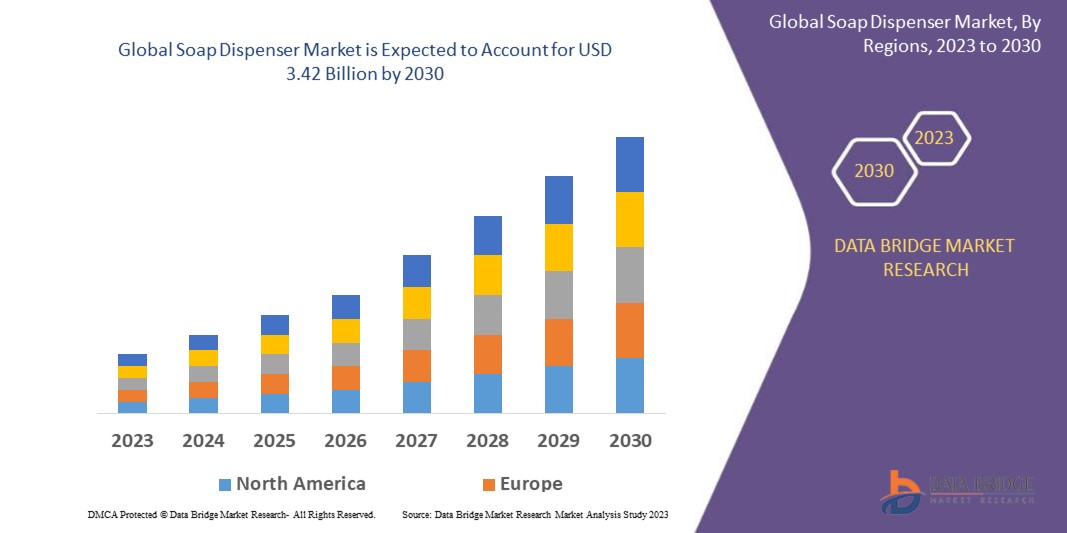
Soap Dispenser Market Analysis and Size
As health infrastructure in some nations quickly increases, safety measures are being built, fuelling the expansion of the global soap dispenser market. Aside from bathrooms, soap dispensers have been installed in offices, healthcare facilities, and public utilities. The government investing large sums of money in the upkeep and expansion of their country's healthcare facilities supports market growth.
Data Bridge Market Research analyses that the global soap dispenser market which was USD 2.38 billion in 2022, is expected to reach USD 3.42 billion by 2030, and is expected to undergo a CAGR of 4.65% during the forecast period of 2023 to 2030. “Automatic” dominates the product type segment of the global soap dispenser market due to a high rate of acceptance in homes, restaurants, bars, public venues, and a variety of other business settings as manual soap dispensers are less expensive and they are preferred by middle-class organizations. In addition to the market insights such as market value, growth rate, market segments, geographical coverage, market players, and market scenario, the market report curated by the Data Bridge Market Research team includes in-depth expert analysis, import/export analysis, pricing analysis, production consumption analysis, and consumer behaviour.
Soap Dispenser Market Scope and Segmentation
|
Report Metric |
Details |
|
Forecast Period |
2023 to 2030 |
|
Base Year |
2022 |
|
Historic Years |
2021 (Customizable to 2015-2020) |
|
Quantitative Units |
Revenue in USD Million, Volumes in Units, Pricing in USD |
|
Segments Covered |
Type (Wall-Mounted, Counter-Mounted), Product Type (Manual, Automatic), Capacity (<250 ml, 250ml to 500 ml, 500ml to 1000 ml), Soap Type (Foam Soap, Liquid Soap), End-User (Residential, Commercial), Distribution Channel (Online, Offline) |
|
Countries Covered |
U.S., Canada, Mexico, Brazil, Argentina, Rest of South America, Germany, France, Italy, U.K., Belgium, Spain, Russia, Turkey, Netherlands, Switzerland, Rest of Europe, Japan, China, India, South Korea, Australia, Singapore, Malaysia, Thailand, Indonesia, Philippines, Rest of Asia-Pacific, U.A.E., Saudi Arabia, Egypt, South Africa, Israel, and Rest of Middle East and Africa |
|
Market Players Covered |
ORCHIDS- The International School (India), American Specialties, Inc. (ASI) (U.S.), Zaf Enterprise (Pakistan), Bright Pancar Sdn Bhd (Malaysia), Askon Hygiene Products Private Limited (India), Shenzhen SVAVO Intelligent Technology Co., Ltd (China), Hokwang Industries Co., Ltd (Taiwan), Liberty Industries (U.S.), Kutol (U.S.), Bobrick Washroom Equipment, Inc (U.S.), SHRESMO (India), Jaquar (India), CERA Sanitaryware Limited (India), and Kohler Co. (U.S.) |
|
Market Opportunities |
|
Market Definition
A soap dispenser is a device or equipment designed to store, control, and dispense liquid soap, foam soap, gel soap, hand sanitizer, or other cleansing agents in a controlled and hygienic manner. Soap dispensers are commonly used in various settings, including public restrooms, commercial spaces, healthcare facilities, hospitality establishments, educational institutions, and residential bathrooms, to promote proper hand hygiene and sanitation practices. Soap dispensers can dispense different forms of soap, including liquid, foam, gel, and powder, depending on the specific design and intended use. They are typically refillable, allowing for the replacement of soap when the container is empty. The use of soap dispensers is a key component of maintaining personal and public hygiene, as they encourage frequent handwashing, reduce soap wastage, and minimize the risk of cross-contamination in shared spaces. These devices play a crucial role in preventing the spread of infections and ensuring cleanliness in various environments.
Global Soap Dispenser Market Dynamics
Drivers
-
Increased Emphasis on Hand Hygiene
Various factors contribute to this emphasis, making soap dispensers an essential tool for promoting handwashing and preventing the spread of infections. Growing awareness about the importance of hand hygiene in preventing the spread of infectious diseases, including respiratory illnesses such as the flu and COVID-19, has led to a heightened emphasis on handwashing. In healthcare facilities, proper hand hygiene is essential to prevent healthcare-associated infections (HAIs). Healthcare professionals and patients rely on soap dispensers for effective handwashing, reducing the risk of infections. Schools and educational institutions promote hand hygiene among students and staff to prevent the spread of illnesses within the school community. Soap dispensers in restrooms and common areas are essential for this purpose.
The increased emphasis on hand hygiene, driven by public health awareness, pandemic responses, regulatory requirements, and changing consumer behavior, is a significant driver for the global soap dispenser market. Soap dispensers are integral to effective handwashing practices in various settings, contributing to overall hygiene and infection control efforts. This driver is expected to remain strong as hygiene awareness continues to grow worldwide.
- Growing Awareness of the Importance of Cleanliness and Hygiene
The emphasis on maintaining cleanliness and hygiene has grown significantly over the years due to various factors, making soap dispensers a critical component in promoting handwashing and overall sanitation. Increased awareness about the transmission of infectious diseases has led to a heightened emphasis on hand hygiene. Individuals and communities recognize that proper handwashing is a simple yet effective way to prevent the spread of illnesses, including colds, flu, and gastrointestinal infections. The availability of information through the internet, television, and social media has made it easier for individuals to access health and hygiene-related content. People are better informed about the benefits of handwashing and its role in preventing diseases.
Health and sanitation awareness are powerful drivers for the global soap dispenser market. Increased knowledge about the role of hand hygiene in preventing diseases, combined with regulatory requirements and public health campaigns, has made soap dispensers an integral part of hygiene practices in various settings. As health and sanitation awareness continue to grow, the demand for soap dispensers is expected to remain robust.
Opportunity
- The Growth of E-Commerce Platforms Offers Soap Dispenser
E-commerce, the buying and selling of products and services online, has seen rapid expansion worldwide. E-commerce platforms provide soap dispenser manufacturers and suppliers with access to a global customer base. They can reach customers in different regions and markets without the need for physical stores or distribution centers. E-commerce offers convenience for both businesses and consumers. Buyers can browse, compare, and purchase soap dispensers online at their convenience, 24/7, without the need to visit physical stores. E-commerce platforms enable soap dispenser manufacturers to showcase a wide range of products, including various models, designs, and price points. This diversity appeals to different customer preferences.
It’s important to note that successful e-commerce operations require attention to several factors, including user experience, cybersecurity, efficient order fulfillment, and customer service. Manufacturers and suppliers must also stay competitive in terms of pricing, product quality, and customer support to thrive in the online marketplace. The rise of e-commerce presents soap dispenser manufacturers and suppliers with vast opportunities to expand their reach, diversify their product offerings, and tap into new customer segments. Adapting to the digital marketplace and leveraging e-commerce platforms can be a crucial strategy for growth in the soap dispenser industry.
Restraint/Challenge
- The Initial Investment in High-Quality Soap Dispensers
The initial cost associated with soap dispensers can be a significant restraint for various users and organizations. This upfront expense can act as a barrier to entry and affect purchasing decisions. Purchasing soap dispensers, especially modern touchless or smart models, often requires a substantial upfront capital investment. This cost includes the procurement of the dispenser units, installation, and, in some cases, infrastructure upgrades to accommodate sensor-based or automated dispensers. For many organizations, especially small businesses, schools, or non-profit entities, allocating funds for soap dispensers may compete with other budget priorities. Limited budgets may lead to compromises in the quality or quantity of soap dispensers purchased.
It's important to note that the perception of initial cost as a restraint may vary among different users and organizations. While some may prioritize lower upfront expenses, others may recognize the value and long-term benefits of investing in advanced soap dispensers that enhance hygiene, reduce waste, and improve overall user experience. Manufacturers and suppliers must consider these diverse preferences and provide options that cater to a range of budgets and needs in the market.
This global soap dispenser market report provides details of new recent developments, trade regulations, import-export analysis, production analysis, value chain optimization, market share, the impact of domestic and localized market players, analyses opportunities in terms of emerging revenue pockets, changes in market regulations, strategic market growth analysis, market size, category market growths, application niches and dominance, product approvals, product launches, geographic expansions, technological innovations in the market. To gain more info on the global soap dispenser market contact Data Bridge Market Research for an Analyst Brief, our team will help you make an informed market decision to achieve market growth.
Recent Developments
- In July 2020, Vikram Sarabhai Space Centre, a significant player, invented a sensor-based handwash dispenser. This microcontroller-based invention was created to reduce water waste and transmission errors caused by manual operation
- In June 2020, Grafdoer introduced automated soap/sanitizer dispensers to allow hands-free access and a simple-to-use mechanism
- In August 2019, Xiaomi has announced the release of an automated soap dispenser in the shape of a classic yellow rubber duck. It is battery-powered and features built-in near-field infrared sensors and micro-foam pump mechanisms that can detect hand movement and dispense a pre-determined amount of soap
Global Soap Dispenser Market Scope
The global soap dispenser market is segmented on the basis of type, product type, capacity, soap type, end-user, and distribution channel. The growth amongst these segments will help you analyse meagre growth segments in the industries and provide the users with a valuable market overview and market insights to help them make strategic decisions for identifying core market applications.
Type
- Wall-Mounted
- Counter-Mounted
Product Type
- Manual
- Automatic
Capacity
- <250 ml
- 250ml to 500 ml
- 500ml to 1000 ml
Soap Type
- Foam Soap
- Liquid Soap
End-User
- Residential
- Commercial
Distribution Channel
- Online
- Offline
Global Soap Dispenser Market Regional Analysis/Insights
The global soap dispenser market is analysed and market size insights and trends are provided by type, product type, capacity, soap type, end-user, and distribution channel are referenced above.
The countries covered in the global soap dispenser market report are U.S., Canada, Mexico, Germany, Poland, Ireland, Italy, U.K., France, Spain, Netherlands, Belgium, Switzerland, Turkey, Russia, Rest of Europe, Japan, China, India, South Korea, New Zealand, Vietnam, Australia, Singapore, Malaysia, Thailand, Indonesia, Philippines, Rest of Asia-Pacific, Brazil, Argentina, Chile, Rest of South America, U.A.E., Saudi Arabia, Egypt, Kuwait, South Africa, Rest of Middle East and Africa
North America dominates the global soap dispenser market due to growth in the number of business buildings, increase in the availability of tailored, easy-to-use, germ-free goods, and increase in hygiene awareness among individuals in this region.
Asia-Pacific is the expected to be the fastest growing region global soap dispenser market, due to there has been an increase in consumer awareness of personal health and cleanliness in this region.
The country section of the report also provides individual market impacting factors and changes in regulation in the market domestically that impact the current and future trends of the market. Data points like down-stream and upstream value chain analysis, technical trends, and porter's five forces analysis, case studies are some of the pointers used to forecast the market scenario for individual countries. Also, the presence and availability of global brands and their challenges faced due to large or scarce competition from local and domestic brands, the impact of domestic tariffs, and trade routes are considered while providing forecast analysis of the country data.
Competitive Landscape and Global Soap Dispenser Market Share Analysis
The global soap dispenser market competitive landscape provides details by competitors. details included are company overview, company financials, revenue generated, market potential, investment in research and development, new market initiatives, global presence, production sites and facilities, production capacities, company strengths and weaknesses, product launch, product width, and breadth, application dominance. The above data points provided are only related to the companies' focus related to the global soap dispenser market.
Some of the major players operating in the global soap dispenser market are:
- ORCHIDS- The International School (India)
- American Specialties, Inc. (ASI) (U.S.)
- Zaf Enterprise (Pakistan)
- Bright Pancar Sdn Bhd (Malaysia)
- Askon Hygiene Products Private Limited (India)
- Shenzhen SVAVO Intelligent Technology Co., Ltd (China)
- Hokwang Industries Co., Ltd (Taiwan)
- Liberty Industries (U.S.)
- Kutol (U.S.)
- Bobrick Washroom Equipment, Inc (U.S.)
- SHRESMO (India)
- Jaquar (India)
- CERA Sanitaryware Limited (India)
- Kohler Co. (U.S.)
SKU-
Obtenha acesso online ao relatório sobre a primeira nuvem de inteligência de mercado do mundo

- Painel interativo de análise de dados
- Painel de análise da empresa para oportunidades de elevado potencial de crescimento
- Acesso de analista de pesquisa para personalização e customização. consultas
- Análise da concorrência com painel interativo
- Últimas notícias, atualizações e atualizações Análise de tendências
- Aproveite o poder da análise de benchmark para um rastreio abrangente da concorrência
Metodologia de Investigação
A recolha de dados e a análise do ano base são feitas através de módulos de recolha de dados com amostras grandes. A etapa inclui a obtenção de informações de mercado ou dados relacionados através de diversas fontes e estratégias. Inclui examinar e planear antecipadamente todos os dados adquiridos no passado. Da mesma forma, envolve o exame de inconsistências de informação observadas em diferentes fontes de informação. Os dados de mercado são analisados e estimados utilizando modelos estatísticos e coerentes de mercado. Além disso, a análise da quota de mercado e a análise das principais tendências são os principais fatores de sucesso no relatório de mercado. Para saber mais, solicite uma chamada de analista ou abra a sua consulta.
A principal metodologia de investigação utilizada pela equipa de investigação do DBMR é a triangulação de dados que envolve a mineração de dados, a análise do impacto das variáveis de dados no mercado e a validação primária (especialista do setor). Os modelos de dados incluem grelha de posicionamento de fornecedores, análise da linha de tempo do mercado, visão geral e guia de mercado, grelha de posicionamento da empresa, análise de patentes, análise de preços, análise da quota de mercado da empresa, normas de medição, análise global versus regional e de participação dos fornecedores. Para saber mais sobre a metodologia de investigação, faça uma consulta para falar com os nossos especialistas do setor.
Personalização disponível
A Data Bridge Market Research é líder em investigação formativa avançada. Orgulhamo-nos de servir os nossos clientes novos e existentes com dados e análises que correspondem e atendem aos seus objetivos. O relatório pode ser personalizado para incluir análise de tendências de preços de marcas-alvo, compreensão do mercado para países adicionais (solicite a lista de países), dados de resultados de ensaios clínicos, revisão de literatura, mercado remodelado e análise de base de produtos . A análise de mercado dos concorrentes-alvo pode ser analisada desde análises baseadas em tecnologia até estratégias de carteira de mercado. Podemos adicionar quantos concorrentes necessitar de dados no formato e estilo de dados que procura. A nossa equipa de analistas também pode fornecer dados em tabelas dinâmicas de ficheiros Excel em bruto (livro de factos) ou pode ajudá-lo a criar apresentações a partir dos conjuntos de dados disponíveis no relatório.











