



Global Software-Defined Anything Market, By Technology (Software Defined Networking (SDN), Software Defined Storage (SDS), Software Defined Data Center (SDDC)), Services (Integration and Deployment Services, Managed Services and Consulting Services), Deployment (On-Premise and Cloud), Vertical (BFSI, Healthcare, Manufacturing, IT and Telecommunication, Retail, Others) – Industry Trends and Forecast to 2029.
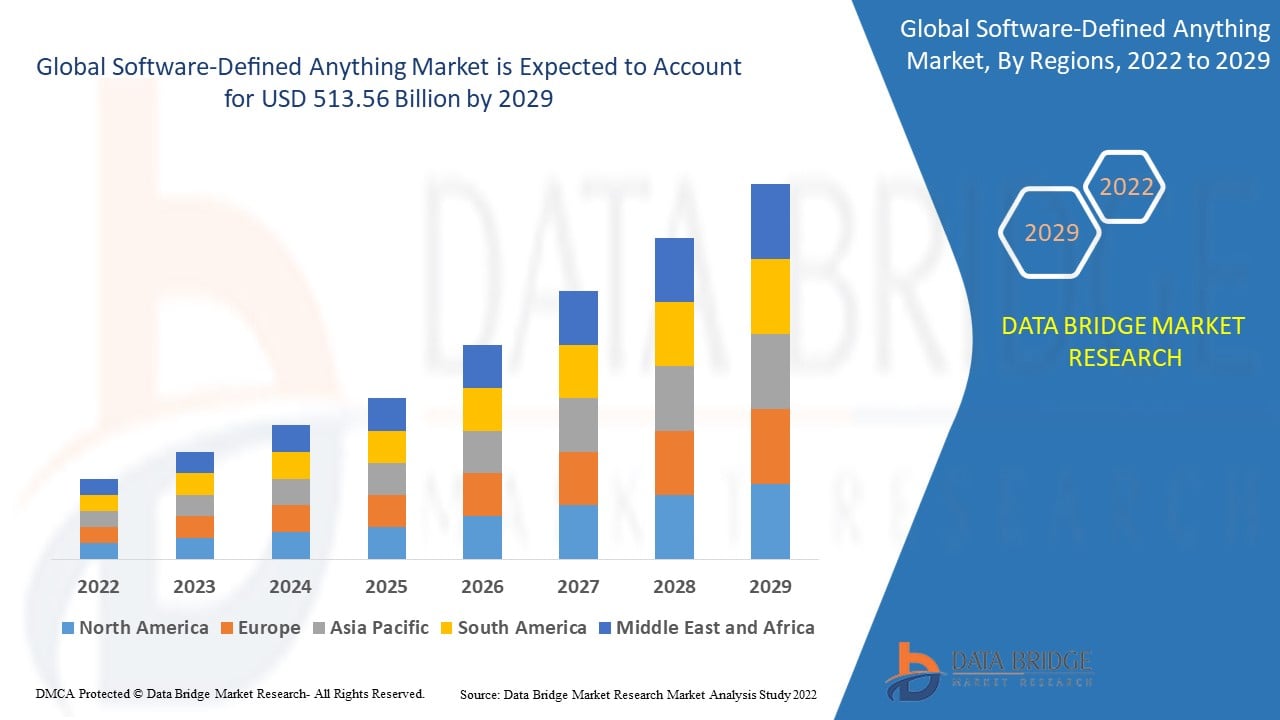
Software-Defined Anything Market Analysis and Size
Software defined anything, which is now an industry standard, is widely used in next generation maritime mobile coastal batteries to enable high-speed data and secure voice communication with anti-jamming capability. Many private companies are eager to produce cutting-edge software defined anything with advanced features and increased compliance flexibility. Software defined anything is a game changer in the field of communication systems and strategic areas. Software defined anything is expected to have a significant impact on net-centric warfare in the coming years.
Data Bridge Market Research analyses that the software-defined anything market which was growing at a value of 66.72 billion in 2021 and is expected to reach the value of USD 513.56 billion by 2029, at a CAGR of 29.06% during the forecast period of 2022-2029. In addition to the insights on market scenarios such as market value, growth rate, segmentation, geographical coverage, and major players, the market reports curated by the Data Bridge Market Research also include in-depth expert analysis, geographically represented company-wise production and capacity, network layouts of distributors and partners, detailed and updated price trend analysis and deficit analysis of supply chain and demand.
Software-Defined Anything Market Scope and Segmentation
|
Report Metric |
Details |
|
Forecast Period |
2022 to 2029 |
|
Base Year |
2021 |
|
Historic Years |
2020 (Customizable to 2014 - 2019) |
|
Quantitative Units |
Revenue in USD Billion, Volumes in Units, Pricing in USD |
|
Segments Covered |
Technology (Software Defined Networking (SDN), Software Defined Storage (SDS), Software Defined Data Center (SDDC)), Services (Integration and Deployment Services, Managed Services and Consulting Services), Deployment (On-Premise and Cloud), Vertical (BFSI, Healthcare, Manufacturing, I.T. and Telecommunication, Retail, Others) |
|
Countries Covered |
U.S., Canada and Mexico in North America, Germany, France, U.K., Netherlands, Switzerland, Belgium, Russia, Italy, Spain, Turkey, Rest of Europe in Europe, China, Japan, India, South Korea, Singapore, Malaysia, Australia, Thailand, Indonesia, Philippines, Rest of Asia-Pacific (APAC) in the Asia-Pacific (APAC), Saudi Arabia, U.A.E, South Africa, Egypt, Israel, Rest of Middle East and Africa (MEA) as a part of Middle East and Africa (MEA), Brazil, Argentina and Rest of South America as part of South America |
|
Market Players Covered |
Broadcom (U.S.), 3M (U.S.), Texas Instruments Incorporated (U.S.), Telit (U.K.), STMicroelectronics (Switzerland), Sony Corporation (Japan), AVERY DENNISON CORPORATION (U.S.), SAMSUNG (South Korea), Panasonic Corporation (Japan), Alpine Electronics Inc. (Japan), NXP Semiconductors (Netherlands), Polaris Industries, Inc. (U.S.), FeliCa Networks, Inc. (Japan), CCL Industries (Canada), LINTEC Corporation (Japan), Robert Bosch GmbH (Germany), Telefonaktiebolaget LM Ericsson (Sweden) |
|
Opportunities |
|
Market Definition
SDx, or software-defined anything, is a sophisticated technique for controlling various networks using automated, virtual solutions rather than traditional hardware devices. It builds a framework to support various network topologies and complex data-intensive applications. Organizations benefit from increased flexibility, faster network operations, cost optimization, and centralized data security when they use software-defined anything.
Global Software-Defined Anything Market Dynamics
Drivers
- Defence modernization
One of the key factors driving market growth is the growing need for military modernization and the growing demand for enhanced situational awareness. SDXs and other advanced communication systems are used in military units to improve defense communication systems that do not have hardware constraints. The widespread use of SDX in telecommunications is also boosting market growth. Network operators are using SDX software in conjunction with Network Function Virtualization (NFV) to improve connectivity solutions to meet the growing demand for stable connections and higher data speeds.
- Digitization in SDX technologies
Various advancements, such as the development of next-generation internet protocol (IP) systems that can be adjusted to 4G and wireless spectrums, are causing the market to be optimistic. Another major growth-inducing factor is the increasing shift from analogue to digital SDX. SDX is expected to be the foundational technology for delivering telecommunications services such as digital television, broadcasts, and video streaming channels. Other factors, such as the integration of the Internet of Things (IoT) with wireless devices and extensive R&D in the field of telecommunications, are expected to drive the market even further.
Opportunities
- Intervention of LTE and 5g technologies
The increasing commercialization of LTE commercial cellular technology and the emergence of 5G technology are expected to boost SDXs demand in the coming years. LTE technology is currently operating in the 450 MHz to 3.8 GHz range, and it is expected to reach 5 GHz soon, fuelling the growth of the software-defined anything market.
Restraints
- High development cost
The SDx necessitates extensive software development as well as a complex PCB structure, which raises the cost and poses a challenge to market growth.
This software-defined anything market report provides details of new recent developments, trade regulations, import-export analysis, production analysis, value chain optimization, market share, impact of domestic and localized market players, analyses opportunities in terms of emerging revenue pockets, changes in market regulations, strategic market growth analysis, market size, category market growths, application niches and dominance, product approvals, product launches, geographic expansions, technological innovations in the market. To gain more info on the software-defined anything market contact Data Bridge Market Research for an Analyst Brief, our team will help you take an informed market decision to achieve market growth.
Impact and Current Market Scenario of Raw Material Shortage and Shipping Delays
Data Bridge Market Research offers a high-level analysis of the market and delivers information by keeping in account the impact and current market environment of raw material shortage and shipping delays. This translates into assessing strategic possibilities, creating effective action plans, and assisting businesses in making important decisions.
Apart from the standard report, we also offer in-depth analysis of the procurement level from forecasted shipping delays, distributor mapping by region, commodity analysis, production analysis, price mapping trends, sourcing, category performance analysis, supply chain risk management solutions, advanced benchmarking, and other services for procurement and strategic support.
COVID-19 Impact on Global Software-Defined Anything Market
The COVID-19 epidemic has disrupted global economic activity. This epidemic has also been aided by the development of defined anything systems, sub-systems, and components. Although software production, as exemplified by military anything broadcasting, is critical, supply chain disruptions have currently halted production. The level of exposure to COVID-19, which is the level at which production operations are performed while keeping export and import regulations in mind, among other factors, determines the resumption of production activities. While businesses continue to accept orders, delivery schedules may not be adjusted. Although the pandemic has heavily impacted the market, it is expected to grow steadily due to technological advancements and rapid adaptation.
Expected Impact of Economic Slowdown on the Pricing and Availability of Products
When economic activity slows, industries begin to suffer. The forecasted effects of the economic downturn on the pricing and accessibility of the products are taken into account in the market insight reports and intelligence services provided by DBMR. With this, our clients can typically keep one step ahead of their competitors, project their sales and revenue, and estimate their profit and loss expenditures.
Recent Development
- In April 2021 Leonardo was chosen by Boeing to supply SWave Airborne SDX SRT-800 anything for the NATO countries' E-3A Airborne Warning and Control System (AWACS) aircraft fleet. The contract was awarded under the FLEP (Final Lifetime Extension Programme) to extend the company's operational viability through 2035. The SRT-800 anythings can replace various previously separate avionic units, including UHF/VHF anythings, SATCOM, SINCGARS, and a crypto device.
- In October 2020 General Dynamics Mission Systems introduced the URC-300 software-defined anything, which can support multiple waveforms and provide frequency (R.F.) support to ground-to-air, line-of-sight, and other mission-critical applications.
- In July 2020 The U.S. Navy awarded Ultra Electronics a 10-year indefinite-delivery/indefinite-quantity (IDIQ) contract to develop, deliver, and service the Amphibious Tactical Communications System (ATCS). (Based on ORION SDX system). The ATCS will enable ship-to-ship, ship-to-shore, and ship-to-ship C2 data and video communication. The initial order is worth USD 26.8 million, and the IDIQ contract has a ceiling value of approximately USD 145.38 million.
Global Software-Defined Anything Market Scope
The software-defined anything market is segmented on the basis of technology, services, deployment and vertical. The growth amongst these segments will help you analyse meagre growth segments in the industries and provide the users with a valuable market overview and market insights to help them make strategic decisions for identifying core market applications.
Technology
- Software Defined Networking (SDN)
- Software Defined Storage (SDS)
- Software Defined Data Center (SDDC)
Services
- Integration and Deployment Services
- Managed Services
- Consulting Services
End user
- BFSI
- Healthcare
- Manufacturing
- IT and Telecommunication
- Retail
- Others
Deployment
- On-premise
- Cloud
Software-Defined Anything Market Regional Analysis/Insights
The software-defined anything market is analysed and market size insights and trends are provided by country, technology, services, deployment and vertical as referenced above.
The countries covered in the software-defined anything market report are U.S., Canada and Mexico in North America, Germany, France, U.K., Netherlands, Switzerland, Belgium, Russia, Italy, Spain, Turkey, Rest of Europe in Europe, China, Japan, India, South Korea, Singapore, Malaysia, Australia, Thailand, Indonesia, Philippines, Rest of Asia-Pacific (APAC) in the Asia-Pacific (APAC), Saudi Arabia, U.A.E, South Africa, Egypt, Israel, Rest of Middle East and Africa (MEA) as a part of Middle East and Africa (MEA), Brazil, Argentina and Rest of South America as part of South America.
North America region had the highest revenue share of the global software defined anything market North America will dominate the software defined anything industry in 2021 due to the Joint Tactical Networking Center (JTNC) programme, which provides technical support for wireless communication systems to the U.S. Department of Defense. Software defined systems are widely used in the defence sector as a result of research projects and the unification of all communication systems in state and federal agencies across North America. Furthermore, increased funding from the U.S. government for next-generation anything communication systems that can accommodate X-band frequencies is driving demand for software defined anything systems.
Asia-Pacific region is expected to grow at the fastest rate. Terrorism has increased in Asian countries such as Pakistan, Bangladesh, and Afghanistan. As a result, regional intelligence and military organizations are progressively implementing SDX to improve communication systems, allowing for safe collaboration, better information sharing, and shared situational analysis. Furthermore, law enforcement's desire for improved communication during natural disasters drives the demand for software defined anything systems. Moreover, government investment in SDX research and development in countries like China and Australia is projected to fuel demand for software-defined systems throughout the Asia-Pacific.
The country section of the report also provides individual market impacting factors and changes in market regulation that impact the current and future trends of the market. Data points like down-stream and upstream value chain analysis, technical trends and porter's five forces analysis, case studies are some of the pointers used to forecast the market scenario for individual countries. Also, the presence and availability of Global brands and their challenges faced due to large or scarce competition from local and domestic brands, impact of domestic tariffs and trade routes are considered while providing forecast analysis of the country data.
Competitive Landscape and Software-Defined Anything Market Share Analysis
The software-defined anything market competitive landscape provides details by competitor. Details included are company overview, company financials, revenue generated, market potential, investment in research and development, new market initiatives, Global presence, production sites and facilities, production capacities, company strengths and weaknesses, product launch, product width and breadth, application dominance. The above data points provided are only related to the companies' focus related to software-defined anything market.
Some of the major players operating in the software-defined anything market are:
- Broadcom (U.S.)
- 3M (U.S.)
- Texas Instruments Incorporated (U.S.)
- Telit (U.K.)
- STMicroelectronics (Switzerland)
- Sony Corporation (Japan)
- AVERY DENNISON CORPORATION (U.S.)
- SAMSUNG (South Korea)
- Panasonic Corporation (Japan)
- Alpine Electronics Inc. (Japan)
- NXP Semiconductors (Netherlands)
- Polaris Industries, Inc. (U.S.)
- FeliCa Networks, Inc. (Japan)
- CCL Industries (Canada)
- LINTEC Corporation (Japan)
- Robert Bosch GmbH (Germany)
- Telefonaktiebolaget LM Ericsson (Sweden)
SKU-
Obtenha acesso online ao relatório sobre a primeira nuvem de inteligência de mercado do mundo

- Painel interativo de análise de dados
- Painel de análise da empresa para oportunidades de elevado potencial de crescimento
- Acesso de analista de pesquisa para personalização e customização. consultas
- Análise da concorrência com painel interativo
- Últimas notícias, atualizações e atualizações Análise de tendências
- Aproveite o poder da análise de benchmark para um rastreio abrangente da concorrência
Metodologia de Investigação
A recolha de dados e a análise do ano base são feitas através de módulos de recolha de dados com amostras grandes. A etapa inclui a obtenção de informações de mercado ou dados relacionados através de diversas fontes e estratégias. Inclui examinar e planear antecipadamente todos os dados adquiridos no passado. Da mesma forma, envolve o exame de inconsistências de informação observadas em diferentes fontes de informação. Os dados de mercado são analisados e estimados utilizando modelos estatísticos e coerentes de mercado. Além disso, a análise da quota de mercado e a análise das principais tendências são os principais fatores de sucesso no relatório de mercado. Para saber mais, solicite uma chamada de analista ou abra a sua consulta.
A principal metodologia de investigação utilizada pela equipa de investigação do DBMR é a triangulação de dados que envolve a mineração de dados, a análise do impacto das variáveis de dados no mercado e a validação primária (especialista do setor). Os modelos de dados incluem grelha de posicionamento de fornecedores, análise da linha de tempo do mercado, visão geral e guia de mercado, grelha de posicionamento da empresa, análise de patentes, análise de preços, análise da quota de mercado da empresa, normas de medição, análise global versus regional e de participação dos fornecedores. Para saber mais sobre a metodologia de investigação, faça uma consulta para falar com os nossos especialistas do setor.
Personalização disponível
A Data Bridge Market Research é líder em investigação formativa avançada. Orgulhamo-nos de servir os nossos clientes novos e existentes com dados e análises que correspondem e atendem aos seus objetivos. O relatório pode ser personalizado para incluir análise de tendências de preços de marcas-alvo, compreensão do mercado para países adicionais (solicite a lista de países), dados de resultados de ensaios clínicos, revisão de literatura, mercado remodelado e análise de base de produtos . A análise de mercado dos concorrentes-alvo pode ser analisada desde análises baseadas em tecnologia até estratégias de carteira de mercado. Podemos adicionar quantos concorrentes necessitar de dados no formato e estilo de dados que procura. A nossa equipa de analistas também pode fornecer dados em tabelas dinâmicas de ficheiros Excel em bruto (livro de factos) ou pode ajudá-lo a criar apresentações a partir dos conjuntos de dados disponíveis no relatório.











