



Global Sulfate-Free Shampoo Market, By Type (Dry and Liquid), Nature (Organic and Conventional), Buyer Type (Individual and Hair Salons), Product Functionality (Clarifying Agent, Colour Protection, Curl Enhancing, Moisturizing Agent, Smoothing & Straightening, and Volumizing Agent), Sales Channel (Supermarket/Hypermarket, Drug Stores and Pharmacies, Convenience Stores, Exclusive Stores, Salons, Online, and Others) - Industry Trends and Forecast to 2031.
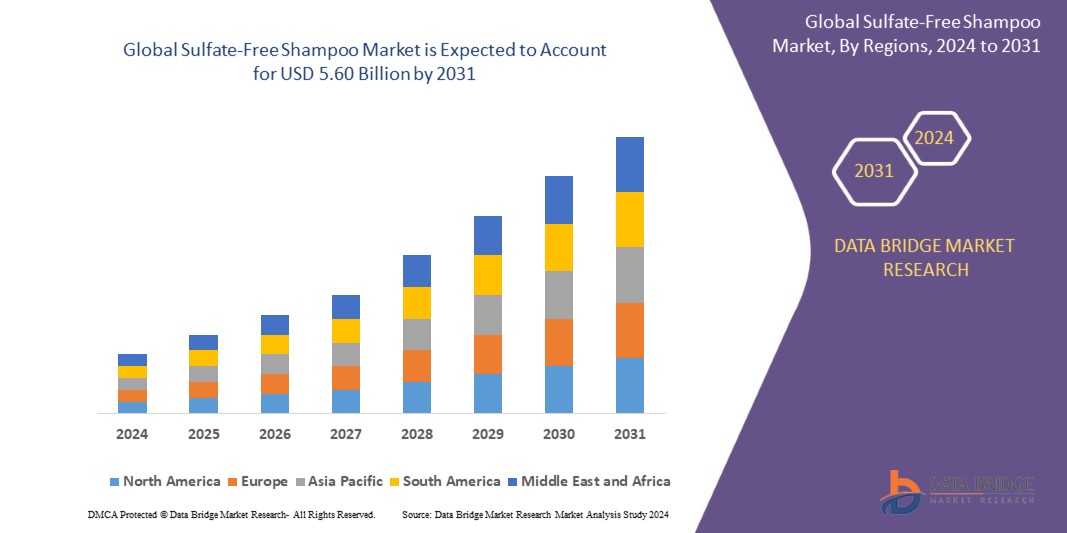
Sulfate-Free Shampoo Market Analysis and Size
The essential factors contributing to the growth of the global sulfate-free shampoo market in the forecast period of 2024 to 2031 include consumer awareness about the harmful effects of sulfates, preference for natural and organic products, expanding product availability, particularly in online channels, rising demand for specialized hair care solutions, and stringent regulations on cosmetic ingredients. Additionally, the growing trend of customization and product innovation, along with the expansion into emerging markets, further contribute to market growth.
Data Bridge Market Research analyses that the global sulfate-free shampoo market which was USD 5.30 Billion in 2023, is expected to reach USD 5.60 Billion by 2031, growing at a CAGR of 5.5% during the forecast period of 2024 to 2031. In 2024, the organic segment will dominate the market due to increasing preference for natural and organic products. In addition to the insights on market scenarios such as market value, growth rate, segmentation, geographical coverage, and major players, the market reports curated by the Data Bridge Market Research also include in-depth expert analysis, geographically represented company-wise production and capacity, network layouts of distributors and partners, detailed and updated price trend analysis and deficit analysis of supply chain and demand.
Report Scope and Market Segmentation
|
Report Metric |
Details |
|
Forecast Period |
2024 to 2031 |
|
Base Year |
2023 |
|
Historic Years |
2022 (Customizable to 2015-2021) |
|
Quantitative Units |
Revenue in USD Billion, Pricing in USD, Volume in Units |
|
Segments Covered |
Type (Dry and Liquid), Nature (Organic and Conventional), Buyer Type (Individual and Hair Salons), Product Functionality (Clarifying Agent, Colour Protection, Curl Enhancing, Moisturizing Agent, Smoothing & Straightening, and Volumizing Agent), Sales Channel (Supermarket/Hypermarket, Drug Stores and Pharmacies, Convenience Stores, Exclusive Stores, Salons, Online, and Others |
|
Countries Covered |
U.S., Canada, Mexico, Brazil, Argentina, Rest of South America, Germany, France, Italy, U.K., Belgium, Spain, Russia, Turkey, Netherlands, Switzerland, Rest of Europe, Japan, China, India, South Korea, Australia, Singapore, Malaysia, Thailand, Indonesia, Philippines, Rest of Asia-Pacific, U.A.E, Saudi Arabia, Egypt, South Africa, Israel, and Rest of Middle East and Africa |
|
Market Players Covered |
Procter & Gamble (U.S.), L'Oreal (France), Aveeno (U.S.), OGX (U.S.), SoulTree (India), Henkel (Germany), Morrocanoil (U.S.), Unilever (Netherlands), Estee Lauder (U.S.), Shiseido Co. Ltd. (Japan), Procter & Gamble (U.S.), Johnson & Johnson Services, Inc. (U.S.), Sephora USA, Inc. (U.S.), Honasa Consumer (India), California Baby (U.S.), Avlon Industries (U.S.) |
|
Market Opportunities |
|
Market Definition
Sulfate-free shampoo is a hair cleansing product that excludes sulfates, such as sodium lauryl sulfate (SLS) and sodium laureth sulfate (SLES). Sulfates are surfactants that produce lather but can strip away natural oils, potentially causing dryness and irritation, particularly for sensitive scalps. Sulfate-free shampoos aim to cleanse without harsh chemicals, preserving natural oils and moisture, suitable for various hair types, including color-treated or chemically processed hair. They can help reduce scalp dryness, minimize frizz, and maintain hair color vibrancy. Additionally, sulfate-free formulations are often preferred by individuals with allergies or skin sensitivities.
Global Sulfate-Free Shampoo Market Dynamics
Drivers
- Increasing Consumer Awareness
Consumer awareness about the potential harmful effects of sulfates in shampoos is a significant driving factor in the global sulfate-free shampoo market. As more people become educated about the adverse effects of sulfates, such as scalp irritation, dryness, and color fading, there is a growing demand for safer alternatives. Consumers are actively seeking sulfate-free shampoos as a healthier option for their hair care routine. This awareness is fuelled by information dissemination through various channels, including social media, online forums, and beauty influencers. As a result, manufacturers are compelled to expand their sulfate-free product lines to meet the rising consumer demand for safer and gentler hair care options.
- Increasing Preference for Natural and Organic Products
The increasing preference for natural and organic products is another driving force behind the growth of the global sulfate-free shampoo market. As consumers become more health-conscious and environmentally aware, there is a shift towards products made with natural ingredients. Sulfate-free shampoos often contain natural cleansing agents derived from sources like coconut or fruit extracts, appealing to consumers seeking gentler, more sustainable alternatives. Additionally, the demand for organic-certified sulfate-free shampoos is on the rise, as they are perceived as safer and more eco-friendly. This trend is driving manufacturers to develop sulfate-free formulations that align with consumer preferences for natural and organic beauty products.
Opportunities
- Product Line Extension and Customization
With a growing demand for personalized beauty solutions, manufacturers can develop a diverse range of sulfate-free shampoos tailored to address various hair concerns, such as dryness, frizz, color protection, or scalp sensitivity. By offering a wide selection of formulations and packaging sizes, companies can appeal to a broader audience and capture market segments that may have been overlooked previously. Additionally, collaborating with hairstylists, dermatologists, or influencers to create signature product lines can further differentiate brands and attract loyal customers seeking specialized hair care solutions. This approach enables companies to stay competitive in the market while meeting the evolving demands of discerning consumers.
- E-commerce Expansion
With the increasing popularity of online shopping consumers are increasingly turning to online channels to purchase personal care products. Sulfate-free shampoos can benefit from this trend by leveraging e-commerce platforms to reach a broader audience, including consumers in remote or underserved areas. Manufacturers can capitalize on this opportunity by optimizing their online presence, offering convenient purchasing options, and implementing targeted digital marketing campaigns to attract and retain customers. By tapping into the growing e-commerce market, companies can drive sales growth and expand their market reach effectively.
Restraint/Challenge
- Cost and Price Competitiveness
Formulating sulfate-free formulations often involves higher-quality ingredients and specialized manufacturing processes, which can drive up production costs compared to conventional shampoos containing sulfates. However, consumers' price sensitivity and expectations for affordability pose a challenge for manufacturers seeking to market sulfate-free products competitively. Balancing the need for premium-quality ingredients with price affordability requires careful cost management, supply chain optimization, and strategic pricing strategies. Moreover, competing with lower-priced sulfate-containing alternatives further intensifies price pressures, making it challenging for sulfate-free shampoo brands to gain market share without compromising on product quality or profitability.
- Ingredient Sourcing and Formulation Challenges
While eliminating sulfates from shampoos, manufacturers often encounter difficulties in finding suitable substitutes that can effectively cleanse the hair without compromising product performance. Additionally, formulating sulfate-free shampoos requires careful consideration of ingredient interactions, stability, and sensory attributes to ensure a pleasant user experience. Finding sustainable and ethically sourced ingredients further adds to the complexity, as sourcing practices must align with consumer preferences for environmentally friendly and socially responsible products. Overcoming these challenges necessitates extensive research and development efforts, as well as collaboration with suppliers and experts to innovate and optimize sulfate-free formulations.
This sulfate-free shampoo market report provides details of new recent developments, trade regulations, import-export analysis, production analysis, value chain optimization, market share, impact of domestic and localized market players, analyses opportunities in terms of emerging revenue pockets, changes in market regulations, strategic market growth analysis, market size, category market growths, application niches and dominance, product approvals, product launches, geographic expansions, technological innovations in the market. To gain more info on the surgical microscopes market contact Data Bridge Market Research for an Analyst Brief, our team will help you take an informed market decision to achieve market growth.
Impact and Current Market Scenario of Raw Material Shortage and Shipping Delays
Data Bridge Market Research offers a high-level analysis of the market and delivers information by keeping in account the impact and current market environment of raw material shortage and shipping delays. This translates into assessing strategic possibilities, creating effective action plans, and assisting businesses in making important decisions. Apart from the standard report, we also offer in-depth analysis of the procurement level from forecasted shipping delays, distributor mapping by region, commodity analysis, production analysis, price mapping trends, sourcing, category performance analysis, supply chain risk management solutions, advanced benchmarking, and other services for procurement and strategic support.
Expected Impact of Economic Slowdown on the Pricing and Availability of Products
When economic activity slows, industries begin to suffer. The forecasted effects of the economic downturn on the pricing and accessibility of the products are taken into account in the market insight reports and intelligence services provided by DBMR. With this, our clients can typically keep one step ahead of their competitors, project their sales and revenue, and estimate their profit and loss expenditures.
Recent Development
- In August 2021, Tresemme introduced a fresh line of hair care items called Pro Pure, boasting the absence of harmful ingredients like sulfates, parabens, DMDM, silicones, and dyes.
- In March 2021, E-Ventures declared its acquisition of the lifestyle care product firm 'Coccoon' as a successful move. This acquisition aims to enhance the operations of Subline Life, marking a pivotal advancement for the company. It is seen as a strategic initiative that will facilitate robust collaborations between the brands, fostering the growth trajectory of Coccoon.
Sulfate-Free Shampoo Market Scope
The market is segmented on the basis of type, nature, buyer type, product functionality, and sales channel. The growth amongst these segments will help you analyse meagre growth segments in the industries and provide the users with a valuable market overview and market insights to help them make strategic decisions for identifying core market applications.
Type
- Dry
- Liquid
Nature
- Organic
- Conventional
Buyer Type
- Individual
- Hair Salons
Product Functionality
- Clarifying Agent
- Color Protection
- Curl Enhancing
- Moisturizing Agent
- Smoothing & Straightening
- Volumizing Agent
Sales Channel
- Supermarket/Hypermarket
- Drug Stores and Pharmacies
- Convenience Stores
- Exclusive Stores
- Salons
- Online
- Others
Global Sulfate-Free Shampoo Market Regional Analysis/Insights
The global sulfate-free shampoo market is analysed and market size insights and trends are provided by country, type, nature, buyer type, product functionality, and sales channel as referenced above.
The countries covered in the global sulfate-free shampoo market report are U.S., Canada, Mexico, Brazil, Argentina, Rest of South America, Germany, France, Italy, U.K., Belgium, Spain, Russia, Turkey, Netherlands, Switzerland, Rest of Europe, Japan, China, India, South Korea, Australia, Singapore, Malaysia, Thailand, Indonesia, Philippines, Rest of Asia-Pacific, U.A.E, Saudi Arabia, Egypt, South Africa, Israel, Rest of Middle East and Africa.
North America dominates the global sulfate-free shampoo market due to increasing consumer awareness about harmful effects of sulfates, preference for natural products, and availability of a wide range of sulfate-free options. Additionally, stringent regulations on cosmetics contribute to the market's growth in this region.
The Asia-Pacific region is experiencing the CAGR in the global sulfate-free shampoo market due to rising disposable incomes, urbanization, increasing awareness about hair care ingredients, and a shift towards natural and organic products among consumers in countries like China, India, and Japan.
The country section of the report also provides individual market impacting factors and changes in regulations in the market domestically that impacts the current and future trends of the market. Data points like down-stream and upstream value chain analysis, technical trends and porter's five forces analysis, case studies are some of the pointers used to forecast the market scenario for individual countries. Also, the presence and availability of global brands and their challenges faced due to large or scarce competition from local and domestic brands, impact of domestic tariffs and trade routes are considered while providing forecast analysis of the country data.
Competitive Landscape and Global Sulfate-Free Shampoo Market Share Analysis
The market competitive landscape provides details by competitor. Details included are company overview, company financials, revenue generated, market potential, investment in research and development, new market initiatives, global presence, production sites and facilities, production capacities, company strengths and weaknesses, product launch, product width and breadth, application dominance. The above data points provided are only related to the companies' focus related to global sulfate-free shampoo market.
Some of the major players operating in the market are:
- Procter & Gamble (U.S.)
- L'Oreal (France)
- Aveeno (U.S.)
- OGX (U.S.)
- SoulTree (India)
- Henkel (Germany)
- Morrocanoil (U.S.)
- Unilever (Netherlands)
- Estee Lauder (U.S.)
- Shiseido Co. Ltd. (Japan)
- Procter & Gamble (U.S.)
- Johnson & Johnson Services, Inc. (U.S.)
- Sephora USA, Inc. (U.S.)
- Honasa Consumer (India)
- California Baby (U.S.)
- Avlon Industries (U.S.)
SKU-
Obtenha acesso online ao relatório sobre a primeira nuvem de inteligência de mercado do mundo

- Painel interativo de análise de dados
- Painel de análise da empresa para oportunidades de elevado potencial de crescimento
- Acesso de analista de pesquisa para personalização e customização. consultas
- Análise da concorrência com painel interativo
- Últimas notícias, atualizações e atualizações Análise de tendências
- Aproveite o poder da análise de benchmark para um rastreio abrangente da concorrência
Metodologia de Investigação
A recolha de dados e a análise do ano base são feitas através de módulos de recolha de dados com amostras grandes. A etapa inclui a obtenção de informações de mercado ou dados relacionados através de diversas fontes e estratégias. Inclui examinar e planear antecipadamente todos os dados adquiridos no passado. Da mesma forma, envolve o exame de inconsistências de informação observadas em diferentes fontes de informação. Os dados de mercado são analisados e estimados utilizando modelos estatísticos e coerentes de mercado. Além disso, a análise da quota de mercado e a análise das principais tendências são os principais fatores de sucesso no relatório de mercado. Para saber mais, solicite uma chamada de analista ou abra a sua consulta.
A principal metodologia de investigação utilizada pela equipa de investigação do DBMR é a triangulação de dados que envolve a mineração de dados, a análise do impacto das variáveis de dados no mercado e a validação primária (especialista do setor). Os modelos de dados incluem grelha de posicionamento de fornecedores, análise da linha de tempo do mercado, visão geral e guia de mercado, grelha de posicionamento da empresa, análise de patentes, análise de preços, análise da quota de mercado da empresa, normas de medição, análise global versus regional e de participação dos fornecedores. Para saber mais sobre a metodologia de investigação, faça uma consulta para falar com os nossos especialistas do setor.
Personalização disponível
A Data Bridge Market Research é líder em investigação formativa avançada. Orgulhamo-nos de servir os nossos clientes novos e existentes com dados e análises que correspondem e atendem aos seus objetivos. O relatório pode ser personalizado para incluir análise de tendências de preços de marcas-alvo, compreensão do mercado para países adicionais (solicite a lista de países), dados de resultados de ensaios clínicos, revisão de literatura, mercado remodelado e análise de base de produtos . A análise de mercado dos concorrentes-alvo pode ser analisada desde análises baseadas em tecnologia até estratégias de carteira de mercado. Podemos adicionar quantos concorrentes necessitar de dados no formato e estilo de dados que procura. A nossa equipa de analistas também pode fornecer dados em tabelas dinâmicas de ficheiros Excel em bruto (livro de factos) ou pode ajudá-lo a criar apresentações a partir dos conjuntos de dados disponíveis no relatório.











