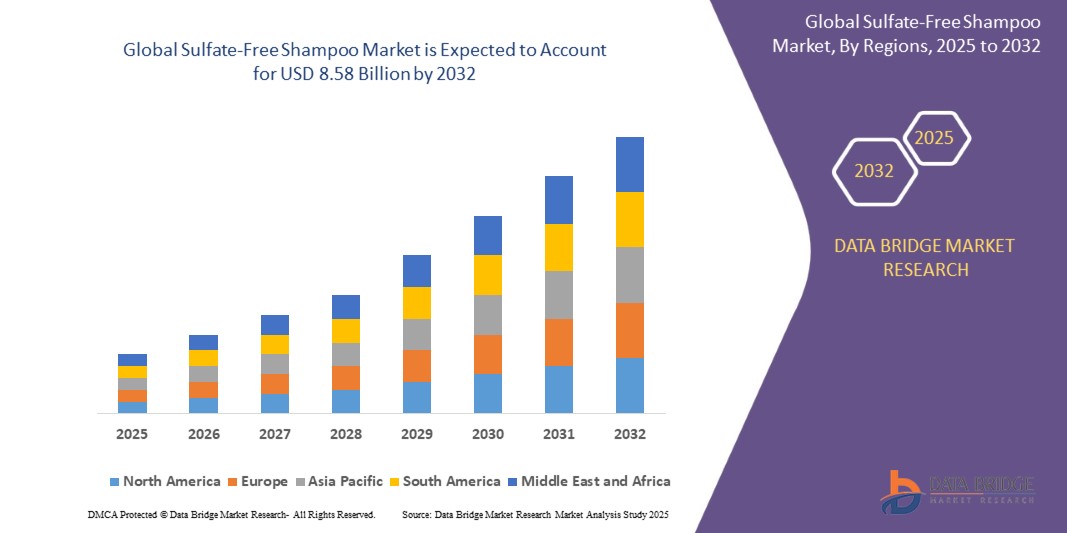
Sulfate-Free Shampoo Market Size
- The global sulfate-free shampoo market size was valued at USD 5.59 billion in 2024 and is expected to reach USD 8.58 billion by 2032, at a CAGR of 5.5% during the forecast period
- This growth is driven by factors such as increasing consumer awareness about hair and scalp health, rising demand for organic and chemical-free personal care products, and growing concerns over hair damage caused by traditional sulfate-based shampoos
Sulfate-Free Shampoo Market Analysis
- Sulfate-free shampoos are personal care products formulated without harsh sulfates like sodium lauryl sulfate (SLS) and sodium laureth sulfate (SLES), making them gentler on the hair and scalp. These shampoos help retain natural oils and reduce irritation, making them ideal for sensitive skin and color-treated hair
- The demand for sulfate-free shampoos is significantly driven by rising consumer awareness of clean beauty, concerns over hair damage from chemical ingredients, and a growing preference for natural and organic personal care products
- North America is anticipated to dominate the sulfate-free shampoo market due to high consumer spending on premium personal care products and the strong presence of leading cosmetic and haircare brands. As of recent trends, North America is expected to hold around 40-45% of the market share in the coming years
- Asia-Pacific is projected to be the fastest-growing region in the sulfate-free shampoo market during the forecast period. This growth is driven by increasing urbanization, rising disposable incomes, and greater awareness of haircare among consumers in countries such as China, India, and Japan. The region is expected to experience a compound annual growth rate (CAGR) of 7-9%, with market share potentially reaching 25-30% by 2026
- The dry and damaged hair segment is expected to dominate the sulfate-free shampoo market, holding a significant market share of 35-40%. This is attributed to the increasing consumer demand for sulfate-free solutions that provide gentle cleansing, repair benefits, and moisture retention, especially for consumers with damaged, brittle, or chemically-treated hair
Report Scope and Sulfate-Free Shampoo Market Segmentation
|
Attributes |
Ophthalmic Operational Microscope Key Market Insights |
|
Segments Covered |
|
|
Countries Covered |
North America
Europe
Asia-Pacific
Middle East and Africa
South America
|
|
Key Market Players |
|
|
Market Opportunities |
|
|
Value Added Data Infosets |
In addition to the insights on market scenarios such as market value, growth rate, segmentation, geographical coverage, and major players, the market reports curated by the Data Bridge Market Research also include import export analysis, production capacity overview, production consumption analysis, price trend analysis, climate change scenario, supply chain analysis, value chain analysis, raw material/consumables overview, vendor selection criteria, PESTLE Analysis, Porter Analysis, and regulatory framework. |
Sulfate-Free Shampoo Market Trends
“Rising Popularity of Clean Beauty and Natural Haircare Formulations”
- One prominent trend in the sulfate-free shampoo market is the growing consumer shift toward clean beauty and natural haircare products that are free from harsh chemicals like sulfates, parabens, and silicones
- This trend is driven by increased awareness of ingredient safety, environmental sustainability, and a preference for mild formulations that support scalp health and prevent hair damage
- For instance, brands such as OGX, SheaMoisture, and Love Beauty and Planet have expanded their sulfate-free product lines with botanical ingredients such as coconut oil, tea tree, and argan oil, catering to consumer demand for nourishing, eco-conscious alternatives
- The rise of influencer marketing, eco-labeling, and transparency in product sourcing is further fueling interest in sulfate-free shampoos, positioning them as a key category in the broader natural personal care market
Sulfate-Free Shampoo Market Dynamics
Driver
“Rising Awareness of Scalp Health and the Impact of Harsh Chemicals”
- Increasing awareness of the importance of scalp health is driving the demand for sulfate-free shampoos, as consumers seek products that avoid harsh chemicals, such as sulfates, which can strip natural oils and irritate the scalp
- Consumers are becoming more educated about how ingredients like sulfates, parabens, and artificial fragrances can affect the scalp’s natural balance, leading to issues like dryness, irritation, or even hair loss. As a result, there is a growing preference for sulfate-free shampoos that provide a gentler, non-irritating cleanse
- This shift is pushing personal care brands to develop sulfate-free formulations that are specifically designed to soothe the scalp, prevent irritation, and preserve hair moisture, particularly for those with sensitive or dry scalps
For instance,
- In July 2023, Dove launched a new line of sulfate-free shampoos specifically designed for sensitive scalps, with ingredients like shea butter and glycerin, focusing on scalp hydration and gentle care
- The increased focus on scalp health is propelling the sulfate-free shampoo market as consumers are prioritizing products that not only cleanse but also nourish and protect the scalp, paving the way for a growing market of scalp-friendly haircare solutions
Opportunity
“Transforming Ophthalmology through Artificial Intelligence Integration”
- As consumer awareness of environmental issues grows, there is a rising demand for sulfate-free shampoos that not only offer cleaner ingredients but also feature sustainable packaging
- Brands that adopt eco-friendly practices, such as using recyclable or biodegradable packaging, are gaining traction among environmentally conscious consumers
- This trend is also driving innovation in packaging design, with companies exploring refillable containers, compostable materials, and reducing plastic waste, all of which align with the broader clean beauty movement
- For instance, In September 2024, Aveda launched a new line of sulfate-free shampoos packaged in 100% post-consumer recycled plastic, positioning the product as both an eco-friendly and clean-beauty solution
- The growing consumer preference for sustainability presents an exciting opportunity for sulfate-free shampoo brands to appeal to a market increasingly concerned with both product ingredients and environmental impact
Restraint/Challenge
“High Price Points of Premium Products Limiting Accessibility”
- The higher price points of premium sulfate-free shampoos, especially those featuring natural or organic ingredients, present a significant challenge to broader market adoption, particularly in price-sensitive regions
- Consumers may find it difficult to justify the premium costs associated with sulfate-free formulations, especially when traditional shampoos with sulfates remain more affordable and widely available
- This price sensitivity can limit market penetration, particularly in emerging markets where income levels and purchasing power may be lower
For instance,
- In February 2024, a report from the Natural Products Association highlighted that while sulfate-free shampoos are gaining popularity in North America and Europe, their high price points are still a barrier for consumers in markets like Latin America and Asia-Pacific, where affordability is a key factor
- As a result, the challenge of balancing product pricing with consumer demand for sulfate-free solutions remains a significant obstacle for many brands in expanding their customer base
Sulfate-Free Shampoo Market Scope
The market is segmented on the basis type, nature, buyer type, product functionality, and sales channel.
|
Segmentation |
Sub-Segmentation |
|
By Type |
|
|
By Nature |
|
|
By Buyer Type |
|
|
By Product Functionality |
|
|
By Sales Channel |
|
In 2025, the dry and damaged hair is projected to dominate the market with a largest share in application segment
The dry and damaged hair segment is expected to dominate the sulfate-free shampoo market, holding a significant market share of 35-40%. This is attributed to the increasing consumer demand for sulfate-free solutions that provide gentle cleansing, repair benefits, and moisture retention, especially for consumers with damaged, brittle, or chemically-treated hair. In addition, the rising awareness around scalp health, clean beauty trends, and ingredient transparency is prompting consumers to opt for hair care products that are not only effective but also perceived as safer and more natural. Many sulfate-free shampoos are enriched with botanical extracts, essential oils, and vitamins that nourish the hair from root to tip while minimizing irritation and preserving hair integrity.
The individual consumers is expected to account for the largest share during the forecast period in technology segment
In 2025, the individual consumers segment is projected to account for the largest share of the sulfate-free shampoo market, driven by the increasing trend of personal care and self-care. Consumers are gravitating towards sulfate-free shampoos due to their clean ingredients and the growing awareness of the potential harmful effects of sulfates. This shift towards more personalized and natural beauty care solutions, coupled with the widespread availability of these products across retail outlets (including online platforms), positions individual consumers as the dominant buyer group. The segment is expected to capture around 60-65% of the total market share during the forecast period
Sulfate-Free Shampoo Market Regional Analysis
“North America Holds the Largest Share in the Sulfate-Free Shampoo Market”
- North America dominates the sulfate-free shampoo market, accounting for 40-45% of the market share driven by rising consumer demand for natural and organic personal care products, high awareness of the benefits of sulfate-free formulations, and a strong presence of leading beauty and personal care brands
- The U.S. holds a significant share due to growing health-consciousness among consumers, with an increasing preference for products that avoid harsh chemicals like sulfates, parabens, and artificial fragrances. In addition, the trend toward natural and eco-friendly beauty solutions further strengthens the demand
- The availability of a wide range of sulfate-free shampoo options across various retail channels, including supermarkets, drugstores, salons, and online platforms, is also contributing to market growth in the region
- Furthermore, the increasing trend of self-care and personal grooming, along with the rise of the "clean beauty" movement, is fueling market expansion across North America. Consumers are becoming more selective about the ingredients in their personal care products, and sulfate-free shampoos align with these preferences
“Asia-Pacific is Projected to Register the Highest CAGR in the Sulfate-Free Shampoo Market”
- The Asia-Pacific region is projected to experience the highest growth rate (CAGR) in the sulfate-free shampoo market, with its market share expected to reach 25-30% by 2025. This growth is driven by the increasing adoption of personal care products with natural and organic ingredients, rising consumer awareness of hair and scalp health, and growing demand for clean beauty solutions
- China, India, and Japan are emerging as key markets due to the expanding middle class, increased disposable income, and greater focus on wellness and self-care. Consumers in these regions are becoming more aware of the harmful effects of sulfates and other chemicals in haircare products
- Japan, with its highly developed beauty and personal care market, remains a crucial market for sulfate-free shampoos, with consumers willing to pay a premium for natural and gentle formulations that promote healthy hair and scalp
- China and India, with their large and growing populations, are witnessing increased consumer spending on beauty and personal care products. The demand for sulfate-free shampoos is further supported by a shift toward cleaner beauty products and the growing availability of these products through both offline and online retail channels
Sulfate-Free Shampoo Market Share
The market competitive landscape provides details by competitor. Details included are company overview, company financials, revenue generated, market potential, investment in research and development, new market initiatives, global presence, production sites and facilities, production capacities, company strengths and weaknesses, product launch, product width and breadth, application dominance. The above data points provided are only related to the companies' focus related to market.
The Major Market Leaders Operating in the Market Are:
- Procter & Gamble (U.S.)
- L'Oreal (France)
- Aveeno (U.S.)
- OGX (U.S.)
- SoulTree (India)
- Henkel (Germany)
- Morrocanoil (U.S.)
- Unilever (Netherlands)
- Estee Lauder (U.S.)
- Shiseido Co. Ltd. (Japan)
- Procter & Gamble (U.S.)
- Johnson & Johnson Services, Inc. (U.S.)
- Sephora USA, Inc. (U.S.)
- Honasa Consumer (India)
- California Baby (U.S.)
- Avlon Industries (U.S.)
Latest Developments in Global Sulfate-Free Shampoo Market
- In December 2024, Nutrafol, a prominent hair health brand, expanded into the salon professional market, by launching professional-sized versions of its Root Purifier Shampoo and Strand Defender Conditioner. These products are designed for salon backbars, addressing the increasing consumer demand for scalp health solutions. This strategic move aligns with Nutrafol's mission to enhance hair and scalp health. The brand aims to introduce clients to its clinically proven formulas while promoting comprehensive hair wellness
- In February 2024, Beyoncé Knowles-Carter's hair care brand, Cécred, unveiled its sulfate-free product line. The collection features shampoos, conditioners, and hair masks suitable for all hair types. Cécred emphasizes the use of ethically sourced natural ingredients and sustainable packaging, reflecting Beyoncé's commitment to both hair health and environmental responsibility. This launch marks a significant step in the beauty industry, combining innovation with inclusivity
- In June 2024, Brooke Shields introduced Commence, a hair care brand specifically designed for women over 40. The brand's debut product, a sulfate-free 2-in-1 Instant Shampoo, addresses the unique needs of mature women, such as oil absorption and scalp moisturization. Commence aims to provide effective solutions for changing hair care requirements while promoting confidence and vitality. Brooke Shields' commitment to empowering women through tailored beauty products is evident in this launch
- In June 2024, Technavio highlighted the anticipated growth of the global zero-waste shampoo market, projecting an increase of USD 80.2 million between 2024 and 2028. This surge is attributed to rising awareness of the environmental drawbacks of plastic consumption and the growing popularity of personalized home salon services. The market's expansion reflects a shift towards sustainable and eco-friendly hair care solutions, catering to environmentally conscious consumers. Zero-waste shampoos, often packaged without plastic, align with this trend
- In August 2024, it was reported that the global rice water shampoo market is expected to grow at a robust 6.5% CAGR, reaching USD 410.4 million by 2034. This growth is driven by increasing consumer demand for natural hair care solutions to address issues like graying hair and hair loss. Manufacturers are focusing on creating products with organic ingredients, such as rice water, known for its nourishing properties. This trend reflects a shift towards sustainable and health-conscious beauty products

- Interactive Data Analysis Dashboard
- Company Analysis Dashboard for high growth potential opportunities
- Research Analyst Access for customization & queries
- Competitor Analysis with Interactive dashboard
- Latest News, Updates & Trend analysis
- Harness the Power of Benchmark Analysis for Comprehensive Competitor Tracking
Data collection and base year analysis are done using data collection modules with large sample sizes. The stage includes obtaining market information or related data through various sources and strategies. It includes examining and planning all the data acquired from the past in advance. It likewise envelops the examination of information inconsistencies seen across different information sources. The market data is analysed and estimated using market statistical and coherent models. Also, market share analysis and key trend analysis are the major success factors in the market report. To know more, please request an analyst call or drop down your inquiry.
The key research methodology used by DBMR research team is data triangulation which involves data mining, analysis of the impact of data variables on the market and primary (industry expert) validation. Data models include Vendor Positioning Grid, Market Time Line Analysis, Market Overview and Guide, Company Positioning Grid, Patent Analysis, Pricing Analysis, Company Market Share Analysis, Standards of Measurement, Global versus Regional and Vendor Share Analysis. To know more about the research methodology, drop in an inquiry to speak to our industry experts.
Data Bridge Market Research is a leader in advanced formative research. We take pride in servicing our existing and new customers with data and analysis that match and suits their goal. The report can be customized to include price trend analysis of target brands understanding the market for additional countries (ask for the list of countries), clinical trial results data, literature review, refurbished market and product base analysis. Market analysis of target competitors can be analyzed from technology-based analysis to market portfolio strategies. We can add as many competitors that you require data about in the format and data style you are looking for. Our team of analysts can also provide you data in crude raw excel files pivot tables (Fact book) or can assist you in creating presentations from the data sets available in the report.