


Global Sport Utility Vehicle (SUV) Market, By Type (SUV-C, SUV-D, SUV-E, and SUV-F), Fuel Type (Petrol, Diesel, and Electric SUV), Size (Mini-SUV, Compact, Mid-Size, Full-Size, and Extended-Length), Seating Capacity (5 Seater, 7 Seater, and 8 and above Seater), Price Range (Medium, and Premium), Application (Remote Areas, Recreation, and Motorsport) - Industry Trends and Forecast to 2031.
Sport Utility Vehicle (SUV) Market Analysis and Size
Technological advancements in the sport utility vehicle (SUV) market continually enhance performance, safety, and comfort. From advanced driver-assistance systems to hybrid and electric powertrains, innovations address diverse consumer needs in the automotive industry. SUVs offer versatility for urban commuting, off-road adventures, and family trips, providing a blend of utility and luxury that benefits many lifestyles.
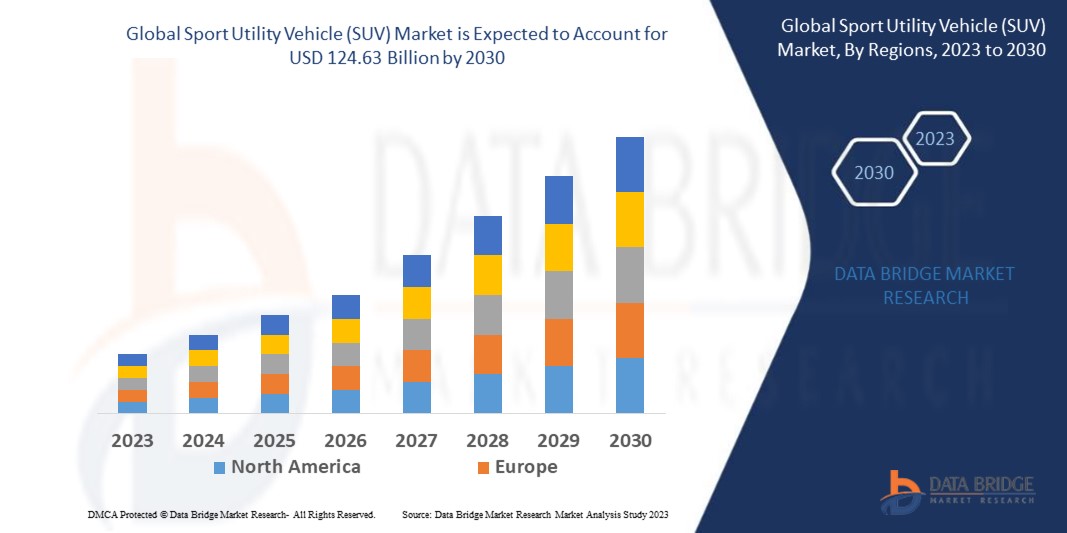
Data Bridge Market Research analyses that the global sport utility vehicle (SUV) market size was valued at USD 46.11 billion in 2023, is projected to reach USD 144.02 billion by 2031, with a CAGR of 15.30% during the forecast period 2024 to 2031. In addition to the market insights such as market value, growth rate, market segments, geographical coverage, market players, and market scenario, the market report curated by the Data Bridge Market Research team includes in-depth expert analysis, import/export analysis, pricing analysis, production consumption analysis, and pestle analysis.
Report Scope and Market Segmentation
|
Report Metric |
Details |
|
Forecast Period |
2024 to 2031 |
|
Base Year |
2023 |
|
Historic Years |
2022 (Customizable to 2016-2021) |
|
Quantitative Units |
Revenue in USD Billion, Volumes in Units, Pricing in USD |
|
Segments Covered |
Type (SUV-C, SUV-D, SUV-E, and SUV-F), Fuel Type (Petrol, Diesel, and Electric SUV), Size (Mini-SUV, Compact, Mid-Size, Full-Size, and Extended-Length), Seating Capacity (5 Seater, 7 Seater, and 8 and Above Seater), Price Range (Medium, and Premium), Application (Remote Areas, Recreation, and Motorsport) |
|
Countries Covered |
U.S., Canada, Mexico, Germany, France, U.K., Netherlands, Switzerland, Belgium, Russia, Italy, Spain, Turkey, Rest of Europe, China, Japan, India, South Korea, Singapore, Malaysia, Australia, Thailand, Indonesia, Philippines, Rest of Asia-Pacific, Saudi Arabia, U.A.E, South Africa, Egypt, Israel, Rest of Middle East and Africa, Brazil, Argentina and Rest of South America |
|
Market Players Covered |
Ford Motor Company (U.S.), General Motors (U.S.), AUDI AG (Germany), Kia Motors Corporation (South Korea), Groupe Renault (France), Groupe PSA (France), SAIC Motor Corporation Limited (China), Tesla (U.S.), Mercedes-Benz Group AG (Germany), BMW AG (Germany), Hyundai Motor Company (South Korea), BYD Company Ltd. (China), Continental AG (Germany), TOYOTA MOTOR CORPORATION (Japan), Nissan Motor Co., LTD. (Japan), Volkswagen Group (Germany), AB Volvo (Sweden), and Honda Motor Co., Ltd. (Japan) |
|
Market Opportunities |
|
Market Definition
A sport utility vehicle (SUV) is a versatile automobile designed for both on-road and off-road use, combining elements of a traditional passenger vehicle with those of a rugged terrain vehicle. SUVs typically offer spacious interiors and higher ground clearance. They are often equipped with four-wheel drive or all-wheel drive systems, making them suitable for various driving conditions and activities.
Sport Utility Vehicle (SUV) Market Dynamics
Drivers
- Increasing Demand for Heavy and Luxury Vehicles
The increasing demand for luxury and heavy vehicles, driven by off-roading capabilities, comfort, and enhanced safety features, is expected to propel market growth. Manufacturers' focus on producing sports cars with advanced security, safety, and infotainment systems further contributes to this trend, fostering awareness and accelerating market expansion, which is driving the market growth.
- Increasing Stringent Regulation
Stringent emission regulations and fuel economy standards worldwide compel SUV manufacturers to invest in cleaner, more efficient technologies, shaping the market. For instance, the European Union mandated the Tire Pressure Monitoring System (TPMS) in passenger car models in November 2012 under the Transportation Recall Enhancement, Accountability, and Documentation (TREAD) Act. Such technologies enhance safety and efficiency, driving market growth by offering improved performance and compliance with regulatory requirements.
Opportunities
- Rise in Urbanization
Urbanization's ascent fuels SUV popularity as city residents seek vehicles offering elevated ground clearance and durability to tackle urban obstacles such as potholes and adverse weather. This trend presents a ripe opportunity for the SUV market, with consumers prioritizing ruggedness and versatility to navigate the challenges of urban environments efficiently.
- Rising Concerns Regarding Safety among Consumers
Rising concerns about consumer safety are driving immense opportunities for market growth in the SUV segment. Equipped with advanced safety features such as Anti-Lock Brake System (ABS), traction control (ASR), Advanced Driver-Assistance Systems (ADAS), Tire-Pressure Monitoring System (TPMS), and torque vectoring, SUVs ensure maximum safety for drivers. For instance, Audi's 2017 launch of the AudiQ3 integrated these technologies. Increasing consumer inclination towards safety features, prompted by growing road accidents, is expected to create opportunities for market growth.
Restraints/Challenges
- Rising Cost of Fuel
Rising fuel prices, spurred by increasing adoption of SUVs, constrain market growth. SUVs, being fuel-intensive, drive demand for crude oil. The Energy Information Administration reports crude oil prices rose, probably hampering market expansion. This trend anticipates a detrimental effect on SUV market growth.
- Supply Chain Disruptions
Supply chain disruptions from natural disasters, trade disputes, or pandemics can halt SUV production, causing critical component shortages. Production delays and reduced availability negatively affect SUV sales, leading to decreased consumer demand and potential revenue loss. Such disruptions highlight the vulnerability of the automotive industry to external factors, posing significant challenges to market stability and profitability.
This market report provides details of new recent developments, trade regulations, import-export analysis, production analysis, value chain optimization, market share, impact of domestic and localized market players, analyses opportunities in terms of emerging revenue pockets, changes in market regulations, strategic market growth analysis, market size, category market growths, application niches and dominance, product approvals, product launches, geographic expansions, technological innovations in the market. To gain more info on the market contact Data Bridge Market Research for an Analyst Brief, our team will help you take an informed market decision to achieve market growth.
Recent Development
- In 2022, Suzuki Motor Corporation and Toyota Motor Corporation unveiled plans to commence manufacturing hybrid SUV vehicles, leveraging Suzuki's expertise in compact vehicles and Toyota's electrification prowess. This alliance aims for broader EV adoption through combined manufacturing, foreseeing market growth
- In 2022, Honda Motor Co., Ltd. launched the ZR-V, an SUV boasting an elegant and intelligent design tailored for urban settings. This hybrid model, equipped with Sports e:HEV, integrates a 2.0-liter direct injection engine with an advanced 2-motor hybrid system (e-CVT)
- In 2022, Hyundai Motor announced the debut of the Ioniq 5 EV, featuring international models with 72.6kWh and 58kWh battery options, offering driving ranges of 480 km and 385 km, respectively. Both battery variants will be available in 4WD and 2WD configurations
Sport Utility Vehicle (SUV) Market Scope
The market is segmented on the basis of type, fuel type, size, seating capacity, price range, and application. The growth amongst these segments will help you analyze meagre growth segments in the industries and provide the users with a valuable market overview and market insights to help them make strategic decisions for identifying core market applications.
Type
- SUV-C
- SUV-D
- SUV-E
- SUV-F
Fuel Type
- Petrol
- Diesel
- Electric SUV
Size
- Mini-SUV
- Compact
- Mid-Size
- Full-Size
- Extended-Length
Seating Capacity
- 5 Seater
- 7 Seater
- 8 and above Seater
Price Range
- Medium
- Premium
Application
- Remote Areas
- Recreation
- Motorsport
Sport Utility Vehicle (SUV) Market Regional Analysis/Insights
The market is analyzed and market size insights and trends are provided, type, fuel type, size, seating capacity, price range, and application as referenced above.
The countries covered in the market report are U.S., Canada, Mexico, Germany, France, U.K., Netherlands, Switzerland, Belgium, Russia, Italy, Spain, Turkey, Rest of Europe, China, Japan, India, South Korea, Singapore, Malaysia, Australia, Thailand, Indonesia, Philippines, Rest of Asia-Pacific, Saudi Arabia, U.A.E., South Africa, Egypt, Israel, Rest of Middle East and Africa, Brazil, Argentina, and Rest of South America.
Asia-Pacific is projected to be the fastest developing region in the market. High investments in research and development activities and the growing demand for automobiles, particularly SUVs, drive this trend. The region's dynamic automotive landscape signifies substantial growth potential, fostering innovation and market expansion.
North America is expected to dominate the market due to rising demand for premium vehicles featuring enhanced comfort features. This region anticipates significant revenue growth and market share owing to consumer preferences for upscale SUVs, reflecting a trend towards luxury and superior driving experiences.
The country section of the report also provides individual market impacting factors and changes in regulation in the market domestically that impacts the current and future trends of the market. Data points like down-stream and upstream value chain analysis, technical trends and porter's five forces analysis, case studies are some of the pointers used to forecast the market scenario for individual countries. Also, the presence and availability of global brands and their challenges faced due to large or scarce competition from local and domestic brands, impact of domestic tariffs and trade routes are considered while providing forecast analysis of the country data.
Competitive Landscape and Sport Utility Vehicle (SUV) Market Share Analysis
The market competitive landscape provides details by competitor. Details included are company overview, company financials, revenue generated, market potential, investment in research and development, new market initiatives, global presence, production sites and facilities, production capacities, company strengths and weaknesses, product launch, product width and breadth, application dominance. The above data points provided are only related to the companies' focus related to the market.
Some of the major players operating in the market are:
- Ford Motor Company (U.S.)
- General Motors (U.S.)
- AUDI AG (Germany)
- Kia Motors Corporation (South Korea)
- Groupe Renault (France)
- Groupe PSA (France)
- SAIC Motor Corporation Limited (China)
- Tesla (U.S.)
- Mercedes-Benz Group AG (Germany)
- BMW AG (Germany)
- Hyundai Motor Company (South Korea)
- BYD Company Ltd. (China)
- Continental AG (Germany)
- TOYOTA MOTOR CORPORATION (Japan)
- Nissan Motor Co., LTD. (Japan)
- Volkswagen Group (Germany)
- AB Volvo (Sweden)
- Honda Motor Co., Ltd. (Japan)
SKU-
Obtenha acesso online ao relatório sobre a primeira nuvem de inteligência de mercado do mundo

- Painel interativo de análise de dados
- Painel de análise da empresa para oportunidades de elevado potencial de crescimento
- Acesso de analista de pesquisa para personalização e customização. consultas
- Análise da concorrência com painel interativo
- Últimas notícias, atualizações e atualizações Análise de tendências
- Aproveite o poder da análise de benchmark para um rastreio abrangente da concorrência
Metodologia de Investigação
A recolha de dados e a análise do ano base são feitas através de módulos de recolha de dados com amostras grandes. A etapa inclui a obtenção de informações de mercado ou dados relacionados através de diversas fontes e estratégias. Inclui examinar e planear antecipadamente todos os dados adquiridos no passado. Da mesma forma, envolve o exame de inconsistências de informação observadas em diferentes fontes de informação. Os dados de mercado são analisados e estimados utilizando modelos estatísticos e coerentes de mercado. Além disso, a análise da quota de mercado e a análise das principais tendências são os principais fatores de sucesso no relatório de mercado. Para saber mais, solicite uma chamada de analista ou abra a sua consulta.
A principal metodologia de investigação utilizada pela equipa de investigação do DBMR é a triangulação de dados que envolve a mineração de dados, a análise do impacto das variáveis de dados no mercado e a validação primária (especialista do setor). Os modelos de dados incluem grelha de posicionamento de fornecedores, análise da linha de tempo do mercado, visão geral e guia de mercado, grelha de posicionamento da empresa, análise de patentes, análise de preços, análise da quota de mercado da empresa, normas de medição, análise global versus regional e de participação dos fornecedores. Para saber mais sobre a metodologia de investigação, faça uma consulta para falar com os nossos especialistas do setor.
Personalização disponível
A Data Bridge Market Research é líder em investigação formativa avançada. Orgulhamo-nos de servir os nossos clientes novos e existentes com dados e análises que correspondem e atendem aos seus objetivos. O relatório pode ser personalizado para incluir análise de tendências de preços de marcas-alvo, compreensão do mercado para países adicionais (solicite a lista de países), dados de resultados de ensaios clínicos, revisão de literatura, mercado remodelado e análise de base de produtos . A análise de mercado dos concorrentes-alvo pode ser analisada desde análises baseadas em tecnologia até estratégias de carteira de mercado. Podemos adicionar quantos concorrentes necessitar de dados no formato e estilo de dados que procura. A nossa equipa de analistas também pode fornecer dados em tabelas dinâmicas de ficheiros Excel em bruto (livro de factos) ou pode ajudá-lo a criar apresentações a partir dos conjuntos de dados disponíveis no relatório.











