



Segmentação do mercado de sensores de visão global, por tipo de sensor (menos do que sensores de visão 3D, sensores de visão 2D, sensores de visão 3D, sensores de visão inteligentes e outros), componente (câmeras e sensores, processadores e controladores, software e algoritmos, iluminação e óptica, e outros), aplicação (inspeção, calibre, leitura de código e localização), indústria (automotiva, eletrônica e semicondutor, eletrônica de consumo, farmacêutica, alimentos e embalagens, e outros)- tendências e previsões industriais para 2033
Qual é o tamanho do mercado do sensor de visão e taxa de crescimento
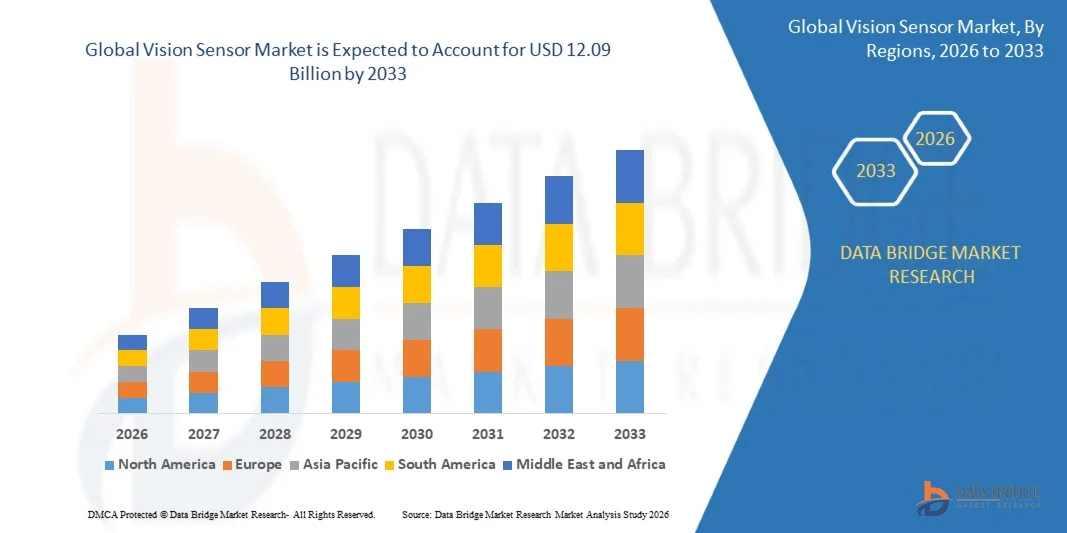
- De acordo com a análise da Data Bridge Market Research, o mercado de sensores de visão foi avaliado emUSD 4,99 mil milhões em 2025e é projetado para alcançarUSD 12,09 mil milhões até 2033, crescendo emCAGR de 11,70% de 2026 a 2033.
- O mercado está experimentando um crescimento consistente impulsionado pela crescente demanda por soluções automatizadas de inspeção e controle de qualidade, avanços rápidos nas tecnologias de visão de máquinas e expansão de aplicações nas indústrias automotiva, eletrônica, semicondutora, de alimentos e bebidas e manufatura.
- A crescente adoção de automação industrial, combinada com a crescente necessidade de detecção de defeitos de alta velocidade, precisa e confiável, está obrigando os fabricantes a integrar sensores de visão avançados em linhas de produção. Os sensores de visão 2D e 3D estão substituindo cada vez mais processos de inspeção manual, oferecendo detecção, medição, identificação e avaliação de qualidade em tempo real, melhorando a eficiência operacional e reduzindo erros de produção.
Tamanho e previsão do mercado
- Valor de Mercado Global (2025): USD 4,99 Bilhões
- Valor de mercado esperado (2033): USD 12.09 Bilhões
- Previsões CAGR (2026-2033): 11,70%
- Região líder em 2025: América do Norte
- Região de crescimento mais rápido: Ásia Pacífico
Quais são as principais takeaways do mercado de sensores de visão
- A América do Norte dominou o mercado de sensores de visão com a maior parcela de receita de 35,4% em 2025, apoiada por automação industrial rápida, forte adoção de tecnologias de inteligência artificial e visão de máquinas, e crescente implantação de sistemas de inspeção automatizados
- Asia-Pacific é esperado para ser a região de crescimento mais rápido em um CAGR de 9,0% de 2026 a 2033, alimentado por automação industrial rápida, expansão da eletrônica e fabricação de semicondutores, e crescente adoção de visão de máquina e robótica em toda a China, Japão, Coreia do Sul e Índia.
- O segmento de sensores de visão menos de 3D liderou o mercado com uma participação de 46,8% em 2025, impulsionado pela implantação generalizada de sensores de visão 2D em aplicações de inspeção, leitura de código e medição.
- Sensores de visão 3D são o tipo de sensor de crescimento mais rápido, projetado para registrar um CAGR de 21,4%, refletindo o aumento da demanda por sensoriamento de profundidade, orientação robótica, medição volumétrica e inspeção avançada.
- O segmento de câmeras e sensores dominou a categoria de componentes com uma quota de receita de 40% em 2025, liderada pelo seu papel essencial na aquisição de imagens, inspeção automatizada, detecção de defeitos, medição e orientação robótica em ambientes de fabricação.
- A inspeção representou 38,4% do market share em 2025, preferencialmente pela implantação generalizada de sensores de visão para controle automatizado de qualidade.
- O segmento de localização é a categoria de software de crescimento mais rápido, com um CAGR de 16%, impulsionado pelo aumento da adoção de robótica e sistemas automatizados de manipulação de materiais.
Segmentação do mercado de sensores de visão e escopo de relatório
|
Atributos |
Visão Sensor Key Market Insights |
|
Segmentos Cobertos |
|
|
Países abrangidos |
América do Norte
Europa
Ásia- Pacífico
Médio Oriente e África
América do Sul
|
|
Jogadores do mercado chave |
|
|
Oportunidades de Mercado |
|
|
Informações sobre o Valor Adicionado |
Além dos insights de mercado, como valor de mercado, taxa de crescimento, segmentos de mercado, cobertura geográfica, atores de mercado e cenário de mercado, o relatório de mercado curado pela equipe de Pesquisa do Mercado da Ponte de Dados inclui análise de especialistas em profundidade, análise de importação/exportação, análise de preços, análise de consumo de produção e análise de pilão. |
Qual é a tendência chave no mercado de sensores de visão
- Sensores de visão habilitados para IA estão sendo cada vez mais integrados em sistemas de inspeção industrial para melhorar a detecção de defeitos, classificação de objetos e precisão de controle de qualidade, reduzindo a dependência de regras de inspeção programadas manualmente.
- Por exemplo, em junho de 2025, a Cognex introduziu a OneVision, uma plataforma baseada em nuvem projetada para ajudar os fabricantes a construir, treinar e escalar aplicações de visão de máquina com IA, abordando barreiras para a adoção de IA industrial mais ampla
- O processamento baseado em bordas permite que os sensores de visão analisem imagens e tomem decisões de inspeção diretamente nas linhas de produção, reduzindo a latência e dependência da infraestrutura de computação externa.
- Os fabricantes estão cada vez mais combinando IA, imagens de alta resolução e processamento incorporado para lidar com produtos variáveis, defeitos complexos e ambientes de produção de alta velocidade com maior flexibilidade.
- Por exemplo, em maio de 2026, a Cognex lançou o sistema de visão de IA incorporado In-Sight 3900, combinando IA Edge e IA avançada com processamento com a Qualcomm para fornecer inspeção em tempo real e de alta velocidade sem um PC externo.
- À medida que os fabricantes priorizam a automação inteligente, inspeção em tempo real e sistemas de controle de qualidade escaláveis, espera-se que a adoção de sensores de visão baseados em IA e em borda acelere, reforçando o sensoriamento de visão avançada como uma tecnologia central para fabricação inteligente.
Quais são os Principais Drivers do Mercado de Sensor de Visão
- A rápida expansão da automação industrial e da fabricação inteligente aumentou significativamente a demanda por sensores de visão capazes de realizar inspeção de alta velocidade, medição, identificação e detecção de defeitos com maior precisão.
- Por exemplo, em julho de 2025, a RealSense garantiu US$ 50 milhões em financiamento para expandir sua tecnologia de visão 3D para robótica, com a empresa relatando mais de 3.000 clientes ativos e suas câmeras sendo usadas por 60% de robôs móveis autônomos e humanóides em todo o mundo
- Fabricantes automotivos, eletrônicos, semicondutores, alimentos e bebidas e logísticos estão integrando sensores de visão em linhas de produção para melhorar a consistência de qualidade, reduzir erros de inspeção e aumentar a eficiência operacional.
- Por exemplo, em outubro de 2025, a Cognex introduziu seu portfólio de logística SLX, com dispositivos de visão de máquina alimentados por IA projetados para leitura de código de barras, captura de imagens e detecção automatizada de pacotes em instalações logísticas.
- Com os fabricantes cada vez mais em transição para ambientes de produção conectados e automatizados, os sensores de visão permanecerão essenciais para o controle de qualidade em tempo real, automação robótica, identificação de produtos e operações de fabricação inteligentes.
Que fatores estão desafiando o crescimento do mercado de sensores de visão
- Sensores avançados de visão podem exigir investimento significativo porque sistemas de alto desempenho combinam câmeras especializadas, ópticas, iluminação, processadores, software e recursos de IA para aplicações de inspeção industrial exigentes.
- Por exemplo, em agosto de 2025, o Vision Systems Design destacou restrições de hardware, integração de software, otimização de modelos de IA e a complexidade da implantação da Edge AI em sistemas de visão industrial como principais desafios que afetam a implementação.
- Esses custos de implementação podem limitar a adoção entre fabricantes e organizações menores com orçamentos de automação limitados, particularmente quando aplicações complexas exigem integração personalizada e especialização técnica especializada.
- A complexidade técnica de integrar sensores de visão com equipamentos de produção existentes, redes industriais, robótica e softwares de IA pode aumentar ainda mais o tempo de implantação e exigir pessoal qualificado para configuração, manutenção e otimização do sistema.
- Por exemplo, em outubro de 2024, Vision Systems Design relatou que as empresas de visão de máquina continuaram enfrentando desafios relacionados à facilidade de uso, habilidades de força de trabalho e a perícia técnica necessária para implementar IA e sistemas avançados de imagem.
- À medida que os fabricantes continuam a equilibrar os benefícios da automação com os custos de equipamentos, integração, software e treinamento, a complexidade e o investimento inicial associados aos sistemas de sensores de visão avançada continuam a ser barreiras fundamentais para uma adoção mais ampla, especialmente entre fabricantes menores e menos automatizados.
Como é segmentado o mercado de sensores de visão
O mercado de sensores de visão é segmentado com base no tipo de sensor, componente, aplicação e indústria.
- Por tipo de sensor
Com base no tipo de sensor, o mercado de sensores de visão é segmentado em menos de sensores de visão 3D, sensores de visão 2D, sensores de visão 3D, sensores de visão inteligentes, entre outros. O segmento de sensores de visão menos de 3D dominou o mercado com uma participação de 46,8% em 2025, principalmente devido à implantação generalizada de sensores de visão 2D em aplicações de inspeção, leitura de código e medição. Esses sensores oferecem custos mais baixos, integração mais simples e um ecossistema estabelecido de tecnologias de iluminação, óptica e processamento compatíveis. Seu uso extensivo em automóveis, eletrônicos, alimentos e embalagens, e fabricação geral continua a apoiar sua posição de liderança. A maturidade da tecnologia de imagem 2D também permite que os fabricantes integrem esses sistemas em linhas de produção automatizadas existentes com modificações relativamente limitadas. Sua capacidade de realizar inspeção de superfície de alta velocidade, reconhecimento de padrões e identificação os torna adequados para ambientes de produção em larga escala.
O segmento de sensores de visão 3D é projetado para ser o tipo de sensor de crescimento mais rápido, registrando um CAGR de 21,4%, impulsionado pela crescente demanda por sensoriamento de profundidade, orientação robótica, medição volumétrica e inspeção avançada. Ao contrário dos sistemas 2D convencionais, os sensores 3D fornecem informações de profundidade e espacial que permitem que as máquinas compreendam a geometria e o posicionamento dos objetos. Aumentar a implantação de robôs, veículos guiados autônomos e sistemas automatizados de manuseio de materiais está fortalecendo a demanda por visão 3D. Os custos de queda das tecnologias estruturadas de luz, tempo de voo e visão estéreo também estão tornando esses sistemas mais acessíveis. Integração com computação de borda e IA está melhorando o processamento em tempo real de dados de nuvens de ponto 3D para aplicações industriais.
- Por Componente
Com base no componente, o mercado de sensores de visão é segmentado em câmeras e sensores, processadores e controladores, software e algoritmos, iluminação e óptica, entre outros. O segmento de câmeras e sensores representou a maior participação em 2025, em 40%, refletindo seu papel fundamental na captura de informações visuais exigidas pelos sistemas de visão de máquina. Câmeras e sensores fornecem os dados primários de imagem usados para inspeção, medição, identificação e localização. A crescente demanda por imagens industriais de alta resolução está incentivando os fabricantes a adotar sensores CMOS avançados e câmeras industriais de alta velocidade. Melhorias nas taxas de quadros, sensibilidade à imagem, resolução e fatores de forma compacta estão expandindo suas aplicações em ambientes de fabricação. Câmeras e sensores também são componentes essenciais em arquiteturas de visão convencionais 2D e avançadas 3D.
O segmento de software e algoritmos é projetado para registrar o crescimento mais rápido, em 18% do CAGR durante o período de previsão, apoiado pelo aumento da integração de inteligência artificial, aprendizado de máquina e capacidades avançadas de processamento de imagens. Software converte imagens capturadas em informações acionáveis para inspeção automatizada e tomada de decisão. Algoritmos movidos por IA são cada vez mais capazes de identificar defeitos complexos e variações de produtos que sistemas convencionais de inspeção baseados em regras podem falhar. A computação de borda também está permitindo que mais processamento de visão ocorra diretamente dentro de equipamentos industriais, reduzindo a latência e dependência da infraestrutura de computação externa. Os fabricantes estão cada vez mais buscando software flexível que possa suportar várias aplicações de inspeção e se adaptar às mudanças nos requisitos de produção.
- Por Aplicação
Com base na aplicação, o mercado de sensores de visão é segmentado em inspeção, aferição, leitura de código e localização. O segmento de inspeção dominou o mercado com 38,4% da participação de receita em 2025, impulsionado pela implantação generalizada de sensores de visão para controle automatizado de qualidade. Sensores de visão são amplamente usados para identificar defeitos de superfície, verificar a completude da montagem, avaliar a qualidade do produto e detectar inconsistências dimensionais. A inspeção automatizada proporciona maior consistência e repetibilidade do que a inspeção visual manual enquanto suporta linhas de produção de alta velocidade. Os fabricantes de automóveis, eletrônicos, farmacêuticos, alimentos e embalagens e semicondutores estão cada vez mais integrando sistemas de visão em processos de controle de qualidade. A necessidade de reduzir os erros de produção, os resíduos materiais e as recalls de produtos está a reforçar ainda mais a adopção.
O segmento de localização é projetado para ser a aplicação de crescimento mais rápido, com crescimento de 16% CAGR durante o período de previsão, impulsionado pelo aumento da adoção de robótica e sistemas automatizados de manuseio de materiais. Sensores de visão permitem que as máquinas determinem a localização, orientação e posição precisas dos componentes antes de realizar operações automatizadas. Esta capacidade é particularmente importante para a escolha robótica, montagem, embalagem e colocação de componentes. A adoção crescente de robôs colaborativos está aumentando a demanda por sistemas de localização visual flexíveis capazes de lidar com posições variáveis do produto. Avanços no sensoriamento 3D e no reconhecimento de objetos baseados em IA estão melhorando ainda mais a precisão de localização de objetos em forma irregular. Logística e automação de armazém também estão criando novas aplicações para posicionamento de objetos baseados em visão.
- Por Indústria
Com base na indústria, o mercado de sensores de visão é segmentado em automotivos, eletrônicos e semicondutores, eletrônicos de consumo, farmacêuticos, alimentos e embalagens, entre outros. O segmento automotivo dominou o mercado com uma participação de 42,1% em 2025, apoiado pela implantação extensiva de sensores de visão ao longo da fabricação de veículos e produção de componentes. Os fabricantes automotivos usam sensores de visão para montagem de corpo, inspeção de tinta, verificação de solda, medição de componentes e controle de qualidade automatizado. A crescente produção de veículos elétricos está gerando demanda adicional para inspeção de baterias, componentes eletrônicos e montagens de precisão. Os sistemas de visão também são cada vez mais integrados com robôs industriais para posicionamento e montagem automatizados. Requisitos crescentes para a precisão de fabricação e consistência de qualidade estão incentivando OEMs e fornecedores a expandir as capacidades de inspeção automatizada.
O segmento eletrônico e semicondutor é projetado para ser a indústria de crescimento mais rápido, registrando um CAGR de 20,8%, impulsionado pela expansão da fabricação de semicondutores, miniaturização eletrônica e crescentes requisitos para inspeção de alta precisão. Os sensores de visão são cada vez mais usados para inspeção de wafers, montagem de PCB, inspeção conjunta de solda, verificação de componentes e controle de qualidade de painel de exibição. A complexidade crescente dos dispositivos semicondutores requer uma identificação altamente precisa de defeitos microscópicos e variações dimensionais. Investimentos de fabricação de semicondutores apoiados pelo governo nos EUA, Europa, Japão, Coreia do Sul e outras grandes economias de produção estão criando demanda adicional por equipamentos de inspeção automatizados. A transição para nós de processo menores também está aumentando a importância das tecnologias avançadas de imagem e detecção de defeitos.
Qual região detém a maior parte do mercado de sensores de visão
- A América do Norte dominou o mercado de sensores de visão com a maior parcela de receita de 35,4% em 2025, apoiada por automação industrial rápida, forte adoção de tecnologias de inteligência artificial e visão de máquinas, e crescente implantação de sistemas de inspeção automatizados
- A região também se beneficia da forte demanda em indústrias automotivas, eletrônicas e semicondutores, farmacêuticas, de alimentos e embalagens e logística, enquanto a presença de empresas líderes em tecnologia de visão e a adoção crescente de inspeção habilitada por IA, sensoriamento 3D e sistemas automatizados de controle de qualidade continuam a fortalecer a liderança da América do Norte no mercado global de sensores de visão.
U.S. Vision Sensor Market Insight
O mercado de sensores de visão dos EUA está testemunhando um forte crescimento devido ao aumento dos investimentos em automação industrial, fabricação inteligente e tecnologias de visão de máquinas alimentadas por IA. O ecossistema automotivo, eletrônico, semicondutor e logístico maduro do país, juntamente com a adoção crescente de inspeção automatizada e robótica, está impulsionando a demanda em aplicações de fabricação. Além disso, a ênfase crescente em melhorar a precisão da produção, reduzir defeitos e permitir o controle de qualidade em tempo real está acelerando a adoção de sensores de visão entre fabricantes e empresas de tecnologia.
Visão Ásia-Pacífico Sensor Market Insight
Espera-se que o mercado de sensores de visão Ásia-Pacífico testemunhe um rápido crescimento, impulsionado pela expansão das atividades de fabricação, aumento da automação industrial e aumento dos investimentos em eletrônicos e produção de semicondutores em países como China, Japão, Coreia do Sul e Índia. A adoção crescente de robótica, tecnologias de inspeção habilitadas por IA e soluções de fábrica inteligente estão apoiando a expansão regional do mercado. Além disso, a presença crescente de fábricas automotivas e eletrônicas está acelerando a adoção de sensores de visão em aplicações industriais e logísticas.
Visão do Japão Sensor Market Insight
O mercado de sensores de visão do Japão está testemunhando crescimento consistente devido ao aumento dos investimentos em automação industrial, robótica, fabricação de precisão e tecnologias avançadas de visão de máquina. Fabricantes de automóveis, empresas de eletrônicos e fabricantes de equipamentos industriais estão adotando cada vez mais sensores de visão para inspeção automatizada, medição, verificação de componentes e orientação robótica. Além disso, o aumento da integração de IA, sensoriamento 3D e tecnologias de imagem de alta resolução e o forte foco do país na eficiência de fabricação contribuem ainda mais para o crescimento do mercado.
China Visão Sensor Market Insight
O mercado de sensores de visão da China está crescendo rapidamente, impulsionado pela expansão da capacidade de fabricação, aumento da automação industrial e aumento do apoio do governo para a fabricação inteligente e tecnologias de produção avançadas. A adoção crescente de sistemas de visão 3D habilitados para IA em indústrias automotivas, eletrônicas, semicondutores e logística está aumentando significativamente a demanda do mercado. Além disso, os crescentes investimentos em fabricação de semicondutores, robótica, inspeção automatizada e fábricas inteligentes estão posicionando a China como um dos mercados de maior crescimento para sensores de visão globalmente.
U.K. Vision Sensor Market Insight
O mercado de sensores de visão do Reino Unido está experimentando crescimento constante, apoiado pela adoção crescente de tecnologias de visão de máquina em aplicações de fabricação, logística, automotivo, farmacêutica e alimentos e embalagens. Aumentar os investimentos em automação industrial e crescente demanda por soluções de inspeção precisas, de alta velocidade e automatizadas estão contribuindo para o crescimento do mercado. Além disso, a integração de IA, computação de borda e tecnologias avançadas de processamento de imagens está melhorando as capacidades de inspeção e eficiência operacional, posicionando o Reino Unido como um importante mercado para tecnologias de sensores de visão.
Alemanha Visão Sensor Market Insight
O mercado de sensores de visão da Alemanha está se expandindo constantemente devido à forte base de fabricação automotiva e industrial do país, recursos avançados de automação e crescente adoção de tecnologias da Indústria 4.0. Empresas automotivas, fabricantes de eletrônicos e produtores industriais estão cada vez mais utilizando sensores de visão para inspeção de qualidade automatizada, medição, detecção de defeitos e aplicações robóticas. Avanços contínuos na visão ativada por IA, sensoriamento 3D e tecnologias de fábrica inteligentes, junto com forte ênfase na eficiência e precisão de fabricação, estão impulsionando o crescimento do mercado na Alemanha.
Quais são as principais empresas no mercado de sensores de visão
A indústria de sensores de visão é liderada principalmente por empresas bem estabelecidas, incluindo:
- Cognex Corporation(EUA)
- DOENÇA(Alemanha)
- CORPORAÇÃO DE CHAVE(Japão)
- OMRON Corporation(Japão)
- Balluff Automation India Pvt. Ltd.(Alemanha)
- Baumer Holding AG (Suíça)
- Basler AG (Alemanha)
- IFM Electronic GmbH (Alemanha)
- Pepperl+Fuchs (Alemanha)
- Banner Engineering Corp. (EUA)
- Datalogic S.p.A. (Itália)
- Zebra Technologies Corporation (EUA)
- Teledyne Technologies Incorporated (EUA)
- LMI Technologies Inc. (Canadá)
- Sistemas de Desenvolvimento de Imagens IDS GmbH (Alemanha)
- Opto Engineering S.p.A. (Itália)
- Allied Vision Technologies GmbH (Alemanha)
- HIKROBOT Co., Ltd. (China)
- Advantech Co., Ltd. (Taiwan)
- MVTec Software GmbH (Alemanha)
Quais são as últimas evoluções no mercado de sensores de visão
- Em outubro de 2025, a Cognex lançou seu portfólio Solutions Experience (SLX) Logistics, introduzindo dispositivos de visão específicos para aplicações projetados para automação logística. O portfólio inicial incluía soluções orientadas por IA para leitura de código de barras, captura de imagens e detecção de pacotes, permitindo que armazéns e instalações de distribuição melhorassem os processos automatizados de identificação e manuseio.
- Em janeiro de 2025, a Cognex anunciou o lançamento dos leitores de código de barras DataMan 290 e DataMan 390, incorporando tecnologia de IA para melhorar o desempenho de leitura de código de barras em aplicações de fabricação e logística. Os novos leitores foram projetados para lidar com códigos desafiadores e melhorar a identificação automatizada, apoiando a crescente integração de IA e tecnologias de visão em sistemas industriais de inspeção e rastreabilidade.
- Em dezembro de 2022, a Cognex adquiriu a SAC Sirius Advanced Cybernetics GmbH, uma fornecedora alemã de tecnologia de iluminação, para fortalecer suas capacidades de visão de máquina para identificar defeitos desafiadores. A aquisição ampliou especificamente as capacidades da Cognex para aplicações automotivas e de consumo eletrônico, incluindo inspeção de baterias de veículos elétricos.
- Em maio de 2022, a SICK apresentou suas soluções de visão 3D Ranger3 e Ruler3000 para produção de pilhas de alta velocidade, permitindo medições precisas em linha a velocidades de produção de até 15,4 gigapixels por segundo. As soluções foram projetadas para melhorar a inspeção de qualidade e reduzir os rejeitados na fabricação de baterias cada vez mais automatizadas.
- Em janeiro de 2021, a Cognex lançou o sistema de visão 3D-L4000 integrado In-Sight, combinando tecnologia de deslocamento a laser 3D com uma câmera inteligente para permitir inspeção e medição automatizada em linhas de produção. O sistema incorporou um processador integrado e ferramentas de visão 3D, permitindo aos fabricantes realizar tarefas complexas de inspeção sem exigir hardware de processamento externo separado.
SKU-
Obtenha acesso online ao relatório sobre a primeira nuvem de inteligência de mercado do mundo

- Painel interativo de análise de dados
- Painel de análise da empresa para oportunidades de elevado potencial de crescimento
- Acesso de analista de pesquisa para personalização e customização. consultas
- Análise da concorrência com painel interativo
- Últimas notícias, atualizações e atualizações Análise de tendências
- Aproveite o poder da análise de benchmark para um rastreio abrangente da concorrência
Metodologia de Investigação
A recolha de dados e a análise do ano base são feitas através de módulos de recolha de dados com amostras grandes. A etapa inclui a obtenção de informações de mercado ou dados relacionados através de diversas fontes e estratégias. Inclui examinar e planear antecipadamente todos os dados adquiridos no passado. Da mesma forma, envolve o exame de inconsistências de informação observadas em diferentes fontes de informação. Os dados de mercado são analisados e estimados utilizando modelos estatísticos e coerentes de mercado. Além disso, a análise da quota de mercado e a análise das principais tendências são os principais fatores de sucesso no relatório de mercado. Para saber mais, solicite uma chamada de analista ou abra a sua consulta.
A principal metodologia de investigação utilizada pela equipa de investigação do DBMR é a triangulação de dados que envolve a mineração de dados, a análise do impacto das variáveis de dados no mercado e a validação primária (especialista do setor). Os modelos de dados incluem grelha de posicionamento de fornecedores, análise da linha de tempo do mercado, visão geral e guia de mercado, grelha de posicionamento da empresa, análise de patentes, análise de preços, análise da quota de mercado da empresa, normas de medição, análise global versus regional e de participação dos fornecedores. Para saber mais sobre a metodologia de investigação, faça uma consulta para falar com os nossos especialistas do setor.
Personalização disponível
A Data Bridge Market Research é líder em investigação formativa avançada. Orgulhamo-nos de servir os nossos clientes novos e existentes com dados e análises que correspondem e atendem aos seus objetivos. O relatório pode ser personalizado para incluir análise de tendências de preços de marcas-alvo, compreensão do mercado para países adicionais (solicite a lista de países), dados de resultados de ensaios clínicos, revisão de literatura, mercado remodelado e análise de base de produtos . A análise de mercado dos concorrentes-alvo pode ser analisada desde análises baseadas em tecnologia até estratégias de carteira de mercado. Podemos adicionar quantos concorrentes necessitar de dados no formato e estilo de dados que procura. A nossa equipa de analistas também pode fornecer dados em tabelas dinâmicas de ficheiros Excel em bruto (livro de factos) ou pode ajudá-lo a criar apresentações a partir dos conjuntos de dados disponíveis no relatório.











