


What is the Vision Sensor Market Size and Growth Rate?
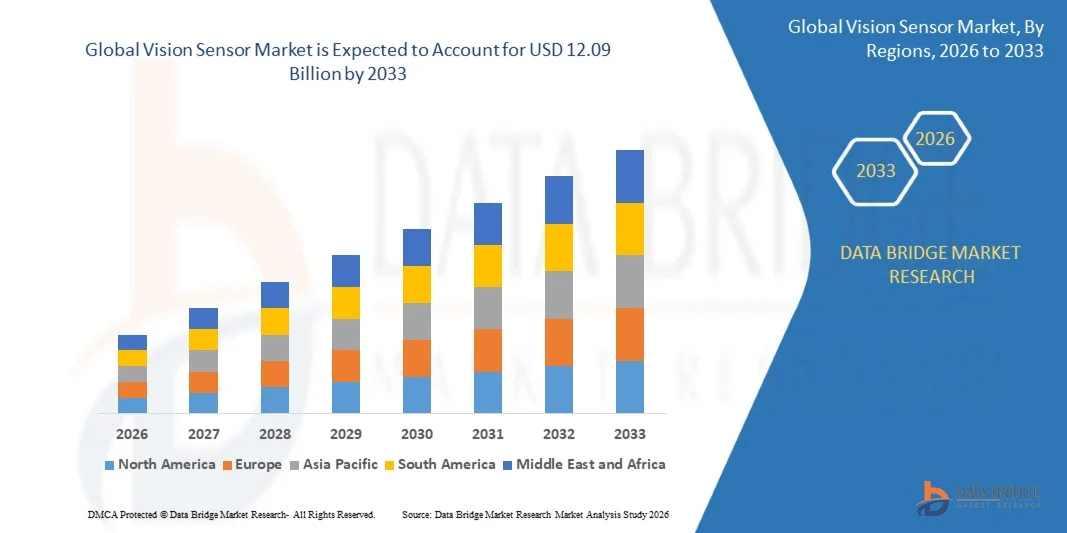
- As per Data Bridge Market Research analysis, the vision sensor market was valued at USD 4.99 billion in 2025 and is projected to reach USD 12.09 billion by 2033, growing at a CAGR of 11.70% from 2026 to 2033.
- The market is experiencing consistent growth driven by rising demand for automated inspection and quality-control solutions, rapid advancements in machine vision technologies, and expanding applications across automotive, electronics, semiconductor, food and beverage, and manufacturing industries.
- The increasing adoption of industrial automation, combined with the growing need for high-speed, accurate, and reliable defect detection, is compelling manufacturers to integrate advanced vision sensors into production lines. 2D and 3D vision sensors are increasingly replacing manual inspection processes, offering real-time object detection, measurement, identification, and quality assessment while improving operational efficiency and reducing production errors.
Market Size & Forecast
- Global Market Value (2025): USD 4.99 Billion
- Expected Market Value (2033): USD 12.09 Billion
- Forecast CAGR (2026–2033): 11.70%
- Leading Region in 2025: North America
- Fastest Growing Region: Asia Pacific
What are the Major Takeaways of the Vision Sensor Market?
- North America dominated the vision sensor market with the largest revenue share of 35.4% in 2025, supported by rapid industrial automation, strong adoption of artificial intelligence and machine vision technologies, and increasing deployment of automated inspection systems
- Asia-Pacific is expected to be the fastest-growing region at a CAGR of 9.0% from 2026 to 2033, fueled by rapid industrial automation, expanding electronics and semiconductor manufacturing, and increasing adoption of machine vision and robotics across China, Japan, South Korea, and India.
- The less than 3D vision sensors segment led the market with a 46.8% share in 2025, driven by the widespread deployment of 2D vision sensors across inspection, code reading, and gauging applications.
- 3D vision sensors are the fastest-growing sensor type, projected to register a CAGR of 21.4%, reflecting the surge in demand for depth sensing, robotic guidance, volumetric measurement, and advanced inspection.
- The cameras & sensors segment dominated the component category with a 40% revenue share in 2025, led by their essential role in image acquisition, automated inspection, defect detection, measurement, and robotic guidance across manufacturing environments.
- Inspection accounted for 38.4% of the market share in 2025, preferred by widespread deployment of vision sensors for automated quality control.
- The localization segment is the fastest-growing software category, with a CAGR of 16%, driven by increasing adoption of robotics and automated material-handling systems.
Report Scope and Vision Sensor Market Segmentation
|
Attributes |
Vision Sensor Key Market Insights |
|
Segments Covered |
|
|
Countries Covered |
North America
Europe
Asia-Pacific
Middle East and Africa
South America
|
|
Key Market Players |
|
|
Market Opportunities |
|
|
Value Added Data Infosets |
In addition to the market insights such as market value, growth rate, market segments, geographical coverage, market players, and market scenario, the market report curated by the Data Bridge Market Research team includes in-depth expert analysis, import/export analysis, pricing analysis, production consumption analysis, and pestle analysis. |
What is the Key Trend in the Vision Sensor Market?
- AI-enabled vision sensors are increasingly being integrated into industrial inspection systems to improve defect detection, object classification, and quality-control accuracy while reducing dependence on manually programmed inspection rules.
- For instance, in June 2025, Cognex introduced OneVision, a cloud-based platform designed to help manufacturers build, train, and scale AI-powered machine-vision applications, addressing barriers to wider industrial AI adoption
- Edge-based processing enables vision sensors to analyze images and make inspection decisions directly on production lines, reducing latency and dependence on external computing infrastructure.
- Manufacturers are increasingly combining AI, high-resolution imaging, and embedded processing to handle variable products, complex defects, and high-speed production environments with greater flexibility.
- For instance, in May 2026, Cognex launched the In-Sight 3900 embedded AI vision system, combining Edge AI and advanced AI with Qualcomm-powered processing to deliver real-time, high-speed inspection without an external PC.
- As manufacturers prioritize intelligent automation, real-time inspection, and scalable quality-control systems, the adoption of AI-powered and edge-based vision sensors is expected to accelerate, reinforcing advanced vision sensing as a core technology for smart manufacturing.
What are the Key Drivers of the Vision Sensor Market?
- The rapid expansion of industrial automation and smart manufacturing has significantly increased demand for vision sensors capable of performing high-speed inspection, measurement, identification, and defect detection with greater accuracy.
- For instance, in July 2025, RealSense secured USD 50 million in funding to expand its 3D vision technology for robotics, with the company reporting more than 3,000 active customers and its cameras being used by 60% of autonomous mobile robots and humanoids worldwide
- Automotive, electronics, semiconductor, food and beverage, and logistics manufacturers are integrating vision sensors into production lines to improve quality consistency, reduce inspection errors, and increase operational efficiency.
- For instance, in October 2025, Cognex introduced its SLX logistics portfolio, featuring AI-powered machine vision devices designed for barcode reading, image capture, and automated package detection in logistics facilities.
- With manufacturers increasingly transitioning toward connected and automated production environments, vision sensors will remain essential for real-time quality control, robotic automation, product identification, and intelligent manufacturing operations.
Which Factors are Challenging the Growth of the Vision Sensor Market?
- Advanced vision sensors can require significant investment because high-performance systems combine specialized cameras, optics, lighting, processors, software, and AI capabilities for demanding industrial inspection applications.
- For instance, in August 2025, Vision Systems Design highlighted hardware constraints, software integration, AI-model optimization, and the complexity of deploying Edge AI on industrial vision systems as key challenges affecting implementation.
- These implementation costs can limit adoption among smaller manufacturers and organizations with limited automation budgets, particularly when complex applications require customized integration and specialized technical expertise.
- The technical complexity of integrating vision sensors with existing production equipment, industrial networks, robotics, and AI software can further increase deployment time and require skilled personnel for configuration, maintenance, and system optimization.
- For instance, in October 2024, Vision Systems Design reported that machine-vision companies continued facing challenges related to ease of use, workforce skills, and the technical expertise required to implement AI and advanced imaging systems.
- As manufacturers continue balancing automation benefits against equipment, integration, software, and training costs, the complexity and upfront investment associated with advanced vision sensor systems remain key barriers to broader adoption, particularly among smaller and less-automated manufacturers.
How is the Vision Sensor Market Segmented?
The vision sensor market is segmented on the basis of sensor type, component, application, and industry.
- By Sensor Type
On the basis of sensor type, the vision sensor market is segmented into less than 3D vision sensors, 2D vision sensors, 3D vision sensors, smart vision sensors, and others. The less than 3D vision sensors segment dominated the market with a 46.8% share in 2025, primarily because of the widespread deployment of 2D vision sensors across inspection, code reading, and gauging applications. These sensors offer lower costs, simpler integration, and an established ecosystem of compatible lighting, optics, and processing technologies. Their extensive use across automotive, electronics, food and packaging, and general manufacturing continues to support their leading position. The maturity of 2D imaging technology also allows manufacturers to integrate these systems into existing automated production lines with relatively limited modifications. Their ability to perform high-speed surface inspection, pattern recognition, and identification makes them suitable for large-scale production environments.
The 3D vision sensors segment is projected to be the fastest-growing sensor type, registering a CAGR of 21.4%, driven by rising demand for depth sensing, robotic guidance, volumetric measurement, and advanced inspection. Unlike conventional 2D systems, 3D sensors provide depth and spatial information that enables machines to understand object geometry and positioning. Increasing deployment of robots, autonomous guided vehicles, and automated material-handling systems is strengthening demand for 3D vision. Falling costs of structured-light, time-of-flight, and stereo-vision technologies are also making these systems more accessible. Integration with edge computing and AI is improving real-time processing of 3D point-cloud data for industrial applications.
- By Component
On the basis of component, the vision sensor market is segmented into cameras & sensors, processors & controllers, software & algorithms, lighting & optics, and others. The cameras & sensors segment accounted for the largest share in 2025, at 40%, reflecting their fundamental role in capturing visual information required by machine-vision systems. Cameras and sensors provide the primary image data used for inspection, measurement, identification, and localization. Increasing demand for high-resolution industrial imaging is encouraging manufacturers to adopt advanced CMOS sensors and high-speed industrial cameras. Improvements in frame rates, image sensitivity, resolution, and compact form factors are expanding their applications across manufacturing environments. Cameras and sensors are also essential components in both conventional 2D and advanced 3D vision architectures.
The software & algorithms segment is projected to register the fastest growth, at 18% CAGR during the forecast period, supported by increasing integration of artificial intelligence, machine learning, and advanced image-processing capabilities. Software converts captured images into actionable information for automated inspection and decision-making. AI-powered algorithms are increasingly capable of identifying complex defects and product variations that conventional rule-based inspection systems may miss. Edge computing is also enabling more vision processing to occur directly within industrial equipment, reducing latency and dependence on external computing infrastructure. Manufacturers are increasingly seeking flexible software that can support multiple inspection applications and adapt to changing production requirements.
- By Application
On the basis of application, the vision sensor market is segmented into inspection, gauging, code reading, and localization. The inspection segment dominated the market with 38.4% of revenue share in 2025, driven by widespread deployment of vision sensors for automated quality control. Vision sensors are extensively used to identify surface defects, verify assembly completeness, assess product quality, and detect dimensional inconsistencies. Automated inspection provides greater consistency and repeatability than manual visual inspection while supporting high-speed production lines. Automotive, electronics, pharmaceutical, food and packaging, and semiconductor manufacturers are increasingly integrating vision systems into quality-control processes. The need to reduce production errors, material waste, and product recalls is further strengthening adoption.
The localization segment is projected to be the fastest-growing application, with growth of 16% CAGR during the forecast period, driven by increasing adoption of robotics and automated material-handling systems. Vision sensors allow machines to determine the precise location, orientation, and position of components before performing automated operations. This capability is particularly important for robotic picking, assembly, packaging, and component placement. The growing adoption of collaborative robots is increasing demand for flexible visual localization systems capable of handling variable product positions. Advances in 3D sensing and AI-based object recognition are further improving localization accuracy for irregularly shaped objects. Logistics and warehouse automation are also creating new applications for vision-based object positioning.
- By Industry
On the basis of industry, the vision sensor market is segmented into automotive, electronics and semiconductor, consumer electronics, pharmaceuticals, food and packaging, and others. The automotive segment dominated the market with a 42.1% share in 2025, supported by extensive deployment of vision sensors throughout vehicle manufacturing and component production. Automotive manufacturers use vision sensors for body assembly, paint inspection, weld verification, component gauging, and automated quality control. The increasing production of electric vehicles is generating additional demand for inspection of batteries, electronic components, and precision assemblies. Vision systems are also increasingly integrated with industrial robots for automated positioning and assembly. Growing requirements for manufacturing precision and quality consistency are encouraging OEMs and suppliers to expand automated inspection capabilities.
The electronics and semiconductor segment is projected to be the fastest-growing industry, registering a CAGR of 20.8%, driven by semiconductor manufacturing expansion, electronics miniaturization, and increasing requirements for high-precision inspection. Vision sensors are increasingly used for wafer inspection, PCB assembly, solder-joint inspection, component verification, and display-panel quality control. The increasing complexity of semiconductor devices requires highly accurate identification of microscopic defects and dimensional variations. Government-backed semiconductor manufacturing investments in the U.S., Europe, Japan, South Korea, and other major production economies are creating additional demand for automated inspection equipment. The transition toward smaller process nodes is also increasing the importance of advanced imaging and defect-detection technologies.
Which Region Holds the Largest Share of the Vision Sensor Market?
- North America dominated the vision sensor market with the largest revenue share of 35.4% in 2025, supported by rapid industrial automation, strong adoption of artificial intelligence and machine vision technologies, and increasing deployment of automated inspection systems
- The region also benefits from strong demand across automotive, electronics and semiconductor, pharmaceuticals, food and packaging, and logistics industries, while the presence of leading vision technology companies and increasing adoption of AI-enabled inspection, 3D sensing, and automated quality-control systems continue to strengthen North America's leadership in the global vision sensor market.
U.S. Vision Sensor Market Insight
The U.S. vision sensor market is witnessing strong growth due to rising investments in industrial automation, smart manufacturing, and AI-powered machine vision technologies. The country’s mature automotive, electronics, semiconductor, and logistics ecosystem, along with increasing adoption of automated inspection and robotics, is driving demand across manufacturing applications. In addition, growing emphasis on improving production accuracy, reducing defects, and enabling real-time quality control is accelerating vision sensor adoption across manufacturers and technology companies.
Asia-Pacific Vision Sensor Market Insight
The Asia-Pacific vision sensor market is expected to witness rapid growth, driven by expanding manufacturing activities, increasing industrial automation, and rising investments in electronics and semiconductor production across countries such as China, Japan, South Korea, and India. Growing adoption of robotics, AI-enabled inspection technologies, and smart-factory solutions is supporting regional market expansion. In addition, the growing presence of automotive and electronics manufacturing facilities is accelerating vision sensor adoption across industrial and logistics applications.
Japan Vision Sensor Market Insight
The Japan vision sensor market is witnessing consistent growth due to rising investments in industrial automation, robotics, precision manufacturing, and advanced machine vision technologies. Automotive manufacturers, electronics companies, and industrial equipment producers are increasingly adopting vision sensors for automated inspection, measurement, component verification, and robotic guidance. Moreover, increasing integration of AI, 3D sensing, and high-resolution imaging technologies and the country’s strong focus on manufacturing efficiency are further contributing to market growth.
China Vision Sensor Market Insight
The China vision sensor market is growing rapidly, driven by expanding manufacturing capacity, increasing industrial automation, and rising government support for smart manufacturing and advanced production technologies. Growing adoption of AI-enabled and 3D vision systems across automotive, electronics, semiconductor, and logistics industries is significantly boosting market demand. In addition, rising investments in semiconductor manufacturing, robotics, automated inspection, and intelligent factories are positioning China as one of the fastest-growing markets for vision sensors globally.
U.K. Vision Sensor Market Insight
The U.K. vision sensor market is experiencing steady growth, supported by rising adoption of machine vision technologies in manufacturing, logistics, automotive, pharmaceuticals, and food and packaging applications. Increasing investments in industrial automation and growing demand for accurate, high-speed, and automated inspection solutions are contributing to market growth. Furthermore, integration of AI, edge computing, and advanced image-processing technologies is improving inspection capabilities and operational efficiency, positioning the U.K. as an important market for vision sensor technologies.
Germany Vision Sensor Market Insight
The Germany vision sensor market is expanding steadily due to the country’s strong automotive and industrial manufacturing base, advanced automation capabilities, and increasing adoption of Industry 4.0 technologies. Automotive companies, electronics manufacturers, and industrial producers are increasingly utilizing vision sensors for automated quality inspection, measurement, defect detection, and robotic applications. Continuous advancements in AI-enabled vision, 3D sensing, and smart-factory technologies, along with strong emphasis on manufacturing efficiency and precision, are further driving market growth in Germany.
Which are the Top Companies in Vision Sensor Market?
The vision sensor industry is primarily led by well-established companies, including:
- Cognex Corporation (U.S.)
- SICK (Germany)
- KEYENCE CORPORATION (Japan)
- OMRON Corporation (Japan)
- Balluff Automation India Pvt. Ltd. (Germany)
- Baumer Holding AG (Switzerland)
- Basler AG (Germany)
- IFM Electronic GmbH (Germany)
- Pepperl+Fuchs (Germany)
- Banner Engineering Corp. (U.S.)
- Datalogic S.p.A. (Italy)
- Zebra Technologies Corporation (U.S.)
- Teledyne Technologies Incorporated (U.S.)
- LMI Technologies Inc. (Canada)
- IDS Imaging Development Systems GmbH (Germany)
- Opto Engineering S.p.A. (Italy)
- Allied Vision Technologies GmbH (Germany)
- HIKROBOT Co., Ltd. (China)
- Advantech Co., Ltd. (Taiwan)
- MVTec Software GmbH (Germany)
What are Latest Developments in Vision Sensor Market?
- In October 2025, Cognex launched its Solutions Experience (SLX) Logistics portfolio, introducing application-specific vision devices designed for logistics automation. The initial portfolio included AI-driven solutions for barcode reading, image capture, and package detection, enabling warehouses and distribution facilities to improve automated identification and handling processes.
- In January 2025, Cognex announced the launch of the DataMan 290 and DataMan 390 barcode readers, incorporating AI-powered technology to improve barcode reading performance across manufacturing and logistics applications. The new readers were designed to handle challenging codes and enhance automated identification, supporting the growing integration of AI and vision technologies into industrial inspection and traceability systems.
- In December 2022, Cognex acquired SAC Sirius Advanced Cybernetics GmbH, a German lighting-technology provider, to strengthen its machine-vision capabilities for identifying challenging defects. The acquisition specifically expanded Cognex's capabilities for automotive and consumer-electronics applications, including inspection of electric-vehicle batteries.
- In May 2022, SICK showcased its Ranger3 and Ruler3000 3D vision solutions for high-speed battery-cell production, enabling precise inline measurement at production speeds of up to 15.4 gigapixels per second. The solutions were designed to improve quality inspection and reduce rejects in increasingly automated battery manufacturing.
- in January 2021, Cognex launched the In-Sight 3D-L4000 integrated 3D vision system, combining 3D laser displacement technology with a smart camera to enable automated inspection and measurement on production lines. The system incorporated an integrated processor and 3D vision tools, allowing manufacturers to perform complex inspection tasks without requiring separate external processing hardware.

- Interactive Data Analysis Dashboard
- Company Analysis Dashboard for high growth potential opportunities
- Research Analyst Access for customization & queries
- Competitor Analysis with Interactive dashboard
- Latest News, Updates & Trend analysis
- Harness the Power of Benchmark Analysis for Comprehensive Competitor Tracking
Data collection and base year analysis are done using data collection modules with large sample sizes. The stage includes obtaining market information or related data through various sources and strategies. It includes examining and planning all the data acquired from the past in advance. It likewise envelops the examination of information inconsistencies seen across different information sources. The market data is analysed and estimated using market statistical and coherent models. Also, market share analysis and key trend analysis are the major success factors in the market report. To know more, please request an analyst call or drop down your inquiry.
The key research methodology used by DBMR research team is data triangulation which involves data mining, analysis of the impact of data variables on the market and primary (industry expert) validation. Data models include Vendor Positioning Grid, Market Time Line Analysis, Market Overview and Guide, Company Positioning Grid, Patent Analysis, Pricing Analysis, Company Market Share Analysis, Standards of Measurement, Global versus Regional and Vendor Share Analysis. To know more about the research methodology, drop in an inquiry to speak to our industry experts.
Data Bridge Market Research is a leader in advanced formative research. We take pride in servicing our existing and new customers with data and analysis that match and suits their goal. The report can be customized to include price trend analysis of target brands understanding the market for additional countries (ask for the list of countries), clinical trial results data, literature review, refurbished market and product base analysis. Market analysis of target competitors can be analyzed from technology-based analysis to market portfolio strategies. We can add as many competitors that you require data about in the format and data style you are looking for. Our team of analysts can also provide you data in crude raw excel files pivot tables (Fact book) or can assist you in creating presentations from the data sets available in the report.













