


India Micro Inverter Market, By Connection Type (Stand-Alone, Grid-Tied), Utility (Rapid Shutdown, Panel-Level Monitoring, System Expansion Ease, Multiple Angel Installation, Higher Durability, Others (IP67 Rated Protection, Electricity)), Type (Single Phase, Three Phase), Offering (Hardware, Software, Services), Communication Technology (Wired, Wireless), Power Rating (Below 250 W, Between 251 W & 500 W, Above 500 W) Sales Channel (Direct Channel, Indirect Channel), Industry (Residential, Commercial, PV Power Plants) Industry Trends and Forecast to 2029
Market Analysis and Size
Micro solar inverters offer numerous advantages over the conventional string and central inverters such as high energy yield, module level monitoring abilities, longer life cycles, enhanced safety, betters flexibility, simplicity, and no single point of failure. These prime factors have increased the adoption of micro inverters in the photovoltaic industry in the recent past. Therefore, these benefits are expected to boost the India micro inverters market growth over the forecast period. They are located beneath each solar panel and convert direct current (DC) power produced by a single solar panel, unlike conventional inverters, which are placed at a distance from the solar array and can monitor a number of solar panels at the same time. This feature allows micro inverters to work independently and improve efficiency of the solar panels.
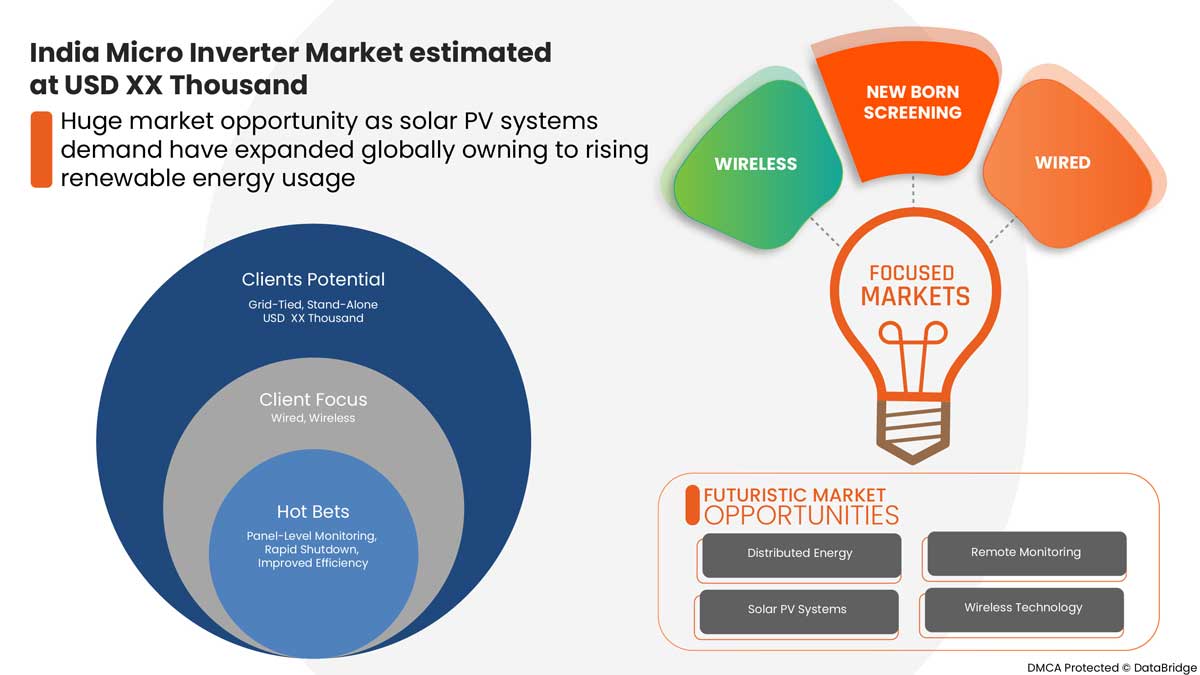
Data Bridge Market Research analyses that the India micro inverter market is expected to reach the value of USD 530,969.11 thousand by 2029, at a CAGR of 16.1% during the forecast period. The micro inverter market report also covers pricing analysis, patent analysis, and technological advancements in depth.
|
Report Metric |
Details |
|
Forecast Period |
2022 to 2029 |
|
Base Year |
2021 |
|
Historic Years |
2020 |
|
Quantitative Units |
Revenue in USD Thousand, Volumes in Units, Pricing in USD |
|
Segments Covered |
By Connection Type (Stand-Alone, Grid-Tied), Utility (Rapid Shutdown, Panel-Level Monitoring, System Expansion Ease, Multiple Angel Installation, Higher Durability, Others (IP67 Rated Protection, Electricity)), Type (Single Phase, Three Phase), Offering (Hardware, Software, Services), Communication Technology (Wired, Wireless), Power Rating (Below 250 W, Between 251 W & 500 W, Above 500 W) Sales Channel (Direct Channel, Indirect Channel), Industry (Residential, Commercial, PV Power Plants) |
|
Countries Covered |
India |
|
Market Players Covered |
Infineon Technologies AG, Fchoice Solar Tech India Pvt Ltd, Nordic (India) Solutions Pvt. Ltd, SunSights Solar, U R Energy, Enphase Energy, 360 Power Products, gracerenew.com, Sun Sine Solution Private Limited, Texas Instruments Incorporated, SuratExim, Waaree Energies Ltd., SMA Solar Technology AG, and P2 Power Solutions Pvt. Ltd among others. |
Market Definition
A solar micro inverter is plug-and-play equipment that transforms direct current generated by a single module to alternating current in photovoltaic installations. Micro inverters, unlike conventional central inverters, operate on module level power electronics (MLPE), which involves power conversion at the module level. As a result, the negative impacts of module mismatch are reduced, and the system's overall efficiency is improved. Micro inverters also provide module level monitoring, increased design flexibility, quicker installation, and improved safety over traditional inverters. Module-level power electronics, which use maximum power point tracking and micro inverters and power optimizers, give significant efficiency above conventional systems (MPPT). As a result, each module's production is maximized, and the whole system is more efficient.
India Micro Inverter Market Dynamics
This section deals with understanding the market drivers, advantages, opportunities, restraints and challenges. All of this is discussed in detail as below:
Drivers
- Rise in demand of renewable energy across the sector
Renewable energy is produced from natural sources or from renewable resources that are constantly replenished. India is third-largest consumer of electricity in the world after U.S. and China. The increasing demand for electricity is forcing India to search for new ways, especially renewable, to produce energy due to which India is constantly investing and developing its renewable energy sector. The lack of an electricity grid in a rural area of India and all the government initiatives to attract more consumers for renewable energy offers a chance to local manufacturers to provide solar panels for many applications. Thus, the growth in the renewable energy sector in India will boost the micro inverter market significantly.
- Increase in installations of solar products such as solar panels across the country
Over the years, the number of solar photovoltaic installations has increased exponentially across the globe. According to the International Energy Agency (IEA) roadmap, solar PV capacity is expected to reach 4,600 GW by 2050, amounting to 16% of the global electricity production. As per IRENA (International Renewable Energy Agency), India’s total gross power capacity will more than double from 284 gigawatts (GW) in 2015 to an estimated 670 GW by 2030, while electricity generation more than triples from 1100 terawatt-hours (TWh) per year to over 3450 TWh per year. Renewable power will maintain its strong growth in the Indian market reaching 35% share of generation and 60% share of power generation capacity. This shows that the there is a rising demand for solar energy and as micro inverters are connected to each solar panel, the demand for it is likely to increase in the nearby future.
Opportunities
- The integrated structure of micro inverter is proving opportunities for many market players
Embedded micro inverters can fully be integrated into the junction box of a module to create a more reliable and cheaper AC module. This, in turn, offers major cost advantage to customers, which replaces conventional junction box arrangement. Moreover, this technology is being incorporated by DC optimizer manufacturers to develop embedded mobiles that are called smart modules.
Moreover, since micro-inverters are not exposed to as high power and heat loads as central inverter, therefore they last significantly longer compare to other types. In addition, micro-inverters typically come with a warranty of 20-25 years to 10-15 years longer than central inverters. As micro inverters are very small in size, so they fit easily in the back of a solar panel. Because of its compact and small size, one doesn’t need to have separate cooling as central inverters.
Restraints/Challenges
- Higher dependence on conventional sources of energy for electricity generation
Conventional energy sources are natural energy resources such as natural gas, oil, coal, and nuclear. These are sources of energy used for since the industrial revolution and the dependency on these sources is too high as the infrastructure needed to generate electricity using these resources has already been built and in use. These infrastructures were made with high capital investments by the government and businesses and has taken decades to build. The time and capital needed to build infrastructure for non-conventional sources is high and technology is not reliable to generate the same capacity of energy as conventional sources. This high dependency on conventional source for electricity generation is being acting as blockage for the transition from conventional source to clean source of energy.
- Complicated design structure of micro inverter
Micro inverter technologies are becoming increasingly popular as a choice of grid connection for small-scale photovoltaic systems are required to harvest direct current (DC) electrical energy from PV modules and convert it to alternating Current (AC). Micro inverter consists of many hardware components such as fly back converter, switches, filter and other electronics components. In any PV (Photovoltaics) system, multiple solar modules are connected in series and parallel to provide voltage output. Combinations of these panels are then connected to a single centralized inverter to yield certain power modules. As each inverter is independently located below a solar panel, a communication bus and a common monitoring system is required as there is on board display system like in string inverters. Hence, the complicated design structure of micro inverter is imposing a challenge for the market to grow.
Post-COVID-19 Impact on India Micro Inverter Market
COVID-19 created a major impact on the micro inverter market as almost every country opted for the shutdown of every production facility except the ones dealing in producing the essential goods. The production of micro inverter system got hampered during lockdown. In post lockdown scenario, the growth of India micro inverter market is attributed to the increasing adoption of solar PV systems and technologies across all regions and countries. India's increasing renewable energy demand is major factor that contribute to the growth of the India micro inverter market.
Manufacturers & solution providers are making various strategic decisions to bounce back post-COVID-19. The players are conducting multiple research and development activities to improve the technology involved in the micro inverter. With this, the companies will bring advanced technologies to the market. In addition, government initiatives related to smart energy system has led to the market's growth
Recent Developments
- In February 2022, Waaree Energies Ltd.’s subsidiary Waaree Renewable Technologies Limited awarded with the 180 MW DC solar power plant project in Tamil Nadu, India. The scope of this project includes engineering, procurement and construction (EPC) services of the solar plant
- In April 2021, Enphase Energy and IBC SOLAR had partnered together to offer their customers even more options for quick and easy solar system planning and installation
India Micro Inverter Market Scope
The India micro inverter market is segmented on the basis of connection type, utility, type, offering, communication technology, power rating, sales channel, and industry. The growth amongst these segments will help you analyse major growth segments in the industries and provide the users with a valuable market overview and market insights to help them make strategic decisions for identifying core market applications.
Connection Type
- Stand-Alone
- Grid-Tied
On the basis of connection type, the India micro inverter market is segmented into stand-alone, grid-tied.
Utility
- Rapid Shutdown
- Panel-Level Monitoring
- System Expansion Ease
- Multiple Angel Installation
- Higher Durability
- Others (IP67 Rated Protection, Electricity)
On the basis of utility, the India micro inverter market has been segmented into rapid shutdown, panel-level monitoring, system expansion ease, multiple angel installation, higher durability, others IP67 rated protection, electricity).
Type
- Single Phase
- Three Phase
On the basis of type, the India micro inverter market has been segmented into single phase, three phase.
Offering
- Hardware
- Software
- Services
On the basis of offering, the India micro inverter market has been segmented into hardware, software, services.
Communication Technology
- Wired
- Wireless
On the basis of communication technology, the India micro inverter market has been segmented into wired, wireless.
Power Rating
- Below 250 W
- Between 251 W & 500 W
- Above 500 W
On the basis of power rating, the India micro inverter market has been segmented into below 250 W, between 251 W & 500 W, above 500 W.
. Sales Channel
- Direct Channel
- Indirect Channel
On the basis of sales channel, the India micro inverter market is segmented into direct channel, indirect channel.
Industry
- Residential
- Commercial
- PV Power Plants
On the basis of industry, the India micro inverter market has been segmented into residential, commercial, PV power plants.
Competitive Landscape and India Micro Inverter Market Share Analysis
The India micro inverter market competitive landscape provides details by the competitor. Details included are company overview, company financials, revenue generated, market potential, investment in research and development, new market initiatives, India presence, production sites and facilities, production capacities, company strengths and weaknesses, product launch, product width and breadth, application dominance. The above data points provided are only related to the companies' focus related to India micro inverter market.
Some of the major players operating in the India micro inverter market are Infineon Technologies AG, Fchoice Solar Tech India Pvt Ltd, Nordic (India) Solutions Pvt. Ltd, SunSights Solar, U R Energy, Enphase Energy, 360 Power Products, gracerenew.com, Sun Sine Solution Private Limited, Texas Instruments Incorporated, SuratExim, Waaree Energies Ltd., SMA Solar Technology AG, and P2 Power Solutions Pvt. Ltd among others.
SKU-
Obtenha acesso online ao relatório sobre a primeira nuvem de inteligência de mercado do mundo

- Painel interativo de análise de dados
- Painel de análise da empresa para oportunidades de elevado potencial de crescimento
- Acesso de analista de pesquisa para personalização e customização. consultas
- Análise da concorrência com painel interativo
- Últimas notícias, atualizações e atualizações Análise de tendências
- Aproveite o poder da análise de benchmark para um rastreio abrangente da concorrência
Metodologia de Investigação
A recolha de dados e a análise do ano base são feitas através de módulos de recolha de dados com amostras grandes. A etapa inclui a obtenção de informações de mercado ou dados relacionados através de diversas fontes e estratégias. Inclui examinar e planear antecipadamente todos os dados adquiridos no passado. Da mesma forma, envolve o exame de inconsistências de informação observadas em diferentes fontes de informação. Os dados de mercado são analisados e estimados utilizando modelos estatísticos e coerentes de mercado. Além disso, a análise da quota de mercado e a análise das principais tendências são os principais fatores de sucesso no relatório de mercado. Para saber mais, solicite uma chamada de analista ou abra a sua consulta.
A principal metodologia de investigação utilizada pela equipa de investigação do DBMR é a triangulação de dados que envolve a mineração de dados, a análise do impacto das variáveis de dados no mercado e a validação primária (especialista do setor). Os modelos de dados incluem grelha de posicionamento de fornecedores, análise da linha de tempo do mercado, visão geral e guia de mercado, grelha de posicionamento da empresa, análise de patentes, análise de preços, análise da quota de mercado da empresa, normas de medição, análise global versus regional e de participação dos fornecedores. Para saber mais sobre a metodologia de investigação, faça uma consulta para falar com os nossos especialistas do setor.
Personalização disponível
A Data Bridge Market Research é líder em investigação formativa avançada. Orgulhamo-nos de servir os nossos clientes novos e existentes com dados e análises que correspondem e atendem aos seus objetivos. O relatório pode ser personalizado para incluir análise de tendências de preços de marcas-alvo, compreensão do mercado para países adicionais (solicite a lista de países), dados de resultados de ensaios clínicos, revisão de literatura, mercado remodelado e análise de base de produtos . A análise de mercado dos concorrentes-alvo pode ser analisada desde análises baseadas em tecnologia até estratégias de carteira de mercado. Podemos adicionar quantos concorrentes necessitar de dados no formato e estilo de dados que procura. A nossa equipa de analistas também pode fornecer dados em tabelas dinâmicas de ficheiros Excel em bruto (livro de factos) ou pode ajudá-lo a criar apresentações a partir dos conjuntos de dados disponíveis no relatório.











