


Middle East and Africa PH Sensors Market, By Type (Process Sensors, Differential Sensors, Combination PH Sensors and Laboratory Sensors), Component (Hardware and Services), Product Type (Digital and Analog), System Type (Benchtop and Portable), Vertical (Water and Wastewater Industry, Chemical Industry, Oil and Gas Industry, Food and Beverages Industry, Medical & pharmaceutical Industry, Paper Industry, Metal and Mining Industry, Agriculture Industry and Others) - Industry Trends & Forecast to 2030.
Middle East and Africa PH Sensors Market Analysis and Size
The Middle East and Africa PH sensors market is segmented on the basis of type, component, product type, system type and vertical. The growth among segments helps you analyze niche pockets of growth and strategies to approach the market and determine your core application areas and the difference in your target markets.
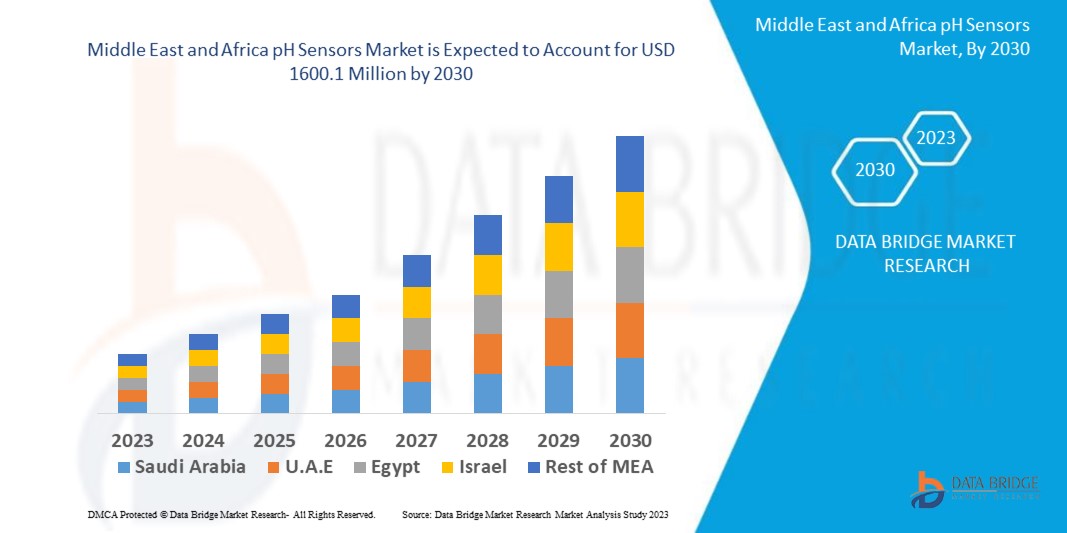
Data Bridge Market Research analyses that the Middle East and Africa PH Sensors market which was USD 801.20 million in 2021, would rocket up to USD 1600.1 million by 2030, and is expected to undergo a CAGR of 14.7% during the forecast period. This indicates the market value. “Process Sensors” dominates the type segment of the Middle East and Africa PH Sensors market due The process sensors segment in the PH sensor market typically caters to industries such as chemical, pharmaceutical, food and beverage, water and wastewater treatment, and oil and gas. These industries require accurate and reliable PH measurement for various processes, quality control, and regulatory compliance. The demand for process sensors in these industrial applications can contribute to their dominance in the Middle East and Africa PH sensor market. In addition to the insights on market scenarios such as market value, growth rate, segmentation, geographical coverage, and major players, the market reports curated by the Data Bridge Market Research also include in-depth expert analysis, geographically represented company-wise production and capacity, network layouts of distributors and partners, detailed and updated price trend analysis and deficit analysis of supply chain and demand.
Middle East and Africa PH Sensors Market Scope and Segmentation
|
Report Metric |
Details |
|
Forecast Period |
2023 to 2030 |
|
Base Year |
2022 |
|
Historic Years |
2021(Customizable to 2015-2020) |
|
Quantitative Units |
Revenue in USD Million, Volumes in Units, Pricing in USD |
|
Segments Covered |
Type (Process Sensors, Differential Sensors, Combination PH Sensors and Laboratory Sensors), Component (Hardware and Services), Product Type (Digital and Analog), System Type (Benchtop and Portable), Vertical (Water and Wastewater Industry, Chemical Industry, Oil and Gas Industry, Food and Beverages Industry, Medical & pharmaceutical Industry, Paper Industry, Metal and Mining Industry, Agriculture Industry and Others) |
|
Countries Covered |
South Africa, Saudi Arabia, U.A.E., Israel, Egypt and rest of Middle East and Africa |
|
Market Players Covered |
Memosens (Egypt), GIMPEX (Egypt), ABDOS Labtech Private Limited (India), Pardis Fanavar Engineering Company (Iran), Arad Technologies (Israel), YSI, a Xylem brand (South Africa), GHM Messtechnik GmbH (South Africa), MASAR Technologies (Saudi Arabia), Scientronics (South Africa), Lemis Process (South Africa), Technews Industry Guide (South Africa), W&L Tech (South Africa), Prisma Instruments (Tunisia), Sensus (United Arab Emirates), Al Nab'a Equipment & Supplies LLC (Oman) |
|
Market Opportunities |
|
Market Definition
The Middle East and Africa PH sensor market refers to the market for pH sensors, also known as pH probes or pH electrodes, in the Middle East and Africa region. PH sensors are devices used to measure the acidity or alkalinity of a solution by measuring its hydrogen ion concentration. These sensors are widely used in various industries such as chemical, pharmaceutical, food and beverage, water and wastewater treatment, agriculture, and environmental monitoring. The Middle East and Africa PH sensor market encompasses the production, distribution, and sale of pH sensors and related products, including pH meters, transmitters, and controllers. It includes both local and global manufacturers, suppliers, and distributors operating in the region. The market also includes various end-users and industries that require pH measurement and control for process optimization, quality assurance, and regulatory compliance.
Middle East and Africa PH Sensors Market Dynamics
Drivers
- Industrial Growth and Infrastructure Development
The Middle East and Africa region has been experiencing significant industrial growth and infrastructure development. This includes the establishment of manufacturing facilities, chemical plants, refineries, and power generation facilities. The increasing industrial activities drive the demand for PH sensors to monitor and control PH levels in various processes, ensuring product quality, efficiency, and regulatory compliance.
- Water and Wastewater Treatment Needs
The Middle East and Africa face challenges related to water scarcity and the need for effective water and wastewater treatment solutions. PH sensors play a crucial role in monitoring and controlling PH levels in water treatment processes, ensuring the quality and safety of drinking water and wastewater discharge. The growing focus on sustainable water management and regulatory requirements drives the adoption of PH sensors in the region.
- Technological Advancements and Automation
The Middle East and Africa are embracing technological advancements and automation in various industries. PH sensors are integrated into automated systems and processes to enable real-time monitoring, data collection, and control. The adoption of Industry 4.0 concepts, such as smart factories and digitalization, drives the demand for PH sensors to support efficient and automated operations.
Opportunities
- Environmental Monitoring And Pollution Control
Environmental monitoring and pollution control are becoming increasingly important in the Middle East and Africa. PH sensors play a vital role in monitoring the acidity or alkalinity of water bodies, soil, and air. With the focus on sustainable development and environmental conservation, there is a growing need for accurate and reliable PH sensors to assess and manage environmental impacts effectively.
Restraints
- High Costs of PH Sensors
Cost is a significant factor influencing the adoption of PH sensors. Some industries or businesses in the Middle East and Africa region may face budget constraints and prioritize cost-effective solutions over advanced and expensive PH sensor technologies. The affordability factor can slow down market growth, especially in price-sensitive industries.
Challenges
- Limited Technological Infrastructure
Some countries in the Middle East and Africa may have limited technological infrastructure, including access to reliable power supply, internet connectivity, and advanced communication networks. These infrastructure limitations can hinder the adoption and implementation of PH sensor systems, which often rely on robust technological infrastructure for data transmission and real-time monitoring.
This Middle East and Africa PH sensors market report provide details of new recent developments, trade regulations, import-export analysis, production analysis, value chain optimization, market share, the impact of domestic and localized market players, analyses opportunities in terms of emerging revenue pockets, changes in market regulations, strategic market growth analysis, market size, category market growths, application niches and dominance, product approvals, product launches, geographic expansions, technological innovations in the market. To gain more info on the variable frequency drive market contact Data Bridge Market Research for an Analyst Brief, our team will help you make an informed market decision to achieve market growth.
Recent Developments
- In April 2022, ANB Sensors has developed breakthrough calibration-free pH sensors for water quality monitoring in aquaculture operations. These cost-effective, robust, and low-maintenance sensors offer accurate real-time monitoring, easy integration with data platforms and can be used as standalone devices or integrated with multi-parameter units, addressing the needs of modern, data-driven aquaculture.
- In November 2020, Endress+Hauser launched the Liquiline Mobile CML18 handheld device and Memosens CPL51E lab pH sensor, providing easy and reliable monitoring of critical measured values in both lab and field applications. The device uses the same Memosens sensors as the process sensors, ensuring consistent data between lab and process measurements, while the CPL51E sensor offers fast response times for lab analysis. The SmartBlue app allows for intuitive operation, data viewing, and adjustment, and the device supports inductive charging and data logging for convenient usage. The Memosens technology ensures maximum data security and resilience to environmental influences.
Middle East and Africa PH Sensors Market Scope
The Middle East and Africa PH sensors market is segmented on the basis of type, component, product type, system type and vertical. The growth amongst these segments will help you analyse meagre growth segments in the industries and provide the users with a valuable market overview and market insights to help them make strategic decisions for identifying core market applications.
Type
- Process Sensors
- Differential Sensors
- Combination PH Sensors
- Laboratory Sensors
Component
- Hardware
- Services
Product Type
- Digital
- Analog
System Type
- Benchtop
- Portable
Vertical
- Water and Wastewater Industry
- Chemical Industry
- Oil and Gas Industry
- Food and Beverages Industry
- Medical & Pharmaceutical Industry
- Paper Industry
- Metal and Mining Industry
- Agriculture Industry
- Others
Middle East and Africa PH Sensors Market Country Analysis/Insights
The Middle East and Africa PH sensors market is analysed, and market size insights and trends are provided by country, type, component, product type, system type and vertical, as referenced above.
The country covered in the Middle East and Africa PH sensors market report is South Africa, Saudi Arabia, U.A.E., Israel, Egypt and rest of Middle East and Africa.
Saudi Arabia is expected to dominate the Middle East and Africa PH sensors market industrial development, government initiatives, investment climate, and market competition. It is recommended to refer to the latest market reports and industry analysis or consult with market research firms to obtain accurate and up-to-date information on the current market dynamics and the dominant players in the Middle East and Africa PH Sensors market. U.A.E. is the fastest growing country in the Middle East and Africa PH Sensors market due to the factors that can contribute to the growth of the PH Sensors market in a country, including industrial expansion, increasing awareness about water and environmental monitoring, government regulations, and the adoption of advanced technologies. It is important to refer to the latest market reports and industry analysis or consult with market research firms to obtain the most accurate and up-to-date information on the growth of the PH Sensors market in the UAE or any other country in the Middle East and Africa region.
The country section of the report also provides individual market-impacting factors and changes in regulation in the market domestically that impact the current and future trends of the market. Data points like downstream and upstream value chain analysis, technical trends, and Porter’s five forces analysis, case studies are some of the pointers used to forecast the market scenario for individual countries. Also, the presence and availability of Middle East and Africa brands and the challenges faced due to large or scarce competition from local and domestic brands, the impact of domestic tariffs, and trade routes are considered while providing forecast analysis of the country data.
In addition to the market insights such as market value, growth rate, market segments, geographical coverage, market players, and market scenario, the market report curated by the Data Bridge Market Research team includes in-depth expert analysis, import/export analysis, pricing analysis, production consumption analysis, and pestle analysis.
Competitive Landscape and Middle East and Africa PH Sensors Market Share Analysis
The Middle East and Africa PH sensors market competitive landscape provides details of competitors. Details included are company overview, company financials, revenue generated, market potential, investment in research and development, new market initiatives, Middle East and Africa presence, production sites and facilities, production capacities, company strengths and weaknesses, product launch, product width and breadth, and application dominance. The above data points provided are only related to the companies' focus related to the Middle East and Africa PH sensors market.
Some of the major players operating in the Middle East and Africa PH sensors market are:
- Memosens (Egypt)
- GIMPEX (Egypt)
- ABDOS Labtech Private Limited (India)
- Pardis Fanavar Engineering Company (Iran)
- Arad Technologies (Israel)
- YSI, a Xylem brand (South Africa)
- GHM Messtechnik GmbH (South Africa)
- MASAR Technologies (Saudi Arabia)
- Scientronics (South Africa)
- Lemis Process (South Africa)
- Technews Industry Guide (South Africa)
- W&L Tech (South Africa)
- Prisma Instruments (Tunisia)
- Sensus (United Arab Emirates)
- Al Nab'a Equipment & Supplies LLC (Oman)
SKU-
Obtenha acesso online ao relatório sobre a primeira nuvem de inteligência de mercado do mundo

- Painel interativo de análise de dados
- Painel de análise da empresa para oportunidades de elevado potencial de crescimento
- Acesso de analista de pesquisa para personalização e customização. consultas
- Análise da concorrência com painel interativo
- Últimas notícias, atualizações e atualizações Análise de tendências
- Aproveite o poder da análise de benchmark para um rastreio abrangente da concorrência
Metodologia de Investigação
A recolha de dados e a análise do ano base são feitas através de módulos de recolha de dados com amostras grandes. A etapa inclui a obtenção de informações de mercado ou dados relacionados através de diversas fontes e estratégias. Inclui examinar e planear antecipadamente todos os dados adquiridos no passado. Da mesma forma, envolve o exame de inconsistências de informação observadas em diferentes fontes de informação. Os dados de mercado são analisados e estimados utilizando modelos estatísticos e coerentes de mercado. Além disso, a análise da quota de mercado e a análise das principais tendências são os principais fatores de sucesso no relatório de mercado. Para saber mais, solicite uma chamada de analista ou abra a sua consulta.
A principal metodologia de investigação utilizada pela equipa de investigação do DBMR é a triangulação de dados que envolve a mineração de dados, a análise do impacto das variáveis de dados no mercado e a validação primária (especialista do setor). Os modelos de dados incluem grelha de posicionamento de fornecedores, análise da linha de tempo do mercado, visão geral e guia de mercado, grelha de posicionamento da empresa, análise de patentes, análise de preços, análise da quota de mercado da empresa, normas de medição, análise global versus regional e de participação dos fornecedores. Para saber mais sobre a metodologia de investigação, faça uma consulta para falar com os nossos especialistas do setor.
Personalização disponível
A Data Bridge Market Research é líder em investigação formativa avançada. Orgulhamo-nos de servir os nossos clientes novos e existentes com dados e análises que correspondem e atendem aos seus objetivos. O relatório pode ser personalizado para incluir análise de tendências de preços de marcas-alvo, compreensão do mercado para países adicionais (solicite a lista de países), dados de resultados de ensaios clínicos, revisão de literatura, mercado remodelado e análise de base de produtos . A análise de mercado dos concorrentes-alvo pode ser analisada desde análises baseadas em tecnologia até estratégias de carteira de mercado. Podemos adicionar quantos concorrentes necessitar de dados no formato e estilo de dados que procura. A nossa equipa de analistas também pode fornecer dados em tabelas dinâmicas de ficheiros Excel em bruto (livro de factos) ou pode ajudá-lo a criar apresentações a partir dos conjuntos de dados disponíveis no relatório.











