


Middle East and Africa Reverse Logistics Market, By Return Type (Returns, Returns Avoidance, Remanufacturing, Refurbishing, Packaging, Unsold Goods, End-Of-Life, Delivery Failure, Rentals & Leasing, Repairs & Maintenance, and Others), Components (Return Policy and Procedure (RPP), Remanufacturing or Refurbishment (ROR), and Waste Disposal (WAD)), Service Type (Transportation, Warehousing, Reselling, Replacement Management, Refund Management Authorization, and Others), End-User (Textile and Garments, Automotive, Consumer Electronics, E-Commerce, Retail, Luxury Goods, Pharmaceutical, Reusable Packaging, and Others), Country (South Africa, Egypt, Saudi Arabia, U.A.E, Israel, Rest of the Middle East and Africa), Industry Trends and Forecast to 2029.
Market Analysis and Insights : Middle East and Africa Reverse Logistics Market
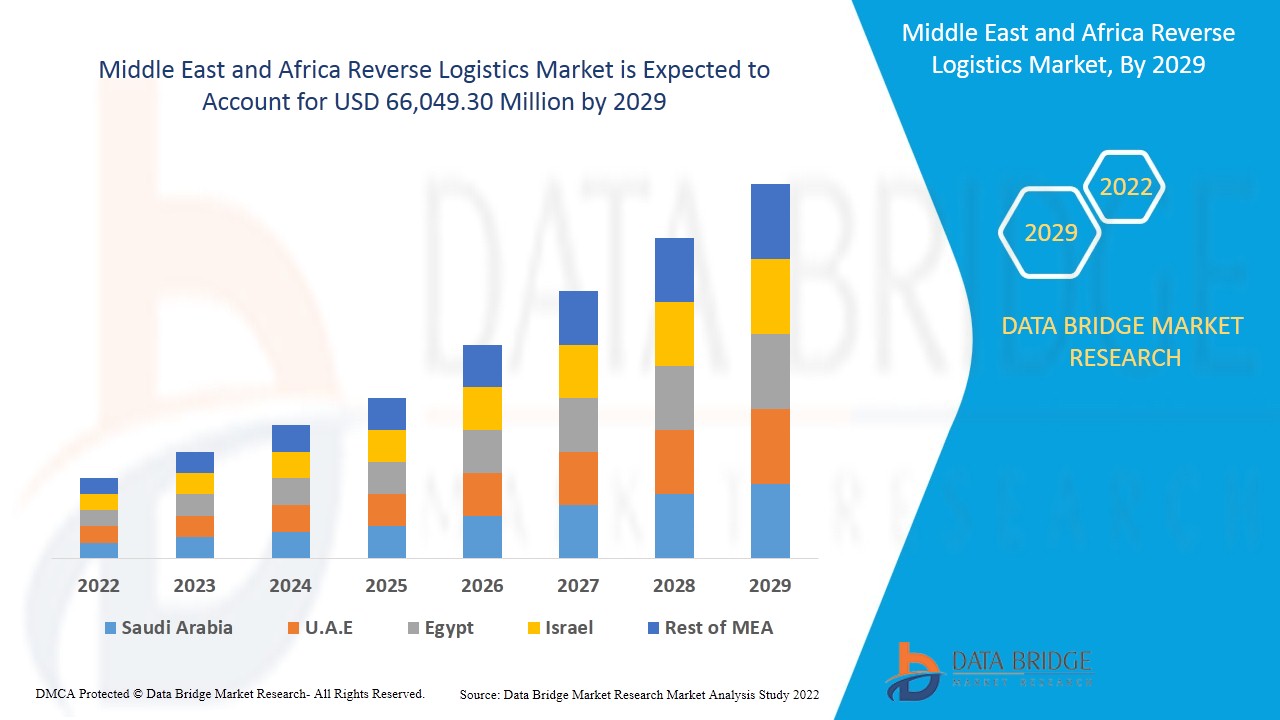
Middle East and Africa reverse logistics market is expected to gain market growth in the forecast period of 2022 to 2029. Data Bridge Market Research analyses that the market is growing with a CAGR of 4.2% in the forecast period of 2022 to 2029 and is expected to reach USD 66,049.30 million by 2029. Increased adoption of smartphones and online shopping is expected to drive the market's growth.
Reverse logistics is a type of supply chain management that various organizations follow in order to move goods/products from customers back to the sellers/manufacturers in an organized and safe manner. Once a customer receives a product, the processes in which the customer wishes to return or recycle the product comes under reverse logistics. Reverse logistics start at the end of the consumer, moving backward through the supply chain of the distribution management to the distributor and from the distributor to the product's manufacturer. Reverse logistics can also include processes where it is responsible for the final disposal of the product, including recycling or resale of the product. Fundamentals steps involved in reverse logistics management process the return, deal with returns, keep returns moving, repair, and recycle.
The major factors driving the growth of the reverse logistics market are rising growth in cross-border trades, globalization, and rapid growth in the e-commerce sector. However, the high cost associated with reverse logistics may act as a major restraint for the reverse logistics market.
The growing inclination towards digitization of the sector is creating opportunities for the growth of the market. On the other hand, inadequate labor resources to handle returns may act as a major challenge for the market's growth.
Middle East and Africa reverse logistics market report provides details of market share, new developments, and product pipeline analysis, the impact of domestic and localized market players, analyses opportunities in terms of emerging revenue pockets, changes in market regulations, product approvals, strategic decisions, product launches, geographic expansions, and technological innovations in the market. To understand the analysis and the market scenario, contact us for an Analyst Brief. Our team will help you create a revenue impact solution to achieve your desired goal.
Middle East and Africa Reverse Logistics Market Scope and Market Size
Middle East and Africa reverse logistics market is segmented on the basis of the return type, components, service type, and end-user. The growth among segments helps you analyze niche pockets of growth and strategies to approach the market and determine your core application areas and the difference in your target markets.
- On the basis of the return type, the Middle East and Africa reverse logistics market is segmented into returns, returns avoidance, remanufacturing, refurbishing, packaging, unsold goods, end-of-life, delivery failure, rentals & leasing, repairs & maintenance, others. In 2022, the returns segment is expected to dominate the market, as the return is the initial and crucial step of reverse logistics. Moreover, returns in reverse logistics improve customer service as well as help to boost profits by repurposing products that are returned.
- On the basis of components, the Middle East and Africa reverse logistics market is segmented into return policy and procedure (RPP), remanufacturing or refurbishment (ROR), and waste disposal (WAD). In 2022, the return policy and procedure (RPP) segment is expected to dominate the market, as the return policy and procedure cover the aspects of handling returns.
- On the basis of service type, the Middle East and Africa reverse logistics market is segmented into transportation, warehousing, reselling, replacement management, refund management authorization, others. In 2022, transportation is expected to dominate the market, as transportation is the key element of any logistics supply chain system. Transportation is crucial and integral to reverse logistics from returns to reselling.
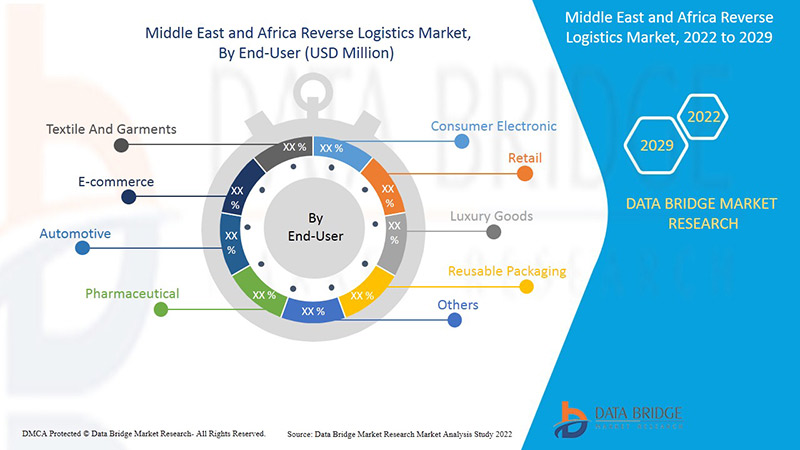
- On the basis of end-user, the Middle East and Africa reverse logistics market is segmented into textile and garments, E-commerce, automotive, pharmaceutical, consumer electronic, retail, luxury goods, reusable packaging, others. In 2022, the E-commerce segment is expected to dominate the market as the e-commerce industry has been growing exponentially in recent years, which also increases the number of returns worldwide. Moreover, the e-commerce industry has the highest rate of return around the globe.
Middle East and Africa Reverse Logistics Market Country Level Analysis
Middle East and Africa reverse logistics market is analyzed, and market size information is provided by return type, components, service type and end-user.
The countries covered in Middle East and Africa reverse logistics market report are South Africa, Egypt, Saudi Arabia, U.A.E, Israel, Rest of the Middle East and Africa.
U.A.E. is expected to dominate the Middle East and Africa reverse logistics market owing to various factors such as growing demand for recycling and sustainability driving innovation in reverse logistics chains and rising growth in cross-border trades and globalization.
The country section of the report also provides individual market impacting factors and changes in regulation in the market domestically that impact the current and future trends of the market. Data points such as new sales, replacement sales, country demographics, regulatory acts, and import-export tariffs are some of the major pointers used to forecast the market scenario for individual countries. Also, the presence and availability of the Middle East and Africa brands and their challenges faced due to large or scarce competition from local and domestic brands, the impact of sales channels are considered while providing forecast analysis of the country data.
Rising Demand of Reverse Logistics
Middle East and Africa reverse logistics market also provides you with detailed market analysis for every country's growth in the industry with sales, components sales, the impact of technological development reverse logistics, and changes in regulatory scenarios with their support for the reverse logistics market. The data is available for the historic period 2012 to 2020.
Competitive Landscape and Reverse logistics Market Share Analysis
Middle East and Africa reverse logistics market competitive landscape provide details by competitor. Details included are company overview, company financials, revenue generated, market potential, investment in research and development, new market initiatives, Middle East & Africa presence, production sites and facilities, company strengths and weaknesses, product launch, product trials pipelines, product approvals, patents, product width and breadth, application dominance, technology lifeline curve. The above data points provided are only related to the companies' focus related to the Middle East and Africa reverse logistics market.
Some of the major players covered in the report are FedEx, United Parcel Service of America, Inc., Deutsche Post DHL Group, C.H. Robinson Worldwide, Inc., Kintetsu World Express, Inc., IBM Corporation, Indev Group of companies, LogiNext Solutions Inc, Schenker AG, YUSEN LOGISTICS CO., LTD., among others. DBMR analysts understand competitive strengths and provide competitive analysis for each competitor separately. Many product developments are also initiated by companies worldwide, which are also accelerating the growth of Middle East and Africa the reverse logistics market.
For instance,
- In January 2022, FedEx entered into a partnership with Microsoft to develop a cross-platform logistics solution for e-commerce. This platform launch will ensure delivery and return of the product. The partnership will help both companies to ensure their market expansion
- In October 2021, C.H. Robinson Worldwide, Inc. and SPS Commerce, Inc. entered into a partnership to solve the logistic issues faced in the North American region. This partnership helped the retail industry to minimize logistic costs by 15% and reduce booking time. This has helped both the companies to expand their regional market
Partnership, contract, joint ventures, and other strategies enhance the company's market share with increased coverage and presence. It also provides the benefit for the organization to improve their offering for the reverse logistics market through an expanded range of sizes.
SKU-
Obtenha acesso online ao relatório sobre a primeira nuvem de inteligência de mercado do mundo

- Painel interativo de análise de dados
- Painel de análise da empresa para oportunidades de elevado potencial de crescimento
- Acesso de analista de pesquisa para personalização e customização. consultas
- Análise da concorrência com painel interativo
- Últimas notícias, atualizações e atualizações Análise de tendências
- Aproveite o poder da análise de benchmark para um rastreio abrangente da concorrência
Metodologia de Investigação
A recolha de dados e a análise do ano base são feitas através de módulos de recolha de dados com amostras grandes. A etapa inclui a obtenção de informações de mercado ou dados relacionados através de diversas fontes e estratégias. Inclui examinar e planear antecipadamente todos os dados adquiridos no passado. Da mesma forma, envolve o exame de inconsistências de informação observadas em diferentes fontes de informação. Os dados de mercado são analisados e estimados utilizando modelos estatísticos e coerentes de mercado. Além disso, a análise da quota de mercado e a análise das principais tendências são os principais fatores de sucesso no relatório de mercado. Para saber mais, solicite uma chamada de analista ou abra a sua consulta.
A principal metodologia de investigação utilizada pela equipa de investigação do DBMR é a triangulação de dados que envolve a mineração de dados, a análise do impacto das variáveis de dados no mercado e a validação primária (especialista do setor). Os modelos de dados incluem grelha de posicionamento de fornecedores, análise da linha de tempo do mercado, visão geral e guia de mercado, grelha de posicionamento da empresa, análise de patentes, análise de preços, análise da quota de mercado da empresa, normas de medição, análise global versus regional e de participação dos fornecedores. Para saber mais sobre a metodologia de investigação, faça uma consulta para falar com os nossos especialistas do setor.
Personalização disponível
A Data Bridge Market Research é líder em investigação formativa avançada. Orgulhamo-nos de servir os nossos clientes novos e existentes com dados e análises que correspondem e atendem aos seus objetivos. O relatório pode ser personalizado para incluir análise de tendências de preços de marcas-alvo, compreensão do mercado para países adicionais (solicite a lista de países), dados de resultados de ensaios clínicos, revisão de literatura, mercado remodelado e análise de base de produtos . A análise de mercado dos concorrentes-alvo pode ser analisada desde análises baseadas em tecnologia até estratégias de carteira de mercado. Podemos adicionar quantos concorrentes necessitar de dados no formato e estilo de dados que procura. A nossa equipa de analistas também pode fornecer dados em tabelas dinâmicas de ficheiros Excel em bruto (livro de factos) ou pode ajudá-lo a criar apresentações a partir dos conjuntos de dados disponíveis no relatório.











