


North America Electronic Components Market, By Component Type (Processors, Motors, Battery, Microcontroller, Integrated Circuits, Circuit Breakers, Transformer, Capacitors, Diodes, Resistors, Inductors, Relays, Switches, Fuse), Commodities Type (Brown Goods, White Goods, Small White Goods), Product Type (Active, Passive, Electromechanical Components), End-Use Type (Consumer Electronics, Networking and Telecommunication, Automotive, Manufacturing, Aerospace and Defense, Healthcare) - Industry Trends and Forecast to 2030.
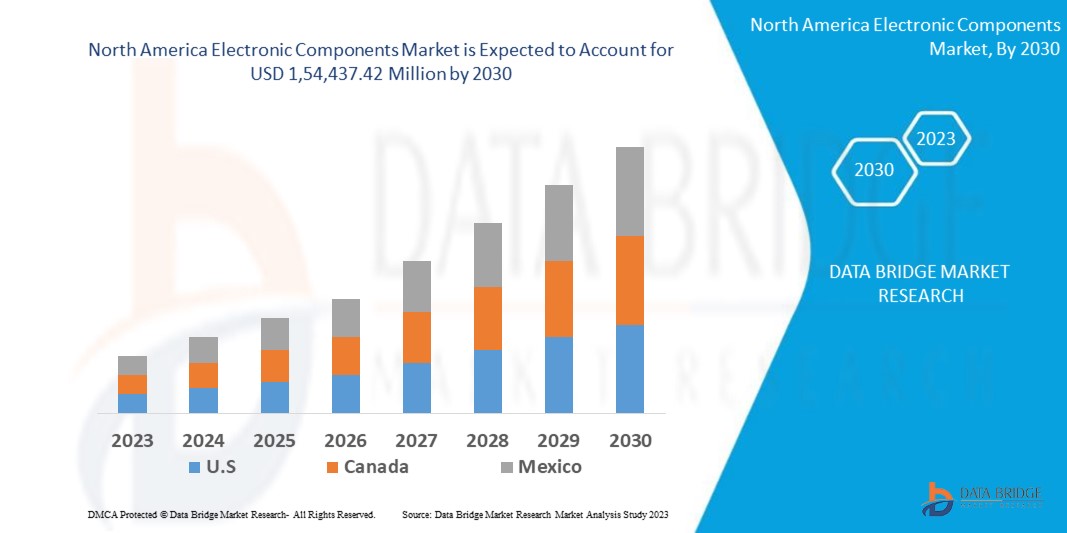
North America Electronic Components Market Analysis and Size
Increasing demand for smart and miniaturized electronic devices is the major driving factor in the market. Shortage in supply of electronic components can prove to be a challenge however increase in the usage of IoT devices prove to be an opportunity. The rise in metal prices hampers the overall component production costs which can be a restraint for the adoption of electronic components and the challenges faced due to the impact of Covid-19 on the supply chain of the raw materials.
North America electronic components market was valued at USD 83,903.86 million in 2022 and is expected to reach USD 1,54,437.42 million by 2030, registering a CAGR of 8.2 % during the forecast period of 2023 to 2030. “Active” dominates the electronics component market as these components can control and amplify electronic signals, enabling complex functionality, while passive components primarily provide resistance, capacitance, or inductance without active control, limiting their role in electronic circuitry. In addition to the insights on market scenarios such as market value, growth rate, segmentation, geographical coverage, and major players, the market reports curated by the Data Bridge Market Research also include in-depth expert analysis, geographically represented company-wise production and capacity, network layouts of distributors and partners, detailed and updated price trend analysis and deficit analysis of supply chain and demand.
North America Electronic Components Market Scope and Segmentation
|
Report Metric |
Details |
|
Forecast Period |
2023 to 2030S |
|
Base Year |
2022 |
|
Historic Years |
2021 (Customizable to 2015-2020) |
|
Quantitative Units |
Revenue in USD Million, Volumes in Units, Pricing in USD |
|
Segments Covered |
Component Type (Processors, Motors, Battery, Microcontroller, Integrated Circuits, Circuit Breakers, Transformer, Capacitors, Diodes, Resistors, Inductors, Relays, Switches, Fuse), Commodities Type (Brown Goods, White Goods, Small White Goods), Product Type (Active, Passive, Electromechanical Components), End-Use Type (Consumer Electronics, Networking and Telecommunication, Automotive, Manufacturing, Aerospace and Defense, Healthcare) |
|
Countries Covered |
U.S., Canada, Mexico |
|
Market Players Covered |
Intel Corporation (U.S.), Broadcom (U.S.), Advanced Micro Devices, Inc. (U.S.), Qualcomm Technologies, Inc. (U.S.), Infineon Technologies (Germany), NXP Semiconductors (Netherlands), KYOCERA Corporation (Japan), Texas Instruments Incorporated (U.S.) among others |
|
Market Opportunities |
|
Market Definition
Electronic components are basic building blocks of electronic circuit or electronic system. They control the flow of electron throughout the circuit. They consist of two or more terminals to connect with one another. These components are connected together in electronic board such as printed circuit board to form the electronic circuit. Active, passive and electromechanical are three major types of electronic components. Active components are those which possess the gain and can amplify or energize the electric signal. On the other hand, passive components do not possess gain and cannot amplify or energize the electric signal, they can only attenuate it.
North America Electronic Components Market Dynamics
Drivers
- Increasing Demand for Smart and Miniaturized Electronic Devices
The increasing demand for smart and miniaturized electronic devices is revolutionizing the tech industry. These compact gadgets, often equipped with powerful processing capabilities and wireless connectivity, are driving innovations in fields such as IoT, wearables, and consumer electronics. As consumers seek more portable and efficient solutions, manufacturers are focusing on creating smaller yet smarter devices to meet the evolving needs of the modern world.
- Technological Advancements in Electronic Components
Technological advancements in electronic components and products are driving rapid innovation and reshaping the way we live and work. These developments, such as smaller and more powerful microchips, improved displays, and enhanced connectivity, are enabling the creation of smarter, more efficient, and more capable electronic devices. As technology continues to evolve, we can anticipate even more groundbreaking electronic products that will transform industries and enhance our daily lives.
Opportunity
- Increase in the Usage of IoT Devices
The proliferation of IoT (internet of things) devices is reshaping our interconnected world. With their ability to collect, transmit, and analyze data in real-time, IoT devices are revolutionizing industries such as healthcare, transportation, agriculture, and manufacturing. As their adoption continues to surge, the transformative impact of IoT technology on our daily lives and businesses becomes increasingly evident.
Restraint/Challenge
- Shortage in the Supply of Electronic Components
On the other hand, the shortage in the supply of electronic components has emerged as a significant challenge for industries reliant on technology. With growing demand and disruptions in global supply chains, securing essential electronic components has become increasingly difficult. This shortage has repercussions across various sectors, impacting production schedules, delaying product launches, and driving up costs.
This electronic components market report provides details of new recent developments, trade regulations, import-export analysis, production analysis, value chain optimization, market share, the impact of domestic and localized market players, analyses opportunities in terms of emerging revenue pockets, changes in market regulations, strategic market growth analysis, market size, category market growths, application niches and dominance, product approvals, product launches, geographic expansions, technological innovations in the market. To gain more info on the electronic components market contact Data Bridge Market Research for an Analyst Brief, Our team will help you take an informed market decision to achieve market growth.
Recent Developments
- In September 2020, Advanced Micro Devices, Inc. Ryzen processors are included in chrome books. AMD announced its Ryzen processor series is joining the Chromebook family—Athlon, too. Both APUs (that means CPU and integrated graphics in non-AMD terms) include Radeon Vega integrated graphics and will be found mid-level to high-end Chromebooks with Athlon on the mid-level and Ryzen on the high-end, respectively. The current A6 and A4 series of AMD Chromebooks processors will be entry-level from here on out. This expansion with chrome book has made integrated graphics available at a low-cost processor
- In December 2019, Broadcom announced that it had delivered the StrataXGS Tomahawk 4 switch series, demonstrating an unprecedented 25.6 Terabits/sec of Ethernet switching performance in a single device— double the bandwidth of any other switch silicon. This enables the next generation of high-throughput, low latency hyper scale networks with 64 ports of 400GbE switching and routing. This collaboration supports the scaling requirements of modern data center networks. This provides the company with exponential growth in the market
North America Electronic Components Market Scope
North america electronic components market is segmented on the basis of components type, commodities type, product type, end-use type. The growth amongst these segments will help you analyse meagre growth segments in the industries and provide the users with a valuable market overview and market insights to help them make strategic decisions for identifying core market applications.
Component Type
- Processors
- Motors
- Battery
- Microcontroller
- Integrated Circuits
- Circuit Breakers
- Transformer
- Capacitors
- Diodes
- Resistors
- Inductors
- Relays
- Switches
- Fuse
Commodities Type
- Brown Goods
- White Goods
- Small White Goods
Product Type
- Active
- Passive
- Electromechanical Components
End-Use Type
- Consumer Electronics
- Networking and Telecommunication
- Automotive
- Manufacturing
- Aerospace and Defense
- Healthcare
North America Electronic Components Market Regional Analysis/Insights
North America electronic components market is analysed and market size insights and trends are provided by components type, commodities type, product type, end-use type as referenced above.
The countries covered in the North America electronic components market report are U.S., Canada, and Mexico in North America
U.S. dominates the electronic components market in North America as increase in research on new electronic technologies and technological advancement is boosting the market growth in the country.
The country section of the report also provides individual market-impacting factors and changes in regulation in the market domestically that impact the current and future trends of the market. Data points such as down-stream and up-stream value chain analysis, technical trends, and Porter’s five forces analysis, case studies are some of the pointers used to forecast the market scenario for individual countries. Also, the presence and availability of Europe brands and the challenges faced due to large or scarce competition from local and domestic brands, the impact of domestic tariffs, and trade routes are considered while providing forecast analysis of the country data.
Competitive Landscape and North America Electronic Components Market Share Analysis
North America electronic components market competitive landscape provides details by competitors. Details included are company overview, company financials, revenue generated, market potential, investment in research and development, new market initiatives, Europe presence, production sites and facilities, production capacities, company strengths and weaknesses, product launch, product width and breadth, and application dominance. The above data points provided are only related to the company's focus related to the North America electronic components market.
Some of the major players operating in the North America electronic components market are:
- Intel Corporation (U.S.)
- Broadcom (U.S.)
- Advanced Micro Devices, Inc. (U.S.)
- Qualcomm Technologies, Inc. (U.S.)
- Infineon Technologies (Germany)
- NXP Semiconductors (Netherlands)
- KYOCERA Corporation (Japan)
- Texas Instruments Incorporated (U.S.)
SKU-
Obtenha acesso online ao relatório sobre a primeira nuvem de inteligência de mercado do mundo

- Painel interativo de análise de dados
- Painel de análise da empresa para oportunidades de elevado potencial de crescimento
- Acesso de analista de pesquisa para personalização e customização. consultas
- Análise da concorrência com painel interativo
- Últimas notícias, atualizações e atualizações Análise de tendências
- Aproveite o poder da análise de benchmark para um rastreio abrangente da concorrência
Metodologia de Investigação
A recolha de dados e a análise do ano base são feitas através de módulos de recolha de dados com amostras grandes. A etapa inclui a obtenção de informações de mercado ou dados relacionados através de diversas fontes e estratégias. Inclui examinar e planear antecipadamente todos os dados adquiridos no passado. Da mesma forma, envolve o exame de inconsistências de informação observadas em diferentes fontes de informação. Os dados de mercado são analisados e estimados utilizando modelos estatísticos e coerentes de mercado. Além disso, a análise da quota de mercado e a análise das principais tendências são os principais fatores de sucesso no relatório de mercado. Para saber mais, solicite uma chamada de analista ou abra a sua consulta.
A principal metodologia de investigação utilizada pela equipa de investigação do DBMR é a triangulação de dados que envolve a mineração de dados, a análise do impacto das variáveis de dados no mercado e a validação primária (especialista do setor). Os modelos de dados incluem grelha de posicionamento de fornecedores, análise da linha de tempo do mercado, visão geral e guia de mercado, grelha de posicionamento da empresa, análise de patentes, análise de preços, análise da quota de mercado da empresa, normas de medição, análise global versus regional e de participação dos fornecedores. Para saber mais sobre a metodologia de investigação, faça uma consulta para falar com os nossos especialistas do setor.
Personalização disponível
A Data Bridge Market Research é líder em investigação formativa avançada. Orgulhamo-nos de servir os nossos clientes novos e existentes com dados e análises que correspondem e atendem aos seus objetivos. O relatório pode ser personalizado para incluir análise de tendências de preços de marcas-alvo, compreensão do mercado para países adicionais (solicite a lista de países), dados de resultados de ensaios clínicos, revisão de literatura, mercado remodelado e análise de base de produtos . A análise de mercado dos concorrentes-alvo pode ser analisada desde análises baseadas em tecnologia até estratégias de carteira de mercado. Podemos adicionar quantos concorrentes necessitar de dados no formato e estilo de dados que procura. A nossa equipa de analistas também pode fornecer dados em tabelas dinâmicas de ficheiros Excel em bruto (livro de factos) ou pode ajudá-lo a criar apresentações a partir dos conjuntos de dados disponíveis no relatório.











