


North America Heat Pump Market, By Type (Air-To-Water Heat Pump, Air-To-Air Heat Pump, Water Source Heat Pump, Ground Source Heat Pump, and Hybrid Heat Pump), Component (Hardware, and Services), Capacity (Up to 10 kW, 10 to 20 kW, 20 to 30 kW, and Above 30 kW), Power Source (Electric, and Others), Refrigerant Type (R410A, R134A, R717 (Ammonia), R407C, R600 and R600A, R744, and Others), Cycle Type (Vapor Compression, Transcritical, and Absorption), System Type (Air Source Heat Pumps, Geothermal Heat Pumps, and Others), Application (Residential, Commercial, Industrial) Industry Trends and Forecast to 2030.
North America Heat Pump Market Analysis and Size
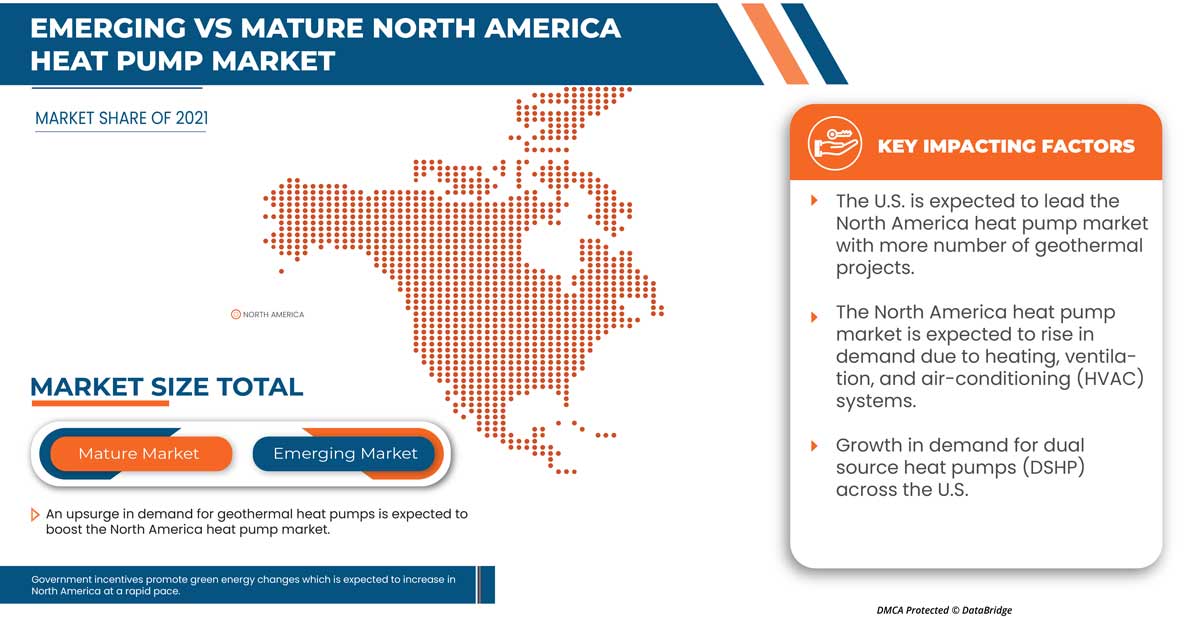
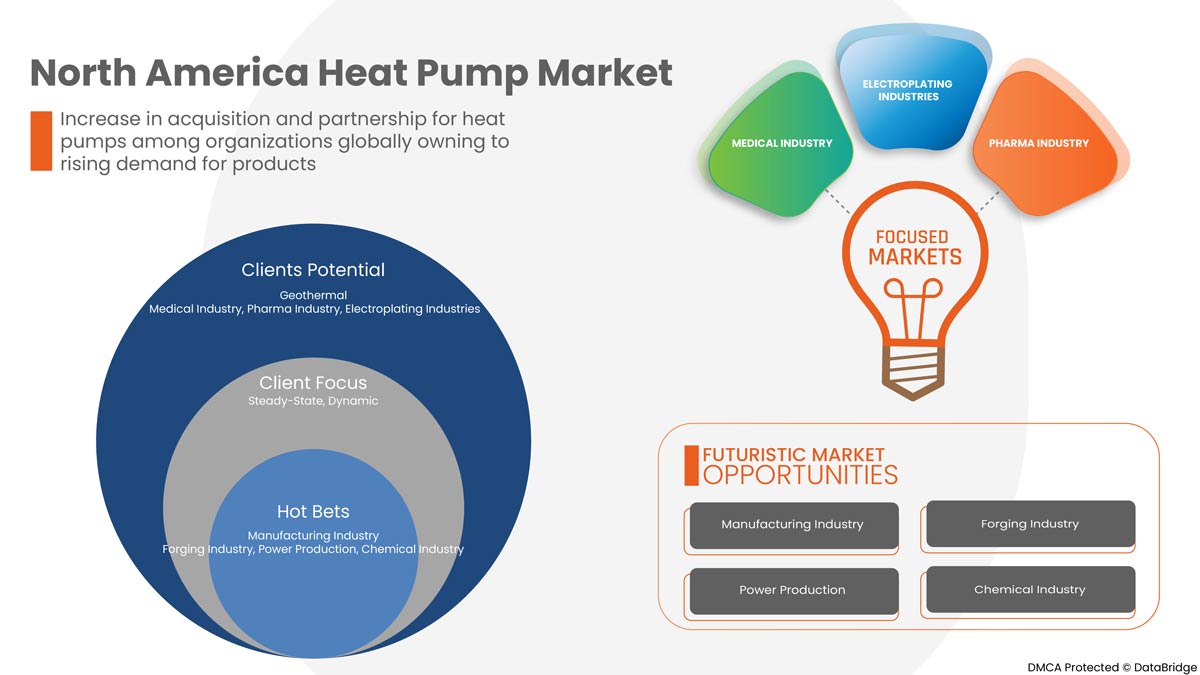
The North America heat pump market has witnessed growth due to the rising demand for heating, ventilation, and air-conditioning (HVAC) Systems. It can be used for numerous residential, commercial, and industrial applications in various industries such as general manufacturing, chemical and petroleum, food and beverages, utilities, textile and leather, wood products, metal, and others. The recent pandemic has slightly decreased growth across all sectors, but these systems have a huge potential to enhance industrial capabilities as these systems are the future. The North America heat pump market is in the rapid growth phase due to the growing demand for dual-source heat pumps (DSHP) across the U.S.
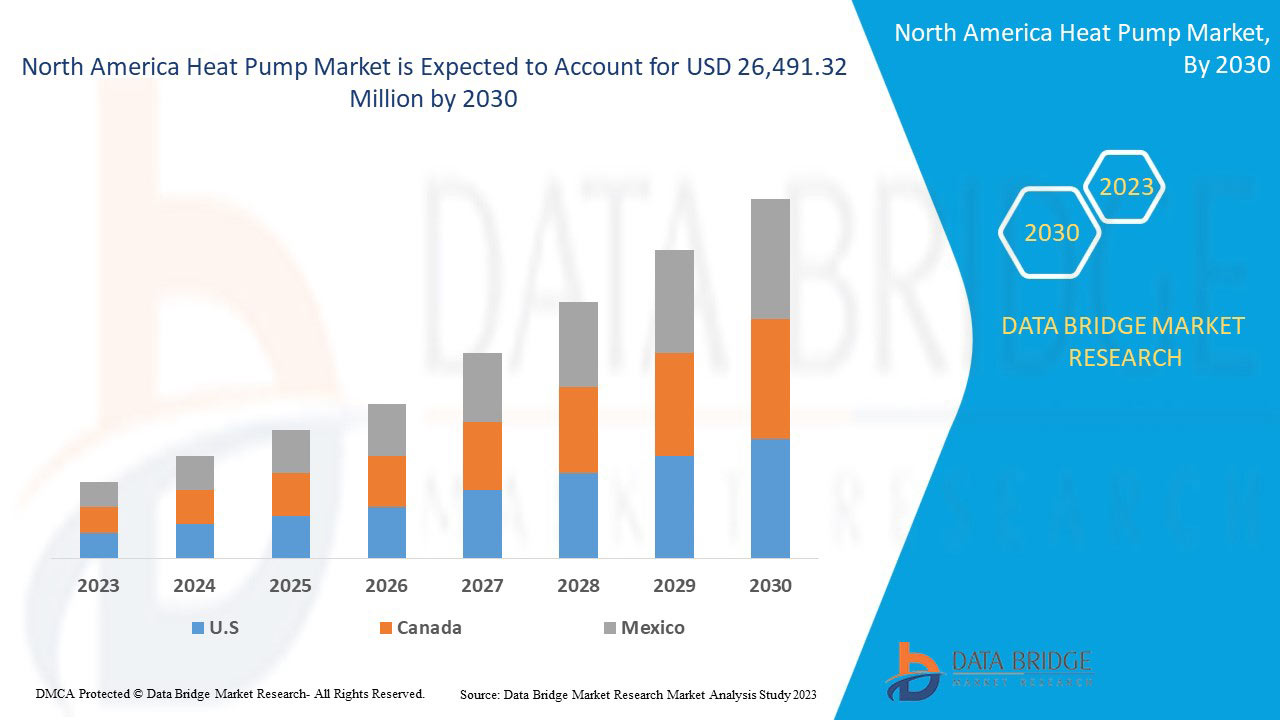
Data Bridge Market Research analyses that the heat pump market is expected to reach a value of USD 26,491.32 million by 2030, at a CAGR of 8.9% during the forecast period. "Air-to water heat pump" is the largest system segment in the heat pump market. The North America heat pump market report also covers pricing analysis, patent analysis, and technological advancements in depth.
|
Report Metric |
Details |
|
Forecast Period |
2023 to 2030 |
|
Base Year |
2022 |
|
Historic Years |
2021 (Customizable to 2020 - 2015) |
|
Quantitative Units |
USD Pricing in Million |
|
Segments Covered |
By Type (Air-To-Water Heat Pump, Air-To-Air Heat Pump, Water Source Heat Pump, Ground Source Heat Pump, and Hybrid Heat Pump), Component (Hardware, and Services), Capacity (Up to 10 kW, 10 to 20 kW, 20 to 30 kW, and Above 30 kW), Power Source (Electric, and Others), Refrigerant Type (R410A, R134A, R717 (Ammonia), R407C, R600 and R600A, R744, and Others), Cycle Type (Vapor Compression, Transcritical, and Absorption), System Type (Air Source Heat Pumps, Geothermal Heat Pumps, and Others), Application (Residential, Commercial, Industrial). |
|
Countries Covered |
U.S., Canada, and Mexico. |
|
Market Players Covered |
Danfoss Industries Pvt. Ltd., Trane Technologies plc, NIBE Industrier AB, Midea Group, VIVRECO group, Robert Bosch GmbH, American Standard Heating and Air Conditioning (Brand of Trane Technologies plc), Lennox International Inc., Rheem Manufacturing Company, Goodman (A Brand of Daikin Comfort Technologies North America, Inc.), Thermax Limited., Mitsubishi Electric Corporation, DAIKIN INDUSTRIES, Ltd., Carrier., Johnson Controls, RUUD (Brand of Rheem Manufacturing Company), BRYANT (Brand of Carrier.), among others. |
Market Definition
Heat pumps offer an energy-efficient alternative to furnaces and air conditioners for all climates. Like your refrigerator, heat pumps use electricity to transfer heat from a cool space to a warm space, making the cool space cooler and the warm space warmer. Heat pumps move heat from the cool outdoors into your warm house during the heating season. Heat pumps move heat from your house into the outdoors during the cooling season. Because they transfer heat rather than generate heat, heat pumps can efficiently provide comfortable temperatures for your home.
North America Heat Pump Market Dynamics
This section deals with understanding the market drivers, advantages, opportunities, restraints, and challenges. All of this is discussed in detail below:
Drivers
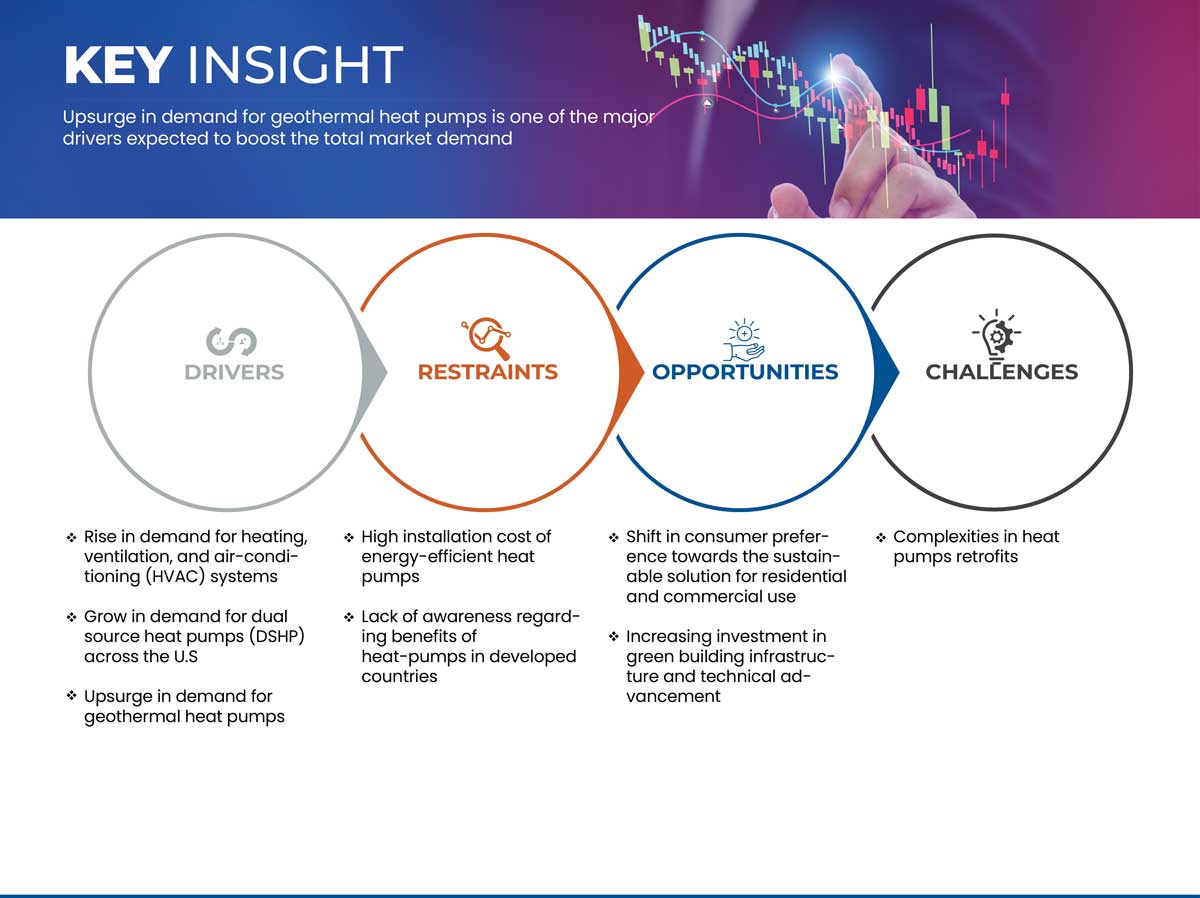
- Rise in demand for heating, ventilation and air-conditioning (HVAC) systems
The heating, ventilation, and air-conditioning (HVAC) systems play a major role in the advanced ventilation systems and technologies adopted to improve air quality and balance excess moisture and various types of contamination. Adopting mathematical models, computer simulation technology, and other techniques involve integrating mechanical components and a digital user interface for easy operation. Hence, this type of system and technology are interdependent. Thus, the development of advanced HVAC depends upon the good and proper usage of heat pump-related components.
- Grow in demand for dual source heat pumps (DSHP) across the U.S.
Moreover, dual-source heat pumps extract energy from natural sources such as the sun and ground. These are available in multiple designs. Solar-assisted air source heat pumps are mostly available in developed countries such as the U.S., Canada, and Mexico. This type of dual-source heat pump is more efficient during colder weather because there is less heat for the heat pump to extract from the outdoor air. This feature will provide dynamic response facilities increasing usage.
Restraint/Challenge
- Complexities in heat pumps retrofits
Modern heat pump systems include the rise in complexities related to retrofitting heat pumps. The air source heat pumps are inherently at the critical stage due to changing technology with the manufacturing process and quality of the end product. These heat pumps are associated with crucial equipment so that energy-efficient sources can be utilized to generate heat.
Opportunity
- Shift in consumer preference towards the sustainable solution for residential and commercial use
Moreover, the amount of electricity required by eco-friendly geothermal heat pumps is significantly lower, affecting the working efficiency of the heat pump operations. The primary advancement in heat pumps is the compressor, a game-changing aspect. As the world focuses on reducing greenhouse gas emissions, heat pumps are readily available solutions to meet the demand for sustainable space and water heating. This has improved the accuracy and working features of the heat pumps.
Post-COVID-19 Impact on the North America Heat Pump Market
COVID-19 significantly impacted the heat pump market as almost every country has opted to shut down every production facility except those producing essential goods. The government has taken some strict actions, such as shutting down the production and sale of non-essential goods, blocking international trade, and many more to prevent the spread of COVID-19. The only business dealing with this pandemic is the essential services allowed to open and run the processes.
Manufacturers are making various strategic decisions to bounce back post-COVID-19. The players are conducting multiple research and development activities to improve the technology in the heat pump market. The companies will bring advanced and accurate solutions to the market. In addition, the government initiatives to boost international trade have led to the market's growth.
Recent Developments
- In April 2021, Thermax Limited signed an agreement with power roll to develop the market for solar film in India. The companies agreed to develop solar energy instruments. The main objective of the companies was to contribute towards a green solution. The companies will be able to expand their product portfolio and attract a new customer base.
- In April 2022, DAIKIN INDUSTRIES, Ltd announced the acquisition of DUPLOMATIC MS S.P.A. the acquisition was decided to start manufacturing hydraulic-related equipment. The acquisition will help diversify the product portfolio and have a business in a wide range of fields. Companies took the step to expand their product portfolio and increase the profit margin and workforce of the company.
North America Heat Pump Market Scope
The North America heat pump market is segmented based on type, component, capacity, power source, refrigerant type, cycle type, system type, and application. The growth amongst these segments will help you analyze meager growth segments in the industries and provide the users with a valuable market overview and market insights to help them make strategic decisions for identifying core market applications.
By Type
- Air-To-Water Heat Pump
- Air-To-Air Heat Pump
- Water Source Heat Pump
- Ground Source Heat Pump
- Hybrid Heat Pump
On the basis of type, the North America heat pump market is segmented into air-to-water heat pump, air-to-air heat pump, water source heat pump, ground source heat pump, and hybrid heat pump.
By Component
- Hardware
- Services
On the basis of component, the North America heat pump market has been segmented into hardware and services.
By Capacity
- Up to 10 kW
- 10 to 20 kW
- 20 to 30 kW
- Above 30 kW
On the basis of capacity, the North America heat pump market has been segmented into Up to 10 kW, 10 to 20 kW, 20 to 30 kW, and above 30 kW.
By Power Source
- Electric
- Others
On the basis of power source, the North America heat pump market has been segmented into electric and others.
By Refrigerant Type
- R410A
- R134A
- R717 (Ammonia)
- R407C
- R600 and R600A
- R744
- Others
On the basis of refrigerant type, the North America heat pump market has been segmented into R410A, R134A, R717 (Ammonia), R407C, R600 and R600A, R744, and others.
By Cycle Type
- Vapor Compression
- Transcritical
- Absorption
On the basis of cycle type, the North America heat pump market has been segmented into vapor compression, transcritical, and absorption.
By System Type
- Air Source Heat Pumps
- Geothermal Heat Pumps
- Others
On the basis of system type, the North America heat pump market has been segmented into air source heat pumps, geothermal heat pumps, and others.
By Application
- Residential
- Commercial
- Industrial
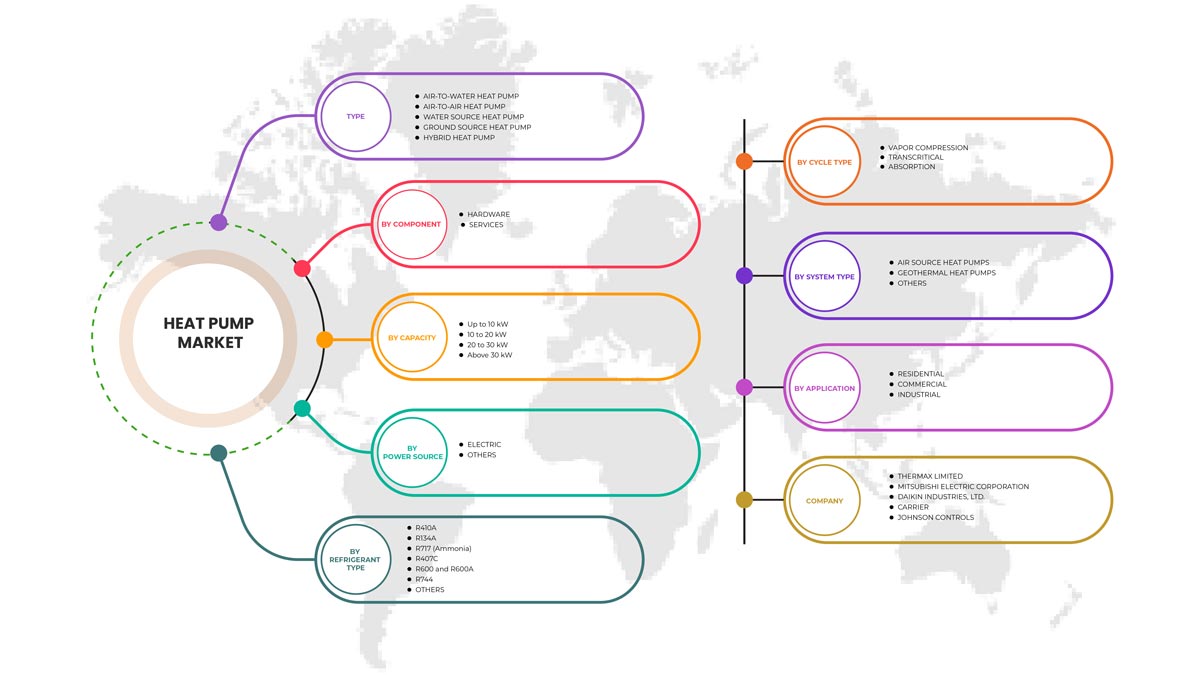
On the basis of application, the North America heat pump market has been segmented into residential, commercial, and industrial.
North America Heat Pump Market Regional Analysis/Insights
The North America heat pump market is analyzed, and market size insights and trends are provided by country, type, component, capacity, power source, refrigerant type, cycle type, system type, and application, as referenced above.
Some countries covered in the North America heat pump market report are the U.S., Canada, and Mexico. The U.S. is expected to dominate the North America heat pump as it is at the forefront of technology development and sustainable development in the region.
The country section of the report also provides individual market-impacting factors and market regulation changes that impact the market's current and future trends. Data points like downstream and upstream value chain analysis, technical trends and porter's five forces analysis, and case studies are some of the pointers used to forecast the market scenario for individual countries. Also, the presence and availability of North American brands and their challenges faced due to large or scarce competition from local and domestic brands, the impact of domestic tariffs, and trade routes are considered while providing forecast analysis of the country data.
Competitive Landscape and North America Heat Pump Market Share Analysis
The North America heat pump market competitive landscape provides details by the competitor. Details included are company overview, company financials, revenue generated, market potential, investment in research and development, new market initiatives, North America presence, production sites and facilities, production capacities, company strengths and weaknesses, product launch, product width and breadth, and application dominance. The above data points provided are only related to the companies' focus related to the North America heat pump market.
Some of the major players operating in the North America heat pump market are Danfoss Industries Pvt. Ltd., Trane Technologies plc, NIBE Industrier AB, Midea Group, VIVRECO group, Robert Bosch GmbH, American Standard Heating and Air Conditioning (Brand of Trane Technologies plc), Lennox International Inc., Rheem Manufacturing Company, Goodman (A Brand of Daikin Comfort Technologies North America, Inc.), Thermax Limited., Mitsubishi Electric Corporation, DAIKIN INDUSTRIES, Ltd., Carrier., Johnson Controls, RUUD (Brand of Rheem Manufacturing Company), BRYANT (Brand of Carrier.), among others.
SKU-
Obtenha acesso online ao relatório sobre a primeira nuvem de inteligência de mercado do mundo

- Painel interativo de análise de dados
- Painel de análise da empresa para oportunidades de elevado potencial de crescimento
- Acesso de analista de pesquisa para personalização e customização. consultas
- Análise da concorrência com painel interativo
- Últimas notícias, atualizações e atualizações Análise de tendências
- Aproveite o poder da análise de benchmark para um rastreio abrangente da concorrência
Índice
1 INTRODUÇÃO
1.1 OBJETIVOS DO ESTUDO
1.2 DEFINIÇÃO DE MERCADO
1.3 VISÃO GERAL DO MERCADO DE BOMBAS DE CALOR DA AMÉRICA DO NORTE
1.4 MOEDA E PREÇOS
1.5 LIMITAÇÕES
1.6 MERCADOS COBERTOS
2 SEGMENTAÇÃO DE MERCADO
2.1 MERCADOS COBERTOS
2.2 ÂMBITO GEOGRÁFICO
2,3 ANOS CONSIDERADOS PARA O ESTUDO
2.4 MODELO DE VALIDAÇÃO DE DADOS TRIPÉ DBMR
2.5 ENTREVISTAS PRINCIPAIS COM PRINCIPAIS LÍDERES DE OPINIÃO
2.6 GRADE DE POSIÇÃO DE MERCADO DBMR
2.7 ANÁLISE DA PARTICIPAÇÃO DO FORNECEDOR
2.8 MODELAGEM MULTIVARIADA
2.9 TIPO DE CURVA DE LINHA DO TEMPO
2.1 GRADE DE COBERTURA DO USUÁRIO FINAL DO MERCADO
2.11 FONTES SECUNDÁRIAS
2.12 PREMISSAS
3 RESUMO EXECUTIVO
4 INSIGHTS PREMIUM
4.1 BOMBA DE CALOR AR-ÁGUA SUBSTITUIRÁ FORNO NA AMÉRICA DO NORTE
4.1.1 POLÍTICAS GOVERNAMENTAIS
4.1.1.1 EUA
4.1.1.2 CANADÁ
4.2 MÉTODO EUROPEU DE AR PARA ÁGUA (USANDO UM RADIADOR) PARA O MERCADO DE BOMBAS DE CALOR DA AMÉRICA DO NORTE
4.2.1 BOMBAS DE CALOR DE AR TECNOLOGIAS AVANÇADAS
4.3 BOMBA DE CALOR VS FORNO
4.4 AS CINCO FORÇAS DE PORTER
5 VISÃO GERAL DO MERCADO
5.1 MOTORISTAS
5.1.1 AUMENTO DA DEMANDA POR SISTEMAS DE AQUECIMENTO, VENTILAÇÃO E AR CONDICIONADO (HVAC)
5.1.2 CRESCIMENTO DA DEMANDA POR BOMBAS DE CALOR DE FONTE DUPLA (DSHP) NOS EUA
5.1.3 AUMENTO DA PROCURA DE BOMBAS DE CALOR GEOTÉRMICAS
5.2 RESTRIÇÕES
5.2.1 ALTO CUSTO DE INSTALAÇÃO DE BOMBAS DE CALOR DE EFICIÊNCIA ENERGÉTICA
5.2.2 FALTA DE CONSCIENTIZAÇÃO SOBRE OS BENEFÍCIOS DAS BOMBAS DE CALOR NOS PAÍSES DESENVOLVIDOS
5.3 OPORTUNIDADES
5.3.1 MUDANÇA NA PREFERÊNCIA DO CONSUMIDOR PARA A SOLUÇÃO SUSTENTÁVEL PARA USO RESIDENCIAL E COMERCIAL
5.3.2 AUMENTO DO INVESTIMENTO EM INFRAESTRUTURA DE CONSTRUÇÃO VERDE E AVANÇO TÉCNICO
5.4 DESAFIO
5.4.1 COMPLEXIDADES NA RETROFITAGEM DE BOMBAS DE CALOR
6 MERCADO DE BOMBAS DE CALOR DA AMÉRICA DO NORTE, POR TIPO
6.1 VISÃO GERAL
6.2 BOMBA DE CALOR AR-ÁGUA
6.3 BOMBA DE CALOR AR-AR
6.4 BOMBA DE CALOR DE FONTE DE ÁGUA
6.5 BOMBA DE CALOR DE ORIGEM GERAL
6.6 BOMBA DE CALOR HÍBRIDA
7 MERCADO DE BOMBAS DE CALOR DA AMÉRICA DO NORTE, POR COMPONENTE
7.1 VISÃO GERAL
7.2 HARDWARE
7.2.1 COMPRESSOR
7.2.2 TROCADORES DE CALOR
7.2.3 SENSORES
7.2.4 RECEPTOR
7.2.5 VÁLVULA DE REVERSÃO
7.2.6 OUTROS
7.3 SERVIÇOS
7.3.1 CUSTO DE INSTALAÇÃO
7.3.1.1 NOVO
7.3.1.2 RETROFIT
7.3.2 CUSTO DE MANUTENÇÃO
8 MERCADO DE BOMBAS DE CALOR DA AMÉRICA DO NORTE, POR CAPACIDADE
8.1 VISÃO GERAL
8.2 ATÉ 10 KW
8,3 10 a 20 kW
8.4 20 a 30 kW
8,5 ACIMA DE 30 KW
9 MERCADO DE BOMBAS DE CALOR DA AMÉRICA DO NORTE, POR FONTE DE ENERGIA
9.1 VISÃO GERAL
9.2 ELÉTRICO
9.3 OUTROS
10 MERCADO DE BOMBAS DE CALOR DA AMÉRICA DO NORTE, POR TIPO DE REFRIGERANTE
10.1 VISÃO GERAL
10.2 R410A
10.3 R134A
10.4 R717 (AMÔNIA)
10,5 R407C
10.6 R600 e R600A
10.7 R744
10.8 OUTROS
11 MERCADO DE BOMBAS DE CALOR DA AMÉRICA DO NORTE, POR TIPO DE CICLO
11.1 VISÃO GERAL
11.2 COMPRESSÃO DE VAPOR
11.3 TRANSCRÍTICO
11.4 ABSORÇÃO
12 MERCADO DE BOMBAS DE CALOR DA AMÉRICA DO NORTE, POR TIPO DE SISTEMA
12.1 VISÃO GERAL
12.2 BOMBAS DE CALOR DE FONTE DE AR
12.2.1 TIPO DIVIDIDO E EMBALADO COM DUTO
12.2.2 MINISPLIT SEM DUTOS
12.2.3 JANELA PORTÁTIL
12.3 BOMBAS DE CALOR GEOTÉRMICAS
12.3.1 HORIZONTAL
12.3.2 VERTICAL
12.4 OUTROS
13 MERCADO DE BOMBAS DE CALOR DA AMÉRICA DO NORTE, POR APLICAÇÃO
13.1 VISÃO GERAL
13.2 RESIDENCIAL
13.2.1 RESIDÊNCIA ÚNICA
13.2.2 MULTI-RESIDÊNCIA
13.3 COMERCIAL
13.3.1 ESCRITÓRIOS
13.3.2 HOSPITALIDADE
13.3.3 ASSISTÊNCIA MÉDICA
13.3.4 VAREJO
13.3.5 LOGÍSTICA E TRANSPORTE
13.3.6 EDUCAÇÃO
13.3.7 OUTROS
13.4 INDUSTRIAIS
13.4.1 FABRICAÇÃO EM GERAL
13.4.2 QUÍMICA E PETRÓLEO
13.4.3 ALIMENTOS E BEBIDAS
13.4.4 UTILITÁRIOS
13.4.5 TÊXTIL E COURO
13.4.6 PRODUTOS DE MADEIRA
13.4.7 METAL
13.4.8 OUTROS
14 MERCADO DE BOMBAS DE CALOR DA AMÉRICA DO NORTE, POR PAÍS
14.1 EUA
14.2 CANADÁ
14.3 MÉXICO
15 PAISAGISMO DA EMPRESA: MERCADO DE BOMBAS DE CALOR DA AMÉRICA DO NORTE
15.1 ANÁLISE DAS AÇÕES DA EMPRESA: AMÉRICA DO NORTE
16 ANÁLISE SWOT
17 PERFIS DE EMPRESAS
17.1 TRANE TECHNOLOGIES PLC
17.1.1 RESUMO DA EMPRESA
17.1.2 ANÁLISE DE RECEITA
17.1.3 PORTFÓLIO DE PRODUTOS
17.1.4 DESENVOLVIMENTO RECENTE
17.2 CONTROLES JOHNSON
17.2.1 RESUMO DA EMPRESA
17.2.2 ANÁLISE DE RECEITA
17.2.3 PORTFÓLIO DE PRODUTOS
17.2.4 DESENVOLVIMENTO RECENTE
17.3 TRANSPORTADORA
17.3.1 RESUMO DA EMPRESA
17.3.2 ANÁLISE DE RECEITA
17.3.3 PORTFÓLIO DE PRODUTOS
17.3.4 DESENVOLVIMENTOS RECENTES
17.4 GRUPO MIDEA
17.4.1 RESUMO DA EMPRESA
17.4.2 ANÁLISE DE RECEITA
17.4.3 PORTFÓLIO DE PRODUTOS
17.4.4 DESENVOLVIMENTOS RECENTES
17.5 LENNOX INTERNATIONAL INC.
17.5.1 RESUMO DA EMPRESA
17.5.2 ANÁLISE DE RECEITA
17.5.3 PORTFÓLIO DE PRODUTOS
17.5.4 DESENVOLVIMENTO RECENTE
17.6 AQUECIMENTO E AR CONDICIONADO PADRÃO AMERICANO
17.6.1 RESUMO DA EMPRESA
17.6.2 PORTFÓLIO DE PRODUTOS
17.6.3 DESENVOLVIMENTO RECENTE
17.7 BRYANT (MARCA DA TRANSPORTADORA)
17.7.1 RESUMO DA EMPRESA
17.7.2 PORTFÓLIO DE PRODUTOS
17.7.3 DESENVOLVIMENTO RECENTE
17.8 DAIKIN INDUSTRIES, LTD.
17.8.1 RESUMO DA EMPRESA
17.8.2 ANÁLISE DE RECEITA
17.8.3 PORTFÓLIO DE PRODUTOS
17.8.4 DESENVOLVIMENTOS RECENTES
17.9 DANFOSS INDÚSTRIAS PVT. LTD.
17.9.1 RESUMO DA EMPRESA
17.9.2 ANÁLISE DE RECEITA
17.9.3 PORTFÓLIO DE PRODUTOS
17.9.4 DESENVOLVIMENTOS RECENTES
17.1 GOODMAN (MARCA DA DAIKIN INDUSTRIES, LTD.)
17.10.1 RESUMO DA EMPRESA
17.10.2 PORTFÓLIO DE PRODUTOS
17.10.3 DESENVOLVIMENTO RECENTE
17.11 MITSUBISHI ELECTRIC CORPORATION
17.11.1 RESUMO DA EMPRESA
17.11.2 ANÁLISE DE RECEITA
17.11.3 PORTFÓLIO DE PRODUTOS
17.11.4 DESENVOLVIMENTOS RECENTES
17.12 NIBE INDUSTRIAL AB
17.12.1 RESUMO DA EMPRESA
17.12.2 ANÁLISE DE RECEITA
17.12.3 PORTFÓLIO DE PRODUTOS
17.12.4 DESENVOLVIMENTO RECENTE
17.13 EMPRESA DE FABRICAÇÃO RHEEM
17.13.1 RESUMO DA EMPRESA
17.13.2 PORTFÓLIO DE PRODUTOS
17.13.3 DESENVOLVIMENTO RECENTE
17.14 ROBERT BOSCH GMBH
17.14.1 RESUMO DA EMPRESA
17.14.2 ANÁLISE DE RECEITA
17.14.3 PORTFÓLIO DE PRODUTOS
17.14.4 DESENVOLVIMENTO RECENTE
17.15 RUUD (MARCA DA EMPRESA DE FABRICAÇÃO RHEEM)
17.15.1 RESUMO DA EMPRESA
17.15.2 PORTFÓLIO DE PRODUTOS
17.15.3 DESENVOLVIMENTO RECENTE
17.16 THERMAX LIMITADA.
17.16.1 RESUMO DA EMPRESA
17.16.2 ANÁLISE DE RECEITA
17.16.3 PORTFÓLIO DE PRODUTOS
17.16.4 DESENVOLVIMENTOS RECENTES
17.17 GRUPO VIVRECO
17.17.1 RESUMO DA EMPRESA
17.17.2 PORTFÓLIO DE PRODUTOS
17.17.3 DESENVOLVIMENTO RECENTE
18 QUESTIONÁRIO
19 RELATÓRIOS RELACIONADOS
Lista de Tabela
TABELA 1 PREÇO DA BOMBA DE CALOR COM BASE NO TIPO, CAPACIDADE E CLASSIFICAÇÃO DE EFICIÊNCIA
TABELA 2 MERCADO DE BOMBAS DE CALOR DA AMÉRICA DO NORTE, POR TIPO, 2021-2030 (US$ MILHÕES)
TABELA 3 MERCADO DE BOMBAS DE CALOR DA AMÉRICA DO NORTE, POR COMPONENTE, 2021-2030 (US$ MILHÕES)
TABELA 4: HARDWARE NO MERCADO DE BOMBAS DE CALOR DA AMÉRICA DO NORTE, POR TIPO, 2021-2030 (US$ MILHÕES)
TABELA 5 SERVIÇOS NA AMÉRICA DO NORTE NO MERCADO DE BOMBAS DE CALOR, POR TIPO, 2021-2030 (US$ MILHÕES)
TABELA 6 CUSTO DE INSTALAÇÃO NO MERCADO DE BOMBAS DE CALOR NA AMÉRICA DO NORTE, POR TIPO, 2021-2030 (US$ MILHÕES)
TABELA 7 MERCADO DE BOMBAS DE CALOR DA AMÉRICA DO NORTE, POR CAPACIDADE, 2021-2030 (US$ MILHÕES)
TABELA 8 MERCADO DE BOMBAS DE CALOR DA AMÉRICA DO NORTE, POR FONTE DE ENERGIA, 2021-2030 (US$ MILHÕES)
TABELA 9 MERCADO DE BOMBAS DE CALOR DA AMÉRICA DO NORTE, POR TIPO DE REFRIGERANTE, 2021-2030 (US$ MILHÕES)
TABELA 10 MERCADO DE BOMBAS DE CALOR DA AMÉRICA DO NORTE, POR TIPO DE CICLO, 2021-2030 (US$ MILHÕES)
TABELA 11 MERCADO DE BOMBAS DE CALOR DA AMÉRICA DO NORTE, POR TIPO DE SISTEMA, 2021-2030 (US$ MILHÕES)
TABELA 12 BOMBAS DE CALOR DE FONTE DE AR DA AMÉRICA DO NORTE NO MERCADO DE BOMBAS DE CALOR, POR CATEGORIA, 2021-2030 (US$ MILHÕES)
TABELA 13 BOMBAS DE CALOR GEOTÉRMICAS DA AMÉRICA DO NORTE NO MERCADO DE BOMBAS DE CALOR, POR CICLO, 2021-2030 (US$ MILHÕES)
TABELA 14 MERCADO DE BOMBAS DE CALOR DA AMÉRICA DO NORTE, POR APLICAÇÃO, 2021-2030 (US$ MILHÕES)
TABELA 15 RESIDENCIAIS DA AMÉRICA DO NORTE NO MERCADO DE BOMBAS DE CALOR, POR TIPO, 2021-2030 (US$ MILHÕES)
TABELA 16 MERCADO DE BOMBAS DE CALOR COMERCIAIS DA AMÉRICA DO NORTE, POR TIPO, 2021-2030 (US$ MILHÕES)
TABELA 17 MERCADO DE BOMBAS DE CALOR INDUSTRIAL DA AMÉRICA DO NORTE, POR TIPO, 2021-2030 (US$ MILHÕES)
TABELA 18 MERCADO DE BOMBAS DE CALOR DA AMÉRICA DO NORTE, POR PAÍS, 2021-2030 (US$ MILHÕES)
TABELA 19 MERCADO DE BOMBAS DE CALOR DOS EUA, POR TIPO, 2021-2030 (US$ MILHÕES)
TABELA 20 MERCADO DE BOMBAS DE CALOR DOS EUA, POR COMPONENTE, 2021-2030 (US$ MILHÕES)
TABELA 21 HARDWARE NO MERCADO DE BOMBAS DE CALOR DOS EUA, POR TIPO, 2021-2030 (US$ MILHÕES)
TABELA 22 SERVIÇOS NOS EUA NO MERCADO DE BOMBAS DE CALOR, POR TIPO, 2021-2030 (US$ MILHÕES)
TABELA 23 CUSTO DE INSTALAÇÃO NO MERCADO DE BOMBAS DE CALOR NOS EUA, POR TIPO, 2021-2030 (US$ MILHÕES)
TABELA 24 MERCADO DE BOMBAS DE CALOR DOS EUA, POR CAPACIDADE, 2021-2030 (US$ MILHÕES)
TABELA 25 MERCADO DE BOMBAS DE CALOR DOS EUA, POR FONTE DE ENERGIA, 2021-2030 (US$ MILHÕES)
TABELA 26 MERCADO DE BOMBAS DE CALOR DOS EUA, POR TIPO DE REFRIGERANTE, 2021-2030 (US$ MILHÕES)
TABELA 27 MERCADO DE BOMBAS DE CALOR DOS EUA, POR TIPO DE CICLO, 2021-2030 (US$ MILHÕES)
TABELA 28 MERCADO DE BOMBAS DE CALOR DOS EUA, POR TIPO DE SISTEMA, 2021-2030 (US$ MILHÕES)
TABELA 29 BOMBAS DE CALOR DE FONTE DE AR DOS EUA NO MERCADO DE BOMBAS DE CALOR, POR CATEGORIA, 2021-2030 (US$ MILHÕES)
TABELA 30 BOMBAS DE CALOR GEOTÉRMICAS DOS EUA NO MERCADO DE BOMBAS DE CALOR, POR CICLO, 2021-2030 (US$ MILHÕES)
TABELA 31 MERCADO DE BOMBAS DE CALOR DOS EUA, POR APLICAÇÃO, 2021-2030 (US$ MILHÕES)
TABELA 32 RESIDENCIAL NOS EUA NO MERCADO DE BOMBAS DE CALOR, POR TIPO, 2021-2030 (US$ MILHÕES)
TABELA 33 MERCADO DE BOMBAS DE CALOR COMERCIAIS DOS EUA, POR TIPO, 2021-2030 (US$ MILHÕES)
TABELA 34 MERCADO INDUSTRIAL DE BOMBAS DE CALOR DOS EUA, POR TIPO, 2021-2030 (US$ MILHÕES)
TABELA 35 MERCADO DE BOMBAS DE CALOR DO CANADÁ, POR TIPO, 2021-2030 (US$ MILHÕES)
TABELA 36 MERCADO DE BOMBAS DE CALOR DO CANADÁ, POR COMPONENTE, 2021-2030 (US$ MILHÕES)
TABELA 37: MERCADO DE HARDWARE DE BOMBAS DE CALOR DO CANADÁ, POR TIPO, 2021-2030 (US$ MILHÕES)
TABELA 38 SERVIÇOS NO MERCADO DE BOMBAS DE CALOR DO CANADÁ, POR TIPO, 2021-2030 (US$ MILHÕES)
TABELA 39 CUSTO DE INSTALAÇÃO NO MERCADO DE BOMBAS DE CALOR NO CANADÁ, POR TIPO, 2021-2030 (US$ MILHÕES)
TABELA 40 MERCADO DE BOMBAS DE CALOR DO CANADÁ, POR CAPACIDADE, 2021-2030 (US$ MILHÕES)
TABELA 41 MERCADO DE BOMBAS DE CALOR DO CANADÁ, POR FONTE DE ENERGIA, 2021-2030 (US$ MILHÕES)
TABELA 42 MERCADO DE BOMBAS DE CALOR DO CANADÁ, POR TIPO DE REFRIGERANTE, 2021-2030 (US$ MILHÕES)
TABELA 43 MERCADO DE BOMBAS DE CALOR DO CANADÁ, POR TIPO DE CICLO, 2021-2030 (US$ MILHÕES)
TABELA 44 MERCADO DE BOMBAS DE CALOR DO CANADÁ, POR TIPO DE SISTEMA, 2021-2030 (US$ MILHÕES)
TABELA 45 BOMBAS DE CALOR DE FONTE DE AR DO CANADÁ NO MERCADO DE BOMBAS DE CALOR, POR CATEGORIA, 2021-2030 (US$ MILHÕES)
TABELA 46 BOMBAS DE CALOR GEOTÉRMICAS DO CANADÁ NO MERCADO DE BOMBAS DE CALOR, POR CICLO, 2021-2030 (US$ MILHÕES)
TABELA 47 MERCADO DE BOMBAS DE CALOR DO CANADÁ, POR APLICAÇÃO, 2021-2030 (US$ MILHÕES)
TABELA 48 RESIDENCIAIS NO CANADÁ NO MERCADO DE BOMBAS DE CALOR, POR TIPO, 2021-2030 (US$ MILHÕES)
TABELA 49 MERCADO DE BOMBAS DE CALOR COMERCIAIS DO CANADÁ, POR TIPO, 2021-2030 (US$ MILHÕES)
TABELA 50 MERCADO INDUSTRIAL DE BOMBAS DE CALOR DO CANADÁ, POR TIPO, 2021-2030 (US$ MILHÕES)
TABELA 51 MERCADO DE BOMBAS DE CALOR DO MÉXICO, POR TIPO, 2021-2030 (US$ MILHÕES)
TABELA 52 MERCADO DE BOMBAS DE CALOR DO MÉXICO, POR COMPONENTE, 2021-2030 (US$ MILHÕES)
TABELA 53: HARDWARE NO MERCADO DE BOMBAS DE CALOR DO MÉXICO, POR TIPO, 2021-2030 (US$ MILHÕES)
TABELA 54 SERVIÇOS NO MERCADO DE BOMBAS DE CALOR DO MÉXICO, POR TIPO, 2021-2030 (US$ MILHÕES)
TABELA 55 CUSTO DE INSTALAÇÃO NO MERCADO DE BOMBAS DE CALOR NO MÉXICO, POR TIPO, 2021-2030 (US$ MILHÕES)
TABELA 56 MERCADO DE BOMBAS DE CALOR DO MÉXICO, POR CAPACIDADE, 2021-2030 (US$ MILHÕES)
TABELA 57 MERCADO DE BOMBAS DE CALOR DO MÉXICO, POR FONTE DE ENERGIA, 2021-2030 (US$ MILHÕES)
TABELA 58 MERCADO DE BOMBAS DE CALOR DO MÉXICO, POR TIPO DE REFRIGERANTE, 2021-2030 (US$ MILHÕES)
TABELA 59 MERCADO DE BOMBAS DE CALOR DO MÉXICO, POR TIPO DE CICLO, 2021-2030 (US$ MILHÕES)
TABELA 60 MERCADO DE BOMBAS DE CALOR DO MÉXICO, POR TIPO DE SISTEMA, 2021-2030 (US$ MILHÕES)
TABELA 61 BOMBAS DE CALOR DE FONTE DE AR DO MÉXICO NO MERCADO DE BOMBAS DE CALOR, POR CATEGORIA, 2021-2030 (US$ MILHÕES)
TABELA 62 BOMBAS DE CALOR GEOTÉRMICAS DO MÉXICO NO MERCADO DE BOMBAS DE CALOR, POR CICLO, 2021-2030 (US$ MILHÕES)
TABELA 63 MERCADO DE BOMBAS DE CALOR DO MÉXICO, POR APLICAÇÃO, 2021-2030 (US$ MILHÕES)
TABELA 64 RESIDENCIAIS NO MÉXICO NO MERCADO DE BOMBAS DE CALOR, POR TIPO, 2021-2030 (US$ MILHÕES)
TABELA 65 MERCADO DE BOMBAS DE CALOR COMERCIAIS DO MÉXICO, POR TIPO, 2021-2030 (US$ MILHÕES)
TABELA 66 MERCADO INDUSTRIAL DE BOMBAS DE CALOR DO MÉXICO, POR TIPO, 2021-2030 (US$ MILHÕES)
Lista de Figura
FIGURA 1 MERCADO DE BOMBAS DE CALOR DA AMÉRICA DO NORTE: SEGMENTAÇÃO
FIGURA 2 MERCADO DE BOMBAS DE CALOR DA AMÉRICA DO NORTE: TRIANGULAÇÃO DE DADOS
FIGURA 3 MERCADO DE BOMBAS DE CALOR DA AMÉRICA DO NORTE: ANÁLISE DROC
FIGURA 4 MERCADO DE BOMBAS DE CALOR DA AMÉRICA DO NORTE: ANÁLISE DE MERCADO REGIONAL VS. PAÍS
FIGURA 5 MERCADO DE BOMBAS DE CALOR DA AMÉRICA DO NORTE: ANÁLISE DE PESQUISA DA EMPRESA
FIGURA 6 MERCADO DE BOMBAS DE CALOR DA AMÉRICA DO NORTE: DEMOGRAFIA DA ENTREVISTA
FIGURA 7 MERCADO DE BOMBAS DE CALOR DA AMÉRICA DO NORTE: GRADE DE POSIÇÃO DE MERCADO DBMR
FIGURA 8 MERCADO DE BOMBAS DE CALOR DA AMÉRICA DO NORTE: ANÁLISE DA PARTICIPAÇÃO DE FORNECEDORES
FIGURA 9 MERCADO DE BOMBAS DE CALOR DA AMÉRICA DO NORTE: GRADE DE COBERTURA DE APLICAÇÃO DE MERCADO
FIGURA 10 MERCADO DE BOMBAS DE CALOR DA AMÉRICA DO NORTE: SEGMENTAÇÃO
FIGURA 11 O AUMENTO NA DEMANDA POR BOMBAS DE CALOR GEOTÉRMICAS DEVE IMPULSIONAR O MERCADO DE BOMBAS DE CALOR DA AMÉRICA DO NORTE NO PERÍODO PREVISTO DE 2023 A 2030
FIGURA 12 O SEGMENTO DE COMPONENTES DE BOMBAS DE CALOR AR-ÁGUA DEVE SER REPRESENTANTE DA MAIOR PARCIALIDADE DO MERCADO DE BOMBAS DE CALOR DA AMÉRICA DO NORTE EM 2023 E 2030
FIGURA 13 AS CINCO FORÇAS DE PORTER
FIGURA 14 MOTIVADORES, RESTRIÇÕES, OPORTUNIDADES E DESAFIOS DO MERCADO DE BOMBAS DE CALOR DA AMÉRICA DO NORTE
FIGURA 15 MERCADO DE BOMBAS DE CALOR DA AMÉRICA DO NORTE: POR TIPO, 2022
FIGURA 16 MERCADO DE BOMBAS DE CALOR DA AMÉRICA DO NORTE: POR COMPONENTE, 2022
FIGURA 17 MERCADO DE BOMBAS DE CALOR DA AMÉRICA DO NORTE: POR CAPACIDADE, 2022
FIGURA 18 MERCADO DE BOMBAS DE CALOR DA AMÉRICA DO NORTE: POR FONTE DE ENERGIA, 2022
FIGURA 19 MERCADO DE BOMBAS DE CALOR DA AMÉRICA DO NORTE: POR TIPO DE REFRIGERANTE, 2022
FIGURA 20 MERCADO DE BOMBAS DE CALOR DA AMÉRICA DO NORTE: POR TIPO DE CICLO, 2022
FIGURA 21 MERCADO DE BOMBAS DE CALOR DA AMÉRICA DO NORTE: POR TIPO DE SISTEMA, 2022
FIGURA 22 MERCADO DE BOMBAS DE CALOR DA AMÉRICA DO NORTE: POR APLICAÇÃO, 2022
FIGURA 23 MERCADO DE BOMBAS DE CALOR DA AMÉRICA DO NORTE: INSTANTÂNEO (2022)
FIGURA 24 MERCADO DE BOMBAS DE CALOR DA AMÉRICA DO NORTE: POR PAÍS (2022)
FIGURA 25 MERCADO DE BOMBAS DE CALOR DA AMÉRICA DO NORTE: POR PAÍS (2023 E 2030)
FIGURA 26 MERCADO DE BOMBAS DE CALOR DA AMÉRICA DO NORTE: POR PAÍS (2022 E 2030)
FIGURA 27 MERCADO DE BOMBAS DE CALOR DA AMÉRICA DO NORTE: POR TIPO (2023-2030)
FIGURA 28 MERCADO DE BOMBAS DE CALOR DA AMÉRICA DO NORTE: PARTICIPAÇÃO DA EMPRESA EM 2022 (%)

Metodologia de Investigação
A recolha de dados e a análise do ano base são feitas através de módulos de recolha de dados com amostras grandes. A etapa inclui a obtenção de informações de mercado ou dados relacionados através de diversas fontes e estratégias. Inclui examinar e planear antecipadamente todos os dados adquiridos no passado. Da mesma forma, envolve o exame de inconsistências de informação observadas em diferentes fontes de informação. Os dados de mercado são analisados e estimados utilizando modelos estatísticos e coerentes de mercado. Além disso, a análise da quota de mercado e a análise das principais tendências são os principais fatores de sucesso no relatório de mercado. Para saber mais, solicite uma chamada de analista ou abra a sua consulta.
A principal metodologia de investigação utilizada pela equipa de investigação do DBMR é a triangulação de dados que envolve a mineração de dados, a análise do impacto das variáveis de dados no mercado e a validação primária (especialista do setor). Os modelos de dados incluem grelha de posicionamento de fornecedores, análise da linha de tempo do mercado, visão geral e guia de mercado, grelha de posicionamento da empresa, análise de patentes, análise de preços, análise da quota de mercado da empresa, normas de medição, análise global versus regional e de participação dos fornecedores. Para saber mais sobre a metodologia de investigação, faça uma consulta para falar com os nossos especialistas do setor.
Personalização disponível
A Data Bridge Market Research é líder em investigação formativa avançada. Orgulhamo-nos de servir os nossos clientes novos e existentes com dados e análises que correspondem e atendem aos seus objetivos. O relatório pode ser personalizado para incluir análise de tendências de preços de marcas-alvo, compreensão do mercado para países adicionais (solicite a lista de países), dados de resultados de ensaios clínicos, revisão de literatura, mercado remodelado e análise de base de produtos . A análise de mercado dos concorrentes-alvo pode ser analisada desde análises baseadas em tecnologia até estratégias de carteira de mercado. Podemos adicionar quantos concorrentes necessitar de dados no formato e estilo de dados que procura. A nossa equipa de analistas também pode fornecer dados em tabelas dinâmicas de ficheiros Excel em bruto (livro de factos) ou pode ajudá-lo a criar apresentações a partir dos conjuntos de dados disponíveis no relatório.











