



North America Very Small Aperture Terminal (VSAT) Market, By Solution (Equipment, Support Services, Connectivity Services), Platform (Land VSAT, Maritime VSAT, Airborne VSAT), Frequency (Ku-Band, C-Band, Ka-Band, X-Band), Network Architecture (Star Topology, Mesh Topology, Hybrid Topology, Point-To-Point Links), Design (Rugged VSAT and Non-Rugged VSAT), Vertical (Telecommunication, Maritime, Aviation, Government & Defense, Media & Entertainment, Transportation & Logistics, Energy & Power, Mining & Construction, Manufacturing, BFSI, Retail, Automotive, Transportation & Logistics, Healthcare, Education, Agriculture & Forestry and Others), End Use (Broadband/Data Network, Voice Communication, Private Network Service, Broadcast and Others) – Industry Trends and Forecast to 2029.
América do Norte Terminal de abertura muito pequeno (VSAT) análise de mercado e tamanho
O crescimento maciço da capacidade dos satélites resultou numa queda significativa dos preços, tornando os terminais de abertura muito pequenos (VSAT) uma solução viável para muitas indústrias e regiões pela primeira vez. Além disso, tem havido uma maior adoção da tecnologia VSAT em indústrias como o transporte marítimo, petróleo e gás, aviação, entre outras. Esses sistemas também fornecem a conectividade necessária entre usuários de aplicativos médicos, bancos de dados, vídeo e telefones em locais remotos, e permitem a comunicação com sites remotos e móveis.
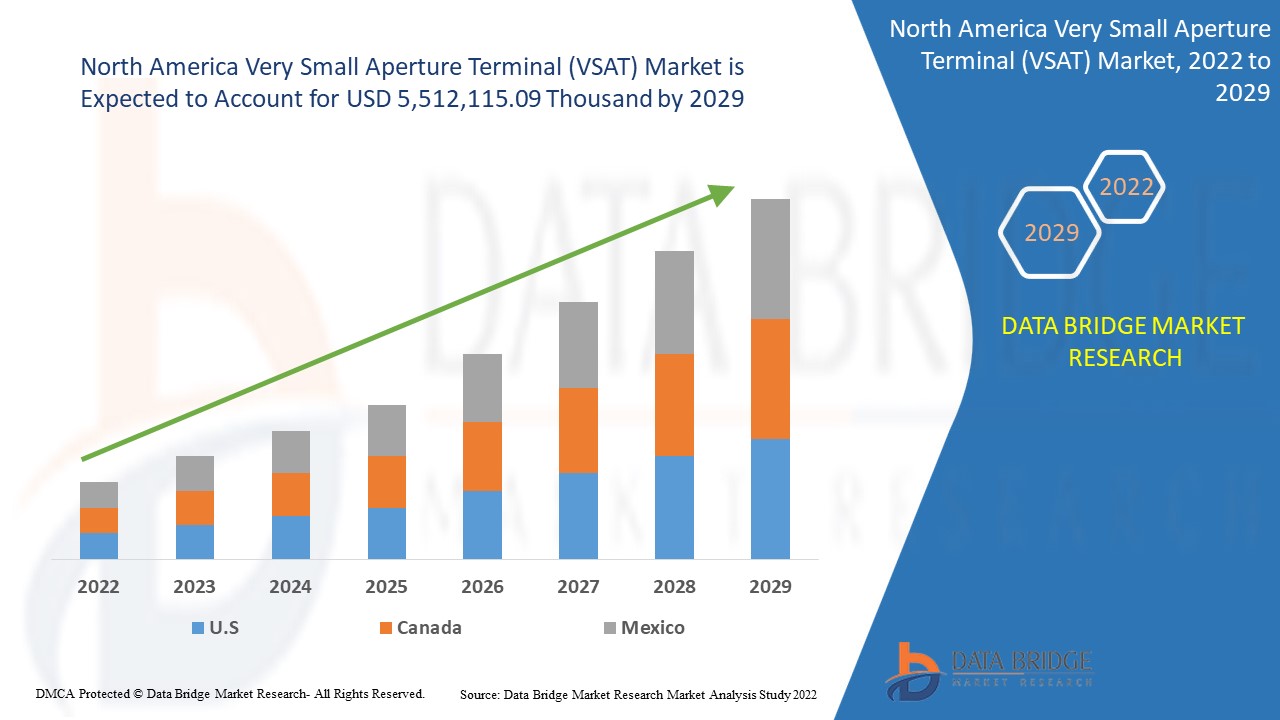
Data Bridge Market Research analisa que o mercado de terminais de abertura muito pequeno (VSAT) da América do Norte deverá atingir o valor de USD 5.512.115,09 mil até 2029, em um CAGR de 9,9% durante o período previsto. O relatório de mercado do terminal de abertura muito pequeno (VSAT) também abrange análise de preços, análise de patentes e avanços tecnológicos em profundidade.
|
Metric de Relatório |
Detalhes |
|
Período de previsão |
2022 a 2029 |
|
Ano de base |
2021 |
|
Anos Históricos |
2020 (Alfândega para 2019-2014) |
|
Unidades quantitativas |
Receitas em USD 1000, Preços em USD |
|
Segmentos Cobertos |
Por Solução (Equipamento, Serviços de Suporte, Serviços de Conectividade), Plataforma (Terra VSAT, VSAT Marítimo, VSAT Aerotransportado), Frequência (Ku-Band, C-Band, Ka-Band, X-Band), Arquitetura de Rede (Topologia das Estrelas, Mesh Topologia, Topologia Híbrida, Ligações Ponto-a-Ponto), Design (VSAT Rugged e VSAT Não Rugged), Vertical (Telecomunicações, Marítimo, Aviação, Governo e Defesa, Mídia e Entretenimento, Transporte e Logística, Energia e Energia, Mineração e Construção, Fabricação, BFSI, Varejo, Automotive, Transporte & Logística, Saúde, Educação, Agricultura e Floresta e Outros), Uso Final (Broadband/Rede de Dados, Comunicação de Voz, Serviço de Rede Privada, Transmissão e Outros) |
|
Países abrangidos |
EUA, Canadá e México |
|
Jogadores de mercado cobertos |
Singtel, Vizocom Company, x2nSat, C-COM Satellite Systems Inc, Marlink, Speedcast, NSSLGlobal, ST Engineering, Atos SE 2, Iridium Communications Inc., EchoStar Corporation, Orbit Communications Systems Ltd., Ultra, Nisshinbo Holdings Inc., General Dynamics Corporation, Honeywell International Inc., Cobham Satcom, Thales, GILAT SATELLITE NETWORKS, L3Harris Technologies, Inc., Viasat, Inc., KVH Industries, Inc., CPI International Inc., Global Invacom |
Definição do mercado
Uma mão duplasatélite comunicaçãosistema é referido como um VSAT, ou Terminal de Abertura Muito Pequeno. O prato deste sistema tem tipicamente menos de 3,8 metros de diâmetro. A eficácia de um sistema VSAT pode ser afetada negativamente pelotempo. Além disso, existem três topologias para redes VSAT que são tipicamente usadas que são estrela, malha ou híbrido. Assim, os sistemas VSAT fornecem a conectividade necessária entre usuários demédicopedidos,bases de dados, vídeo e telefones em locais remotos, e permitir a comunicação com sites remotos e móveis.
América do Norte Terminal de abertura muito pequeno (VSAT) Dinâmica do mercado
Esta secção trata da compreensão dos condutores de mercado, vantagens, oportunidades, restrições e desafios. Tudo isto é discutido em detalhe como abaixo:
Controladores
- Procura crescente de comunicação segura para aplicações de IoT marítima
A tecnologia VSAT tornou-se um importante negócio para a indústria marítima. Eles são usados para comunicações via satélite para internet, dados e telefonia, tipicamente em áreas rurais e ambientes severos. Nos últimos anos, houve uma mudança progressiva na ecosfera da IoT marítima. Esta ecosfera é servida por várias peças eletrônicas padrão que é o hardware integrado com vários softwares. Os serviços de IoT via satélite permitem às empresas aceder aos dados dos activos da forma mais acessível. Por conseguinte, os navios no mar são remotos, os navios e outras entidades discretas estão adotando sistemas digitais como parte de redes de IoT maiores. O uso de dispositivos de IoT e sistemas de sensores em embarcações/fleet ajuda a ganhar vantagem competitiva, permitindo que essas tecnologias sejam capazes de aproveitar todo o potencial de dados para operações mais eficazes e tomada de decisões.
- Aumento da adoção de tecnologia VSAT na indústria de petróleo e gás
Atualmente, o setor de petróleo e gás está passando por uma enorme mudança devido às várias inovações digitais. Há múltiplas demandas, como segurança, segurança, exploração de novas áreas de petróleo e crescente visibilidade entre a plataforma e a sede, mantendo os custos operacionais sob controle. Portanto, os operadores de plataformas estão constantemente sendo pressionados a tomar decisões mais rápidas e executar operações de forma mais eficiente. Além disso, a indústria de petróleo e gás opera em ambientes remotos onshore e offshore, onde o uso de comunicações terrestres não é prático ou confiável. Assim, muitas empresas começaram a implementar a tecnologia VSAT para que os operadores de plataformas possam tomar decisões rápidas e mais informadas, o que reduzirá os custos operacionais, aumentará a produtividade e proporcionará condições de trabalho mais seguras para a tripulação, independentemente da localização.
Oportunidades
- Aumento da parceria estratégica e aquisição entre várias organizações
A coordenação e o investimento em projectos são essenciais para a realização de melhorias sustentadas no sector dos terminais de abertura muito pequenos (VSAT). Devido ao qual o governo e outras organizações privadas estão lutando através de parcerias e aquisições, acelerando assim o crescimento das indústrias. Isso ajuda a construir consciência e lucro para a organização e, assim, cria espaço para uma nova invenção na indústria. Além disso, através de parcerias, a empresa pode investir mais em tecnologias avançadas para fornecer serviços e soluções de terminal de abertura muito pequeno (VSAT) mais seguros e confiáveis. Além disso, isso ajuda ambas as empresas a serem reconhecidas no mercado competitivo, gerando assim lucro em certa medida.
Restrições/Desafios
- Aumentar as preocupações de segurança cibernética e as violações de dados
As questões de cibercrime/hacking e cibersegurança aumentaram 600% durante a pandemia em todos os setores. Falhas na segurança de rede ou software é uma fraqueza que é explorada por hackers para executar ações não autorizadas dentro de um sistema.
De acordo com o recente relatório publicado pelo Maritime Cybersecurity Survey by Safety at Sea and BIMCO, nos 12 meses anteriores a fevereiro de 2020, 31% das organizações foram vítimas de ciberataques, o que representa um aumento de 9% em relação a 2019. De acordo com outro relatório publicado por Robert Rizika, chefe de operações norte-americanas na Naval Dome, informou que os ataques cibernéticos à tecnologia operacional da indústria marítima (OT) aumentaram 900% de 50% em 2017, para 120% e 31% em 2018 e 2019, respectivamente.
- Questões relacionadas com a fiabilidade da rede de terminais de abertura muito pequena (VSAT) durante o mau tempo
O tempo espacial interfere com a comunicação de rádio entre a Terra e os satélites, porque pode causar distúrbios da ionosfera que refletem, refratem ou absorvam ondas de rádio. Dado que os sinais de satélite devem percorrer grandes distâncias no ar, os serviços de Internet via satélite para utilizadores rurais podem ser vulneráveis a condições meteorológicas graves. Embora o vento raramente afete sinais de rádio, ele pode oscilar, vibrar, ou até mesmo deslocar equipamentos como antenas parabólicas. A latência e a chuva desaparecem são dois fatores particulares que afetam a capacidade dos satélites de enviar sinais. Chuva e umidade atmosférica são as principais causas do desbotamento da chuva, que pode enfraquecer ou degradar o sinal de satélite em frequências Ku e Ka-band mais altas.
Pós COVID-19 Impacto na América do Norte Muito Pequeno Terminal de Abertura (VSAT)
COVID-19 criou um impacto negativo no pequeno mercado de terminais de abertura (VSAT) devido a regulamentos de bloqueio e desligamento de instalações de fabricação.
A pandemia de COVID-19 afectou de forma negativa o pequeno mercado de terminais de abertura (VSAT). No entanto, o aumento da demanda por sistema global de segurança de socorro marítimo em todo o mundo tem ajudado o mercado a crescer após a pandemia. Além disso, o crescimento tem sido elevado após a abertura do mercado após COVID-19, e espera-se que haja um crescimento considerável no setor devido ao aumento da proliferação de comunicação baseada em satélites no setor militar e de defesa.
Os provedores de soluções estão tomando várias decisões estratégicas para recuperar pós-COVID-19. Os atores estão realizando várias atividades de pesquisa e desenvolvimento para melhorar a tecnologia envolvida no terminal de abertura muito pequeno (VSAT). Com isso, as empresas trarão tecnologias avançadas ao mercado. Além disso, iniciativas governamentais para o uso da tecnologia de automação levaram ao crescimento do mercado
Evolução recente
- Em maio de 2022, a ST Engineering fez parceria com a NiAT para oferecer conectividade VSAT crítica e atender a essa demanda insaciável de acesso à internet utilizando a plataforma ST Engineering iDirect Evolution. Isso ajudou ainda mais a empresa a expandir seus negócios para outros setores, incluindo empresas, energia e offshore, marítimo, backhaul celular, governo e defesa.
- Em dezembro de 2021, a Orbit Communications Systems Ltd. adquiriu a Euclid Systems Engineering, uma empresa especializada no desenvolvimento de posicionadores e sistemas de rastreamento inteligentes e leves para as indústrias de defesa. O motivo por trás desta aquisição foi fortalecer as capacidades marítimas e aéreas da empresa SATCOM com a ajuda da Euclid Systems Engineering. Este desenvolvimento ajudará a empresa a expandir seu portfólio de produtos e presença global no mercado.
América do Norte Terminal de abertura muito pequeno (VSAT) Âmbito de mercado
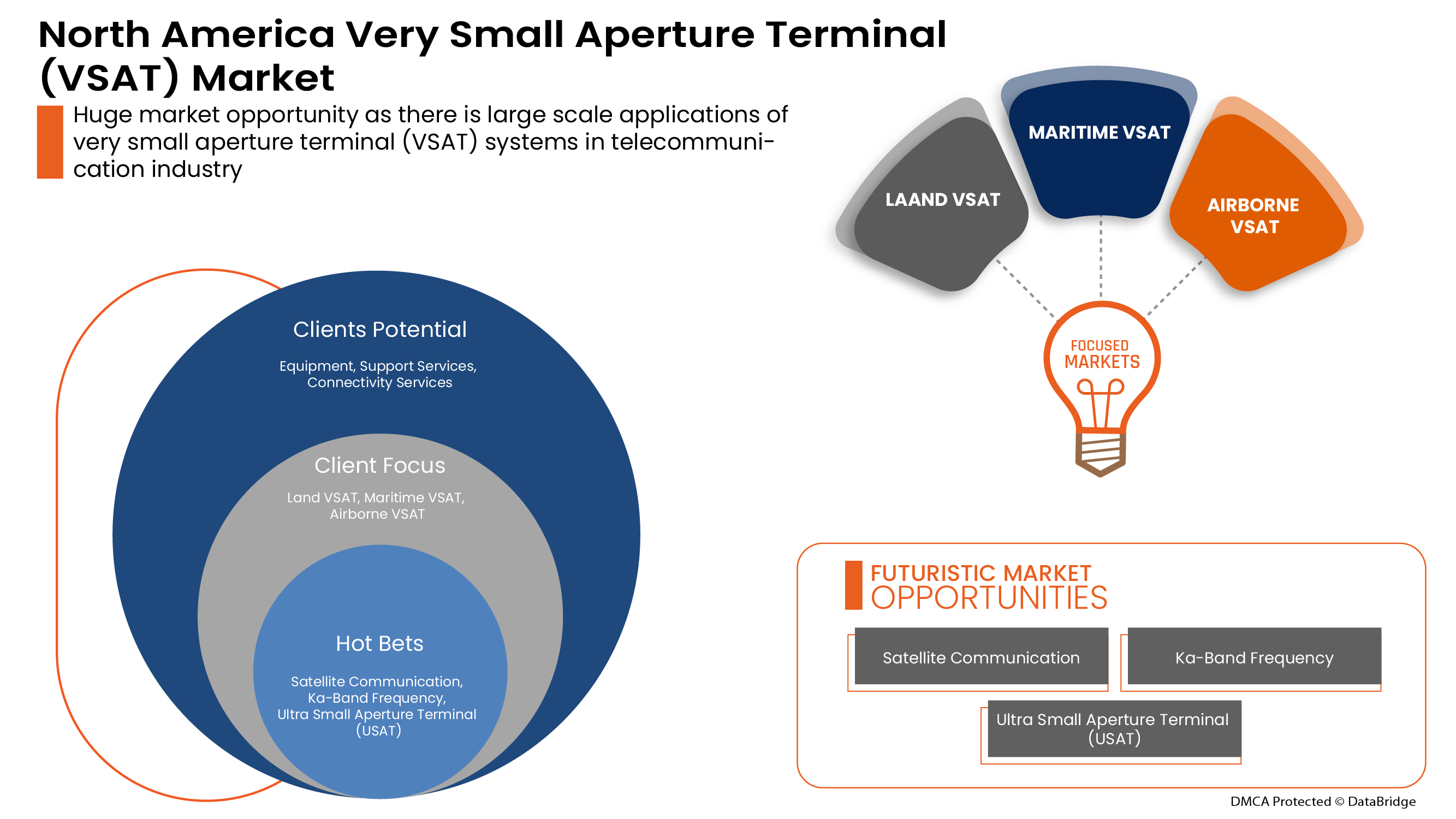
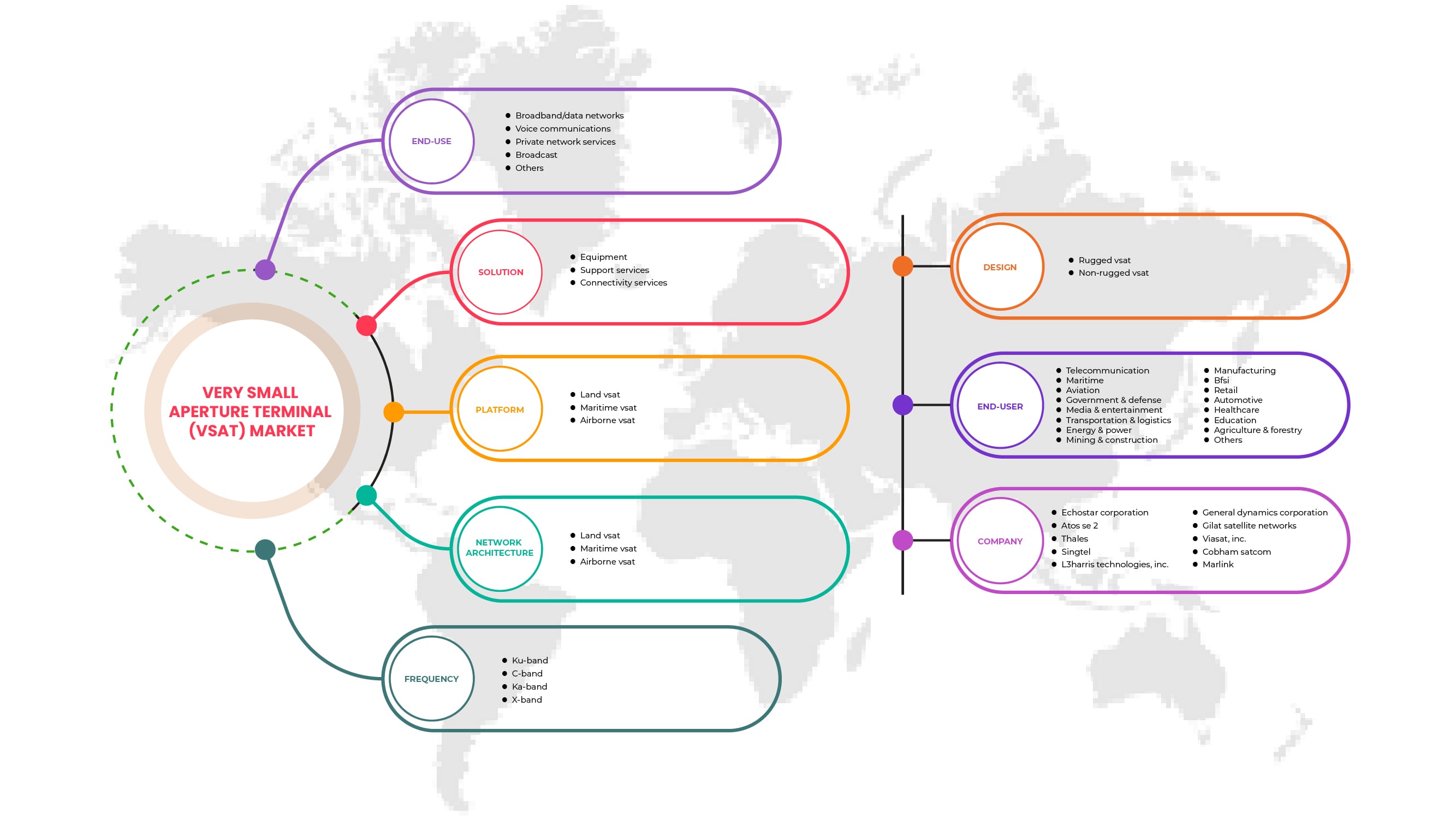
América do Norte muito pequeno mercado terminal de abertura (VSAT) é segmentado com base em solução, plataforma, frequência, arquitetura de rede, design, uso vertical e final. O crescimento entre esses segmentos irá ajudá-lo a analisar segmentos de crescimento escassos nas indústrias e fornecer aos usuários uma visão geral de mercado valiosa e insights de mercado para ajudá-los a tomar decisões estratégicas para identificar aplicações de mercado principais.
Solução
- Equipamento
- Serviços de apoio
- Serviços de Conectividade
Com base na solução, o mercado do terminal de abertura (VSAT) muito pequeno da América do Norte é segmentado em equipamentos, serviços de suporte, serviços de conectividade.
Plataforma
- Terra VSAT
- VSAT marítimo
- VSAT de bordo
Com base na plataforma, o mercado do terminal de abertura muito pequeno da América do Norte (VSAT) foi segmentado em terra VSAT, VSAT marítimo, VSAT aéreo.
Frequência
- Ku-Band
- Banda C
- Ka-Band
- Banda X
Com base na frequência, o mercado de terminais de abertura muito pequeno (VSAT) da América do Norte foi segmentado para Ku-band, banda C, banda Ka e banda X.
Arquitetura de rede
- Topologia Estelar
- Topologia da Malha
- Topologia híbrida
- Ligações Ponto- a- Ponto
Com base na arquitetura de rede, o mercado de terminais de abertura muito pequeno (VSAT) da América do Norte foi segmentado em topologia de estrela, topologia de malha, topologia híbrida e ligações ponto-a-ponto.
Desenho
- VSAT robusto
- VSAT Não Rugged
Com base no design, o mercado de terminais de abertura muito pequeno (VSAT) da América do Norte é segmentado em VSAT robusto, VSAT não-robusto.
Vertical
- Telecomunicações
- Marítimo
- Aviação
- Governo e Defesa
- Mídia e entretenimento
- Transporte e Logística
- Energia e Energia
- Mineração e Construção
- Fabricação
- BFSI
- Retalho
- Automóvel
- Transporte e Logística
- Cuidados de saúde
- Educação
- Agricultura e Florestas
- Outros
Com base na vertical, o mercado de terminal de abertura muito pequena (VSAT) da América do Norte é segmentado em telecomunicações, marítima, aviação, governo e defesa, mídia e entretenimento, transporte e logística, energia e energia, mineração e construção, fabricação, BFSI, varejo, automotivo, transporte e logística, saúde, educação, agricultura e silvicultura, outros.
Uso Final
- Banda Larga/Rede de Dados
- Comunicação de voz
- Serviço de rede privada
- Transmissão
- Outros
Com base no uso final, o mercado de terminais de abertura muito pequeno (VSAT) da América do Norte é segmentado em rede de banda larga/dados, comunicação de voz, serviço de rede privada, transmissão, outros.
América do Norte Terminal de Abertura Muito Pequeno (VSAT) Análise/Insights Regionais de Mercado
O mercado de terminais de abertura muito pequeno (VSAT) da América do Norte é analisado, e as insights e tendências do tamanho do mercado são fornecidas pelo país, tipo de material, processo de fabricação e indústria de uso final, conforme referido acima.
Os países cobertos no terminal de abertura muito pequeno da América do Norte (VSAT) são os EUA, Canadá e México na América do Norte.
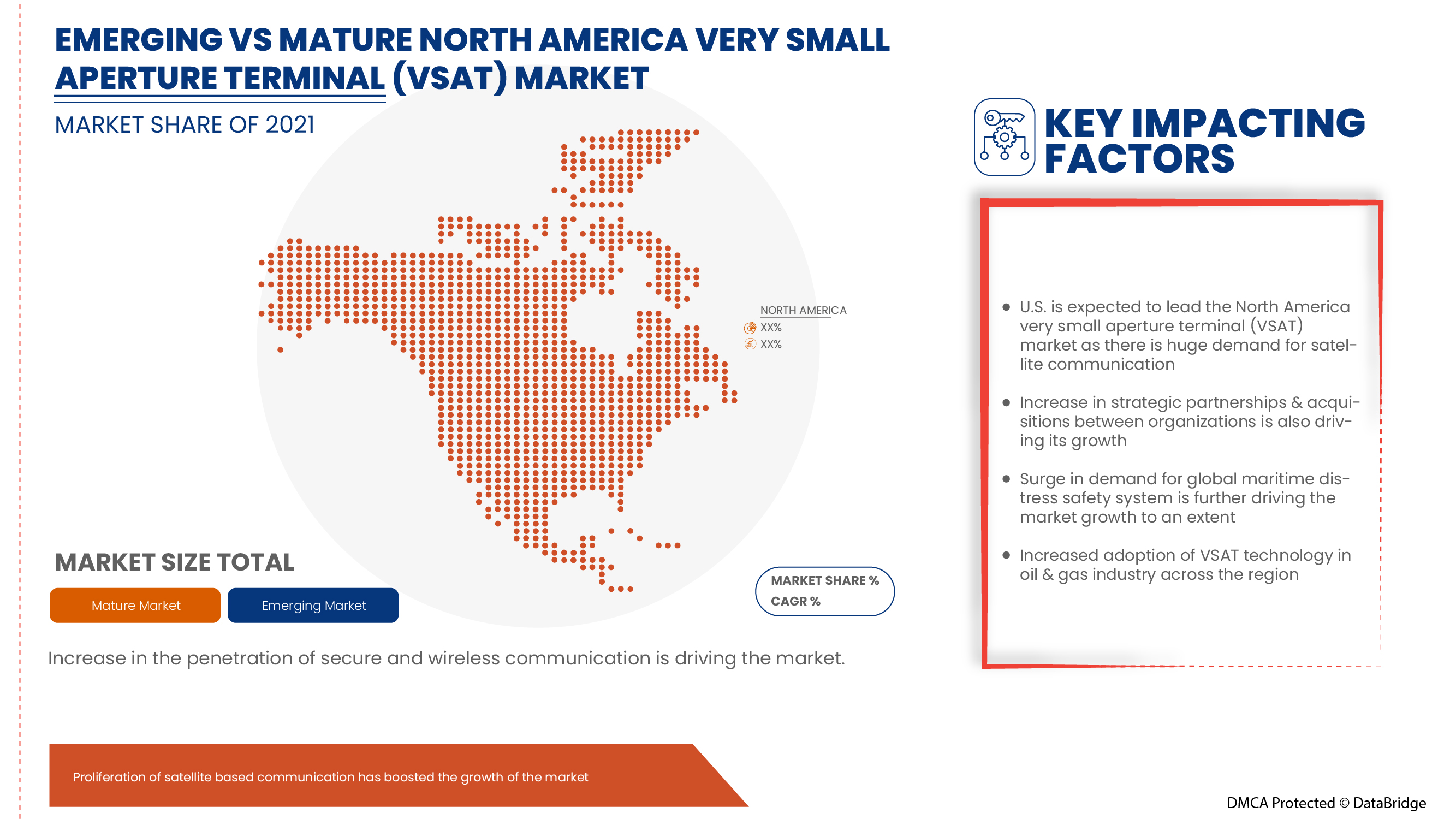
Os EUA dominam a região da América do Norte devido à rápida adoção de tecnologia de comunicação via satélite e ao aumento das atividades de pesquisa e desenvolvimento para reduzir o tamanho da antena.
A secção «país» do relatório também fornece factores de impacto individuais no mercado e alterações na regulamentação do mercado que afectam as tendências actuais e futuras do mercado. Pontos de dados como análise da cadeia de valor a jusante e a montante, tendências técnicas, análise de cinco forças porter e estudos de caso são alguns dos indicadores usados para prever o cenário de mercado para cada país. Além disso, a presença e disponibilidade de marcas globais e seus desafios enfrentados devido à grande ou escassa concorrência de marcas locais e nacionais, o impacto das tarifas nacionais e rotas comerciais são considerados ao fornecer análise de previsão dos dados do país.
Paisagem competitiva e América do Norte Terminal de abertura muito pequeno (VSAT) Análise de market share
América do Norte muito pequeno terminal de abertura (VSAT) mercado paisagem competitiva fornece detalhes do concorrente. Detalhes incluídos são visão geral da empresa, finanças da empresa, receita gerada, potencial de mercado, investimento em pesquisa e desenvolvimento, novas iniciativas de mercado, presença global, locais de produção e instalações, capacidades de produção, pontos fortes e fracos da empresa, lançamento do produto, largura e amplitude do produto, dominância da aplicação. Os pontos de dados acima fornecidos estão relacionados apenas com o foco das empresas relacionados com o mercado de terminais de abertura muito pequeno (VSAT).
Alguns dos principais jogadores que operam no terminal de abertura muito pequeno da América do Norte (VSAT) mercado são Singtel, Vizocom Company, x2nSat, C-COM Satellite Systems Inc, Marlink, Speedcast, NSSLGlobal, ST Engineering, Atos SE 2, Iridium Communications Inc., EchoStar Corporation, Orbit Communications Systems Ltd., Ultra, Nisshinbo Holdings Inc., General Dynamics Corporation, Honeywell International Inc., Cobham Satcom, Thales, GILAT SATELLITE NETWORKS, L3Harris Technologies, Inc., Viasat, Inc., KVH Industries, Inc., CPI International Inc., Global Invacom entre outros.
SKU-
Obtenha acesso online ao relatório sobre a primeira nuvem de inteligência de mercado do mundo

- Painel interativo de análise de dados
- Painel de análise da empresa para oportunidades de elevado potencial de crescimento
- Acesso de analista de pesquisa para personalização e customização. consultas
- Análise da concorrência com painel interativo
- Últimas notícias, atualizações e atualizações Análise de tendências
- Aproveite o poder da análise de benchmark para um rastreio abrangente da concorrência
Índice
1 INTRODUÇÃO
1.1 OBJECTIVOS DO ESTUDO
1.2 DEFINIÇÃO DE MERCADO
1.3 VISÃO GERAL DO MERCADO DA AMÉRICA DO NORTE
1.4 MOEDA E PREÇOS
1.5 LIMITAÇÕES
1.6 MERCADOS COBERTOS
2 SEGMENTAÇÃO DO MERCADO
2.1 MERCADOS COBERTOS
2.2 ÂMBITO GEOGRÁFICO
2.3 ANOS CONSIDERADOS PARA O ESTUDO
2.4 MODELO DE VALIDAÇÃO DE DADOS TRIPOD DBRR
2.5 INTERVENÇÕES PRIMÁRIAS COM OPINIÕES-CHAVE
2.6 GRIDE DE POSIÇÃO DO MERCADO DA DBRR
2.7 ANÁLISE DA PARTICIPAÇÃO DOS VENDANTES
2.8 MODELO MULTIVARIADO
2.9 Curva da linha do tempo da solução
2.1 MATRIX DOS DESAFIOS DE MERCADO
2.11 GRIDE DE CAPA DE PLATFORMA DE MERCADO
2.12 FONTES SEGUNDÁRIAS
2.13 ASSUNTOS
3 RESUMO
4 INSIGHTS PRÉMIO
4.1 MODELO DE CINCO FORÇAS DO PORTRO
4.2 ANÁLISE DA TECNOLOGIA
4.3 PROCESSOS DE UTILIZAÇÃO
4.3.1 A CONNECTIVIDADE CONFIÁVEL DOS VSAT MELHORA A ESTABILIDADE OPERACIONAL DAS EMPRESAS DO SOL
4.3.2 O CLIENTE VENCE A MAIOR OLEO E O CONTRATO DE GÁS UTILIZANDO A ARMA SECRETA DE WINEGARD
4.3.3 A SOLUÇÃO SATÉLITA DA VIZOCOM PROVENIENTES DO DEPARTAMENTO DA ACTIVIDADE DE EDUCAÇÃO DE DEFESA (DODEA) COM A CONNECTIVIDADE INTERNET À PUERTO RICO APÓS HURRICANE MARIA EM 2017
5 VISÃO GERAL DO MERCADO
5. 1 CONDUTORES
5.1.1 CRIAÇÃO DE DEMANDA DE COMUNICAÇÃO SEGURA PARA PEDIDOS MARÍTIMOS
5.1.2 AUMENTO DA APROVAÇÃO DA TECNOLOGIA VSAT NA INDÚSTRIA DO ÓLEO E DO GÁS
5.1.3 PROLIFERAÇÃO DA COMUNICAÇÃO BASEADA EM SATÉLITE NO SECTOR MILITAR E DEFESA
5.2 RESTRUÇÕES
5.2.1 RISING CYBER SEGURANÇA EM MATÉRIA DE PRESTAÇÕES E DADOS
5.2.2 QUESTÕES RELATIVAS À LATÊNCIA DOS DADOS NA TECNOLOGIA VSAT
5.3 OPORTUNIDADES
5.3.1 INQUÉRITO EM MATÉRIA DE EXERCÍCIO DO SISTEMA DE SEGURANÇA DO MARÍTIMO DO NORTE
5.3.2 AUMENTAR A PARCERIA E A AQUISIÇÃO ESTRATÉGICA ENTRE DIVERSAS ORGANIZAÇÕES
5.3.3 ADVENTO DOS PROVENIENTES DE SERVIÇO VSAT EM VÁRIOS SECTORES DE EMPRESAS
5.4 DESAFIOS
5.4.1 Custos mais elevados de segurança e instalação dos sistemas VSAT
5.4.2 QUESTÕES RELACIONADAS COM A CONFIABILIDADE DA REDE DE VSAT DURANTE O TAMANHO
5.4.3 OBSERVAÇÕES DE INTERFERÊNCIA EM REDES DE TERMINAL DE APERTURA MUITO PEQUENA (VSAT)
6 MERCADO DO TERMINAL DE APERTURA MUITO PEQUENA (VSAT), POR SOLUÇÃO
6.1 VISÃO GERAL
6. 2 EQUIPAMENTO
6.2.1 UNIDADES DE FORA
6.2.1.1 ANTENNAS
6.2.1.2 CONVERSOS DE FRÉQUÊNCIA
6.2.1.3 APLICÁVEIS
6.2.1.4 DIPLEXANTES
6.2.1.5 OUTROS
6.2.2 UNIDADES NA PORTA
6.2.2.1 MODEMO DE SATELLITE
6.2.2 VIAR SATELLITE
6.2.3 MONTANTES
6.2.4 UNIDADES DE CONTROLO ANTENA
6.2.5 OUTROS
6.2.6 SERVIÇOS DE APOIO
SERVIÇOS PROFISSIONAIS
6.2.6.1.1 SERVIÇOS DE MANUTENÇÃO E APOIO
6.2.6.1.2 ENGENHARIA E CONSULTA
6.2.6.1.3 FORMAÇÃO
SERVIÇOS DE GESTÃO
6.2.6.2.1 INSTALAÇÃO E CONSTRUÇÃO
6.2.6.2.2 DESIGN E OPTIMIZAÇÃO DA REDE
6.2.6.2.3 OPERAÇÕES DE REDE
6.3 SERVIÇOS DE CONNECTIVIDADE
7 MERCADO DO TERMINAL DE APERTURA MUITO PEQUENA (VSAT), POR PLATFORM
7.1 VISÃO GERAL
7.2 Terra VSAT
7.2.1 FIXADO
7.2.1.1.1 ESTAÇÃO TERRA
72.1.2 CONSTRUÇÕES COMERCIAIS
7.2.1.3 CENTROS DE COMANDO E CONTROLO
7.2.2 EM CIRCULAÇÃO
7.2.2.1 VEÍCULOS COMERCIAIS
VEÍCULOS MILITARES
7.2.2.3 TRAINHOS
VEÍCULOS DE EMERGÊNCIA
7.2.2.5 VEÍCULOS SEM FUNDAMENTO
7.2.3 PORTÁVEIS/MANPACOS
7.3 VSAT MARÍTIMO
7.3.1 NAVIOS COMERCIAIS
Navio militar 7.3.2
7.3.3 NAVIOS MARINHOS SEM MENÇÃO
7.4 VSAT AIRBORNE
7.4.1 AERONAVES COMERCIAIS
7.4.2 AERONAVES MILITARES
7.4.3 NAVIOS MARINHOS SEM MANTIDOS
8 MERCADO DO TERMINAL DE APERTURA MUITO PEQUENA (VSAT), POR ARQUITETURA DA REDE
8.1 VISÃO GERAL
8.2 TOPOLOGIA STAR
8,3 MESH TOPOLOGIA
8,4 TOPOLOGIA HIBRIDA
8.5 LINHAS PONTO-A-POINT
9 MERCADO DO TERMINAL DE APERTURA MUITO PEQUENA (VSAT), POR FREQUÊNCIA
9.1 VISÃO GERAL
9.2 KU-BAND
9.3 C-BAND
9.4 KA-BAND
9.5 X-BAND
10 MERCADO DO TERMINAL DE APERTURA MUITO PEQUENA (VSAT), POR PROJETO
10.1 VISÃO GERAL
10.2 VSAT RUGADO
10.3 VSAT NÃO RUGADO
11 MERCADO DO TERMINAL DE APERTURA MUITO PEQUENA (VSAT), POR VERTICAL
11.1 VISÃO GERAL
11.2 TELECOMUNICAÇÃO
11.2.1 EQUIPAMENTO
11.2.2 SERVIÇOS DE APOIO
11.2.3 SERVIÇOS DE CONNECTIVIDADE
11.3 MARÍTIMO
11.3.1 EQUIPAMENTO
11.3.2 SERVIÇOS DE APOIO
11.3.3 SERVIÇOS DE CONNECTIVIDADE
11.4 AVIAÇÃO
11.4.1 EQUIPAMENTO
11.4.2 SERVIÇOS DE APOIO
11.4.3 SERVIÇOS DE CONNECTIVIDADE
11.5 GOVERNO E DEFESA
11.5.1 EQUIPAMENTO
11.5.2 SERVIÇOS DE APOIO
11.5.3 SERVIÇOS DE CONNECTIVIDADE
11,6 MEDIA & ENTERtainMENT
11.6.1 EQUIPAMENTO
SERVIÇOS DE APOIO
11.6.3 SERVIÇOS DE CONNECTIVIDADE
11.7 TRANSPORTES E LOGÍSTICAS
11.7.1 EQUIPAMENTO
11.7.2 SERVIÇOS DE APOIO
11.7.3 SERVIÇOS DE CONNECTIVIDADE
11.8 ENERGIA & PODER
11.9 MINAÇÃO & CONSTRUÇÃO
11.9.1 EQUIPAMENTO
11.9.2 SERVIÇOS DE APOIO
11.9.3 SERVIÇOS DE CONNECTIVIDADE
11.1 FABRICO
11.10.1 EQUIPAMENTO
11.10.2 SERVIÇOS DE APOIO
11.10.3 SERVIÇOS DE CONNECTIVIDADE
11.11 BFSI
11.12 RETALHO
11.12.1 EQUIPAMENTO
11.12.2 SERVIÇOS DE APOIO
11.12.3 SERVIÇOS DE CONNECTIVIDADE
11.13 AUTOMÓVEIS
11.13.1 EQUIPAMENTO
11.13.2 SERVIÇOS DE APOIO
11.13.3 SERVIÇOS DE CONNECTIVIDADE
11.14 CARE DE SAÚDE
11.15 EDUCAÇÃO
11.16 AGRICULTURA E FLORESTA
11.16.1 EQUIPAMENTO
11.16.2 SERVIÇOS DE APOIO
11.16.3 SERVIÇOS DE CONNECTIVIDADE
11.17 OUTRAS
12 MERCADO DO TERMINAL DE APERTURA MUITO PEQUENA (VSAT), POR FIM
12.1 VISÃO GERAL
12.2 REDES BROADBAND/DATA
12.3. COMUNICAÇÕES DE VOZ
12.4 SERVIÇOS DE REDE PRIVADA
12,5 BROADCAST
12.6 OUTRAS
13 MERCADO DO TERMINAL DE APERTURA MUITO PEQUENA (VSAT), POR REGIÃO
13.1 AMÉRICA DO NORTE
13.1.1 Estados Unidos
13.1.2 CANADÁ
13.1.3 MÉXICO
14 MERCADO DO TERMINAL DE APERTURA MUITO PEQUENA (VSAT) DA AMÉRICA DO NORTE: COMPANHIA PAISCAPE
15 ANLISE SUCA
16 PERFIL DE COMPAMIBILIDADE
16.1 CORPORAÇÃO ECHOSTAR
16.1.1 EMPRESA SNAPSHOT
ANÁLISE DAS RECEITAS
16.1.3 ANÁLISE DA COMPANHIA
16.1.4 PRODUTO PORTFÓLIO
16.1.5 DESENVOLVIMENTO RECENTE
16.2 ATOS SE
16.2.1 EMPRESA SNAPSHOT
16.2.2 ANÁLISE DAS RECEITAS
16.2.3 ANÁLISE PARTICIPAL
16.2.4 PRODUTOS PORTFÓLIO
16.2.5 EVOLUÇÃO RECENTE
16.3 FALTAS
16.3.1 EMPRESA SNAPSHOT
ANÁLISE DAS RECEITAS 16.3.2
16.3.3 ANÁLISE PARTICIPAL
16.3.4 PRODUTO PORTFÓLIO
16.3.5 DESENVOLVIMENTO RECENTE
16. 4 SINGTEL
16.4.1 EMPRESA SNAPSHOT
16.4.2 ANÁLISE DAS RECEITAS
16.4.3 ANÁLISE DA COMPANHIA
16.4.4 PRODUTO PORTFOLIO
16.4.5 DESENVOLVIMENTO RECENTE
16,5 TECNOLOGIAS L3HARRIS, INC
16.5.1 EMPRESA SNAPSHOT
ANÁLISE DAS RECEITAS
16.5.3 ANÁLISE DA COMPANHIA
16.5.4 PRODUTO PORTFÓLIO
16.5.5 EVOLUÇÃO RECENTE
16,6 CORPORAÇÃO DINAMICA GERAL
16.6.1 EMPRESA SNAPSHOT
ANÁLISE DAS RECEITAS
16.6.3 PRODUTO PORTFOLIO
16.6.4 EVOLUÇÃO RECENTE
16.7 REDES DE SATELLITE DE GILAT
16.7.1 EMPRESA SNAPSHOT
ANÁLISE DE RECEITAS 16.7.2
16.7.3 PRODUTO PORTFÓLIO
16.7.4 EVOLUÇÃO RECENTE
16.8 Sistemas C-COM Satellite INC.
16.8.1 EMPRESA SNAPSHOT
16.8.2 ANÁLISE DAS RECEITAS
16.8.3 PRODUTO PORTFOLIO
16.8.4 EVOLUÇÃO RECENTE
16.9 COBHAM SATCOM
16.9.1 EMPRESA SNAPSHOT
16.9.2 PRODUTO PORTFÓLIO
16.9.3 EVOLUÇÃO RECENTE
16.1 CPI INTERNATIONAL INC.
16.10.1 EMPRESA SNAPSHOT
16.10.2 PRODUTO PORTFÓLIO
16.10.3 DESENVOLVIMENTO RECENTE
16.11 INVACOM AMÉRICA DO NORTE
16.11.1 EMPRESA SNAPSHOT
ANÁLISE DE RECEITAS
16.11.3 SERVIÇOS PORTFOLIO
16.11.4 DESENVOLVIMENTO RECENTE
16.12 INC INTERNACIONAL HONEWELL.
16.12.1 EMPRESA SNAPSHOT
ANÁLISE DAS RECEITAS
16.12.3 PRODUTO PORTFOLIO
16.12.4 EVOLUÇÃO RECENTE
16.13 COMUNICAÇÕES IRIDIUM INC.
16.13.1 EMPRESA SNAPSHOT
16.13.2 ANÁLISE DAS RECEITAS
16.13.3 SERVIÇO PORTFÓLIO
16.13.4 DESENVOLVIMENTO RECENTE
16.14 INDÚSTRIAS KVH, INC.
16.14.1 EMPRESA SNAPSHOT
ANÁLISE DAS RECEITAS
16.14.3 SOLUÇÃO PORTFÓLIO
16.14.4 DESENVOLVIMENTO RECENTE
16.15 MARLINK
16.15.1 EMPRESA SNAPSHOT
16.15.2 SOLUÇÃO PORTFÓLIO
16.15.3 DESENVOLVIMENTOS RECENTES
16.16 NISSHINBO holdings INC.
16.16.1 EMPRESA SNAPSHOT
ANÁLISE DAS RECEITAS
16.16.3 PRODUTO PORTFOLIO
16.16.4 DESENVOLVIMENTOS RECENTES
16.17 NSSL América do Norte
16.17.1 EMPRESA SNAPSHOT
16.17.2 PRODUTO PORTFÓLIO
16.17.3 DESENVOLVIMENTO RECENTE
16.18 SISTEMAS DE COMUNICAÇÕES DE ORBIT LTD.
16.18.1 EMPRESA SNAPSHOT
ANÁLISE DAS RECEITAS
16.18.3 PRODUTO PORTFÓLIO
16.18.4 EVOLUÇÃO RECENTE
16.19 SPEEDCAST
16.19.1 EMPRESA SNAPSHOT
16.19.2 SOLUÇÃO PORTFÓlio
16.19.3 EVOLUÇÃO RECENTE
16.2 ENGENHARIA
16.20.1 EMPRESA SNAPSHOT
16.20.2 ANÁLISE DE RECEITAS
16.20.3 PRODUTO PORTFÓLIO
16.20.4 DESENVOLVIMENTO RECENTE
16.21 COMPANHIA DAS TELECOMUNICAÇÕES DE THURAYA
16.21.1 EMPRESA SNAPSHOT
16.21.2 SERVIÇO PORTFÓLIO
16.21.3 DESENVOLVIMENTO RECENTE
16.22 ULTRA
16.22.1 EMPRESA SNAPSHOT
16.22.2 ANÁLISE DAS RECEITAS
16.22.3 PRODUTO PORTFÓLIO
16.22.4 EVOLUÇÃO RECENTE
16.23 VIASAT, INC.
16.23.1 EMPRESA SNAPSHOT
ANÁLISE DAS RECEITAS
16.23.3 PRODUTO PORTFÓLIO
16.23.4 DESENVOLVIMENTOS RECENTES
16.24 EMPRESA VIZOCOM
16.24.1 EMPRESA SNAPSHOT
16.24.2 SOLUÇÃO PORTFOLIO
16.24.3 DESENVOLVIMENTO RECENTE
16.25 X2NSAT
16.25.1 EMPRESA SNAPSHOT
16.25.2 SERVIÇO PORTFÓLIO
16.25.3 DESENVOLVIMENTO RECENTE
17 QUESTIONÁRIO
18 RELATÓRIOS RELACIONADOS
Lista de Tabela
QUADRO 1 ACTOS DE CYBER SOBRE NAVIOS/ INDÚSTRIA MARÍTIMA
QUADRO 2
QUADRO 3 AMÉRICA DO NORTE
QUADRO 4 EQUIPAMENTO DA AMÉRICA DO NORTE NO MERCADO DO TERMINAL DE APERTURA MUITO PEQUENA (VSAT), POR REGIÃO, 2020-2029 (USD mil)
QUADRO 5 EQUIPAMENTO DA AMÉRICA DO NORTE NO MERCADO DO TERMINAL DE APERTURA MUITO PEQUENA (VSAT), POR TIPO 2020-2029 (USD MIL)
QUADRO 6 UNIDADES EXTERNAS DA AMÉRICA DO NORTE EM MERCADO TERMINAL DE APERTURA MUITO PEQUENA (VSAT), POR TIPO 2020-2029 (USD mil)
QUADRO 7 UNIDADES DA AMÉRICA DO NORTE EM TERMINAL DE APERTURA MUITO PEQUENA (VSAT), POR TIPO 2020-2029 (USD MIL)
QUADRO 8 SERVIÇOS DE APOIO À AMÉRICA DO NORTE NO MERCADO DO TERMINAL DE APERTURA MUITO PEQUENA (VSAT), POR REGIÃO, 2020-2029 (USD mil)
QUADRO 9 SERVIÇOS DE APOIO À AMÉRICA DO NORTE EM MERCADO DE TERMINAL DE APERTURA MUITO PEQUENA (VSAT), POR TIPO 2020-2029 (USD MIL)
QUADRO 10
QUADRO 11 SERVIÇOS DE GESTÃO DA AMÉRICA DO NORTE NO MERCADO DO TERMINAL DE APERTURA MUITO PEQUENA (VSAT), POR TIPO 2020-2029 (USD MIL)
QUADRO 12 SERVIÇOS DE CONNECTIVIDADE DA AMÉRICA DO NORTE NO MERCADO DO TERMINAL DE APERTURA MUITO PEQUENA (VSAT), POR REGIÃO, 2020-2029 (USD MIL)
QUADRO 13 AMÉRICA DO NORTE MERCADO DO TERMINAL DE APERTURA MUITO PEQUENA (VSAT), POR PLATFORM, 2020-2029 (USD MIL)
QUADRO 14 PAÍSES DA AMÉRICA DO NORTE VSAT NO MERCADO DO TERMINAL DE APERTURA MUITO PEQUENA (VSAT), POR REGIÃO, 2020-2029 (USD MIL)
QUADRO 15 PAÍSES DA AMÉRICA DO NORTE VSAT EM MERCADO DE TERMINAL DE APERTURA MUITO PEQUENA (VSAT), POR TIPO, 2020-2029 (USD MIL)
QUADRO 16 AMÉRICA NORTE FIXADA EM MERCADO TERMINAL DE APERTURA MUITO PEQUENA (VSAT), POR TIPO 2020-2029 (USD MIL)
QUADRO 17 AMÉRICA DO NORTE EM VIGOR NO MERCADO DO TERMINAL DE APERTURA MUITO PEQUENA (VSAT), POR TIPO 2020-2029 (USD mil)
QUADRO 18 VSAT MARITIMA DA AMÉRICA DO NORTE NO MERCADO DO TERMINAL DE APERTURA MUITO PEQUENA (VSAT), POR REGIÃO, 2020-2029 (USD THOUSand)
QUADRO 19 VSAT MARITIMA DA AMÉRICA DO NORTE NO MERCADO DO TERMINAL DE APERTURA MUITO PEQUENA (VSAT), POR TIPO 2020-2029 (USD MILHÕES DE USD)
QUADRO 20 VSAT AIRBORNE DA AMÉRICA DO NORTE NO MERCADO DO TERMINAL DE APERTURA MUITO PEQUENA (VSAT), POR REGIÃO, 2020-2029 (USD MIL)
QUADRO 21 VSAT AIRBORNE DA AMÉRICA DO NORTE NO MERCADO DO TERMINAL DE APERTURA MUITO PEQUENA (VSAT), POR TIPO 2020-2029 (USD MIL)
QUADRO 22 AMÉRICA DO NORTE MERCADO DE TERMINAL DE APERTURA MUITO PEQUENA (VSAT), POR ARQUITETURA DA REDE, 2020-2029 (USD MILHÕES DE USD)
QUADRO 23
QUADRO 24
QUADRO 25 TOPOLOGIA HÍBRIDA DA AMÉRICA DO NORTE NO MERCADO DO TERMINAL DE APERTURA MUITO PEQUENA (VSAT), POR REGIÃO, 2020-2029 (USD THOUSand)
QUADRO 26
QUADRO 27
QUADRO 28
QUADRO 29
QUADRO 30 DA AMÉRICA DO NORTE
QUADRO 31
QUADRO 32 AMÉRICA DO NORTE MERCADO DO TERMINAL DE APERTURA MUITO PEQUENA (VSAT), POR PROJETO, 2020-2029 (USD THOUSand)
QUADRO 33 A AMÉRICA DO NORTE RUGOU A VSAT NO MERCADO DO TERMINAL DE APERTURA MUITO PEQUENA (VSAT), POR REGIÃO, 2020-2029 (USD THOUSand)
QUADRO 34 DA AMÉRICA DO NORTE NÃO RUGIDA EM MERCADO TERMINAL DE APERTURA MUITO PEQUENA (VSAT), POR REGIÃO, 2020-2029 (USD THOUSand)
QUADRO 35 AMÉRICA DO NORTE
QUADRO 36 TELECOMUNICAÇÃO AMÉRICA DO NORTE NO MERCADO DO TERMINAL DE APERTURA MUITO PEQUENA (VSAT), POR REGIÃO, 2020-2029 (USD MILHÕES DE USD)
QUADRO 37 TELECOMUNICAÇÃO DA AMÉRICA DO NORTE NO MERCADO DO TERMINAL DE APERTURA MUITO PEQUENA (VSAT), POR SOLUÇÃO, 2020-2029 (USD MIL)
QUADRO 38 MARÍTIMO DA AMÉRICA DO NORTE NO MERCADO DO TERMINAL DE APERTURA MUITO PEQUENA (VSAT), POR REGIÃO, 2020-2029 (USD mil)
QUADRO 39 MARÍTIMO DA AMÉRICA DO NORTE NO MERCADO DO TERMINAL DE APERTURA MUITO PEQUENA (VSAT), POR SOLUÇÃO, 2020-2029 (USD mil)
QUADRO 40 AVIAÇÃO DA AMÉRICA DO NORTE EM MERCADO TERMINAL DE APERTURA MUITO PEQUENA (VSAT), POR REGIÃO, 2020-2029 (USD MIL)
QUADRO 41 AVIAÇÃO DA AMÉRICA DO NORTE NO MERCADO DO TERMINAL DE APERTURA MUITO PEQUENA (VSAT), POR SOLUÇÃO, 2020-2029 (USD MIL)
QUADRO 42
QUADRO 43
QUADRO 44 MEDIA & ENTERTENAMENTO DA AMÉRICA DO NORTE NO MERCADO DO TERMINAL DE APERTURA MUITO PEQUENA (VSAT), POR REGIÃO, 2020-2029 (USD MIL)
QUADRO 45 MEDIA E EMPRESA NO NORTE NO MERCADO DO TERMINAL DE APERTURA MUITO PEQUENA (VSAT), POR SOLUÇÃO, 2020-2029 (USD MIL)
QUADRO 46 TRANSPORTE E LOGÍSTICAS DA AMÉRICA DO NORTE NO MERCADO DO TERMINAL DE APERTURA MUITO PEQUENA (VSAT), POR REGIÃO, 2020-2029 (USD MIL)
QUADRO 47 TRANSPORTE E LOGÍSTICAS DA AMÉRICA DO NORTE NO MERCADO DO TERMINAL DE APERTURA MUITO PEQUENA (VSAT), POR SOLUÇÃO, 2020-2029 (USD MIL)
QUADRO 48 ENERGIA E PODER DA AMÉRICA DO NORTE NO MERCADO DO TERMINAL DE APERTURA MUITO PEQUENA (VSAT), POR REGIÃO, 2020-2029 (USD MIL)
QUADRO 49 MINURAÇÃO E CONSTRUÇÃO DA AMÉRICA DO NORTE NO MERCADO DO TERMINAL DE APERTURA MUITO PEQUENA (VSAT), POR REGIÃO, 2020-2029 (USD THOUSand)
QUADRO 50 MINURAÇÃO E CONSTRUÇÃO DA AMÉRICA DO NORTE NO MERCADO DO TERMINAL DE APERTURA MUITO PEQUENA (VSAT), POR SOLUÇÃO, 2020-2029 (MIL DE USD)
QUADRO 51 FABRICO DA AMÉRICA DO NORTE NO MERCADO DO TERMINAL DE APERTURA MUITO PEQUENA (VSAT), POR REGIÃO, 2020-2029 (USD mil)
QUADRO 52 FABRICAÇÃO DA AMÉRICA DO NORTE NO MERCADO DO TERMINAL DE APERTURA MUITO PEQUENA (VSAT), POR SOLUÇÃO, 2020-2029 (USD mil)
QUADRO 53 BFSI AMÉRICA DO NORTE NO MERCADO DO TERMINAL DE APERTURA MUITO PEQUENA (VSAT), POR REGIÃO, 2020-2029 (USD MIL)
QUADRO 54 RETALHO DA AMÉRICA DO NORTE NO MERCADO DO TERMINAL DE APERTURA MUITO PEQUENA (VSAT), POR REGIÃO, 2020-2029 (USD MIL)
QUADRO 55 RETALHO DA AMÉRICA DO NORTE NO MERCADO DO TERMINAL DE APERTURA MUITO PEQUENA (VSAT), POR SOLUÇÃO, 2020-2029 (USD MIL)
QUADRO 56 AUTOMOTIVO DA AMÉRICA DO NORTE NO MERCADO DO TERMINAL DE APERTURA MUITO PEQUENA (VSAT), POR REGIÃO, 2020-2029 (USD mil)
QUADRO 57 AUTOMOTIVO DA AMÉRICA DO NORTE NO MERCADO DO TERMINAL DE APERTURA MUITO PEQUENA (VSAT), POR SOLUÇÃO, 2020-2029 (USD mil)
QUADRO 58
QUADRO 59 EDUCAÇÃO DA AMÉRICA DO NORTE NO MERCADO DO TERMINAL DE APERTURA MUITO PEQUENA (VSAT), POR REGIÃO, 2020-2029 (USD mil)
QUADRO 60 AGRICULTURA E FLORESTA DA AMÉRICA DO NORTE NO MERCADO DO TERMINAL DE APERTURA MUITO PEQUENA (VSAT), POR REGIÃO, 2020-2029 (MIL DEUS)
QUADRO 61 AGRICULTURA E FLORESTA DA AMÉRICA DO NORTE NO MERCADO DO TERMINAL DE APERTURA MUITO PEQUENA (VSAT), POR SOLUÇÃO, 2020-2029 (MIL DEUS)
QUADRO 62 OUTROS PAÍSES DA AMÉRICA DO NORTE NO MERCADO DO TERMINAL DE APERTURA MUITO PEQUENA (VSAT), POR REGIÃO, 2020-2029 (USD MIL)
QUADRO 63 AMÉRICA DO NORTE MERCADO DO TERMINAL DE APERTURA MUITO PEQUENA (VSAT), POR END-USE, 2020-2029 (USD MILHÕES DE USD)
QUADRO 64 REDES BROADBAND/DATA DA AMÉRICA DO NORTE NO MERCADO DO TERMINAL DE APERTURA MUITO PEQUENA (VSAT), POR REGIÃO, 2020-2029 (USD MIL)
QUADRO 65
QUADRO 66 REDE PRIVADA DA AMÉRICA DO NORTE
QUADRO 67
QUADRO 68 OUTROS PAÍSES DA AMÉRICA DO NORTE EM MERCADO TERMINAL DE APERTURA MUITO PEQUENA (VSAT), POR REGIÃO, 2020-2029 (USD MIL)
QUADRO 69 AMÉRICA DO NORTE MERCADO DO TERMINAL DE APERTURA MUITO PEQUENA (VSAT), POR PAÍS, 2020-2029 (USD MIL)
Lista de Figura
FIGURA 1 AMÉRICA DO NORTE MERCADO DO TERMINAL DE APERTURA MUITO PEQUENA (VSAT): SEGMENTAÇÃO
FIGURA 2 MERCADO DO TERMINAL DE APERTURA MUITO PEQUENA (VSAT): TRIANGULAÇÃO DE DADOS
FIGURA 3 AMÉRICA DO NORTE MERCADO DO TERMINAL DE APERTURA MUITO PEQUENA (VSAT): ANÁLISE DE DROC
FIGURA 4 AMÉRICA DO NORTE MERCADO DO TERMINAL DE APERTURA MUITO PEQUENA (VSAT): ANÁLISE REGIONAL DO MERCADO DO NORTE
FIGURA 5 AMÉRICA DO NORTE MERCADO DO TERMINAL DE APERTURA MUITO PEQUENA (VSAT): ANÁLISE DA INVESTIGAÇÃO DA EMPRESA
FIGURA 6 MERCADO DO TERMINAL DE APERTURA MUITO PEQUENA (VSAT): DEMOGRAFIAS DE ENTREVISTAS
FIGURA 7 AMÉRICA DO NORTE MERCADO DO TERMINAL DE APERTURA MUITO PEQUENA (VSAT): GRIDE DE POSIÇÃO DO MERCADO DA DBRM
FIGURA 8 AMÉRICA DO NORTE MERCADO DO TERMINAL DE APERTURA MUITO PEQUENA (VSAT): ANÁLISE DA PARTICIPAÇÃO DOS VENDANTES
FIGURA 9 AMÉRICA DO NORTE MUITO PEQUENA TERMINAL DE APERTURA (VSAT) MERCADO: GRIDE DE COBERTURA DE PLATFORMES DE MERCADO
FIGURA 10 AMÉRICA DO NORTE MERCADO DO TERMINAL DE APERTURA MUITO PEQUENA (VSAT): SEGMENTAÇÃO
FIGURA 11 A AMÉRICA DO NORTE ESPERA-SE PARA DOMINAR CONSIDERANDO QUE O PACÍFICO ÁSIA É A REGIÃO MAIS CRESCENTE NA AMÉRICA DO NORTE MUITO PEQUENA TERMINAL DE APERTURA (VSAT) NO PERÍODO PREVISTO
FIGURA 12 A ÁSIA-PACÍFICO É O MERCADO DE CRESCIMENTO MAIS FRESCO PARA OS FABRICANTES TERMINAIS DE APERTURA MUITO PEQUENAS NO PERÍODO PREVISTO
FIGURA 13 A PROLIFERAÇÃO DA COMUNICAÇÃO BASEADA EM SATÉLITE NO SECTOR MILITAR E DEFESA ESPERA-SE QUE NO PERÍODO FOREMAS 2022 A 2029 NO MERCADO DO TERMINAL DE APERTURA MUITO PEQUENA (VSAT)
FIGURA 14 O SEGMENTO DE EQUIPAMENTO ESTÁ ESPERADO EM CONTA PARA A PARTICIPAÇÃO MAIS LARGESTA DO MERCADO DO TERMINAL DE APERTURA MUITO PEQUENA EM 2022 E 2029
FIGURA 15 IMPACTO DAS VARIAS TECNOLOGIA DE SATELITE E INOVAÇÕES EM 2022
FIGURA 16 DIRECTORES, RESTRUMENTOS, OPORTUNIDADES E DESAFIOS DO MERCADO DA AMÉRICA DO NORTE
FIGURA 17 PARTICIPAÇÃO DO MERCADO REGIONAL NO DOMÍNIO DO SERVIÇO
FIGURA 18 Perdas de navegação da América do Norte pelo número de navios ao longo dos anos
FIGURA 19 MERCADO DO TERMINAL DE APERTURA MUITO PEQUENA (VSAT), SOLUÇÃO, 2021
FIGURA 20 AMÉRICA DO NORTE MERCADO DE TERMINAL DE APERTURA MUITO PEQUENA (VSAT), PLATFORM, 2021 (USD MIL)
FIGURA 21 AMÉRICA DO NORTE MERCADO DE TERMINAL DE APERTURA MUITO PEQUENA (VSAT), ARQUITETURA DE REDE, 2021 (USD MILHÕES)
FIGURA 22 AMÉRICA DO NORTE MERCADO DE TERMINAL DE APERTURA MUITO PEQUENA (VSAT), FREQUÊNCIA, 2021 (USD MIL)
FIGURA 23 AMÉRICA DO NORTE MUITO PEQUENA TERMINAL DE APERTURA (VSAT) MERCADO, PROJETO, 2021 (USD MILHÕES)
FIGURA 24 AMÉRICA DO NORTE MERCADO TERMINAL DE APERTURA MUITO PEQUENA (VSAT), VERTICAL, 2021
FIGURA 25 AMÉRICA DO NORTE MUITO PEQUENA TERMINAL DE APERTURA (VSAT) MERCADO, END-USE, 2021 (USD MIL)
FIGURA 26 MERCADO DO TERMINAL DE APERTURA MUITO PEQUENA (VSAT): SNAPSHOT (2021)
FIGURA 27 AMÉRICA DO NORTE MERCADO DE TERMINAL DE APERTURA MUITO PEQUENA (VSAT): POR PAÍS (2021)
FIGURA 28 MERCADO DO TERMINAL DE APERTURA MUITO PEQUENA (VSAT): POR PAÍS (2022 e 2029)
FIGURA 29 AMÉRICA DO NORTE MERCADO DO TERMINAL DE APERTURA MUITO PEQUENA (VSAT): POR PAÍS (2021 e 2029)
FIGURA 30 AMÉRICA DO NORTE MERCADO DO TERMINAL DE APERTURA MUITO PEQUENA (VSAT): POR SOLUÇÃO (2022-2029)
FIGURA 31 AMÉRICA DO NORTE MERCADO DO TERMINAL DE APERTURA MUITO PEQUENA (VSAT): COMPANHIA COMPARTILHE 2021 (%)

Metodologia de Investigação
A recolha de dados e a análise do ano base são feitas através de módulos de recolha de dados com amostras grandes. A etapa inclui a obtenção de informações de mercado ou dados relacionados através de diversas fontes e estratégias. Inclui examinar e planear antecipadamente todos os dados adquiridos no passado. Da mesma forma, envolve o exame de inconsistências de informação observadas em diferentes fontes de informação. Os dados de mercado são analisados e estimados utilizando modelos estatísticos e coerentes de mercado. Além disso, a análise da quota de mercado e a análise das principais tendências são os principais fatores de sucesso no relatório de mercado. Para saber mais, solicite uma chamada de analista ou abra a sua consulta.
A principal metodologia de investigação utilizada pela equipa de investigação do DBMR é a triangulação de dados que envolve a mineração de dados, a análise do impacto das variáveis de dados no mercado e a validação primária (especialista do setor). Os modelos de dados incluem grelha de posicionamento de fornecedores, análise da linha de tempo do mercado, visão geral e guia de mercado, grelha de posicionamento da empresa, análise de patentes, análise de preços, análise da quota de mercado da empresa, normas de medição, análise global versus regional e de participação dos fornecedores. Para saber mais sobre a metodologia de investigação, faça uma consulta para falar com os nossos especialistas do setor.
Personalização disponível
A Data Bridge Market Research é líder em investigação formativa avançada. Orgulhamo-nos de servir os nossos clientes novos e existentes com dados e análises que correspondem e atendem aos seus objetivos. O relatório pode ser personalizado para incluir análise de tendências de preços de marcas-alvo, compreensão do mercado para países adicionais (solicite a lista de países), dados de resultados de ensaios clínicos, revisão de literatura, mercado remodelado e análise de base de produtos . A análise de mercado dos concorrentes-alvo pode ser analisada desde análises baseadas em tecnologia até estratégias de carteira de mercado. Podemos adicionar quantos concorrentes necessitar de dados no formato e estilo de dados que procura. A nossa equipa de analistas também pode fornecer dados em tabelas dinâmicas de ficheiros Excel em bruto (livro de factos) ou pode ajudá-lo a criar apresentações a partir dos conjuntos de dados disponíveis no relatório.











