


Asia-Pacific 2D Machine Vision Market Segmentation, By Product (Lighting, Lenses, Image Sensor, and Vision Processing), Platform (PC-Based, Vision Controllers, Standalone Vision Systems, Vision Sensors, and Image-Based Barcode Readers), Application (Inspection, Gauging, Pattern Recognition, Identification, and Location Analysis), End User (Automotive, Semiconductor and Electronics, Food, Plastic, Metal, Healthcare, Logistic, Printing, Wood, and Aerospace and Defense) - Industry Trends and Forecast to 2033
Asia-Pacific 2D Machine Vision Market Size
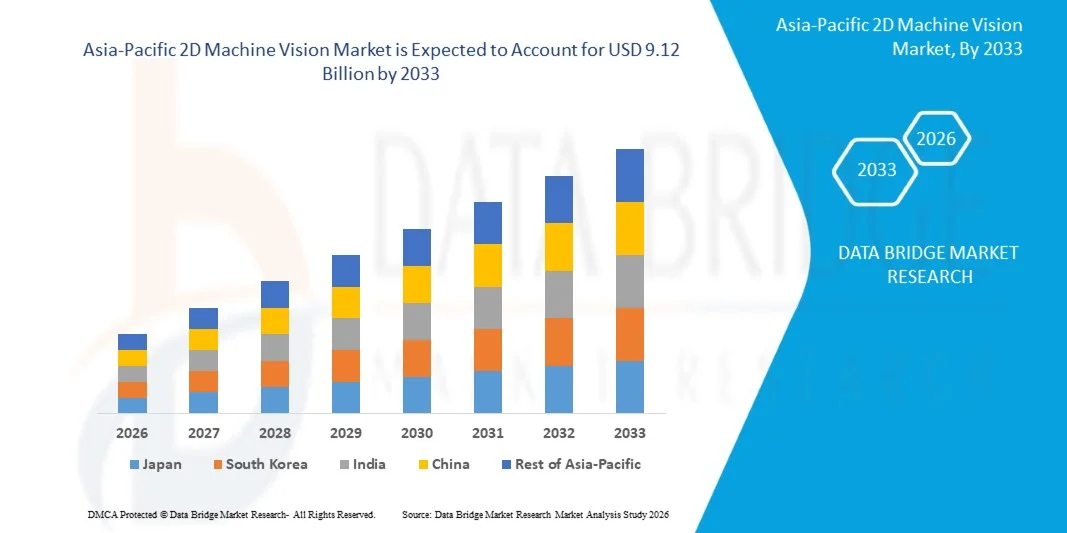
- The Asia-Pacific 2D Machine Vision Market size was valued at USD 4.38 billion in 2025 and is expected to reach USD 9.12 billion by 2033, at a CAGR of 9.60% during the forecast period
- The market growth is largely fueled by the increasing adoption of industrial automation and the rapid advancement of imaging technologies, leading to enhanced precision and efficiency in manufacturing processes across various industries
- Furthermore, rising demand for high-quality inspection, defect detection, and real-time monitoring in production environments is establishing 2D machine vision systems as essential components of modern manufacturing. These converging factors are accelerating the integration of machine vision solutions, thereby significantly boosting the market growth
Asia-Pacific 2D Machine Vision Market Analysis
- 2D machine vision systems are imaging-based technologies that enable automated inspection, measurement, and identification processes using cameras, sensors, and software algorithms. These systems play a critical role in enhancing quality control, improving operational efficiency, and reducing human intervention in industrial applications
- The growing demand for 2D machine vision systems is primarily driven by the expansion of smart manufacturing practices, increasing emphasis on zero-defect production, and the need for cost-effective automation solutions across industries such as automotive, electronics, and logistics
- Japan dominated the Asia-Pacific 2D Machine Vision Market in 2025, due to highly advanced manufacturing sector, strong presence of robotics and automation industries, and early adoption of precision inspection technologies across automotive and electronics production
- China is expected to be the fastest growing country in the Asia-Pacific 2D Machine Vision Market during the forecast period due to its expansive manufacturing base, rapid industrial automation, and increasing demand for advanced quality inspection systems across industries such as electronics and automotive
- Image sensor segment dominated the market with a market share of 42.5% in 2025, due to its critical role in capturing high-resolution images required for accurate inspection and analysis. Continuous advancements in CMOS and CCD sensor technologies have enhanced image clarity, speed, and sensitivity, making them indispensable in industrial automation environments. Industries increasingly rely on high-performance image sensors to detect defects, ensure quality control, and maintain production efficiency
Report Scope and Asia-Pacific 2D Machine Vision Market Segmentation
|
Attributes |
2D Machine Vision Key Market Insights |
|
Segments Covered |
|
|
Countries Covered |
Asia-Pacific
|
|
Key Market Players |
|
|
Market Opportunities |
|
|
Value Added Data Infosets |
In addition to the insights on market scenarios such as market value, growth rate, segmentation, geographical coverage, and major players, the market reports curated by the Data Bridge Market Research also include in-depth expert analysis, geographically represented company-wise production and capacity, network layouts of distributors and partners, detailed and updated price trend analysis and deficit analysis of supply chain and demand. |
Asia-Pacific 2D Machine Vision Market Trends
“Increasing Integration of AI and Deep Learning in Machine Vision Systems”
- A significant trend in the Asia-Pacific 2D Machine Vision Market is the increasing integration of artificial intelligence and deep learning algorithms into vision systems, driven by the need for higher accuracy, adaptability, and real-time decision-making in industrial environments. This integration is transforming traditional rule-based inspection into intelligent systems capable of handling complex and variable production scenarios
- For instance, Cognex Corporation has introduced AI-powered vision tools such as its In-Sight D900 system, which utilizes deep learning for advanced defect detection and classification. These solutions enhance inspection accuracy and reduce the need for manual programming in complex applications
- The adoption of AI-enabled vision systems is enabling manufacturers to improve quality control by identifying subtle defects that conventional systems may fail to detect. This is particularly important in industries such as electronics and automotive where precision is critical for product reliability
- Machine learning capabilities are allowing systems to continuously improve performance by learning from new data, thereby increasing operational efficiency over time. This adaptability is supporting dynamic production environments with varying product specifications
- The integration of deep learning is also reducing false positives and improving decision consistency in inspection processes, which is essential for maintaining production throughput. This is encouraging wider deployment of intelligent vision systems across automated manufacturing lines
- The market is witnessing growing demand for smart vision solutions that combine AI with imaging technologies to deliver faster, more accurate, and scalable inspection capabilities. This trend is reinforcing the transition toward fully automated and intelligent manufacturing ecosystems
Asia-Pacific 2D Machine Vision Market Dynamics
Driver
“Rising Adoption of Industrial Automation and Smart Manufacturing”
- The increasing shift toward industrial automation and smart manufacturing is a major driver for the Asia-Pacific 2D Machine Vision Market, as industries seek to enhance productivity, reduce human error, and ensure consistent product quality. Machine vision systems play a crucial role in enabling automated inspection, measurement, and guidance within production lines
- For instance, Keyence Corporation provides advanced machine vision systems that are widely deployed in automated manufacturing environments for high-speed inspection and process optimization. These systems support manufacturers in achieving higher throughput and improved operational efficiency
- The growing adoption of Industry 4.0 practices is driving demand for integrated vision systems that can communicate with other automation technologies and provide real-time data insights. This connectivity enhances process control and supports predictive maintenance strategies
- Industries such as automotive and electronics are increasingly relying on machine vision for precision tasks such as component alignment, defect detection, and assembly verification. This reliance is strengthening the role of vision systems as essential components of modern production facilities
- The continued expansion of smart factories and automated production lines is reinforcing this driver, as manufacturers invest in advanced vision technologies to remain competitive and improve overall efficiency
Restraint/Challenge
“High Initial Investment and Integration Complexity”
- The Asia-Pacific 2D Machine Vision Market faces challenges related to the high initial investment required for system deployment, including costs associated with cameras, sensors, lighting, and software integration. These expenses can be a barrier for small and medium enterprises seeking to adopt automation technologies
- For instance, Omron Corporation offers comprehensive machine vision solutions that require integration with existing automation systems, which can involve significant setup costs and technical expertise. This complexity may limit adoption among organizations with constrained budgets
- The integration of machine vision systems into existing production lines often requires customization and alignment with specific operational requirements, increasing implementation time and complexity. This can delay return on investment for end users
- The need for skilled personnel to configure, operate, and maintain these systems further adds to the overall cost burden. A shortage of technical expertise in some regions can hinder effective deployment and utilization
- The combination of high upfront costs and technical challenges continues to restrain market growth, requiring manufacturers to focus on cost optimization and simplified solutions to encourage broader adoption
Asia-Pacific 2D Machine Vision Market Scope
The market is segmented on the basis of product, platform, application, and end user.
• By Product
On the basis of product, the Asia-Pacific 2D Machine Vision Market is segmented into lighting, lenses, image sensor, and vision processing. The image sensor segment dominated the largest market revenue share of 42.5% in 2025, driven by its critical role in capturing high-resolution images required for accurate inspection and analysis. Continuous advancements in CMOS and CCD sensor technologies have enhanced image clarity, speed, and sensitivity, making them indispensable in industrial automation environments. Industries increasingly rely on high-performance image sensors to detect defects, ensure quality control, and maintain production efficiency. The growing demand for precision manufacturing and miniaturization of electronic components further strengthens the adoption of advanced image sensors across sectors.
The lighting segment is anticipated to witness the fastest growth rate from 2026 to 2033, fueled by the increasing need for optimized illumination in machine vision systems. Proper lighting is essential for improving image contrast and reducing errors in detection, especially in complex inspection environments. Innovations in LED lighting solutions, including smart and adaptive lighting systems, are enabling better performance in varying industrial conditions. The rising deployment of customized lighting setups in industries such as electronics and automotive is accelerating segment growth.
• By Platform
On the basis of platform, the Asia-Pacific 2D Machine Vision Market is segmented into PC-based, vision controllers, standalone vision systems, vision sensors, and image-based barcode readers. The PC-based segment dominated the largest market revenue share in 2025, driven by its high processing power, flexibility, and ability to handle complex vision tasks. These systems support advanced algorithms, large data processing, and integration with multiple cameras, making them suitable for sophisticated industrial applications. Manufacturers prefer PC-based platforms for applications requiring scalability and customization in production lines. The increasing adoption of Industry 4.0 and smart manufacturing further strengthens the demand for PC-based vision systems.
The vision sensors segment is expected to witness the fastest growth rate from 2026 to 2033, driven by their compact design, cost-effectiveness, and ease of deployment. Vision sensors offer simplified solutions for basic inspection and detection tasks without the need for complex system integration. Their growing use in small and medium enterprises seeking affordable automation solutions is boosting adoption. The increasing focus on decentralized and edge-based processing in manufacturing environments is also contributing to the rapid expansion of this segment.
• By Application
On the basis of application, the Asia-Pacific 2D Machine Vision Market is segmented into inspection, gauging, pattern recognition, identification, and location analysis. The inspection segment dominated the largest market revenue share in 2025, driven by the rising demand for automated quality control across manufacturing industries. Inspection systems help detect defects, ensure compliance with standards, and reduce human error in production processes. The growing emphasis on zero-defect manufacturing and stringent quality regulations in sectors such as automotive and electronics further drives the segment’s growth. Continuous advancements in imaging and software capabilities enhance the accuracy and speed of inspection processes.
The identification segment is anticipated to witness the fastest growth rate from 2026 to 2033, fueled by increasing demand for traceability and product authentication. Machine vision-based identification systems enable barcode reading, OCR, and product tracking across supply chains. The expansion of e-commerce and logistics industries is significantly boosting the need for efficient identification and sorting solutions. Integration of AI and deep learning technologies is further improving the accuracy and reliability of identification applications.
• By End User
On the basis of end user, the Asia-Pacific 2D Machine Vision Market is segmented into automotive, semiconductor and electronics, food, plastic, metal, healthcare, logistic, printing, wood, and aerospace and defense. The semiconductor and electronics segment dominated the largest market revenue share in 2025, driven by the need for high-precision inspection in complex manufacturing processes. The production of microchips and electronic components requires advanced vision systems to detect minute defects and ensure product reliability. Rapid growth in consumer electronics and increasing semiconductor demand are further strengthening the segment’s dominance. The trend toward miniaturization and high-performance devices continues to drive adoption of machine vision systems in this sector.
The logistics segment is expected to witness the fastest growth rate from 2026 to 2033, driven by the rapid expansion of e-commerce and warehouse automation. Machine vision systems are increasingly used for sorting, tracking, and inventory management in logistics operations. The need for faster and more accurate package handling is encouraging the adoption of vision-based solutions. Integration with automated guided vehicles and robotic systems is further accelerating the growth of machine vision in logistics environments.
Asia-Pacific 2D Machine Vision Market Regional Analysis
- Japan dominated the Asia-Pacific 2D Machine Vision Market with the largest revenue share in 2025, driven by its highly advanced manufacturing sector, strong presence of robotics and automation industries, and early adoption of precision inspection technologies across automotive and electronics production
- Robust investments in factory automation, combined with the integration of AI-driven vision systems and increasing deployment of robotics in industrial processes, reinforce Japan’s leadership in the regional market
- The presence of leading technology providers, collaborations between domestic manufacturers and global automation companies, and continuous innovation in high-speed and high-accuracy vision systems continue to consolidate Japan’s dominant position during the forecast period
China Asia-Pacific 2D Machine Vision Market Insight
China is projected to register the fastest CAGR in the Asia-Pacific 2D Machine Vision Market during 2026–2033, supported by its expansive manufacturing base, rapid industrial automation, and increasing demand for advanced quality inspection systems across industries such as electronics and automotive. Government initiatives promoting smart manufacturing and digital transformation are accelerating market growth. The presence of strong domestic manufacturers and collaborations with global companies are enhancing technological capabilities and production efficiency. Rising investments in semiconductor manufacturing and robotics integration are further boosting adoption of machine vision systems. These factors position China as the fastest-growing market in the region during the forecast period.
India Asia-Pacific 2D Machine Vision Market Insight
India is anticipated to grow steadily from 2026 to 2033, driven by increasing industrial automation, rising investments in manufacturing, and growing demand for cost-effective quality inspection solutions across sectors. Expansion of electronics manufacturing, automotive production, and logistics automation is supporting the adoption of machine vision technologies. The demand for scalable and affordable vision systems is particularly strong among small and medium enterprises. Government initiatives such as Make in India and increasing foreign investments are enhancing market development. These developments contribute to the steady growth of the Asia-Pacific 2D Machine Vision Market in India throughout the forecast period.
Asia-Pacific 2D Machine Vision Market Share
The 2D machine vision industry is primarily led by well-established companies, including:
- Canon U.S.A. (U.S.)
- SICK AG (Germany)
- OMRON Corporation (Japan)
- Cognex Corporation (U.S.)
- National Instruments Corp. (U.S.)
- Baumer (Switzerland)
- Keyence Corporation (Japan)
- Basler AG (Germany)
- ISRA Vision AG (Germany)
- A&B Software LLC. (U.S.)
- Active Silicon (U.K.)
- Adimec Advanced Image Systems BV (Netherlands)
- Hexagon AB (Sweden)
- Allied Vision Technologies GmbH (Germany)
- Datalogic S.p.A. (Italy)
- Tordivel AS (Norway)
Latest Developments in Asia-Pacific 2D Machine Vision Market
- In November 2025, Nikon Corporation launched a new robot vision system model specializing in 2D vision tracking, enabling high-speed and flexible robotic arm movement in industrial automation environments. The system integrates Nikon’s ultra-compact LuFact machine vision camera, which significantly reduces the weight and size of sensors mounted on robotic arms while maintaining high-speed image processing capabilities. This advancement enhances precision, efficiency, and agility in robotic operations, supporting increased adoption of machine vision systems in applications requiring rapid and accurate motion control
- In April 2025, Teledyne Technologies Incorporated strengthened its position in the Asia-Pacific 2D Machine Vision Market by advancing its integration of imaging and sensing technologies following the acquisition of FLIR Systems, enabling the company to significantly broaden its portfolio across visible and thermal imaging domains. This development has enhanced its ability to deliver comprehensive inspection solutions for complex industrial environments, improving accuracy and reliability in quality control processes. The expanded technological capabilities have also allowed Teledyne to target high-growth applications such as electronics, automotive, and defense manufacturing, thereby reinforcing its competitive positioning and supporting overall market expansion
- In March 2024, Keyence Corporation entered into a strategic partnership with Omron Corporation to co-develop advanced machine vision systems, which has accelerated innovation in high-speed and high-precision inspection technologies. This collaboration has enabled both companies to leverage their complementary expertise in sensors, automation, and control systems, resulting in more integrated and efficient solutions for manufacturing industries. The partnership has also expanded their global reach and strengthened their presence in smart factory deployments, contributing to increased adoption of machine vision technologies across diverse industrial sectors
- In January 2024, Cognex Corporation launched the In-Sight 2000 series vision sensors with improved resolution and faster processing capabilities, enhancing its smart camera offerings for industrial inspection. This product innovation has enabled manufacturers to achieve higher accuracy in defect detection while maintaining cost efficiency and ease of deployment. The enhanced performance and scalability of these sensors have driven their adoption in industries such as packaging, electronics, and automotive, thereby reinforcing Cognex’s leadership in the machine vision market and supporting broader automation trends
- In January 2024, CGI Inc. introduced an AI-powered machine vision platform integrated with IoT-enabled sensors, improving inspection accuracy and enabling real-time data analysis in industrial operations. This advancement has allowed businesses to transition toward predictive maintenance and intelligent quality control systems, reducing downtime and operational costs. The integration of AI and IoT technologies has also increased the scalability and adaptability of machine vision solutions, encouraging wider adoption among enterprises aiming to enhance productivity and digital transformation initiatives
SKU-
Получите онлайн-доступ к отчету на первой в мире облачной платформе рыночной аналитики

- Интерактивная панель анализа данных
- Панель анализа компании для возможностей с высоким потенциалом роста
- Доступ аналитика-исследователя для настройки и запросов
- Анализ конкурентов с помощью интерактивной панели
- Последние новости, обновления и анализ тенденций
- Используйте возможности сравнительного анализа для комплексного отслеживания конкурентов
Методология исследования
Сбор данных и анализ базового года выполняются с использованием модулей сбора данных с большими размерами выборки. Этап включает получение рыночной информации или связанных данных из различных источников и стратегий. Он включает изучение и планирование всех данных, полученных из прошлого заранее. Он также охватывает изучение несоответствий информации, наблюдаемых в различных источниках информации. Рыночные данные анализируются и оцениваются с использованием статистических и последовательных моделей рынка. Кроме того, анализ доли рынка и анализ ключевых тенденций являются основными факторами успеха в отчете о рынке. Чтобы узнать больше, пожалуйста, запросите звонок аналитика или оставьте свой запрос.
Ключевой методологией исследования, используемой исследовательской группой DBMR, является триангуляция данных, которая включает в себя интеллектуальный анализ данных, анализ влияния переменных данных на рынок и первичную (отраслевую экспертную) проверку. Модели данных включают сетку позиционирования поставщиков, анализ временной линии рынка, обзор рынка и руководство, сетку позиционирования компании, патентный анализ, анализ цен, анализ доли рынка компании, стандарты измерения, глобальный и региональный анализ и анализ доли поставщика. Чтобы узнать больше о методологии исследования, отправьте запрос, чтобы поговорить с нашими отраслевыми экспертами.
Доступна настройка
Data Bridge Market Research является лидером в области передовых формативных исследований. Мы гордимся тем, что предоставляем нашим существующим и новым клиентам данные и анализ, которые соответствуют и подходят их целям. Отчет можно настроить, включив в него анализ ценовых тенденций целевых брендов, понимание рынка для дополнительных стран (запросите список стран), данные о результатах клинических испытаний, обзор литературы, обновленный анализ рынка и продуктовой базы. Анализ рынка целевых конкурентов можно проанализировать от анализа на основе технологий до стратегий портфеля рынка. Мы можем добавить столько конкурентов, о которых вам нужны данные в нужном вам формате и стиле данных. Наша команда аналитиков также может предоставить вам данные в сырых файлах Excel, сводных таблицах (книга фактов) или помочь вам в создании презентаций из наборов данных, доступных в отчете.











