


Asia-Pacific Retro-Reflective Materials Market Segmentation, By Technology (Micro Prismatic Technology, Glass Beads Technology, and Ceramic Beads Technology), Product Type (Films, Sheets, Tapes, Paints, Inks and Coatings, Retro-Reflective Threads, and Retro-Reflective Fabrics), Application (Traffic Control and Work Zone, Conspicuity, Fleet and Vehicle Registration, Personals Safety, and Others), End User (Automotive, Industrial, Construction, Textile, and Others)- Industry Trends and Forecast to 2033
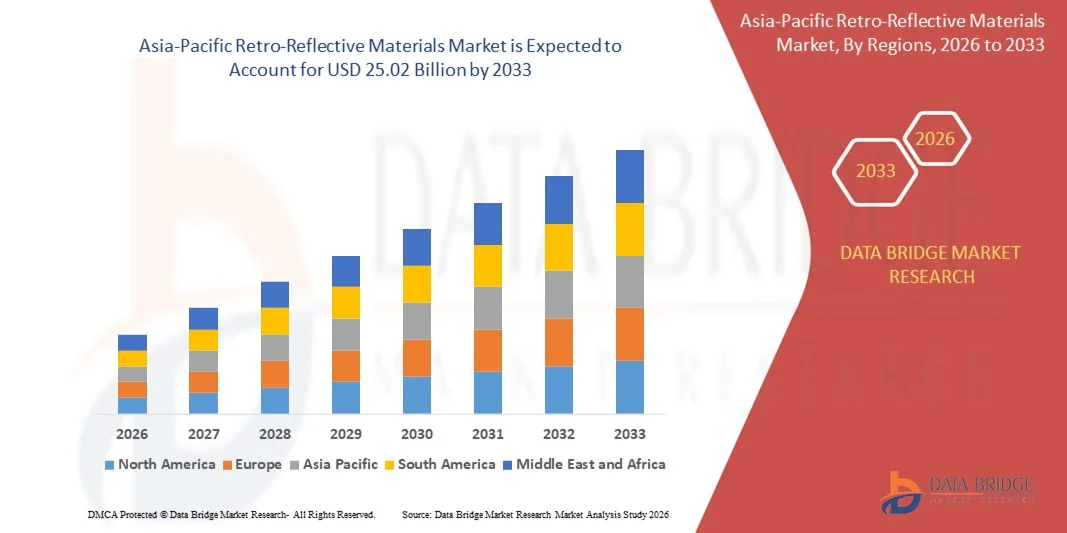
Asia-Pacific Retro-Reflective Materials Market Size
- The Asia-Pacific retro-reflective materials market size was valued at USD 5.85 billion in 2025 and is expected to reach USD 25.02 billion by 2033, at a CAGR of 19.90% during the forecast period
- The market growth is largely fuelled by the increasing demand for enhanced visibility and safety in transportation, construction, and industrial applications
- Rising adoption of retro-reflective materials in road signage, personal protective equipment (PPE), and automotive lighting systems is also driving market expansion
Asia-Pacific Retro-Reflective Materials Market Analysis
- Growing emphasis on road safety and accident prevention is propelling the use of retro-reflective materials across highways, urban roads, and pedestrian zones
- Increasing demand from automotive, construction, and traffic management industries is enhancing the adoption of advanced retro-reflective solutions
- Germany dominated the retro-reflective materials market with the largest revenue share of 28.5% in 2025, driven by strong automotive and construction sectors, along with stringent road safety regulations requiring high-visibility markings and signage
- U.K. is expected to witness the highest compound annual growth rate (CAGR) in the Asia-Pacific retro-reflective materials market due to increasing demand in transportation safety, infrastructure development, and rising adoption of innovative reflective technologies
- The Micro Prismatic Technology segment held the largest market revenue share in 2025 driven by its high reflectivity, durability, and ability to meet stringent safety standards for traffic signs and vehicle markings. Micro prismatic materials offer superior visibility over long distances and under low-light conditions, making them a preferred choice in transportation and safety applications
Report Scope and Asia-Pacific Retro-Reflective Materials Market Segmentation
|
Attributes |
Asia-Pacific Retro-Reflective Materials Key Market Insights |
|
Segments Covered |
|
|
Countries Covered |
Asia-Pacific
|
|
Key Market Players |
• Nippon Carbide Industries Co., Inc (Japan) |
|
Market Opportunities |
|
|
Value Added Data Infosets |
In addition to the insights on market scenarios such as market value, growth rate, segmentation, geographical coverage, and major players, the market reports curated by the Data Bridge Market Research also include import export analysis, production capacity overview, production consumption analysis, price trend analysis, climate change scenario, supply chain analysis, value chain analysis, raw material/consumables overview, vendor selection criteria, PESTLE Analysis, Porter Analysis, and regulatory framework. |
Asia-Pacific Retro-Reflective Materials Market Trends
Rising Demand for Enhanced Safety and Visibility
- Growing emphasis on road safety, occupational safety, and vehicle visibility is significantly shaping the retro-reflective materials market, as manufacturers and end-users increasingly prefer materials that improve visibility and reduce accident risks. Retro-reflective materials are gaining traction due to their high reflectivity, durability, and ability to meet stringent safety standards. This trend strengthens their adoption across transportation, construction, and industrial safety applications, encouraging manufacturers to innovate with new products that enhance performance and compliance
- Increasing awareness around workplace safety regulations and traffic safety initiatives has accelerated the demand for retro-reflective materials in signage, apparel, and vehicle markings. Regulatory bodies and safety-conscious organizations are actively seeking products that adhere to international standards, prompting brands to prioritize compliance and quality assurance. This has also led to collaborations between material suppliers and manufacturers to develop high-performance reflective solutions
- Safety and regulatory trends are influencing procurement decisions, with manufacturers emphasizing product certification, long-lasting performance, and eco-friendly production. These factors are helping brands differentiate products in a competitive market and build trust with end-users, while also driving the adoption of certified reflective solutions. Companies are increasingly highlighting these benefits in marketing campaigns to reinforce brand positioning and appeal to safety-conscious consumers
- For instance, in 2024, 3M introduced next-generation reflective sheeting for road signs and vehicle applications, designed to meet evolving visibility standards. The new products enhance nighttime visibility, reduce accidents, and expand 3M’s market presence in traffic safety solutions
- While demand for retro-reflective materials is growing, sustained market expansion depends on continuous R&D, cost-effective production, and meeting evolving safety regulations. Manufacturers are also focusing on improving scalability, material performance, and developing innovative solutions that balance cost, durability, and regulatory compliance for broader adoption
Asia-Pacific Retro-Reflective Materials Market Dynamics
Driver
Increasing Need for Road Safety and Workplace Visibility
- Rising global initiatives to improve road safety, pedestrian protection, and occupational visibility is a major driver for the retro-reflective materials market. Organizations and governments are implementing stricter regulations that require the use of reflective materials in signage, vehicles, and safety apparel, encouraging widespread adoption
- Expanding applications in traffic signs, vehicle markings, industrial clothing, and safety equipment are driving market growth. Retro-reflective materials help improve nighttime visibility, reduce accident risks, and maintain compliance with international safety standards, enabling manufacturers to meet stringent safety requirements
- Material suppliers and end-users are actively promoting high-performance retro-reflective solutions through product innovation, safety certifications, and marketing campaigns. These efforts are supported by increasing awareness of accident prevention and regulatory compliance, and they also encourage partnerships to improve product durability and performance
- For instance, in 2023, Avery Dennison and Reflexite reported significant incorporation of advanced retro-reflective materials in traffic signs and high-visibility apparel, following higher demand for safer roads and workplaces. Both companies highlighted regulatory compliance and performance benefits to strengthen brand trust and expand adoption
- Although rising safety and regulatory trends support growth, wider adoption depends on cost management, raw material availability, and technological innovation. Investment in advanced materials, efficient production processes, and regulatory compliance will be critical for meeting global demand and maintaining competitive advantage
Restraint/Challenge
High Production Costs And Regulatory Compliance Requirements”
- The relatively higher cost of retro-reflective materials compared to conventional materials remains a key challenge, limiting adoption among cost-sensitive end-users. Advanced production processes, stringent quality checks, and certification requirements contribute to elevated pricing
- Limited awareness and technical understanding of performance specifications restrict adoption in some sectors. Small manufacturers or organizations with budget constraints may hesitate to invest in high-quality retro-reflective materials despite safety benefits
- Supply chain and logistical challenges also impact market growth, as materials require precise handling, storage, and adherence to regulatory standards. Complex production techniques and durability requirements increase operational costs
- For instance, in 2024, smaller apparel manufacturers in developing markets reported slower uptake of retro-reflective fabrics due to higher costs and limited knowledge of performance benefits. These factors also prompted selective adoption in safety applications, affecting market penetration
- Overcoming these challenges will require cost-efficient production, streamlined distribution networks, and targeted educational initiatives for manufacturers and end-users. Collaboration with regulatory bodies, safety organizations, and suppliers can help unlock long-term growth potential. Furthermore, developing cost-effective solutions without compromising reflectivity or compliance will be essential for widespread adoption
Asia-Pacific Retro-Reflective Materials Market Scope
The market is segmented on the basis of technology, product type, application, and end user
- By Technology
On the basis of technology, the retro-reflective materials market is segmented into Micro Prismatic Technology, Glass Beads Technology, and Ceramic Beads Technology. The Micro Prismatic Technology segment held the largest market revenue share in 2025 driven by its high reflectivity, durability, and ability to meet stringent safety standards for traffic signs and vehicle markings. Micro prismatic materials offer superior visibility over long distances and under low-light conditions, making them a preferred choice in transportation and safety applications.
The Glass Beads Technology segment is expected to witness the fastest growth rate from 2026 to 2033, owing to its cost-effectiveness, ease of application on various substrates, and efficient light retro-reflection for road markings and signage. Glass bead-based materials are particularly favored for maintenance and repair projects due to their simple integration and reliable performance.
- By Product Type
On the basis of product type, the market is segmented into Films, Sheets, Tapes, Paints, Inks and Coatings, Retro-Reflective Threads, and Retro-Reflective Fabrics. The Films segment held the largest market revenue share in 2025 driven by its versatility, long service life, and ability to be applied on a variety of surfaces including vehicles, road signs, and safety equipment. Films provide consistent reflectivity and are widely adopted across automotive, industrial, and transportation sectors.
The Retro-Reflective Fabrics segment is expected to witness the fastest growth from 2026 to 2033, fueled by increasing demand in personal safety gear and high-visibility clothing in construction, industrial, and sports applications. These fabrics are preferred for their flexibility, comfort, and compliance with safety standards.
- By Application
On the basis of application, the market is segmented into Traffic Control and Work Zone, Conspicuity, Fleet and Vehicle Registration, Personal Safety, and Others. The Traffic Control and Work Zone segment held the largest revenue share in 2025 due to rising investments in road infrastructure, growing urbanization, and the need for enhanced safety measures on highways and construction zones. Retro-reflective materials in this segment improve visibility and reduce accident risks during night-time or adverse weather conditions.
The Personal Safety segment is projected to register the fastest growth from 2026 to 2033, driven by increasing awareness of worker safety, stricter regulatory requirements, and rising adoption of high-visibility clothing in industrial and construction environment.
- By End User
On the basis of end user, the market is segmented into Automotive, Industrial, Construction, Textile, and Others. The Automotive segment held the largest market revenue share in 2025, supported by the growing need for reflective markings on vehicles, license plates, and safety signs to enhance visibility and comply with traffic safety regulations.
The Textile segment is expected to witness the fastest growth from 2026 to 2033, driven by increasing demand for high-visibility apparel in construction, logistics, and sports, along with the adoption of retro-reflective fabrics in fashion and safety-oriented clothing.
Asia-Pacific Retro-Reflective Materials Market Regional Analysis
- China dominated the retro-reflective materials market in 2025, driven by rapid urbanization, extensive road networks, and a strong automotive industry requiring reflective signage and vehicle markings
- Municipalities and enterprises prioritize high-quality retro-reflective films, fabrics, and coatings to ensure safety compliance and improve visibility on roads and highways
- The widespread adoption is supported by technological advancements, government regulations, and ongoing infrastructure expansion
Japan Retro-Reflective Materials Market Insight
The Japan retro-reflective materials market is expected to witness the fastest growth from 2026 to 2033, fueled by increasing road safety initiatives, advanced construction activities, and rising demand for personal protective equipment. Industries and municipalities are adopting micro-prismatic and glass bead technologies to enhance visibility and meet stringent safety standards. The market growth is further boosted by technological innovations, government investments in transportation infrastructure, and rising awareness of pedestrian and occupational safety.
Asia-Pacific Retro-Reflective Materials Market Share
The Asia-Pacific retro-reflective materials industry is primarily led by well-established companies, including:
• Nippon Carbide Industries Co., Inc (Japan)
• Changzhou Hua R Sheng Reflective Material Co. Ltd (China)
• DM Reflective (China)
• Paiho Group (Taiwan)
• Asian Paints PPG (India)
• Unitika Sparklite Ltd (Japan)
• Reflomax Co., Ltd (South Korea)
• Yeagood Inc. (China)
• Aura Optical Systems (India)
• Zhejiang Caiyuan Reflecting Materials (China)
• Yeshili New Materials Co., Ltd (China)
• Quanzhou FLIGHT Reflective Material Co., Ltd (China)
• Huarsheng (China)
• Jisung Corporation (South Korea)
• Huangshan Xingwei Reflectorized Materials (China)
SKU-
Получите онлайн-доступ к отчету на первой в мире облачной платформе рыночной аналитики

- Интерактивная панель анализа данных
- Панель анализа компании для возможностей с высоким потенциалом роста
- Доступ аналитика-исследователя для настройки и запросов
- Анализ конкурентов с помощью интерактивной панели
- Последние новости, обновления и анализ тенденций
- Используйте возможности сравнительного анализа для комплексного отслеживания конкурентов
Методология исследования
Сбор данных и анализ базового года выполняются с использованием модулей сбора данных с большими размерами выборки. Этап включает получение рыночной информации или связанных данных из различных источников и стратегий. Он включает изучение и планирование всех данных, полученных из прошлого заранее. Он также охватывает изучение несоответствий информации, наблюдаемых в различных источниках информации. Рыночные данные анализируются и оцениваются с использованием статистических и последовательных моделей рынка. Кроме того, анализ доли рынка и анализ ключевых тенденций являются основными факторами успеха в отчете о рынке. Чтобы узнать больше, пожалуйста, запросите звонок аналитика или оставьте свой запрос.
Ключевой методологией исследования, используемой исследовательской группой DBMR, является триангуляция данных, которая включает в себя интеллектуальный анализ данных, анализ влияния переменных данных на рынок и первичную (отраслевую экспертную) проверку. Модели данных включают сетку позиционирования поставщиков, анализ временной линии рынка, обзор рынка и руководство, сетку позиционирования компании, патентный анализ, анализ цен, анализ доли рынка компании, стандарты измерения, глобальный и региональный анализ и анализ доли поставщика. Чтобы узнать больше о методологии исследования, отправьте запрос, чтобы поговорить с нашими отраслевыми экспертами.
Доступна настройка
Data Bridge Market Research является лидером в области передовых формативных исследований. Мы гордимся тем, что предоставляем нашим существующим и новым клиентам данные и анализ, которые соответствуют и подходят их целям. Отчет можно настроить, включив в него анализ ценовых тенденций целевых брендов, понимание рынка для дополнительных стран (запросите список стран), данные о результатах клинических испытаний, обзор литературы, обновленный анализ рынка и продуктовой базы. Анализ рынка целевых конкурентов можно проанализировать от анализа на основе технологий до стратегий портфеля рынка. Мы можем добавить столько конкурентов, о которых вам нужны данные в нужном вам формате и стиле данных. Наша команда аналитиков также может предоставить вам данные в сырых файлах Excel, сводных таблицах (книга фактов) или помочь вам в создании презентаций из наборов данных, доступных в отчете.











