


Europe Advanced Recycling Technologies Market, By Technology (Pyrolysis/Cracking, Gasification, Depolymerization, and Microwave), Process Output (Naphtha, Heavy Gas Oil, and Wax Residue), End Use (Packaging, Infrastructure & Construction, Consumer Electronics, and Automotive) - Industry Trends and Forecast to 2030.
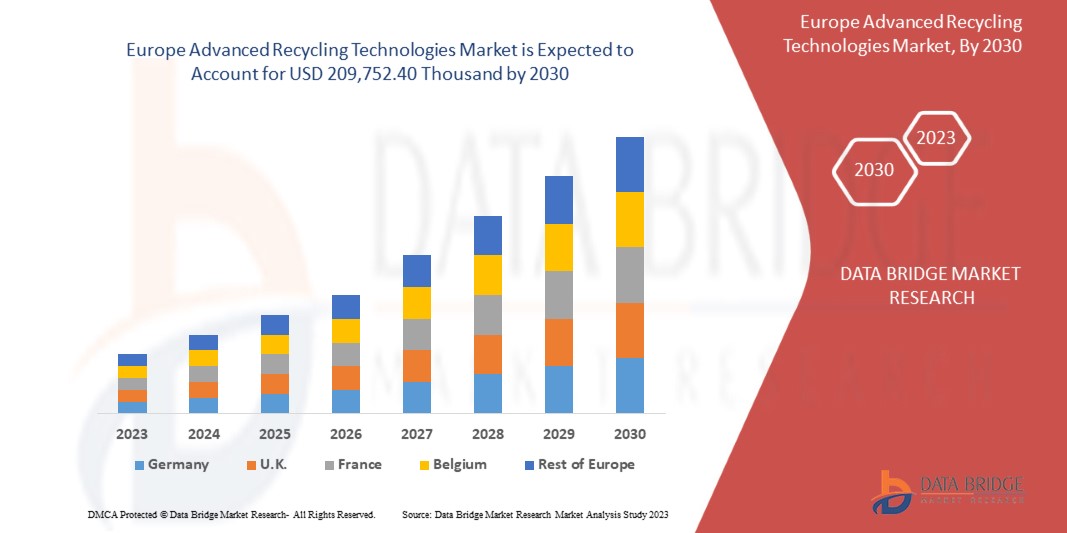
Europe Advanced Recycling Technologies Market Analysis and Size
The advanced recycling technologies refers to the industry focused on innovative methods for recycling waste materials into valuable resources. These technologies aim to enhance resource efficiency, reduce environmental impact, and promote circular economy principles.
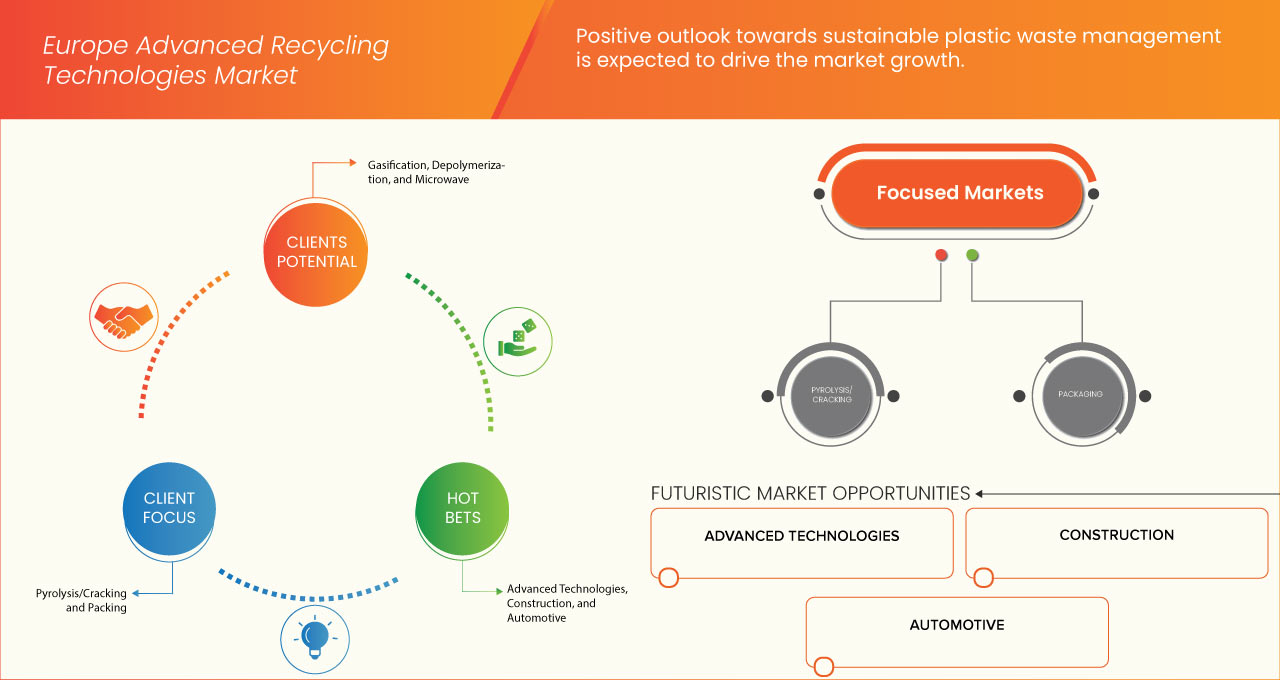
The Europe advanced recycling technologies market report provides details of market share, new developments, and the impact of domestic and localized market players, analyzes opportunities in terms of emerging revenue pockets, changes in market regulations, products approvals, strategic decisions, product launches, geographic expansions, and technological innovations in the market. To understand the analysis and the market scenario, contact us for an analyst brief. Our team will help you create a revenue-impact solution to achieve your desired goal.
The Europe advanced recycling technologies market is expected to grow significantly in the forecast period of 2023 to 2030. Data Bridge Market Research analyzes that the market is growing with a CAGR of 6.9% in the forecast period of 2023 to 2030 and is expected to reach USD 209,752.40 thousand by 2030.
|
Report Metric |
Details |
|
Forecast Period |
2023 to 2030 |
|
Base Year |
2022 |
|
Historic Year |
2021 (Customizable to 2015-2020) |
|
Quantitative Units |
Revenue in USD Thousand |
|
Segments Covered |
Technology (Pyrolysis/Cracking, Gasification, Depolymerization, and Microwave), Process Output (Naphtha, Heavy Gas Oil, and Wax Residue), End Use (Packaging, Infrastructure & Construction, Consumer Electronics, and Automotive) |
|
Countries Covered |
Germany, Netherlands, Spain, U.K., Belgium, Italy, Switzerland, Austria, France, Turkey, and Rest of Europe |
|
Market Players Covered |
Honeywell International Inc., Chevron Phillips Chemical Company LLC, Synova, Gr3n Recycling, Quantafuel ASA, Agilyx, BlueAlp Innovations BV, GARBO SRL, Mura Technology Limited, Olefy Technologies Ltd., PLASTIC ENERGY, and Recycling Avenue |
Market Definition
The advanced recycling technologies industry encompasses a diverse range of processes aimed at regenerating polymers or breaking down polymer chains into valuable feedstocks. These technologies, including molecular recycling and chemical recycling, utilize thermochemical reactions to transform plastics into new products such as virgin plastic, monomers, fuels, energy, and other commodities. The market for advanced recycling technologies holds significant potential due to the increasing demand for sustainable and circular economy practices.
Europe Advanced Recycling Technologies Market Dynamics
This section deals with understanding the market drivers, advantages, restraints, and challenges. All of this is discussed in detail below:
Drivers
- Shifting Inclination Towards Circular Economy
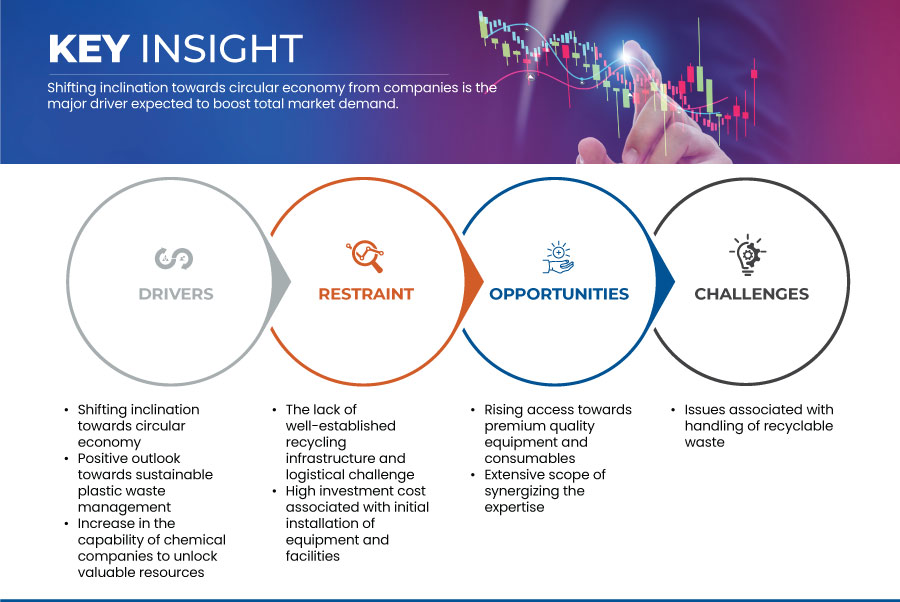
The concept of the circular economy has gained significant attention in recent years to address environmental and economic challenges. Governments, businesses, and organizations worldwide are finding innovative ways to adopt circular practices for the creation of a sustainable economic model. The circular economy aims to eliminate waste and promote the reuse and recycling of materials and products. The circular economy initiatives are on the rise as industries are finding the need for the reduction of waste.
Advanced recycling technologies consist of various innovative processes for breaking down waste to produce valuable materials such as new plastics, fuels, or other products. They offer a valuable alternative to other recycling methods such as plastics incineration or landfilling which accelerates the transition toward a circular economy. Moreover, the government has implemented regulations for industries that promote the circular economy. Furthermore, by using such advanced recycling technologies the industries of different sector organizations reduce their carbon footprint and fulfill the expectations of environmentally conscious consumers, which is expected to drive market growth.
- Positive Outlook Towards Sustainable Plastic Waste Management
The issue of plastic waste has become a global concern due to its harsh impact on the environment and human health. This has led to an increasing focus on sustainable solutions to manage and recycle plastic waste effectively. Advanced recycling technologies play an important role in achieving sustainable plastic waste management. They help plastic waste to break down into smaller molecules through processes such as pyrolysis or gasification. The broken molecules act as feedstock for new chemical reactions to produce recycled plastics and other chemicals. Such advanced recycling technologies are in demand when compared to traditional mechanical recycling as they can handle difficult-to-recycle plastics that cannot be processed by mechanical recycling.
The demand for sustainable solutions is rising as there is increasing awareness regarding the harmful impact of plastic waste. Advanced recycling technologies have the ability to produce valuable products such as recycled plastics, naphtha, and heavy gas oil. They provide an alternative to traditional recycling methods thus, chemical recycling offers a more sustainable approach to managing plastic waste and reducing the reliance on virgin plastics. Such advanced recycling technologies have immense economical significance through the transformation of used plastics into valuable resources, which is expected to drive market growth.
Opportunities
- Rising Access Towards Premium Quality Equipment and Consumables for Inducing Recycling Practices
Technological advancements are always seen as an opportunity for the expansion of market scope as they will always result in better and high-quality products, cost efficiency, energy efficiency, and others. In that case, recycling involves many innovative technologies such as advanced recycling technologies. This will help in attaining a more effective and efficient recycling process and helps in overcoming the challenges such as contamination, limited recyclability, and even results in higher-quality recycling products.
Thus, advancements in plastic recycling technology create opportunities for market growth by enhancing quality, expanding supply, and enabling the creation of new applications. These developments support sustainable development initiatives, lessen dependency on virgin plastics, and foster a circular economy for plastics.
- Extensive Scope of Synergizing the Expertise Between Technological Providers and Chemical Manufacturers
Collaboration and partnerships between recycling technology providers and chemical manufacturers widen the scope of the Europe advanced recycling technology market by aligning supply and demand, improving quality, fostering innovation and R&D, achieving economies of scale, promoting market awareness, and influencing policy and regulations. Through collaboration with the technological providers, the chemical manufacturers have the ability to contribute the expertise for optimization of the processes. Through such collaboration and partnerships, it also ensures a consistent supply of recycled plastics and other valuable products that meet manufacturers' specifications, enhance the quality, and drive innovation in recycling technologies and applications. Together, these efforts contribute to a more sustainable and economically viable circular economy for plastics.
Thus, the partnership between recycling technology providers and chemical manufacturers offers a substantial chance to grow the world market for advanced recycling technologies. Together, they can promote the use of such advanced recycling technologies further cutting down on plastic waste, and support a circular economy where waste plastic is valued as a resource. Such synergy has a tremendous deal of promise to address the environmental issues brought on by plastic trash while also opening up new market prospects.
Restraints/ Challenges
- High Investment Cost Associated with Initial Installation of Equipment and Facilities
Advanced recycling technologies often require specialized and sophisticated equipment and infrastructure. Acquiring, installing, and maintaining such equipment can be expensive, especially for Small and Medium-Sized Enterprises (SMEs) or start-ups. Implementing and operating advanced recycling technologies necessitate trained personnel and expertise. The costs associated with training employees or hiring skilled professionals proficient in handling these technologies can add to the initial investment.
Developing and perfecting advanced recycling technologies requires extensive R&D efforts. The costs associated with conducting R&D activities, testing prototypes, and achieving commercial viability can be substantial. Investing in novel and innovative technologies carries inherent risks and uncertainties. Companies may be reluctant to commit significant capital without a clear understanding of the technology's long-term benefits and return on investment.
Advanced recycling technologies must comply with various environmental and safety regulations. Meeting regulatory requirements may involve additional costs, such as obtaining permits, conducting environmental impact assessments, and ensuring compliance with waste management regulations. Initial investments may be high, especially if the technology requires a substantial volume of waste materials to be processed efficiently.
Therefore, implementing advanced recycling technologies often requires significant upfront capital investment. The costs associated with acquiring and setting up advanced recycling equipment, infrastructure, and facilities can be a major barrier for companies looking to adopt these technologies, which is expected to restrain market growth.
- Lack of Well-Established Recycling Infrastructure and Logistical Challenge
Advanced recycling technologies often require waste materials to be sorted and segregated based on their composition. The absence of advanced sorting facilities hampers the efficient processing of diverse waste streams, making it challenging to extract valuable materials from mixed waste. Many regions lack efficient and comprehensive waste collection systems, especially in developing countries or remote areas. Without proper collection mechanisms, the steady supply of recyclable materials required for advanced recycling technologies becomes inconsistent or insufficient.
Transporting waste materials from collection points to recycling facilities can be logistically complex and costly, especially when dealing with large volumes or remote locations. Inadequate transportation networks can result in delays, increased costs, and hinder the scalability of recycling operations. Setting up advanced recycling facilities requires specific infrastructure tailored to each technology's requirements. Many regions lack specialized facilities, making it challenging for companies to find suitable locations to implement their advanced recycling processes. Integrating advanced recycling technologies into existing waste management infrastructure can be challenging due to compatibility issues and the need for retrofitting or building new facilities.
Obtaining necessary permits and approvals to establish advanced recycling facilities may be burdensome, involving complex regulations and administrative processes. This can deter potential investors or companies from entering the market. The successful implementation and growth of advanced recycling technologies depend heavily on a well-established and efficient waste management infrastructure, including collection, sorting, transportation, and processing facilities.
Recent Developments
- In July 2023, Chevron Phillips Chemical Company LLC strengthened its collaboration with Nexus Circular by securing a long-term supply agreement for advanced recycled plastic feedstocks. Nexus Circular, a leader in advanced recycling, utilize technology to convert landfill-bound plastics into high-quality liquids that produce virgin-quality circular plastics. The partnership with Nexus will enable Chevron Phillips Chemical to scale its circular polymers program and contribute to the transition to a circular economy for plastics.
- In April 2023, BioBTX and Agilyx formed a strategic collaboration to explore the commercial scale-up of BioBTX's renewable aromatics technology. Agilyx will integrate its pyrolysis technology with BioBTX's catalytic technology to produce renewable aromatic chemicals (BTX) from difficult-to-recycle plastic waste streams. The partnership aims to create a high-quality BTX product that meets the chemical industry's specifications and contributes to a circular economy.
- In March 2023, Garbo SRL partnered with Saipem S.p.A. to advance the industrial development of their chemical recycling technology, Chempet, for plastics. The collaboration includes the construction of the world's first industrial plant for the chemical recycling of PET in Cerano, Italy. This partnership positions Garbo as a leader in chemical recycling and supports the increasing demand for PET recycling, offering a simpler process and a wider range of treatable PET waste.
- In November 2022, Synova, SABIC Global Technologies B.V., and Technip Energies signed a joint development and cooperation agreement to collaborate on the development of a commercial plant that will produce olefins and aromatics from plastic waste. The plant will integrate Synovia's MILENA solids cracking technology and OLGA gas conditioning and tars removal technology with T.EN's Pure.rGas gas treatment technology. The combined technology efficiently converted plastic waste into high-value chemicals, contributing to SABIC's vision of closing the loop on used plastic.
- In November 2022, PLASTIC ENERGY, a global leader in chemical recycling technology, announced the opening of its new research and development labs at Loughborough University in the U.K. This lab will be the hub for Plastic Energy’s work on further development and optimization of its unique chemical recycling technology.
Europe Advanced Recycling Technologies Market Scope
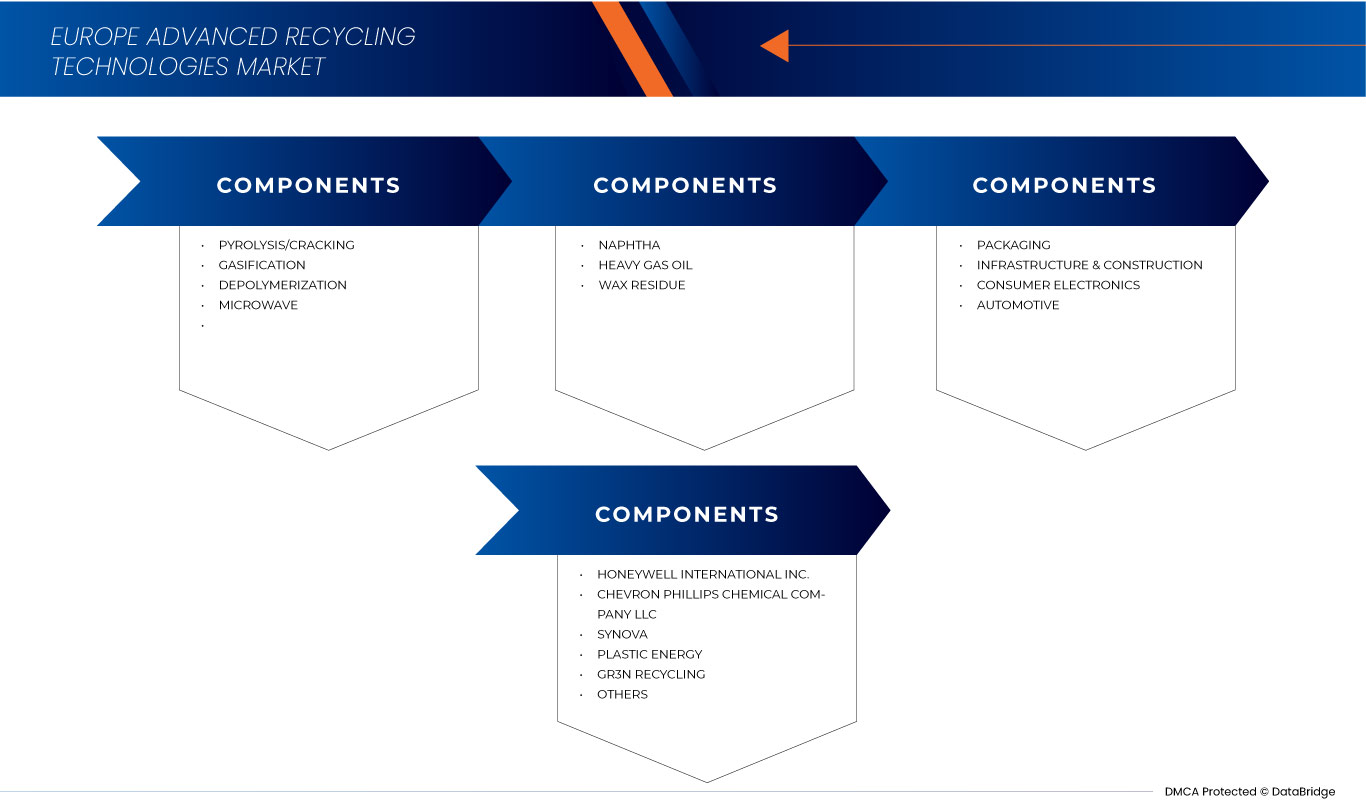
The Europe advanced recycling technologies market is segmented into three notable segments based on technology, process output, and end use. The growth amongst these segments will help you analyze major growth segments in the industries and provide the users with a valuable market overview and market insights to make strategic decisions to identify core market applications.
Technology
- Pyrolysis/Cracking
- Gasification
- Depolymerization
- Microwave
On the basis of technology, the market is segmented into pyrolysis/cracking, gasification, depolymerization, and microwave.
Process Output
- Naphtha
- Heavy Gas Oil
- Wax Residue
On the basis of process output, the market is segmented into naphtha, heavy gas oil, and wax residue.
End Use
- Packaging
- Infrastructure & Construction
- Consumer Electronics
- Automotive
On the basis of end use, the market is segmented into packaging, infrastructure & construction, consumer electronics, and automotive.
Europe Advanced Recycling Technologies Market Regional Analysis/Insights
The Europe advanced recycling technologies market is segmented on the basis of technology, process output and end use.
The countries covered in this market report are Germany, Netherlands, Spain, U.K., Belgium, Italy, Switzerland, Austria, France, Turkey, and rest of Europe.
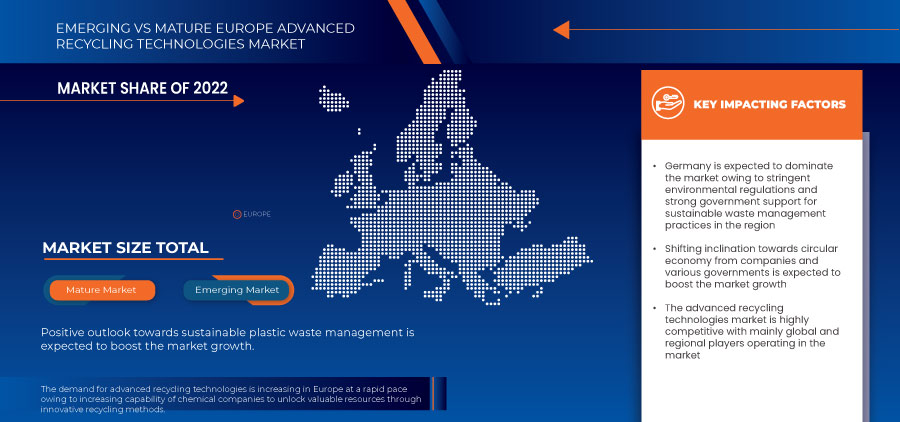
Germany is expected to dominate the Europe advanced recycling technologies market due to the increasing focus on sustainable solutions to manage and recycle plastic waste effectively. Advanced recycling technologies play an important role in achieving sustainable plastic waste management, contributing to the market growth.
The country section of the report also provides individual market-impacting factors and changes in market regulation that impact the current and future trends of the market. Data point downstream and upstream value chain analysis, technical trends, Porter's five forces analysis, and case studies are some of the pointers used to forecast the market scenario for individual countries. Also, the presence and availability of regional brands and their challenges faced due to large or scarce competition from local and domestic brands, the impact of domestic tariffs, and trade routes are considered while providing forecast analysis of the country data.
Competitive Landscape and Europe Advanced Recycling Technologies Market Share Analysis
The Europe advanced recycling technologies market competitive landscape provides details of competitors. Details included are company overview, company financials, revenue generated, market potential, investment in research and development, new market initiatives, production sites and facilities, company strengths and weaknesses, product launch, product trials pipelines, product approvals, patents, product width and breadth, application dominance, technology lifeline curve. The above data points provided are only related to the companies’ focus related to the market.
Some of the major market players operating in the Europe advanced recycling technologies market are Honeywell International Inc., Chevron Phillips Chemical Company LLC, Synova, Gr3n Recycling, Quantafuel ASA, Agilyx, BlueAlp Innovations BV, GARBO SRL, Mura Technology Limited, Olefy Technologies Ltd., PLASTIC ENERGY, and Recycling Avenue, among others.
SKU-
Получите онлайн-доступ к отчету на первой в мире облачной платформе рыночной аналитики

- Интерактивная панель анализа данных
- Панель анализа компании для возможностей с высоким потенциалом роста
- Доступ аналитика-исследователя для настройки и запросов
- Анализ конкурентов с помощью интерактивной панели
- Последние новости, обновления и анализ тенденций
- Используйте возможности сравнительного анализа для комплексного отслеживания конкурентов
Методология исследования
Сбор данных и анализ базового года выполняются с использованием модулей сбора данных с большими размерами выборки. Этап включает получение рыночной информации или связанных данных из различных источников и стратегий. Он включает изучение и планирование всех данных, полученных из прошлого заранее. Он также охватывает изучение несоответствий информации, наблюдаемых в различных источниках информации. Рыночные данные анализируются и оцениваются с использованием статистических и последовательных моделей рынка. Кроме того, анализ доли рынка и анализ ключевых тенденций являются основными факторами успеха в отчете о рынке. Чтобы узнать больше, пожалуйста, запросите звонок аналитика или оставьте свой запрос.
Ключевой методологией исследования, используемой исследовательской группой DBMR, является триангуляция данных, которая включает в себя интеллектуальный анализ данных, анализ влияния переменных данных на рынок и первичную (отраслевую экспертную) проверку. Модели данных включают сетку позиционирования поставщиков, анализ временной линии рынка, обзор рынка и руководство, сетку позиционирования компании, патентный анализ, анализ цен, анализ доли рынка компании, стандарты измерения, глобальный и региональный анализ и анализ доли поставщика. Чтобы узнать больше о методологии исследования, отправьте запрос, чтобы поговорить с нашими отраслевыми экспертами.
Доступна настройка
Data Bridge Market Research является лидером в области передовых формативных исследований. Мы гордимся тем, что предоставляем нашим существующим и новым клиентам данные и анализ, которые соответствуют и подходят их целям. Отчет можно настроить, включив в него анализ ценовых тенденций целевых брендов, понимание рынка для дополнительных стран (запросите список стран), данные о результатах клинических испытаний, обзор литературы, обновленный анализ рынка и продуктовой базы. Анализ рынка целевых конкурентов можно проанализировать от анализа на основе технологий до стратегий портфеля рынка. Мы можем добавить столько конкурентов, о которых вам нужны данные в нужном вам формате и стиле данных. Наша команда аналитиков также может предоставить вам данные в сырых файлах Excel, сводных таблицах (книга фактов) или помочь вам в создании презентаций из наборов данных, доступных в отчете.











