


Europe Surfactant Market Segmentation, By Type (Anionic surfactants, Cationic Detergents, Non-Ionic Surfactants, and Amphoteric Surfactants), Substrate (Synthetic Surfactants and Bio-Based Surfactants), Application (Detergents, Personal Care, Textiles, Oilfield Chemicals, Food and Beverages, Emulsifier, Foaming Agents, Industrial and Institutional Cleaning, and Crop Protection)- Industry Trends and Forecast to 2033
Europe Surfactant Market Size
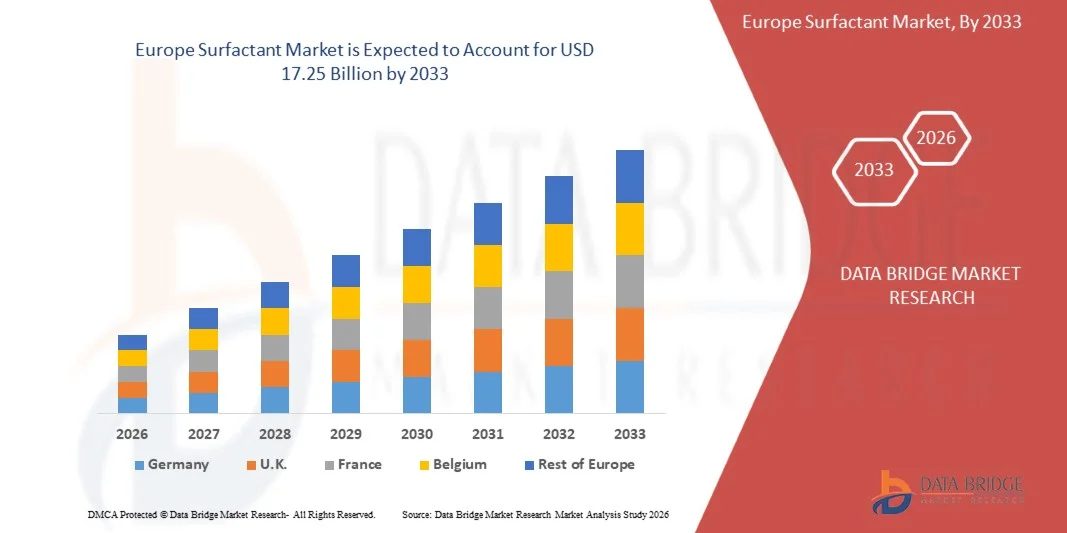
- The Europe surfactant market size was valued at USD 11.86 billion in 2025 and is expected to reach USD 17.25 billion by 2033, at a CAGR of 4.80% during the forecast period
- The market growth is largely fuelled by the rising demand for surfactants in household detergents, personal care products, and industrial cleaning applications across the region
- Increasing awareness regarding hygiene and sanitation, along with growing consumption of cleaning products, is further supporting the demand for surfactant-based formulations
Europe Surfactant Market Analysis
- The market is witnessing steady growth due to the increasing application of surfactants in sectors such as home care, personal care, agriculture, and oil and gas industries
- Growing investments in research and development for sustainable and bio-based surfactants, along with the presence of major chemical manufacturers in the region, are further strengthening the market expansion
- Germany surfactant market captured the largest revenue share in 2025 within Europe, driven by the strong presence of chemical manufacturing companies and advanced industrial infrastructure. The country’s well-established detergents, personal care, and industrial cleaning industries are significantly contributing to the demand for surfactants
- U.K. is expected to witness the highest compound annual growth rate (CAGR) in the Europe surfactant market due to the increasing demand for eco-friendly and biodegradable cleaning products, rising consumer preference for sustainable personal care formulations, and growing investments in green chemical technologies. The expansion of the household cleaning and cosmetics industries is also contributing to the market’s rapid growth
- The Anionic Surfactants segment held the largest market revenue share in 2025 driven by their widespread use in detergents, household cleaning products, and personal care formulations. These surfactants are highly effective in removing dirt, grease, and stains, making them a preferred choice in laundry detergents, dishwashing liquids, and industrial cleaners across the region
Report Scope and Europe Surfactant Market Segmentation
|
Attributes |
Europe Surfactant Key Market Insights |
|
Segments Covered |
|
|
Countries Covered |
Europe
|
|
Key Market Players |
• BASF SE (Germany) |
|
Market Opportunities |
• Increasing Demand For Bio-Based And Sustainable Surfactants |
|
Value Added Data Infosets |
In addition to the insights on market scenarios such as market value, growth rate, segmentation, geographical coverage, and major players, the market reports curated by the Data Bridge Market Research also include import export analysis, production capacity overview, production consumption analysis, price trend analysis, climate change scenario, supply chain analysis, value chain analysis, raw material/consumables overview, vendor selection criteria, PESTLE Analysis, Porter Analysis, and regulatory framework. |
Europe Surfactant Market Trends
“Rising Demand for Sustainable and Bio-Based Surfactants”
• The increasing emphasis on sustainable and environmentally friendly chemical solutions is significantly influencing the surfactant market, as industries shift toward biodegradable and bio-based formulations. Surfactants derived from renewable raw materials are gaining popularity due to their lower environmental impact and improved compatibility with regulatory standards. This trend is encouraging manufacturers to invest in research and development to introduce innovative surfactant formulations that deliver high performance while supporting sustainability goals across multiple industries
• Growing awareness regarding hygiene, sanitation, and personal care has accelerated the demand for surfactants in household cleaning products, detergents, and personal care formulations. Consumers are increasingly prioritizing effective cleaning and skin-friendly ingredients, prompting manufacturers to incorporate mild and biodegradable surfactants in their products. This trend is particularly visible in liquid detergents, shampoos, body washes, and surface cleaners, where surfactants play a crucial role in improving foaming, emulsification, and cleansing efficiency
• Sustainability and regulatory compliance are influencing purchasing decisions, with manufacturers focusing on transparent sourcing, eco-friendly production methods, and compliance with environmental regulations. Companies are increasingly highlighting biodegradable properties and reduced environmental impact in their marketing strategies to strengthen brand positioning. These initiatives are helping companies differentiate products in a competitive market and build trust among environmentally conscious consumers
• For instance, in 2024, Unilever and Procter & Gamble expanded their product portfolios by introducing cleaning and personal care products formulated with bio-based surfactants. These launches were designed to align with consumer demand for environmentally responsible products while maintaining high cleaning performance. The products were distributed across retail and online platforms and promoted as sustainable alternatives to conventional formulations
• While the demand for sustainable surfactants continues to grow, long-term market development depends on advancements in production technologies, cost-effective manufacturing, and maintaining performance levels comparable to conventional surfactants. Manufacturers are focusing on improving raw material sourcing, expanding production capacity, and developing innovative surfactant formulations that balance performance, cost, and sustainability
Europe Surfactant Market Dynamics
Driver
“Increasing Demand from Household Cleaning and Personal Care Industries”
• Rising demand for cleaning and hygiene products is a major driver for the surfactant market. Surfactants are essential ingredients in detergents, dishwashing liquids, surface cleaners, and disinfectants due to their ability to remove dirt, grease, and contaminants effectively. Growing awareness about hygiene and sanitation is encouraging consumers to adopt cleaning products more frequently, which is directly boosting the consumption of surfactants
• Expanding applications in personal care products such as shampoos, body washes, facial cleansers, and cosmetics are further influencing market growth. Surfactants play a critical role in improving foaming, emulsification, and product stability in these formulations. Increasing demand for skin-friendly and mild surfactants is also encouraging manufacturers to develop innovative formulations that enhance product performance and consumer experience
• Chemical manufacturers are actively investing in product innovation and sustainable surfactant development to meet the evolving needs of consumer goods industries. These initiatives include the introduction of bio-based surfactants, improved production technologies, and partnerships with consumer goods companies to enhance product functionality. Such collaborations are helping manufacturers strengthen their product portfolios and expand market reach
• For instance, in 2023, BASF and Evonik introduced new surfactant formulations designed for personal care and home care applications. These products were developed to provide improved cleaning efficiency while supporting sustainability objectives through reduced environmental impact. The introduction of these formulations strengthened the companies’ presence in the global surfactant industry and supported product innovation in consumer goods manufacturing
• Although strong demand from cleaning and personal care sectors supports market growth, sustained expansion will depend on raw material availability, cost optimization, and technological advancements in surfactant production. Continuous investments in research, innovation, and supply chain efficiency will be essential to meet rising global demand and maintain competitiveness
Restraint/Challenge
“Volatility in Raw Material Prices and Environmental Concerns”
• Fluctuations in the prices of petrochemical feedstocks used in surfactant production remain a significant challenge for the market. Variations in crude oil prices can directly influence the cost of key raw materials such as ethylene oxide and other intermediates used in surfactant manufacturing. These cost fluctuations create pricing pressure for manufacturers and may affect profitability and long-term supply agreements
• Environmental concerns related to certain synthetic surfactants also present challenges for market expansion. Some conventional surfactants may have adverse environmental impacts if not properly treated, leading to stricter regulatory scrutiny and compliance requirements. Manufacturers are therefore required to invest in sustainable alternatives and adopt environmentally responsible production processes
• Supply chain complexities and sourcing challenges can also affect production stability and product availability. Dependence on petrochemical raw materials and specialized processing technologies increases operational costs and may lead to delays in production during supply disruptions. Companies must invest in efficient logistics, diversified sourcing strategies, and advanced processing technologies to maintain consistent supply
• For instance, in 2024, manufacturers of household and personal care products reported increased production costs due to fluctuations in petrochemical feedstock prices used for surfactant production. These cost increases affected product pricing and encouraged companies to accelerate the development of bio-based surfactant alternatives. The situation also prompted companies to reassess sourcing strategies and invest in more resilient supply chains
• Addressing these challenges will require the development of cost-effective and environmentally friendly surfactant formulations, along with stronger supply chain management. Collaboration between chemical manufacturers, consumer goods companies, and regulatory bodies will be essential to ensure sustainable growth and support innovation in the global surfactant market.
Europe Surfactant Market Scope
The market is segmented on the basis of type, substrate, and application.
• By Type
On the basis of type, the Europe surfactant market is segmented into Anionic Surfactants, Cationic Detergents, Non-Ionic Surfactants, and Amphoteric Surfactants. The Anionic Surfactants segment held the largest market revenue share in 2025 driven by their widespread use in detergents, household cleaning products, and personal care formulations. These surfactants are highly effective in removing dirt, grease, and stains, making them a preferred choice in laundry detergents, dishwashing liquids, and industrial cleaners across the region.
The Non-Ionic Surfactants segment is expected to witness the fastest growth rate from 2026 to 2033, driven by their superior emulsifying properties and compatibility with a wide range of formulations. Non-ionic surfactants are increasingly used in personal care products, industrial cleaning agents, and food processing applications due to their mildness and stability across varying temperatures and pH levels.
• By Substrate
On the basis of substrate, the Europe surfactant market is segmented into Synthetic Surfactants and Bio-Based Surfactants. The Synthetic Surfactants segment accounted for the largest market revenue share in 2025 due to their cost-effectiveness, high performance, and large-scale availability for industrial applications. These surfactants are widely used in detergents, oilfield chemicals, and industrial cleaning products because of their strong cleansing and foaming capabilities.
The Bio-Based Surfactants segment is expected to witness the fastest growth rate from 2026 to 2033, driven by increasing environmental awareness and rising demand for sustainable ingredients. Bio-based surfactants derived from renewable resources are gaining traction in personal care, household cleaning, and food processing industries due to their biodegradability and reduced environmental impact.
• By Application
On the basis of application, the Europe surfactant market is segmented into Detergents, Personal Care, Textiles, Oilfield Chemicals, Food and Beverages, Emulsifier, Foaming Agents, Industrial and Institutional Cleaning, and Crop Protection. The Detergents segment held the largest market revenue share in 2025 driven by the extensive use of surfactants in laundry detergents, dishwashing liquids, and household cleaning products. The increasing focus on hygiene and sanitation continues to support the demand for surfactants in cleaning applications.
The Personal Care segment is expected to witness the fastest growth rate from 2026 to 2033, driven by the rising demand for skincare, haircare, and cosmetic products. Surfactants are widely used in shampoos, body washes, facial cleansers, and cosmetics to enhance foaming, emulsification, and cleansing performance, supporting product innovation and consumer preference for premium formulations.
Europe Surfactant Market Regional Analysis
- Germany surfactant market captured the largest revenue share in 2025 within Europe, driven by the strong presence of chemical manufacturing companies and advanced industrial infrastructure. The country’s well-established detergents, personal care, and industrial cleaning industries are significantly contributing to the demand for surfactants
- Increasing emphasis on sustainable chemical production and the development of bio-based surfactants is further strengthening market expansion
- Moreover, continuous investments in research and innovation are supporting the introduction of high-performance and environmentally friendly surfactant formulations across multiple applications
U.K. Surfactant Market Insight
The U.K. surfactant market is expected to witness the fastest growth rate from 2026 to 2033, driven by the increasing demand for sustainable and eco-friendly cleaning and personal care products. Consumers are increasingly shifting toward biodegradable and plant-based formulations, encouraging manufacturers to innovate with greener surfactant solutions. The growing popularity of premium personal care products and the expansion of the household cleaning sector are also supporting market growth. Furthermore, rising awareness regarding environmental regulations and sustainable manufacturing practices is accelerating the adoption of advanced surfactant technologies.
Europe Surfactant Market Share
The Europe surfactant industry is primarily led by well-established companies, including:
• BASF SE (Germany)
• Akzo Nobel N.V. (Netherlands)
• Clariant AG (Switzerland)
• Croda International Plc. (U.K.)
• Solvay S.A. (Belgium)
• Evonik Industries AG (Germany)
• Arkema S.A. (France)
• Wacker Chemie AG (Germany)
• LANXESS AG (Germany)
• Nouryon N.V. (Netherlands)
• DSM-Firmenich AG (Switzerland)
• Henkel AG & Co. KGaA (Germany)
• Stepan Europe Ltd. (U.K.)
• Novozymes A/S (Denmark)
• Italmatch Chemicals S.p.A. (Italy)
SKU-
Получите онлайн-доступ к отчету на первой в мире облачной платформе рыночной аналитики

- Интерактивная панель анализа данных
- Панель анализа компании для возможностей с высоким потенциалом роста
- Доступ аналитика-исследователя для настройки и запросов
- Анализ конкурентов с помощью интерактивной панели
- Последние новости, обновления и анализ тенденций
- Используйте возможности сравнительного анализа для комплексного отслеживания конкурентов
Методология исследования
Сбор данных и анализ базового года выполняются с использованием модулей сбора данных с большими размерами выборки. Этап включает получение рыночной информации или связанных данных из различных источников и стратегий. Он включает изучение и планирование всех данных, полученных из прошлого заранее. Он также охватывает изучение несоответствий информации, наблюдаемых в различных источниках информации. Рыночные данные анализируются и оцениваются с использованием статистических и последовательных моделей рынка. Кроме того, анализ доли рынка и анализ ключевых тенденций являются основными факторами успеха в отчете о рынке. Чтобы узнать больше, пожалуйста, запросите звонок аналитика или оставьте свой запрос.
Ключевой методологией исследования, используемой исследовательской группой DBMR, является триангуляция данных, которая включает в себя интеллектуальный анализ данных, анализ влияния переменных данных на рынок и первичную (отраслевую экспертную) проверку. Модели данных включают сетку позиционирования поставщиков, анализ временной линии рынка, обзор рынка и руководство, сетку позиционирования компании, патентный анализ, анализ цен, анализ доли рынка компании, стандарты измерения, глобальный и региональный анализ и анализ доли поставщика. Чтобы узнать больше о методологии исследования, отправьте запрос, чтобы поговорить с нашими отраслевыми экспертами.
Доступна настройка
Data Bridge Market Research является лидером в области передовых формативных исследований. Мы гордимся тем, что предоставляем нашим существующим и новым клиентам данные и анализ, которые соответствуют и подходят их целям. Отчет можно настроить, включив в него анализ ценовых тенденций целевых брендов, понимание рынка для дополнительных стран (запросите список стран), данные о результатах клинических испытаний, обзор литературы, обновленный анализ рынка и продуктовой базы. Анализ рынка целевых конкурентов можно проанализировать от анализа на основе технологий до стратегий портфеля рынка. Мы можем добавить столько конкурентов, о которых вам нужны данные в нужном вам формате и стиле данных. Наша команда аналитиков также может предоставить вам данные в сырых файлах Excel, сводных таблицах (книга фактов) или помочь вам в создании презентаций из наборов данных, доступных в отчете.











