



Global Affective Computing Market Segmentation, By Component (Software, Hardware), Technology (Touch-Based, Touchless), End-Use Industry (Healthcare, Automotive, Retail, IT and Telecom, Media and Entertainment, BFSI, Others) - Industry Trends and Forecast to 2032
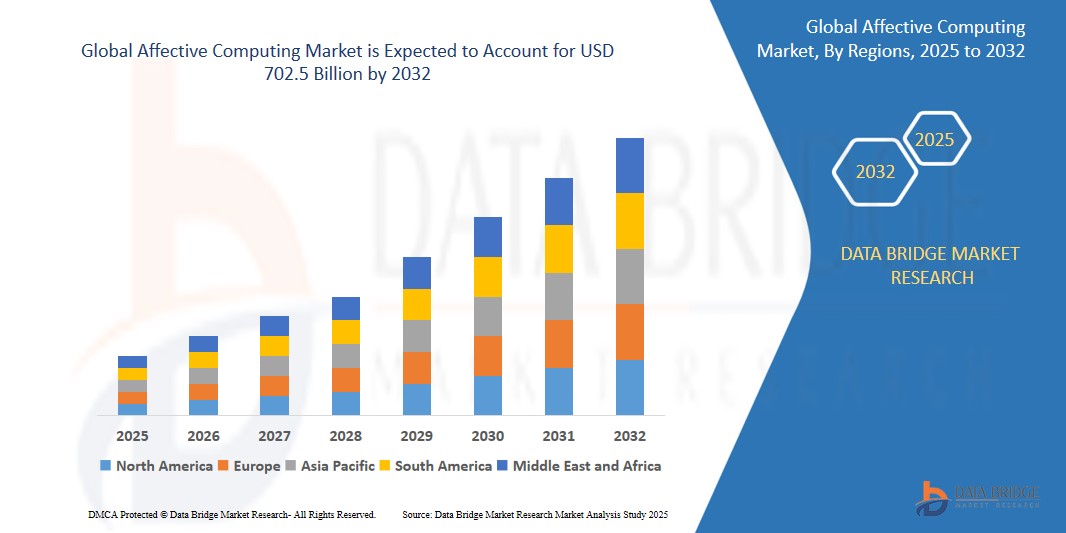
Affective Computing Market Size
- The global Affective Computing market size was valued atUSD 66.1 billion in 2024 and is expected to reachUSD 702.5 billion by 2032, at aCAGR of 30.1% during the forecast period
- This growth is driven by advancements in artificial intelligence (AI), machine learning (ML), and sensor technologies, coupled with increasing demand for personalized human-computer interactions across industries like healthcare, automotive, and retail.
Affective Computing Market Analysis
- The Affective Computing market involves the development of systems and devices that can recognize, interpret, process, and simulate human emotions using technologies like facial recognition, speech analysis, and gesture detection, enhancing human-machine interactions.
- The demand for affective computing solutions is significantly driven by the growing adoption of emotion AI in customer service, with 70% of retailers investing in emotion recognition technologies by 2024, and the rise of telehealth, with 60% of healthcare providers using affective computing for mental health monitoring.,
- North America is expected to dominate the Affective Computing market due to significant investments in AI and ML, holding a 30% market share in 2023, driven by key players like Affectiva and IBM.
- Asia-Pacific is expected to be the fastest-growing region during the forecast period due to rapid technological advancements, government support for AI in countries like China and Japan, and increasing demand for smart wearables.
- The Software segment is expected to dominate the market with a market share of55.0% in 2025 due to the critical role of analytics, facial recognition, and speech recognition software in enabling emotion-aware systems.
Report Scope and Affective Computing Market Segmentation
|
Attributes |
Affective Computing Key Market Insights |
|
Segments Covered |
|
|
Countries Covered |
North America
Europe
Asia-Pacific
Middle East and Africa
South America
|
|
Key Market Players |
|
|
Market Opportunities |
|
|
Value Added Data Infosets |
In addition to the insights on market scenarios such as market value, growth rate, segmentation, geographical coverage, and major players, the market reports curated by the Data Bridge Market Research also include import export analysis, production capacity overview, production consumption analysis, price trend analysis, climate change scenario, supply chain analysis, value chain analysis, raw material/consumables overview, vendor selection criteria, PESTLE Analysis, Porter Analysis, and regulatory framework. |
Affective Computing Market Trends
“Advancements in Touchless Emotion Recognition Technologies”
- A prominent trend in the Affective Computing market is the rapid adoption of touchless technologies, such as computer vision and voice recognition, which enable precise emotion detection without physical contact, growing at a CAGR of 32% by 2032.
- These technologies are increasingly integrated with AI and ML algorithms, with 65% of affective computing solutions leveraging deep learning for real-time emotion analysis by 2024, enhancing applications in healthcare, automotive, and customer service.
- For instance,. in June 2024, OMNIVISION Technologies launched the OV01D1R intelligent CMOS image sensor, enabling human presence detection and facial authentication for affective computing applications.
- This trend is driving demand for scalable, touchless affective computing solutions that prioritize hygiene and user convenience.
Affective Computing Market Dynamics
Driver
“Increasing Demand for Personalized Human-Computer Interactions”
- The growing demand for personalized experiences, with 75% of businesses adopting affective computing to deliver tailored customer interactions by 2024, and advancements in AI and ML for emotion recognition are significantly contributing to the Affective Computing market growth.
- These solutions enable real-time analysis of facial expressions, voice tones, and physiological signals, improving customer satisfaction by 20% in retail and enhancing patient care in healthcare.
For instance,
- In 2024, Amazon’s personalized recommendation system, incorporating affective computing, accounted for 35% of its total sales, demonstrating the technology’s impact.
- As industries prioritize emotional intelligence, the demand for affective computing solutions continues to rise, ensuring enhanced user experiences.
Opportunity
“Expansion of Emotion AI in Autonomous Vehicles”
- The integration of affective computing in autonomous vehicles, with 50% of new ADAS-featured vehicles incorporating emotion recognition by 2025, offers significant opportunities for market growth by enhancing driver safety and passenger experience.
- These systems detect driver fatigue, stress, or distraction, enabling real-time interventions, with deployments projected to reduce accident rates by 15% by 2025.
For instance,
- in 2024, automotive manufacturers partnered with emotion AI companies to integrate affective computing in infotainment systems, improving driver engagement.
- This opportunity drives market expansion by enabling safer and more intuitive automotive systems.
Restraint/Challenge
“Data Privacy Concerns and System Complexity”
- Data privacy concerns, with 55% of consumers expressing unease about emotion data collection in 2024, and the complexity of developing accurate emotion recognition systems, with 40% of solutions facing accuracy issues, pose significant barriers to the Affective Computing market.
- These challenges require robust data protection frameworks and advanced algorithms, increasing development costs for organizations.
For instance,
- in 2024, 30% of enterprises cited high production costs of affective computing systems as a barrier to adoption.
- These issues can hinder market growth, necessitating secure and reliable solutions to build consumer trust.
Affective Computing Market Scope
The market is segmented on the basis of component, technology, and end-use industry.
|
Segmentation |
Sub-Segmentation |
|
By Component |
|
|
By Technology |
|
|
By End-Use Industry |
|
In 2025, the Software segment is projected to dominate the market with the largest share in the component segment.
The Software segment is expected to dominate the Affective Computing market with the largest share of 55.0% in 2025 due to the essential role of analytics, facial recognition, and speech recognition software in enabling real-time emotion analysis and personalized interactions.
“North America Holds the Largest Share in the Affective Computing Market”
- North America dominates the Affective Computing market, driven by significant investments in AI and ML, the presence of key vendors like Affectiva, IBM, and Microsoft, and a 30% market share in 2023.
- The U.S. holds a significant share, valued at USD 20 billion in 2024, due to high adoption of emotion AI in retail, with 79% of U.S. retailers planning to invest in AI by 2025, and healthcare innovations.
- The region’s advanced technological infrastructure and focus on customer experience further strengthen the market.
- In addition, high demand for smart wearables, with 60% of consumers using emotion-tracking devices, fuels market expansion.
“Asia-Pacific is Projected to Register the Highest CAGR in the Affective Computing Market”
- The Asia-Pacific region is expected to witness the highest growth rate, driven by rapid technological advancements, government initiatives for AI development, and increasing demand for emotional intelligence solutions in China, Japan, and India.
- China, with a projected market value of USD 66.9 billion by 2033, remains a key market due to its focus on smart wearables and healthcare applications.
- India is projected to grow at a CAGR of 33.0% due to rising mental health awareness and expanding digital infrastructure.
- The growing adoption of 5G and smart city projects further contributes to market growth.
Affective Computing Market Share
The market competitive landscape provides details by competitor. Details included are company overview, company financials, revenue generated, market potential, investment in research and development, new market initiatives, global presence, production sites and facilities, production capacities, company strengths and weaknesses, product launch, product width and breadth, application dominance. The above data points provided are only related to the companies' focus related to market.
The Major Market Leaders Operating in the Market Are:
- Affectiva Inc. (U.S.)
- IBM Corporation (U.S.)
- Microsoft Corporation (U.S.)
- Google Inc. (U.S.)
- Apple Inc. (U.S.)
- Qualcomm Inc. (U.S.)
- Intel Corporation (U.S.)
- Nuance Communications Inc. (U.S.)
- Eyesight Technologies Ltd. (Israel)
- Sony Depthsensing Solutions (Japan)
Latest Developments in Global Affective Computing Market
- June 2024: OMNIVISION Technologies launched the OV01D1R intelligent CMOS image sensor, designed for human presence detection and facial authentication. Targeted at affective computing applications, this sensor enhances devices with real-time emotional and identity recognition capabilities.
- 2024: Amazon upgraded its personalized recommendation system by integrating affective computing, allowing it to analyze customer emotions more deeply. This innovation helped drive 35% of Amazon’s total sales by delivering more emotionally resonant and targeted product suggestions.
- February 2023: Affectiva collaborated with automotive manufacturers to embed emotion AI into Advanced Driver Assistance Systems (ADAS). This integration enables real-time monitoring of driver emotions, enhancing road safety by detecting stress, fatigue, or distraction during vehicle operation.
SKU-
Получите онлайн-доступ к отчету на первой в мире облачной платформе рыночной аналитики

- Интерактивная панель анализа данных
- Панель анализа компании для возможностей с высоким потенциалом роста
- Доступ аналитика-исследователя для настройки и запросов
- Анализ конкурентов с помощью интерактивной панели
- Последние новости, обновления и анализ тенденций
- Используйте возможности сравнительного анализа для комплексного отслеживания конкурентов
Методология исследования
Сбор данных и анализ базового года выполняются с использованием модулей сбора данных с большими размерами выборки. Этап включает получение рыночной информации или связанных данных из различных источников и стратегий. Он включает изучение и планирование всех данных, полученных из прошлого заранее. Он также охватывает изучение несоответствий информации, наблюдаемых в различных источниках информации. Рыночные данные анализируются и оцениваются с использованием статистических и последовательных моделей рынка. Кроме того, анализ доли рынка и анализ ключевых тенденций являются основными факторами успеха в отчете о рынке. Чтобы узнать больше, пожалуйста, запросите звонок аналитика или оставьте свой запрос.
Ключевой методологией исследования, используемой исследовательской группой DBMR, является триангуляция данных, которая включает в себя интеллектуальный анализ данных, анализ влияния переменных данных на рынок и первичную (отраслевую экспертную) проверку. Модели данных включают сетку позиционирования поставщиков, анализ временной линии рынка, обзор рынка и руководство, сетку позиционирования компании, патентный анализ, анализ цен, анализ доли рынка компании, стандарты измерения, глобальный и региональный анализ и анализ доли поставщика. Чтобы узнать больше о методологии исследования, отправьте запрос, чтобы поговорить с нашими отраслевыми экспертами.
Доступна настройка
Data Bridge Market Research является лидером в области передовых формативных исследований. Мы гордимся тем, что предоставляем нашим существующим и новым клиентам данные и анализ, которые соответствуют и подходят их целям. Отчет можно настроить, включив в него анализ ценовых тенденций целевых брендов, понимание рынка для дополнительных стран (запросите список стран), данные о результатах клинических испытаний, обзор литературы, обновленный анализ рынка и продуктовой базы. Анализ рынка целевых конкурентов можно проанализировать от анализа на основе технологий до стратегий портфеля рынка. Мы можем добавить столько конкурентов, о которых вам нужны данные в нужном вам формате и стиле данных. Наша команда аналитиков также может предоставить вам данные в сырых файлах Excel, сводных таблицах (книга фактов) или помочь вам в создании презентаций из наборов данных, доступных в отчете.











