



Global Antiaging Products and Services Market Segmentation, By Product (UV Absorbers, Anti-Wrinkle, Anti-Stretch, Natural, Hair Color, Intense Pulsed Light (IPL), Oils and Serums, Microdermabrasion, Shampoo and Conditioner, and Others), Active Ingredients (Alpha Hydroxy Acids, Epidermal Growth Factors, Argirelline, Retinol, Peptides, Co-enzyme Q10, Sun Protection Factor (SPF), Vitamin C, Anti-Oxidants), Therapies and Services (Eye-Lid Surgery, Abdominoplasty, Hormone Replacement Therapy, Breast Augmentation, Liposuction, Sclerotherapy, Injectable Skin, Anti-Pigmentation Therapy, Hair Restoration Services, and Chemical Peels), Demography (Baby Boomer, Generation X, and Generation Y), End User (Hospitals, Clinics, and Home Health Care) - Industry Trends and Forecast to 2033
Antiaging Products and Services Market Size
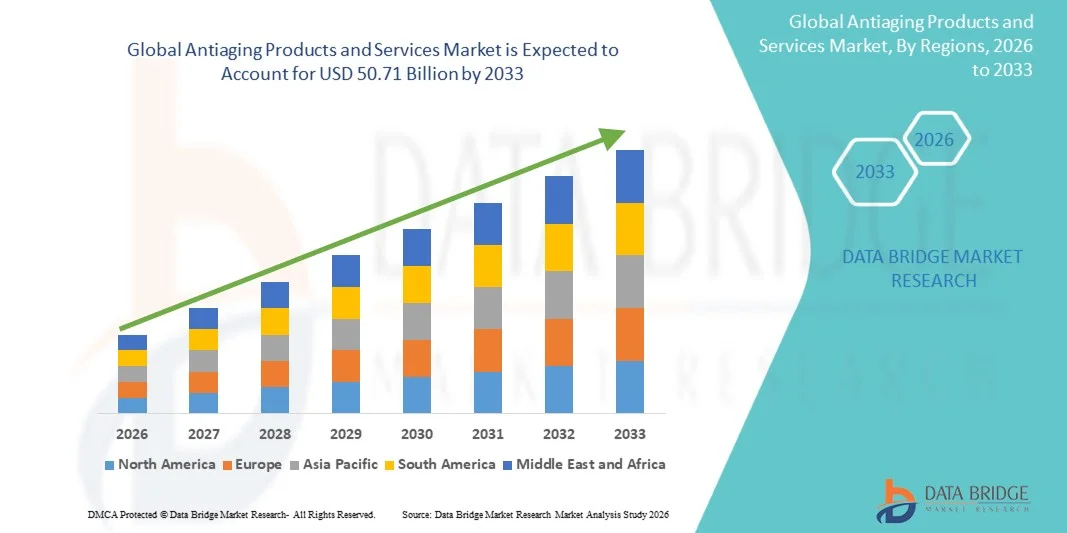
- The global antiaging products and services market size was valued at USD 33.50 billion in 2025 and is expected to reach USD 50.71 billion by 2033, at a CAGR of 5.32% during the forecast period
- The market growth is largely fueled by the increasing global aging population and the rising awareness regarding age-related skin concerns such as wrinkles, fine lines, pigmentation, and loss of skin elasticity. Consumers are increasingly investing in advanced skincare products, cosmetic treatments, and minimally invasive procedures to maintain youthful appearance and improve skin health. In addition, technological advancements in dermatology, including innovative formulations with peptides, retinoids, antioxidants, and hyaluronic acid, are enhancing product efficacy and driving demand for antiaging solutions across both developed and emerging markets
- Furthermore, the growing influence of social media, beauty trends, and celebrity endorsements is significantly encouraging consumers to adopt antiaging products and professional aesthetic services. Rising disposable income, expansion of medical spas and dermatology clinics, and the increasing availability of non-surgical cosmetic procedures such as Botox, dermal fillers, and laser treatments are establishing antiaging products and services as a mainstream component of modern beauty and wellness routines. These converging factors are accelerating the adoption of Antiaging Products and Services solutions, thereby significantly boosting the overall growth of the market
Antiaging Products and Services Market Analysis
- Antiaging products and services, which include advanced skincare formulations, aesthetic devices, minimally invasive cosmetic procedures, and dermatology services, are increasingly becoming essential components of the global beauty and wellness industry. These solutions are widely adopted across dermatology clinics, medical spas, and home-care settings to reduce visible signs of aging such as wrinkles, pigmentation, and skin laxity, while improving overall skin health and appearance. The growing focus on personal grooming, aesthetic enhancement, and preventive skincare is significantly strengthening the demand for antiaging solutions in both developed and emerging markets
- The escalating demand for antiaging products and services is primarily fueled by the rapidly growing aging population, increasing awareness of skincare treatments, and technological advancements in cosmetic dermatology. Consumers are increasingly seeking non-invasive and minimally invasive procedures such as dermal fillers, Botox injections, laser resurfacing, and chemical peels. In addition, the introduction of advanced ingredients such as peptides, antioxidants, retinoids, and hyaluronic acid in skincare products has improved product effectiveness, further boosting consumer confidence and adoption rates across different age groups
- North America dominated the antiaging products and services market with the largest revenue share of approximately 37.6% in 2025, supported by high consumer spending on aesthetic treatments, advanced healthcare infrastructure, and the strong presence of leading skincare and cosmetic companies. The U.S. represents the largest contributor in the region, driven by increasing adoption of cosmetic dermatology procedures, expansion of medical spas, and continuous product innovation from global beauty brands and pharmaceutical companies developing advanced antiaging therapies and skincare solutions
- Asia-Pacific is expected to be the fastest-growing region in the antiaging products and services market during the forecast period, registering a CAGR of around 8.9% from 2026 to 2033. The growth is attributed to rapidly expanding middle-class populations, rising disposable incomes, increasing awareness regarding skincare routines, and growing demand for cosmetic procedures in countries such as China, Japan, South Korea, and India
- The baby boomer segment dominated the largest market revenue share of 43.7% in 2025, driven by the increasing aging population and high demand for antiaging treatments among individuals aged 55 years and above
Report Scope and Antiaging Products and Services Market Segmentation
|
Attributes |
Antiaging Products and Services Key Market Insights |
|
Segments Covered |
|
|
Countries Covered |
North America
Europe
Asia-Pacific
Middle East and Africa
South America
|
|
Key Market Players |
• L'Oréal Group (France) |
|
Market Opportunities |
|
|
Value Added Data Infosets |
In addition to the insights on market scenarios such as market value, growth rate, segmentation, geographical coverage, and major players, the market reports curated by the Data Bridge Market Research also include in-depth expert analysis, patient epidemiology, pipeline analysis, pricing analysis, and regulatory framework. |
Antiaging Products and Services Market Trends
“Rising Demand for Personalized and Preventive Anti-Aging Solutions”
- A significant and accelerating trend in the global antiaging products and services market is the growing demand for personalized and preventive skincare and wellness solutions that address aging concerns before they become pronounced. Consumers are increasingly seeking tailored treatments, customized skincare regimens, and early intervention strategies to maintain youthful skin and overall well-being
- For instance, many dermatology clinics and aesthetic centers now provide individualized anti-aging treatment plans that combine medical-grade skincare products, cosmetic procedures, and lifestyle recommendations designed to target specific skin concerns such as wrinkles, pigmentation, and loss of elasticity. Similarly, premium skincare brands are introducing personalized formulations based on skin diagnostics and consumer preferences
- Technological advancements in dermatology and cosmetic science are enabling more targeted solutions that help improve skin health and delay visible signs of aging. Innovations such as peptide-based formulations, retinol alternatives, collagen-boosting treatments, and advanced antioxidant ingredients are gaining popularity due to their ability to improve skin firmness and texture over time. In addition, professional services such as chemical peels, laser therapies, and non-invasive skin rejuvenation procedures are becoming increasingly accessible to consumers seeking effective anti-aging solutions
- The expansion of wellness-focused lifestyles has also contributed to the rising popularity of holistic anti-aging approaches. Consumers are adopting skincare routines that incorporate nutrition, hydration, and stress management alongside topical treatments and aesthetic procedures. This integrated approach supports long-term skin health and aligns with the broader shift toward preventive healthcare and beauty maintenance
- As consumer awareness of skincare science continues to grow, companies are introducing innovative products and services designed to deliver visible results while maintaining skin safety. Leading cosmetic brands and aesthetic service providers are focusing on clinically tested ingredients and evidence-based treatments that address age-related concerns such as fine lines, dullness, and uneven skin tone
- The demand for advanced anti-aging solutions is rising rapidly across both developed and emerging markets, as consumers increasingly prioritize self-care, long-term skin health, and effective beauty treatments that support youthful appearance and overall confidence
Antiaging Products and Services Market Dynamics
Driver
“Increasing Aging Population and Rising Consumer Focus on Aesthetic Wellness”
- The increasing global aging population, combined with growing consumer awareness about aesthetic wellness and skincare maintenance, is a significant driver for the expansion of the antiaging products and services market. As people live longer and remain active later in life, there is a stronger emphasis on maintaining youthful skin and overall physical appearance
- For instance, in recent years several dermatology clinics and cosmetic treatment providers have expanded their offerings to include minimally invasive anti-aging procedures such as dermal fillers, botulinum toxin treatments, and laser-based skin rejuvenation. These developments demonstrate the growing acceptance of professional anti-aging treatments among consumers seeking visible yet natural results
- As consumers become more conscious about skin health and personal appearance, they are increasingly investing in high-quality skincare products and professional aesthetic treatments that help reduce signs of aging. Products containing ingredients such as hyaluronic acid, peptides, and antioxidants are widely used to support skin hydration, elasticity, and collagen production
- Furthermore, the rising influence of social media, beauty influencers, and dermatological awareness campaigns is encouraging consumers to adopt comprehensive skincare routines at earlier stages of life. Younger demographics are increasingly embracing preventive anti-aging products designed to maintain healthy skin and delay the appearance of wrinkles and fine lines
- The availability of a wide range of anti-aging solutions—from over-the-counter skincare products to advanced medical aesthetic procedures—has made it easier for consumers to access treatments that align with their personal goals and budgets. As a result, both product manufacturers and aesthetic service providers are expanding their offerings to meet evolving consumer preferences
Restraint/Challenge
“High Cost of Advanced Treatments and Concerns About Product Safety”
- The relatively high cost associated with advanced anti-aging treatments and premium skincare formulations remains a key challenge for the widespread adoption of antiaging products and services. Many professional aesthetic procedures, including laser therapies, injectable treatments, and specialized dermatological services, require significant financial investment, which may limit access for price-sensitive consumers
- For instance, premium anti-aging skincare products often incorporate specialized ingredients and advanced formulations that increase production costs, resulting in higher retail prices compared with conventional skincare alternatives. This price difference can discourage consumers from regularly purchasing or maintaining long-term treatment regimens
- In addition, concerns regarding product safety and the effectiveness of certain cosmetic treatments may influence consumer confidence in the anti-aging market. Some consumers remain cautious about potential side effects, allergic reactions, or unsatisfactory outcomes associated with invasive or improperly administered procedures
- Addressing these concerns through rigorous clinical testing, transparent product labeling, and adherence to regulatory standards is essential for building consumer trust. Many skincare brands and aesthetic clinics emphasize dermatological testing, scientifically validated ingredients, and professional supervision to ensure safety and reliability
- While technological advancements and increased competition are gradually making anti-aging treatments more accessible, affordability remains a key factor influencing purchasing decisions. Expanding the availability of cost-effective products and providing consumer education on proper skincare practices will be important for supporting long-term growth in the global antiaging products and services market
Antiaging Products and Services Market Scope
The Antiaging Products and Services market is segmented on the basis of product, active ingredients, therapies and services, demography, and end user.
• By Product
On the basis of product, the Antiaging Products and Services market is segmented into UV absorbers, anti-wrinkle, anti-stretch, natural, hair color, intense pulsed light (IPL), oils and serums, microdermabrasion, shampoo and conditioner, and others. The anti-wrinkle segment dominated the largest market revenue share of 25.4% in 2025, driven by the increasing demand for skincare solutions that reduce wrinkles, fine lines, and other visible signs of aging. Anti-wrinkle creams, serums, and lotions are widely used due to their convenience and accessibility for daily skincare routines. Consumers are increasingly adopting preventive skincare regimens, which is further boosting demand for these products. The availability of scientifically formulated products containing retinol, peptides, and antioxidants is improving treatment effectiveness. Cosmetic companies are continuously introducing advanced anti-wrinkle formulations to enhance product performance and skin benefits. Strong marketing campaigns and the influence of beauty trends on social media platforms are also increasing product adoption. In addition, easy availability through e-commerce platforms and retail channels supports the segment’s growth.
The intense pulsed light (IPL) segment is expected to witness the fastest CAGR of 11.6% from 2026 to 2033, driven by the rising adoption of non-invasive aesthetic procedures. IPL technology is widely used for skin rejuvenation, wrinkle reduction, and pigmentation treatment. Dermatology clinics and aesthetic centers increasingly adopt IPL devices due to their ability to deliver effective results with minimal downtime. Growing awareness about professional antiaging treatments and the rising popularity of cosmetic dermatology procedures are significantly driving segment growth. Technological advancements in light-based skin therapies are also improving treatment safety and effectiveness. Increasing disposable income and consumer willingness to invest in aesthetic procedures are further accelerating demand.
• By Active Ingredients
On the basis of active ingredients, the Antiaging Products and Services market is segmented into alpha hydroxy acids, epidermal growth factors, Argirelline, retinol, peptides, co-enzyme Q10, sun protection factor (SPF), vitamin C, and antioxidants. The retinol segment dominated the largest market revenue share of 23.2% in 2025, driven by its strong clinical effectiveness in reducing wrinkles and improving skin texture. Retinol promotes skin cell turnover and stimulates collagen production, making it one of the most widely recommended antiaging ingredients by dermatologists. Increasing consumer awareness regarding scientifically proven skincare ingredients has significantly boosted demand for retinol-based products. Cosmetic companies are launching advanced retinol formulations that offer improved stability and reduced skin irritation. Retinol is widely used in creams, serums, and night repair treatments, contributing to its high market penetration. The increasing popularity of dermatologist-approved skincare routines also supports the growth of this segment.
The peptides segment is expected to witness the fastest CAGR of 10.8% from 2026 to 2033, driven by their ability to stimulate collagen production and improve skin elasticity. Peptides are increasingly incorporated into premium antiaging skincare products due to their regenerative properties. Skincare companies are investing heavily in peptide-based formulations designed to address multiple skin aging concerns. Rising consumer demand for advanced, science-based skincare products is also accelerating the adoption of peptide-based formulations.
• By Therapies and Services
On the basis of therapies and services, the Antiaging Products and Services market is segmented into eye-lid surgery, abdominoplasty, hormone replacement therapy, breast augmentation, liposuction, sclerotherapy, injectable skin treatments, anti-pigmentation therapy, hair restoration services, and chemical peels. The injectable skin treatments segment dominated the largest market revenue share of 29.3% in 2025, driven by the growing popularity of minimally invasive cosmetic procedures such as Botox and dermal fillers. These treatments are widely used to reduce wrinkles, restore facial volume, and enhance skin appearance. Consumers prefer injectable treatments due to their immediate results and minimal recovery time. Dermatology clinics and medical spas are expanding their offerings to include a wide range of injectable procedures. The increasing acceptance of aesthetic treatments among both men and women further supports segment growth. Technological advancements in filler materials and injection techniques are also improving treatment safety and effectiveness.
The hair restoration services segment is expected to witness the fastest CAGR of 12.1% from 2026 to 2033, fueled by the increasing prevalence of hair loss conditions such as androgenetic alopecia. Technological advancements in hair transplantation techniques such as follicular unit extraction (FUE) are significantly improving treatment outcomes. Growing awareness about hair restoration procedures and rising aesthetic consciousness among consumers are further accelerating segment growth. In addition, increasing acceptance of cosmetic procedures among both men and women is expanding the potential consumer base for hair restoration treatments. The growing number of specialized hair transplant clinics and skilled practitioners worldwide is also improving treatment accessibility. Furthermore, advancements in regenerative therapies such as platelet-rich plasma (PRP) and stem-cell–based treatments are further supporting the rapid growth of the hair restoration services segment.
• By Demography
On the basis of demography, the Antiaging Products and Services market is segmented into baby boomer, Generation X, and Generation Y. The baby boomer segment dominated the largest market revenue share of 43.7% in 2025, driven by the increasing aging population and high demand for antiaging treatments among individuals aged 55 years and above. This demographic group actively invests in skincare products, aesthetic treatments, and cosmetic procedures to maintain youthful skin and appearance. Baby boomers generally possess higher disposable income and stronger purchasing power compared to younger consumers. The growing focus on healthy aging and maintaining physical appearance further supports the demand for antiaging products and services among this group. Cosmetic companies are increasingly targeting this demographic with specialized skincare solutions designed for mature skin.
The Generation X segment is expected to witness the fastest CAGR of 10.4% from 2026 to 2033, driven by increasing awareness regarding preventive skincare and early adoption of antiaging treatments. Consumers in this age group are proactively investing in advanced skincare products and minimally invasive aesthetic procedures. Rising disposable income and growing beauty consciousness are further contributing to the growth of this segment. In addition, individuals in this demographic are increasingly seeking long-term skin health solutions to delay visible aging signs such as wrinkles, pigmentation, and skin laxity. The growing popularity of dermatologist-recommended skincare routines and professional aesthetic treatments is further boosting segment demand. Moreover, increased exposure to digital beauty content, social media influence, and targeted marketing by cosmetic brands is encouraging Generation X consumers to adopt premium antiaging products and services.
• By End User
On the basis of end user, the Antiaging Products and Services market is segmented into hospitals, clinics, and home health care. The clinics segment dominated the largest market revenue share of 47.5% in 2025, driven by the growing number of dermatology clinics and aesthetic treatment centers worldwide. Clinics provide specialized antiaging treatments including Botox injections, dermal fillers, laser therapies, and chemical peels. The availability of trained dermatologists and advanced equipment makes clinics the preferred treatment location for many consumers. Increasing consumer trust in professional skincare procedures further strengthens the segment’s dominance. Clinics also provide personalized treatment plans tailored to individual skin conditions.
The home health care segment is expected to witness the fastest CAGR of 11.2% from 2026 to 2033, fueled by the rising demand for at-home antiaging skincare products and beauty devices. Consumers increasingly prefer convenient and cost-effective skincare solutions that can be used without visiting clinics. The growing popularity of home-use devices such as LED therapy tools, microcurrent devices, and antiaging serums is accelerating segment growth. In addition, the rapid expansion of e-commerce platforms and direct-to-consumer beauty brands has made advanced antiaging products more accessible to a broader consumer base. Increasing consumer awareness regarding preventive skincare and long-term skin health management is also encouraging the adoption of at-home treatment solutions. Furthermore, continuous product innovations by cosmetic and dermatology companies, including smart beauty devices and dermatologist-developed skincare kits, are further supporting the rapid growth of the home health care segment.
Antiaging Products and Services Market Regional Analysis
- North America dominated the antiaging products and services market with the largest revenue share of approximately 37.6% in 2025, supported by high consumer spending on aesthetic treatments, advanced healthcare infrastructure, and the strong presence of leading skincare, cosmetic, and pharmaceutical companies. The region has a well-established beauty and wellness industry, along with a high level of consumer awareness regarding skin health, preventive aging solutions, and cosmetic dermatology treatments, which significantly contributes to market expansion
- The strong presence of dermatology clinics, cosmetic surgery centers, and medical spas across the region further supports the widespread adoption of antiaging services, including laser treatments, chemical peels, dermal fillers, and botulinum toxin procedures
- Rising awareness regarding preventive skincare routines, combined with increasing demand for advanced formulations such as retinoids, peptides, antioxidants, and collagen-boosting ingredients, continues to drive product innovation and consumer adoption
U.S. Antiaging Products and Services Market Insight
The U.S. antiaging products and services market represents the largest contributor within North America, driven by the widespread adoption of cosmetic dermatology procedures, rapid expansion of medical spas, and continuous product innovation from global beauty brands and pharmaceutical companies. The country has a well-developed aesthetic industry supported by board-certified dermatologists, cosmetic surgeons, and specialized skincare clinics offering advanced antiaging treatments. Increasing demand for minimally invasive procedures such as dermal fillers, botulinum toxin injections, and laser resurfacing treatments is significantly contributing to market growth. In addition, strong consumer awareness regarding skincare routines, increasing social media influence on beauty standards, and the growing popularity of personalized skincare solutions are further fueling the expansion of the antiaging products and services industry in the United States.
Europe Antiaging Products and Services Market Insight
The Europe antiaging products and services market is projected to expand at a substantial CAGR during the forecast period, driven by increasing consumer awareness regarding skincare, a growing aging population, and the strong presence of luxury cosmetic and pharmaceutical companies. Countries such as France, Germany, Italy, and the U.K. have well-established skincare industries supported by advanced dermatology clinics and cosmetic research institutions. The demand for natural and organic antiaging formulations, along with innovative cosmetic procedures such as laser therapy and skin rejuvenation treatments, is steadily increasing across the region. Furthermore, rising investments in dermatological research and increasing consumer preference for clinically tested antiaging products are expected to contribute to sustained market growth.
U.K. Antiaging Products and Services Market Insight
The U.K. antiaging products and services market is anticipated to grow at a noteworthy CAGR during the forecast period, supported by increasing consumer interest in advanced skincare products, aesthetic treatments, and wellness therapies. The country has witnessed a significant rise in non-invasive cosmetic procedures, including dermal fillers, skin tightening treatments, and chemical peels performed in dermatology clinics and medical spas. In addition, strong retail and e-commerce networks are enabling wider availability of premium antiaging skincare brands, allowing consumers to easily access a variety of products designed to improve skin elasticity, hydration, and overall appearance.
Germany Antiaging Products and Services Market Insight
The Germany antiaging products and services market is expected to expand at a considerable CAGR during the forecast period, fueled by rising consumer awareness regarding skin health, increasing adoption of advanced dermatological treatments, and strong demand for scientifically formulated skincare products. Germany’s well-developed healthcare infrastructure and emphasis on medical research contribute to the development and adoption of innovative antiaging therapies, including regenerative skincare treatments and advanced cosmetic procedures. The growing popularity of wellness centers, dermatology clinics, and aesthetic medical practices is also supporting market growth across the country.
Asia-Pacific Antiaging Products and Services Market Insight
The Asia-Pacific antiaging products and services market is expected to be the fastest-growing region, registering a CAGR of approximately 8.9% during the forecast period from 2026 to 2033. The growth is primarily attributed to rapidly expanding middle-class populations, rising disposable incomes, and increasing awareness regarding skincare and aesthetic treatments. Countries such as China, Japan, South Korea, and India are witnessing strong demand for antiaging skincare products, cosmetic procedures, and wellness therapies. In addition, the growing influence of beauty trends, social media, and the expansion of dermatology clinics and cosmetic treatment centers across the region are further driving market growth.
Japan Antiaging Products and Services Market Insight
The Japan antiaging products and services market gaining significant momentum due to the country’s rapidly aging population and strong consumer focus on maintaining healthy and youthful skin. Japanese consumers place high importance on skincare routines and preventive treatments, which has led to increased demand for high-quality antiaging products containing advanced ingredients such as collagen, hyaluronic acid, and peptides. Furthermore, the country’s well-developed cosmetic research sector and the presence of globally recognized beauty brands are encouraging continuous innovation in antiaging skincare solutions.
China Antiaging Products and Services Market Insight
The China antiaging products and services market accounted for the largest revenue share within the Asia-Pacific region in 2025, driven by the country’s rapidly expanding middle-class population, increasing beauty consciousness, and rising disposable incomes. The growing popularity of premium skincare brands, cosmetic dermatology procedures, and antiaging treatments among younger consumers is significantly contributing to market growth. In addition, the rapid expansion of e-commerce platforms, beauty clinics, and aesthetic treatment centers across urban areas is improving accessibility to advanced antiaging products and services, further strengthening the market outlook in China.
Antiaging Products and Services Market Share
The Antiaging Products and Services industry is primarily led by well-established companies, including:
• L'Oréal Group (France)
• Estée Lauder Companies (U.S.)
• Procter & Gamble (U.S.)
• Unilever (U.K.)
• Beiersdorf AG (Germany)
• Shiseido Company, Limited (Japan)
• Amorepacific Corporation (South Korea)
• Coty Inc. (U.S.)
• Johnson & Johnson (U.S.)
• Allergan Aesthetics (Ireland)
• Galderma (Switzerland)
• Merz Pharma (Germany)
• Hugel Inc. (South Korea)
• Cynosure (U.S.)
• Cutera, Inc. (U.S.)
• Nu Skin Enterprises (U.S.)
• Oriflame Holding AG (Switzerland)
• Revlon, Inc. (U.S.)
• Kao Corporation (Japan)
• LG Household & Health Care (South Korea)
Latest Developments in Global Antiaging Products and Services Market
- In March 2021, CeraVe introduced the Hydrating Hyaluronic Acid Cream in the United Kingdom, a skincare formulation designed to improve skin hydration and barrier protection using hyaluronic acid and ceramides. The launch strengthened CeraVe’s anti-aging skincare portfolio and addressed growing consumer demand for moisturization-focused antiaging treatments
- In November 2021, Estée Lauder Companies Inc. launched Advanced Night Repair Intense Reset Concentrate, an anti-aging serum formulated with potent ingredients aimed at reducing skin damage, improving texture, and promoting visible skin rejuvenation. The product reinforced the company’s leadership in science-driven anti-aging skincare solutions
- In January 2022, L’Oréal S.A. announced the acquisition of Thayers Natural Remedies, a U.S.-based skincare company recognized for its natural formulations. The acquisition strengthened L’Oréal’s position in the growing clean beauty and anti-aging skincare segment and expanded its skincare brand portfolio
- In March 2022, Beiersdorf AG launched the NIVEA Cellular Filler anti-aging skincare range, developed with advanced ingredients designed to restore skin firmness and volume while reducing visible wrinkles associated with aging
- In January 2023, Boots introduced its No7 Future Renew anti-aging skincare collection, formulated with a proprietary peptide technology designed to help stimulate the skin’s natural repair processes and address multiple visible signs of skin aging
- In April 2024, Beiersdorf AG announced a scientific breakthrough identifying a new active ingredient targeting skin glycation, a biological process linked to skin aging and wrinkle formation. This discovery supports the development of next-generation anti-aging skincare products aimed at improving skin elasticity and reducing age-related damage
- In September 2025, entrepreneur Martha Stewart launched Elm Biosciences, a skincare brand developed with dermatologist Dr. Dhaval Bhanusali, introducing anti-aging products such as the A30 Elemental Serum and Inner Dose Daily Skin Supplement designed to improve skin texture, hydration, and overall skin health
SKU-
Получите онлайн-доступ к отчету на первой в мире облачной платформе рыночной аналитики

- Интерактивная панель анализа данных
- Панель анализа компании для возможностей с высоким потенциалом роста
- Доступ аналитика-исследователя для настройки и запросов
- Анализ конкурентов с помощью интерактивной панели
- Последние новости, обновления и анализ тенденций
- Используйте возможности сравнительного анализа для комплексного отслеживания конкурентов
Методология исследования
Сбор данных и анализ базового года выполняются с использованием модулей сбора данных с большими размерами выборки. Этап включает получение рыночной информации или связанных данных из различных источников и стратегий. Он включает изучение и планирование всех данных, полученных из прошлого заранее. Он также охватывает изучение несоответствий информации, наблюдаемых в различных источниках информации. Рыночные данные анализируются и оцениваются с использованием статистических и последовательных моделей рынка. Кроме того, анализ доли рынка и анализ ключевых тенденций являются основными факторами успеха в отчете о рынке. Чтобы узнать больше, пожалуйста, запросите звонок аналитика или оставьте свой запрос.
Ключевой методологией исследования, используемой исследовательской группой DBMR, является триангуляция данных, которая включает в себя интеллектуальный анализ данных, анализ влияния переменных данных на рынок и первичную (отраслевую экспертную) проверку. Модели данных включают сетку позиционирования поставщиков, анализ временной линии рынка, обзор рынка и руководство, сетку позиционирования компании, патентный анализ, анализ цен, анализ доли рынка компании, стандарты измерения, глобальный и региональный анализ и анализ доли поставщика. Чтобы узнать больше о методологии исследования, отправьте запрос, чтобы поговорить с нашими отраслевыми экспертами.
Доступна настройка
Data Bridge Market Research является лидером в области передовых формативных исследований. Мы гордимся тем, что предоставляем нашим существующим и новым клиентам данные и анализ, которые соответствуют и подходят их целям. Отчет можно настроить, включив в него анализ ценовых тенденций целевых брендов, понимание рынка для дополнительных стран (запросите список стран), данные о результатах клинических испытаний, обзор литературы, обновленный анализ рынка и продуктовой базы. Анализ рынка целевых конкурентов можно проанализировать от анализа на основе технологий до стратегий портфеля рынка. Мы можем добавить столько конкурентов, о которых вам нужны данные в нужном вам формате и стиле данных. Наша команда аналитиков также может предоставить вам данные в сырых файлах Excel, сводных таблицах (книга фактов) или помочь вам в создании презентаций из наборов данных, доступных в отчете.











