


Global Antimicrobial Susceptibility Testing Market Segmentation, By Product Type (Instruments, Consumables & Accessories, and Services & Software), Methods (Mass Spectrometry Method, Dilution, Disk Diffusion, E-Test, Genotypic Methods & Others), Type (Antibacterial Testing, Antifungal Testing & Rapid-AST), Application (Clinical Diagnostics, Drug Discovery and Development, Epidemiology & Others), End User (Hospitals, Pharmaceuticals and Biotechnology Companies, Diagnostic Laboratories, Contract Research Organizations, Research Centres and Academic Institutes & Others), Distribution Channel (Direct Sales, Retail Sales & Third Party Distributor)- Industry Trends and Forecast to 2033
Antimicrobial Susceptibility Testing Market Size
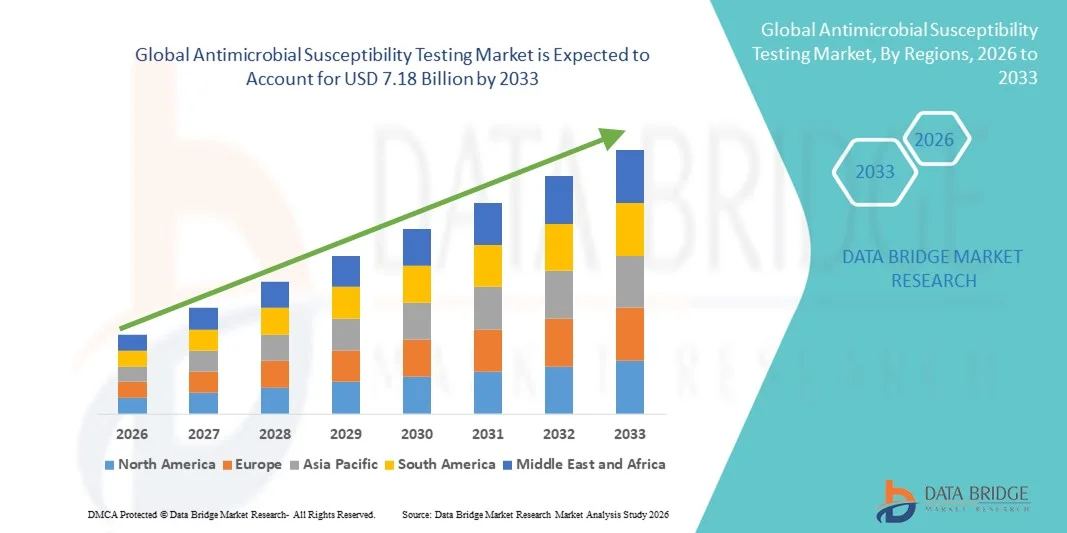
- The global antimicrobial susceptibility testing market size was valued at USD 4.54 billion in 2025 and is expected to reach USD 7.18 billion by 2033, at a CAGR of 5.90% during the forecast period
- The market growth is largely fueled by the rising prevalence of infectious diseases and antimicrobial resistance (AMR), coupled with increasing emphasis on precision diagnostics and effective antibiotic stewardship programs across healthcare settings
- Furthermore, growing investments in advanced laboratory automation, rapid diagnostic technologies, and regulatory support for combating drug-resistant pathogens are positioning antimicrobial susceptibility testing as a critical component of modern clinical microbiology, thereby significantly boosting the industry's growth
Antimicrobial Susceptibility Testing Market Analysis
- Antimicrobial susceptibility testing (AST), which determines the effectiveness of antibiotics and antifungal agents against specific pathogens, has become a cornerstone of modern clinical microbiology and infectious disease management due to its essential role in guiding targeted therapy, reducing empirical antibiotic usage, and addressing the escalating threat of antimicrobial resistance (AMR) across healthcare and research environments
- The escalating demand for antimicrobial susceptibility testing is primarily fueled by the rising global burden of hospital-acquired and community-acquired infections, increasing prevalence of multidrug-resistant organisms, and expanding antimicrobial stewardship initiatives aimed at optimizing treatment regimens and improving patient outcomes
- North America dominated the antimicrobial susceptibility testing market with the largest revenue share of 38.74% in 2025, characterized by well-established clinical laboratory infrastructure, strong regulatory oversight, and rapid adoption of advanced diagnostic technologies, with the U.S. leading in the implementation of automated instruments and genotypic methods within hospital and reference laboratory settings
- Asia-Pacific is expected to be the fastest growing region in the antimicrobial susceptibility testing market during the forecast period due to expanding healthcare infrastructure, rising government initiatives to combat antimicrobial resistance, and growing investments in diagnostic laboratories and pharmaceutical research activities
- Consumables & Accessories segment dominated the antimicrobial susceptibility testing market with a market share of 47.3% in 2025, driven by the recurring demand for reagents, culture media, test kits, and disks required for routine dilution, disk diffusion, and E-test methods across hospitals, diagnostic laboratories, and research institutes
Report Scope and Antimicrobial Susceptibility Testing Market Segmentation
|
Attributes |
Antimicrobial Susceptibility Testing Key Market Insights |
|
Segments Covered |
|
|
Countries Covered |
North America
Europe
Asia-Pacific
Middle East and Africa
South America
|
|
Key Market Players |
|
|
Market Opportunities |
|
|
Value Added Data Infosets |
In addition to the insights on market scenarios such as market value, growth rate, segmentation, geographical coverage, and major players, the market reports curated by the Data Bridge Market Research also include in-depth expert analysis, patient epidemiology, pipeline analysis, pricing analysis, and regulatory framework |
Antimicrobial Susceptibility Testing Market Trends
Integration of Rapid and Automated Diagnostic Technologies
- A significant and accelerating trend in the global antimicrobial susceptibility testing market is the integration of rapid-AST platforms and automated laboratory systems, which are enhancing turnaround times and workflow efficiency in clinical microbiology laboratories
- For instance, the VITEK® 2 automated system allows simultaneous testing of multiple bacterial isolates, providing faster susceptibility results compared to traditional manual methods, thereby supporting timely clinical decisions
- Automation and rapid testing integration enable features such as real-time data reporting, reduced manual errors, and improved standardization across laboratories. For instance, BD Phoenix™ systems offer automated detection with advanced software analytics to quickly identify resistant pathogens
- The seamless integration of AST platforms with laboratory information management systems (LIMS) facilitates centralized monitoring of resistance patterns and test results, enabling improved epidemiological tracking and decision-making
- This trend toward faster, more accurate, and interconnected diagnostic workflows is reshaping expectations for clinical microbiology labs. Consequently, companies such as bioMérieux are developing AI-supported rapid-AST solutions with automated interpretation and electronic reporting capabilities
- The demand for automated and rapid AST technologies is growing across hospitals, diagnostic labs, and research institutions, as healthcare providers increasingly prioritize quick, reliable, and actionable susceptibility results
- Another emerging trend is the adoption of multiplex testing kits that allow simultaneous evaluation of multiple pathogens, reducing sample processing time and improving lab throughput
- Furthermore, integration with cloud-based platforms for remote monitoring and data analytics is enabling real-time surveillance of antimicrobial resistance trends at regional and national levels
Antimicrobial Susceptibility Testing Market Dynamics
Driver
Increasing Threat of Antimicrobial Resistance and Need for Targeted Therapy
- The rising prevalence of multidrug-resistant infections and global antimicrobial resistance (AMR) is a significant driver for the increased demand for AST, as accurate susceptibility data is essential for effective treatment
- For instance, in March 2025, Thermo Fisher Scientific announced the launch of a new genotypic AST assay for multidrug-resistant Gram-negative bacteria, aiming to accelerate targeted therapy in clinical settings
- As healthcare providers seek to minimize inappropriate antibiotic use and optimize treatment regimens, AST offers critical support by providing actionable resistance profiles for pathogens
- Furthermore, increasing adoption of hospital antimicrobial stewardship programs and national AMR initiatives is making AST a mandatory component of infection management strategies, enhancing its market relevance
- The ability to guide personalized therapy, improve patient outcomes, and reduce treatment costs is a key factor propelling the adoption of AST across clinical and research settings, while growing awareness of AMR risks further supports market expansion
- Rising investments in pharmaceutical R&D for new antibiotics and combination therapies are driving the need for robust AST to evaluate drug efficacy during preclinical and clinical trials
- Moreover, growing demand for point-of-care AST solutions in outpatient and emergency care settings is encouraging manufacturers to develop portable and rapid testing devices, expanding the market footprint
Restraint/Challenge
High Costs and Infrastructure Limitations in Emerging Regions
- The relatively high cost of advanced AST instruments, consumables, and software solutions poses a significant challenge to broader market penetration, particularly in resource-limited regions
- For instance, smaller hospitals or laboratories in developing countries may face budget constraints that limit the adoption of automated or rapid-AST platforms despite their clinical benefits
- Addressing infrastructure limitations such as the need for skilled personnel, controlled laboratory environments, and stable power supply is crucial for wider implementation of AST technologies
- In addition, regulatory approvals, varying quality standards, and complex compliance requirements across regions can delay product launches and adoption, increasing operational hurdles for manufacturers
- While costs and infrastructure are gradually improving with the introduction of modular and lower-cost systems, these factors continue to pose barriers to market growth, particularly in emerging economies, necessitating targeted solutions and support initiatives
- Limited awareness and training among healthcare providers regarding the interpretation and use of AST results can reduce adoption rates, especially in smaller clinics and laboratories
- Furthermore, logistical challenges in transporting samples and maintaining reagent stability in remote or underdeveloped regions can hinder consistent and reliable AST testing
Antimicrobial Susceptibility Testing Market Scope
The market is segmented on the basis of product type, methods, type, application, end user, and distribution channel.
- By Product Type
On the basis of product type, the antimicrobial susceptibility testing market is segmented into instruments, consumables & accessories, and services & software. Consumables & Accessories segment dominated the market with the largest revenue share of 47.3% in 2025, driven by the recurring demand for culture media, reagents, disks, and test kits required for routine AST procedures. Laboratories and hospitals rely on consumables for dilution, disk diffusion, and E-test methods, making this segment a consistent revenue generator. Consumables are essential to maintain testing accuracy and compliance with standard protocols. Ready-to-use kits and quality-assured products improve lab workflow and minimize errors. The recurring nature of consumables ensures steady demand across clinical, pharmaceutical, and research applications. Continuous innovation by manufacturers enhances product reliability and usability.
Instruments segment is anticipated to witness the fastest growth from 2026 to 2033, driven by rising adoption of automated AST platforms, rapid detection systems, and integration with laboratory information management systems (LIMS). Automated instruments reduce manual errors, increase throughput, and accelerate testing timelines, particularly in high-volume clinical labs. Hospitals and reference laboratories are increasingly investing in high-throughput instruments to manage growing sample volumes efficiently. AI-supported analysis, digital readouts, and remote connectivity enhance the usability of these instruments. Integration with hospital IT infrastructure enables real-time reporting and monitoring. Technological innovation and improved efficiency drive the growth of instruments as the preferred AST solution.
- By Methods
On the basis of methods, the market is segmented into mass spectrometry, dilution, disk diffusion, E-test, genotypic methods, and others. Disk Diffusion Method dominated the market in 2025 due to its simplicity, cost-effectiveness, and wide adoption in clinical laboratories. It remains a standard method for routine AST, particularly in hospitals and diagnostic labs with limited budgets. The method is compatible with a wide range of bacterial strains and is valued for its visual interpretation of inhibition zones. Standardized protocols provided by CLSI and EUCAST enhance reliability and reproducibility. Educational institutions and research labs frequently use disk diffusion for teaching and training purposes. Its established reputation and low operational cost make it a dominant method in AST globally.
Genotypic Methods are expected to witness the fastest growth from 2026 to 2033, fueled by increasing demand for rapid and precise detection of antimicrobial resistance genes. These methods enable early identification of multidrug-resistant organisms and guide targeted therapy without waiting for phenotypic culture results. PCR-based assays, multiplex panels, and next-generation sequencing tools drive adoption across hospitals, diagnostic labs, and research institutes. Integration with automated platforms and real-time data reporting enhances their value. Genotypic methods support antimicrobial stewardship programs and infection control strategies. Rising regulatory emphasis on rapid pathogen detection further accelerates the adoption of genotypic methods.
- By Type
On the basis of type, the market is segmented into antibacterial testing, antifungal testing, and rapid-AST. Antibacterial Testing dominated the market with the largest revenue share in 2025 due to the high prevalence of bacterial infections worldwide. Hospital-acquired and community-acquired infections drive the continuous demand for antibacterial testing. This testing is essential for monitoring resistance trends and ensuring proper antimicrobial stewardship. Pharmaceutical companies also use antibacterial AST for drug development and evaluation. Routine use in clinical labs for patient diagnosis contributes to a steady revenue base. The ongoing emergence of multidrug-resistant bacteria sustains long-term market dominance.
Rapid-AST segment is expected to witness the fastest growth from 2026 to 2033, owing to the urgent need for faster diagnostic results and timely therapeutic interventions. Rapid-AST technologies reduce turnaround times from 24–48 hours to just a few hours, improving patient outcomes. Hospitals, emergency care units, and high-volume diagnostic labs are increasingly adopting rapid-AST platforms. Integration with automated instruments and cloud-based reporting enhances accuracy and accessibility. The growing emphasis on antimicrobial stewardship supports its accelerated adoption. Point-of-care applications further expand the demand for rapid-AST solutions.
- By Application
On the basis of application, the market is segmented into clinical diagnostics, drug discovery and development, epidemiology, and others. Clinical Diagnostics dominated the market with the largest share in 2025 due to AST’s critical role in guiding appropriate antibiotic therapy and reducing treatment failures. Hospitals and diagnostic labs routinely perform AST to determine pathogen susceptibility profiles. Integration with automated reporting and rapid-AST platforms enhances efficiency and patient care. Rising prevalence of infectious and hospital-acquired infections contributes to sustained demand. AST data also supports infection control programs and epidemiological tracking. Continuous updates in testing guidelines and protocols ensure reliability and drive clinical adoption.
Drug Discovery and Development is expected to witness the fastest growth from 2026 to 2033, driven by increasing investments in novel antibiotic R&D and combination therapies. Pharmaceutical and biotechnology companies require robust AST platforms to evaluate drug efficacy during preclinical and clinical trials. High-throughput instruments and automated workflows accelerate R&D efficiency and reduce timelines. Collaboration with diagnostic labs and research institutes enhances utilization of AST. Rising global focus on antimicrobial resistance creates a strong incentive for adoption. Integration of rapid and automated methods further strengthens market growth in this segment.
- By End User
On the basis of end user, the market is segmented into hospitals, pharmaceuticals and biotechnology companies, diagnostic laboratories, contract research organizations, research centres and academic institutes, and others. Hospitals dominated the market with the largest revenue share in 2025 as they perform most AST procedures for patient diagnosis, infection control, and antimicrobial stewardship programs. Hospitals adopt both phenotypic and genotypic testing methods to guide therapy and monitor resistance trends. Integration of automated instruments and rapid-AST platforms improves workflow efficiency in high-volume labs. Hospitals invest in staff training and infrastructure to support advanced AST technologies. High prevalence of multidrug-resistant infections boosts hospital demand. Continuous reliance on AST for clinical decision-making ensures sustained growth in this end-user segment.
Pharmaceuticals and Biotechnology Companies are expected to witness the fastest growth from 2026 to 2033, driven by rising drug discovery initiatives and the development of new antibiotics. Companies require AST platforms for preclinical and clinical evaluation of novel antimicrobial agents. Adoption of high-throughput instruments and automated workflows enhances R&D efficiency. Collaborations with research institutes and diagnostic labs further expand AST usage. Increasing global emphasis on combating antimicrobial resistance creates strong incentives for adoption. AST is critical for regulatory submissions and clinical trial success, boosting demand in this segment.
- By Distribution Channel
On the basis of distribution channel, the market is segmented into direct sales, retail sales, and third-party distributors. Direct Sales dominated the market with the largest share in 2025 as major AST instrument and consumable manufacturers prefer selling directly to hospitals, diagnostic labs, and research institutes. Direct engagement ensures technical support, training, and customized solutions. Companies can provide post-sale services and maintain long-term relationships. Direct sales also allow faster adoption of new technologies in complex lab environments. Hospitals and large laboratories benefit from on-site installation and maintenance services. Strong manufacturer-client relationships sustain the dominance of direct sales channels.
Third-Party Distributors are expected to witness the fastest growth from 2026 to 2033, driven by their ability to reach smaller laboratories, emerging regions, and remote locations where direct sales networks are limited. Distributors provide logistical support, maintenance, and access to multiple product lines. They enable smaller end users to adopt AST technologies with minimal upfront investment. Expanding distribution networks in Asia-Pacific, Latin America, and Africa support market penetration. Partnerships with local distributors help manufacturers expand their geographic footprint efficiently. Third-party distribution ensures wider accessibility of AST products, fueling growth in this segment.
Antimicrobial Susceptibility Testing Market Regional Analysis
- North America dominated the antimicrobial susceptibility testing market with the largest revenue share of 38.74% in 2025, characterized by well-established clinical laboratory infrastructure, strong regulatory oversight, and rapid adoption of advanced diagnostic technologies
- Healthcare providers in the region prioritize timely and accurate susceptibility testing to combat the growing threat of multidrug-resistant infections and support antimicrobial stewardship programs
- The widespread adoption is further supported by high healthcare spending, well-established clinical laboratories, and the presence of leading market players such as bioMérieux, Thermo Fisher Scientific, and BD, enabling rapid deployment of advanced AST solutions across hospitals, reference laboratories, and research centers
U.S. Antimicrobial Susceptibility Testing Market Insight
The U.S. antimicrobial susceptibility testing market captured the largest revenue share of 79% in 2025 within North America, driven by the increasing prevalence of multidrug-resistant infections and the widespread adoption of automated and rapid-AST systems. Hospitals, diagnostic laboratories, and research centers are prioritizing timely and accurate susceptibility testing to optimize antimicrobial therapy. The growing implementation of antimicrobial stewardship programs and advanced clinical microbiology workflows further propels market growth. Integration with laboratory information management systems (LIMS) and cloud-based reporting solutions enhances operational efficiency. Strong healthcare infrastructure and high R&D investment by leading companies, such as bioMérieux, Thermo Fisher Scientific, and BD, support market expansion. Moreover, the increasing demand for rapid, high-throughput AST solutions in critical care and emergency settings contributes significantly to market growth.
Europe Antimicrobial Susceptibility Testing Market Insight
The Europe antimicrobial susceptibility testing market is projected to expand at a significant CAGR during the forecast period, primarily driven by stringent regulations on antimicrobial resistance and growing adoption of hospital and laboratory diagnostic solutions. Rising urbanization, along with increased healthcare spending, is fostering the adoption of advanced AST methods. European healthcare providers are focusing on rapid, accurate susceptibility testing to prevent treatment failures and reduce the spread of resistant pathogens. The region is witnessing growth across hospitals, diagnostic laboratories, and research institutes, with AST being increasingly incorporated into routine clinical diagnostics and drug development workflows. Countries such as Germany, France, and Italy are emphasizing infection control measures, driving demand for automated and genotypic testing systems. In addition, the integration of AST with digital health platforms supports real-time monitoring and reporting, strengthening regional market growth.
U.K. Antimicrobial Susceptibility Testing Market Insight
The U.K. antimicrobial susceptibility testing market is anticipated to grow at a notable CAGR during the forecast period, driven by rising antimicrobial resistance concerns and the need for rapid diagnostic solutions. Hospitals and diagnostic laboratories are increasingly adopting automated and rapid-AST technologies to enhance clinical decision-making. Growing awareness of multidrug-resistant infections encourages healthcare providers to rely on advanced testing methods for targeted therapy. The U.K.’s robust healthcare infrastructure, coupled with strong government initiatives on AMR surveillance, continues to support market expansion. The country’s strong research and development ecosystem and widespread adoption of digital health solutions further stimulate demand. Moreover, increasing collaborations between hospitals, diagnostic labs, and pharmaceutical companies for drug efficacy studies contribute to market growth.
Germany Antimicrobial Susceptibility Testing Market Insight
The Germany antimicrobial susceptibility testing market is expected to expand at a substantial CAGR during the forecast period, fueled by rising awareness of antimicrobial resistance and the demand for rapid, reliable diagnostic solutions. Hospitals, research centers, and diagnostic laboratories are increasingly adopting automated instruments and genotypic AST methods. Germany’s well-developed healthcare infrastructure and emphasis on technological innovation support the uptake of advanced testing platforms. There is a growing preference for integrated AST systems that provide accurate and timely results, particularly in hospitals and clinical research settings. Government programs and infection control regulations further drive the adoption of standardized susceptibility testing. In addition, the increasing use of AST in pharmaceutical R&D and clinical trials supports consistent market growth.
Asia-Pacific Antimicrobial Susceptibility Testing Market Insight
The Asia-Pacific antimicrobial susceptibility testing market is poised to grow at the fastest CAGR of 22% during the forecast period of 2026 to 2033, driven by increasing healthcare infrastructure, rising awareness of antimicrobial resistance, and growing adoption of modern diagnostic technologies in countries such as China, Japan, and India. The region’s expanding hospital networks and diagnostic laboratories are boosting demand for automated and rapid-AST platforms. Government initiatives to strengthen AMR surveillance and improve laboratory capabilities further support market growth. Increasing investments by pharmaceutical and biotech companies in R&D of new antibiotics are also driving AST adoption. In addition, the availability of cost-effective instruments and consumables, along with rising training programs for laboratory personnel, is expanding market accessibility across APAC. The growing prevalence of infectious diseases and multi-drug-resistant pathogens continues to fuel the demand for reliable AST solutions.
Japan Antimicrobial Susceptibility Testing Market Insight
The Japan antimicrobial susceptibility testing market is gaining momentum due to the country’s advanced healthcare system, high awareness of antimicrobial resistance, and demand for rapid diagnostic solutions. Hospitals and research institutions are increasingly adopting automated AST instruments and genotypic testing methods to reduce turnaround times. The integration of AST with hospital IT systems and laboratory information management supports real-time reporting and decision-making. Japan’s aging population and increasing number of hospitalized patients further drive the need for effective susceptibility testing. Pharmaceutical companies are investing in AST for drug discovery and development programs. Moreover, the growing focus on infection prevention and antimicrobial stewardship contributes significantly to market growth.
India Antimicrobial Susceptibility Testing Market Insight
The India antimicrobial susceptibility testing market accounted for the largest revenue share in Asia-Pacific in 2025, attributed to rapid expansion of healthcare facilities, increasing awareness of antimicrobial resistance, and growing adoption of advanced diagnostic technologies. Hospitals, diagnostic laboratories, and research centers are driving demand for automated and rapid-AST platforms. Government initiatives, including AMR surveillance programs and smart lab infrastructure development, support market expansion. India’s large population and rising incidence of infectious diseases necessitate reliable susceptibility testing for improved patient outcomes. Cost-effective instruments and consumables, along with growing domestic manufacturing capabilities, enhance accessibility and affordability. The increasing focus on pharmaceutical R&D and clinical trials further propels market growth in the country.
Antimicrobial Susceptibility Testing Market Share
The Antimicrobial Susceptibility Testing industry is primarily led by well-established companies, including:
- BIOMÉRIEUX (France)
- BD (U.S.)
- Thermo Fisher Scientific Inc. (U.S.)
- Bruker Corporation (U.S.)
- Bio‑Rad Laboratories Inc. (U.S.)
- Danaher (U.S.)
- HiMedia Laboratories Pvt Ltd (India)
- Liofilchem S.r.l. (Italy)
- Accelerate Diagnostics Inc. (U.S.)
- F. Hoffmann‑La Roche Ltd (Switzerland)
- Creative Diagnostics (U.S.)
- Alifax Holding S.p.A. (Italy)
- Merck KGaA (Germany)
- Cepheid Inc. (U.S.)
- Siemens Healthineers AG (Germany)
- Mast Group Ltd (U.K.)
- Hain Lifescience GmbH (Germany)
- Hardy Diagnostics Inc. (U.S.)
- Synbiosis Ltd (U.K.)
- Bioanalyse Ltd (U.K.)
What are the Recent Developments in Global Antimicrobial Susceptibility Testing Market?
- In October 2025, the World Health Organization (WHO) released updated reports on new tests and diagnostics in development for priority bacterial pathogens, highlighting advances in susceptibility testing technologies and emphasizing their role in the global fight against antimicrobial resistance
- In March 2025, bioMérieux received FDA 510(k) clearance for its VITEK® COMPACT PRO system, an upgraded AST and microbial ID platform designed to improve workflow efficiency and deliver faster routine susceptibility results for clinical and industrial labs
- In August 2024, the Vitek Reveal AST system was also noted as FDA‑cleared and CE‑marked, reinforcing its broader regulatory acceptance and growing adoption as a faster phenotypic AST solution in key global markets
- In June 2024, bioMérieux’s VITEK REVEAL AST system achieved U.S. FDA 510(k) clearance, enabling rapid AST directly from positive blood cultures with actionable results in about 5.5–6 hours, supporting faster clinical decisions for Gram‑negative bloodstream infections
- In June 2023, Sysmex launched the PA‑100 AST System in Europe, the world’s first point‑of‑care antimicrobial susceptibility testing solution that can detect bacteria and assess antimicrobial effectiveness from urine samples in as little as ~30 minutes, significantly speeding up diagnosis compared with traditional methods
SKU-
Получите онлайн-доступ к отчету на первой в мире облачной платформе рыночной аналитики

- Интерактивная панель анализа данных
- Панель анализа компании для возможностей с высоким потенциалом роста
- Доступ аналитика-исследователя для настройки и запросов
- Анализ конкурентов с помощью интерактивной панели
- Последние новости, обновления и анализ тенденций
- Используйте возможности сравнительного анализа для комплексного отслеживания конкурентов
Методология исследования
Сбор данных и анализ базового года выполняются с использованием модулей сбора данных с большими размерами выборки. Этап включает получение рыночной информации или связанных данных из различных источников и стратегий. Он включает изучение и планирование всех данных, полученных из прошлого заранее. Он также охватывает изучение несоответствий информации, наблюдаемых в различных источниках информации. Рыночные данные анализируются и оцениваются с использованием статистических и последовательных моделей рынка. Кроме того, анализ доли рынка и анализ ключевых тенденций являются основными факторами успеха в отчете о рынке. Чтобы узнать больше, пожалуйста, запросите звонок аналитика или оставьте свой запрос.
Ключевой методологией исследования, используемой исследовательской группой DBMR, является триангуляция данных, которая включает в себя интеллектуальный анализ данных, анализ влияния переменных данных на рынок и первичную (отраслевую экспертную) проверку. Модели данных включают сетку позиционирования поставщиков, анализ временной линии рынка, обзор рынка и руководство, сетку позиционирования компании, патентный анализ, анализ цен, анализ доли рынка компании, стандарты измерения, глобальный и региональный анализ и анализ доли поставщика. Чтобы узнать больше о методологии исследования, отправьте запрос, чтобы поговорить с нашими отраслевыми экспертами.
Доступна настройка
Data Bridge Market Research является лидером в области передовых формативных исследований. Мы гордимся тем, что предоставляем нашим существующим и новым клиентам данные и анализ, которые соответствуют и подходят их целям. Отчет можно настроить, включив в него анализ ценовых тенденций целевых брендов, понимание рынка для дополнительных стран (запросите список стран), данные о результатах клинических испытаний, обзор литературы, обновленный анализ рынка и продуктовой базы. Анализ рынка целевых конкурентов можно проанализировать от анализа на основе технологий до стратегий портфеля рынка. Мы можем добавить столько конкурентов, о которых вам нужны данные в нужном вам формате и стиле данных. Наша команда аналитиков также может предоставить вам данные в сырых файлах Excel, сводных таблицах (книга фактов) или помочь вам в создании презентаций из наборов данных, доступных в отчете.











