


Global Antimony Market Segmentation, By Product Type (Trioxides, Alloys and Others), Application (Flame Retardants, Lead-Acid Batteries, Plastic Additives, Glass and Ceramics and Others), End-User (Chemical, Automotive, Electrical and Electronics and Others)- Industry Trends and Forecast to 2033
Antimony Market Size
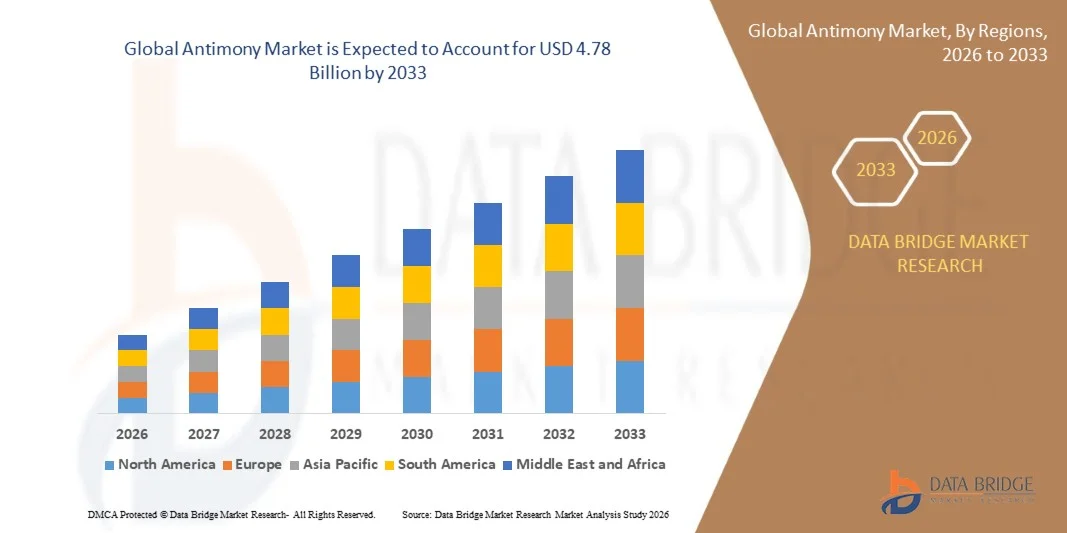
- The global antimony market size was valued at USD 2.85 billion in 2025 and is expected to reach USD 4.78 billion by 2033, at a CAGR of 6.70% during the forecast period
- The market growth is largely fuelled by the rising demand for flame retardant materials in construction, automotive, and textile applications, where antimony compounds are widely used for enhancing fire resistance
- Increasing consumption of antimony in lead-acid batteries, particularly for grid strengthening and performance improvement in energy storage systems, is supporting market expansion
Antimony Market Analysis
- The market is witnessing steady growth due to its critical role in flame retardant formulations used across industrial and consumer products such as plastics, coatings, and insulation materials
- Rising demand from the energy storage sector, especially in battery manufacturing such as lead-acid systems, is strengthening long-term consumption trends
- North America dominated the antimony market with the largest revenue share in 2025, driven by strong demand from flame retardant applications, lead-acid battery manufacturing, and industrial alloy production
- The Asia-Pacific region is expected to witness the highest growth rate in the global antimony market, driven by accelerating urbanization, strong manufacturing expansion, growing electronics production, and increasing demand from automotive and construction industries
- The trioxide segment held the largest market revenue share in 2025 driven by its extensive use in flame retardant formulations across plastics, textiles, coatings, and construction materials. Antimony trioxide is widely preferred due to its strong synergistic effect with halogenated compounds, which significantly enhances fire resistance and thermal stability in end-use products. Its cost-effectiveness and high performance in safety-critical applications further strengthen its dominant position across industrial manufacturing sectors
Report Scope and Antimony Market Segmentation
|
Attributes |
Antimony Key Market Insights |
|
Segments Covered |
|
|
Countries Covered |
North America
Europe
Asia-Pacific
Middle East and Africa
South America
|
|
Key Market Players |
• AMG (Germany) |
|
Market Opportunities |
|
|
Value Added Data Infosets |
In addition to the insights on market scenarios such as market value, growth rate, segmentation, geographical coverage, and major players, the market reports curated by the Data Bridge Market Research also include import export analysis, production capacity overview, production consumption analysis, price trend analysis, climate change scenario, supply chain analysis, value chain analysis, raw material/consumables overview, vendor selection criteria, PESTLE Analysis, Porter Analysis, and regulatory framework. |
Antimony Market Trends
“Rising Demand for Flame Retardant Applications”
• The increasing emphasis on fire safety standards across construction, automotive, and electronics industries is significantly shaping the antimony market, as antimony trioxide is widely used in flame retardant formulations. This material enhances heat resistance and reduces flammability in plastics, coatings, textiles, insulation materials, and polymer-based components used in modern infrastructure. Growing urbanization and stricter building safety regulations are further accelerating its adoption across residential, commercial, and industrial projects. This trend is encouraging manufacturers to expand production capacity and invest in advanced flame retardant technologies to meet rising global demand
• Growing focus on safety in infrastructure development and electrical systems has accelerated the use of antimony-based flame retardants in wires, cables, circuit boards, and building materials. Manufacturers are increasingly integrating antimony compounds to comply with evolving fire safety regulations and reduce risks associated with electrical failures and overheating. This is driving strong collaboration between chemical producers and end-use industries to develop high-performance, durable, and cost-efficient flame retardant solutions. The demand is also rising in transportation sectors such as automotive and aerospace due to stricter passenger safety standards
• Regulatory pressure and sustainability expectations are influencing material selection, with industries prioritizing high-performance additives that improve safety without compromising product durability or recyclability. Antimony compounds are being optimized for lower dosage efficiency, enabling manufacturers to maintain performance while reducing material consumption and production costs. This is also encouraging innovation in hybrid flame retardant systems combining antimony with phosphorus-based and other synergistic additives. Continuous R&D efforts are focusing on enhancing thermal stability and reducing environmental impact across end-use applications
• For instance, in 2024, BASF in Germany and Albemarle Corporation in the U.S. expanded their flame retardant product portfolios incorporating antimony-based compounds for use in electronics housings, automotive components, and construction materials. These products were launched to address rising demand for fire-safe materials in high-growth industrial sectors and meet stringent international safety standards. The developments strengthened their global supply chain presence and improved product competitiveness in safety-focused chemical markets. These expansions also supported partnerships with OEMs and industrial manufacturers across multiple regions
• While demand for flame retardant applications is rising, sustained growth depends on regulatory compliance, cost optimization, and continuous development of alternative synergistic materials that maintain high performance while improving environmental profiles. Manufacturers are also focusing on recycling and recovery of antimony from industrial waste streams to improve supply security. However, balancing performance efficiency with sustainability goals remains a key challenge for long-term market expansion
Antimony Market Dynamics
Driver
“Growing Demand From Flame Retardants And Energy Storage Applications”
• Rising use of antimony trioxide in flame retardant systems across plastics, textiles, insulation materials, and construction components is a key driver for the antimony market. Increasing global fire safety regulations and stricter building codes are significantly boosting demand across residential, commercial, and industrial sectors. The material’s effectiveness in enhancing thermal resistance and reducing flame propagation makes it essential in safety-critical applications. Expanding urban infrastructure development and industrial manufacturing activities are further accelerating consumption across multiple end-use industries
• Expanding utilization of antimony in lead-acid batteries for grid stabilization, automotive systems, industrial backup power, and renewable energy storage solutions is further supporting market growth. Its role in improving battery durability, charge retention, and performance efficiency is driving sustained demand in energy storage applications. Increasing electrification of transportation and rising demand for uninterrupted power supply systems are also contributing to higher consumption. This trend is particularly strong in developing economies with growing energy infrastructure needs
• Industrial demand for antimony-based alloys in electronics, semiconductors, ammunition, and defense components is contributing to steady consumption growth. These alloys provide enhanced hardness, mechanical strength, and resistance properties required in high-performance and precision engineering applications. Growing demand for miniaturized electronic devices and advanced manufacturing technologies is further strengthening the importance of antimony-based materials. The defense sector also continues to rely on antimony alloys for critical performance and durability requirements
• For instance, in 2023, Exide Industries in India and Johnson Controls in Ireland increased their use of antimony alloys in lead-acid battery manufacturing to improve lifecycle performance and meet rising demand from automotive and industrial backup systems. This expansion was driven by increasing energy storage requirements and growth in electric mobility and renewable integration. Both companies also focused on improving battery efficiency and durability through optimized material usage. These developments highlight the strong link between energy transition trends and antimony demand growth
• Although demand is increasing, long-term growth depends on stable raw material supply, improved recycling systems, and continuous innovation in efficient usage technologies. Supply chain diversification and investment in secondary recovery methods are becoming increasingly important to reduce dependency on primary mining sources. Cost volatility and environmental regulations remain key factors influencing production stability and market competitiveness
Restraint/Challenge
“Supply Constraints And Price Volatility Of Raw Materials”
• Limited availability of high-grade antimony ores is a major challenge affecting global supply stability, leading to frequent fluctuations in pricing and availability across international markets. Concentrated production in a few countries increases vulnerability to geopolitical risks, export restrictions, and supply chain disruptions. This supply imbalance often creates uncertainty for downstream industries such as batteries and flame retardants. As a result, manufacturers face difficulties in long-term procurement planning and cost forecasting
• Environmental regulations and mining restrictions are further limiting extraction activities, increasing dependency on recycling and secondary recovery processes to meet industrial demand. Stricter environmental compliance requirements are raising operational costs and reducing production efficiency in mining regions. This is also pushing companies to adopt cleaner extraction technologies and invest in sustainable mining practices. However, the transition toward environmentally compliant production methods is slow and capital-intensive
• High processing costs and complex extraction methods also contribute to elevated pricing structures, making antimony less competitive compared to alternative materials in certain applications. The refining and purification processes require significant energy input and technical expertise, increasing overall production expenses. This impacts adoption in cost-sensitive industries where alternative flame retardants or alloying materials may be preferred. Volatile energy prices further add to production uncertainty and cost pressures
• For instance, in 2024, several battery and chemical manufacturers in Southeast Asia and Europe reported supply delays due to reduced ore exports and tighter mining regulations, leading to temporary production adjustments in flame retardant and energy storage supply chains. These disruptions affected inventory levels and forced companies to source materials at higher spot market prices. The situation also highlighted the risks of overdependence on limited mining regions and exposed vulnerabilities in global supply networks
• Addressing these challenges will require diversification of supply sources, expansion of recycling infrastructure, and investment in advanced recovery technologies to ensure long-term market stability. Strategic partnerships between mining companies, recyclers, and end-use industries will be critical for securing consistent supply. In addition, improving material efficiency and developing substitution technologies will help reduce pressure on primary antimony resources
Antimony Market Scope
The market is segmented on the basis of product type, application, and end-user.
• By Product Type
On the basis of product type, the antimony market is segmented into trioxides, alloys, and others. The trioxide segment held the largest market revenue share in 2025 driven by its extensive use in flame retardant formulations across plastics, textiles, coatings, and construction materials. Antimony trioxide is widely preferred due to its strong synergistic effect with halogenated compounds, which significantly enhances fire resistance and thermal stability in end-use products. Its cost-effectiveness and high performance in safety-critical applications further strengthen its dominant position across industrial manufacturing sectors.
The alloys segment is expected to witness the fastest growth rate from 2026 to 2033, driven by increasing demand in lead-acid batteries, ammunition, and metal strengthening applications. Antimony alloys are widely used to improve hardness, mechanical strength, and corrosion resistance in industrial and automotive components. Rising demand from energy storage systems and expanding use in precision engineering applications are further supporting growth. Continuous advancements in metallurgical processes are also enabling more efficient alloy production and wider industrial adoption.
• By Application
On the basis of application, the antimony market is segmented into flame retardants, lead-acid batteries, plastic additives, glass and ceramics, and others. The flame retardants segment held the largest market revenue share in 2025 driven by stringent fire safety regulations across construction, automotive, and electronics industries. Antimony compounds are extensively used to reduce flammability in plastics, insulation materials, and coatings, ensuring compliance with global safety standards. Increasing urbanization and infrastructure development are further strengthening demand across residential and commercial applications.
The lead-acid batteries segment is expected to witness the fastest growth rate from 2026 to 2033, driven by rising demand for energy storage, automotive starter batteries, and backup power systems. Antimony is widely used in battery grids to enhance durability, charge retention, and overall performance efficiency. Growing adoption of renewable energy systems and increasing need for reliable power backup solutions are further accelerating demand. Expanding industrial and transportation electrification is also contributing to sustained market growth.
• By End-User
On the basis of end-user, the antimony market is segmented into chemical, automotive, electrical and electronics, and others. The chemical segment held the largest market revenue share in 2025 driven by strong consumption of antimony trioxide in flame retardant chemicals and industrial formulations. Chemical manufacturers rely heavily on antimony compounds to develop high-performance materials used across multiple downstream industries. Strong demand from plastics, coatings, and polymer processing industries further reinforces segment dominance.
The electrical and electronics segment is expected to witness the fastest growth rate from 2026 to 2033, driven by increasing use of antimony-based materials in semiconductors, circuit boards, and electronic components. Rising demand for miniaturized and high-performance electronic devices is supporting growth across consumer electronics and industrial equipment. Expanding adoption of fire-safe and thermally stable materials in electronic housings is further strengthening demand. Continuous innovation in electronics manufacturing is also enhancing the role of antimony in advanced applications.
Antimony Market Regional Analysis
• North America dominated the antimony market with the largest revenue share in 2025, driven by strong demand from flame retardant applications, lead-acid battery manufacturing, and industrial alloy production
• Industries in the region increasingly rely on antimony compounds to enhance fire safety, improve material durability, and support energy storage systems used across automotive and power backup applications
• This widespread consumption is further supported by advanced industrial infrastructure, high technological adoption, and strong regulatory focus on safety standards, establishing antimony as a critical industrial material across multiple end-use sectors
U.S. Antimony Market Insight
The U.S. antimony market captured the largest revenue share in 2025 within North America, fueled by strong demand from flame retardant chemicals, defense applications, and battery manufacturing industries. The country’s growing focus on fire-safe construction materials and advanced electronics is significantly supporting consumption of antimony trioxide and alloys. Increasing investment in energy storage systems, including grid stabilization and backup power solutions, is further driving demand. Moreover, the presence of established chemical and materials manufacturers, along with strong R&D capabilities, is accelerating innovation in antimony-based applications.
Europe Antimony Market Insight
The Europe antimony market is expected to witness the fastest growth rate from 2026 to 2033, primarily driven by strict fire safety regulations and increasing demand for sustainable industrial materials. Rising adoption of antimony-based flame retardants in construction, automotive, and electronics industries is strengthening market expansion. The region’s strong emphasis on environmental compliance and material efficiency is encouraging the use of optimized antimony formulations. In addition, increasing investment in energy-efficient infrastructure and recycling initiatives is further supporting market growth across industrial applications.
U.K. Antimony Market Insight
The U.K. antimony market is expected to witness steady growth from 2026 to 2033, driven by increasing demand for advanced flame retardant materials and energy storage solutions. Growing focus on building safety regulations and fire-resistant construction materials is boosting the use of antimony compounds in residential and commercial infrastructure. The expansion of the automotive and electronics sectors is also supporting market growth. Furthermore, rising awareness of supply chain resilience and material efficiency is encouraging industries to adopt recycled and optimized antimony-based solutions.
Germany Antimony Market Insight
The Germany antimony market is expected to witness strong growth from 2026 to 2033, fueled by rising demand for high-performance industrial materials and advanced manufacturing applications. The country’s strong automotive and electrical engineering sectors are key consumers of antimony-based alloys and flame retardants. Increasing focus on sustainability and circular economy practices is also promoting recycling and efficient use of antimony materials. In addition, Germany’s emphasis on innovation and high safety standards is supporting the integration of antimony in modern industrial and electronic systems.
Asia-Pacific Antimony Market Insight
The Asia-Pacific antimony market is expected to witness the fastest growth rate from 2026 to 2033, driven by rapid industrialization, urbanization, and expanding manufacturing activities in countries such as China, India, and Japan. Increasing demand for flame retardants in construction and automotive industries, along with rising consumption in battery manufacturing, is significantly boosting regional growth. The region’s strong electronics production base and growing infrastructure development are further supporting antimony demand. In addition, cost-effective manufacturing capabilities and abundant industrial output are enhancing market accessibility across end-use industries.
Japan Antimony Market Insight
The Japan antimony market is expected to witness steady growth from 2026 to 2033 due to the country’s advanced industrial base, strong electronics manufacturing sector, and high safety standards. Demand for antimony-based flame retardants is increasing in electrical and electronic devices, automotive components, and construction materials. Japan’s focus on technological innovation and energy-efficient systems is also supporting adoption in battery and alloy applications. Moreover, the integration of antimony materials into precision engineering and high-performance products is further strengthening market expansion.
China Antimony Market Insight
The China antimony market accounted for the largest market revenue share in Asia-Pacific in 2025, attributed to its strong position as a global producer and consumer of antimony materials. The country’s extensive mining base, combined with large-scale manufacturing industries, supports widespread use in flame retardants, batteries, and industrial alloys. Rapid urbanization and infrastructure development are further driving demand across construction and electronics sectors. In addition, strong domestic supply chains and cost advantages are reinforcing China’s dominance in both production and consumption of antimony-based products.
Antimony Market Share
The Antimony industry is primarily led by well-established companies, including:
• AMG (Germany)
• Mandalay Resources (Canada)
• US Antimony (U.S.)
• GeoProMining, Ltd. (Russia)
• United States Antimony Corporation (U.S.)
• Korea Zinc (South Korea)
• Nihon Seiko Co. Ltd. (Japan)
• Umicore (Belgium)
• Hunan Chenzhou Mining Group Co. Ltd. (China)
• Huachang Antimony Industry (China)
• Belmont Metals (U.S.)
• American Elements (U.S.)
• Tri-Star Resources PLC (U.K.)
• Amspec Chemical Corporation (U.S.)
• LANXESS (Germany)
• Cambrian Mining Ltd. (U.K.)
• Yunnan Muli Antimony Industry Co. Ltd. (China)
• Suzuhiro Chemical Co. Ltd. (Japan)
• Nyacol Nano Technologies Inc. (U.S.)
• Campine (Belgium)
• Automized Products Group Inc. (U.S.)
• BASF SE (Germany)
Latest Developments in Global Antimony Market
- In January 2024, Campine, a Belgium-based company, expanded its recycling capabilities by deploying advanced technologies to extract valuable chemicals from post-consumer and industrial metal waste, focusing on lead recycling and antimony trioxide production, which is expected to improve resource efficiency, strengthen secondary raw material supply, and support sustainability-driven demand in the global antimony market
- In January 2024, Critical Metals Resources (CMR), through Hesperis Resources, expanded its mining portfolio by acquiring 26 exploration permits in central Morocco covering potential antimony and other critical metals, which is expected to strengthen its upstream resource base, enhance exploration capacity, and support long-term supply security for the clean energy and industrial metals market
- In August 2023, Hyundai Motor Group (HMG) entered a strategic partnership with Korea Zinc Company Ltd, focusing on strengthening the nickel value chain, which is expected to indirectly support antimony-linked alloy and battery material demand, improve non-ferrous metal supply integration, and enhance collaboration across advanced automotive and energy storage ecosystems
- In July 2022, Slovak Antimony Corp completed the acquisition of an antimony and tin processing circuit in Eastern Slovakia, which is expected to expand its production capacity, improve processing efficiency, and strengthen regional supply availability of refined antimony for industrial applications such as flame retardants and metal alloys
- In January 2021, Campine, a Belgium-based recycling and chemical company, enhanced its recycling operations by introducing advanced technologies for recovering metals from industrial and post-consumer waste, which is expected to increase secondary antimony trioxide production, reduce dependency on primary mining, and strengthen circular economy practices in the global antimony supply chain
SKU-
Получите онлайн-доступ к отчету на первой в мире облачной платформе рыночной аналитики

- Интерактивная панель анализа данных
- Панель анализа компании для возможностей с высоким потенциалом роста
- Доступ аналитика-исследователя для настройки и запросов
- Анализ конкурентов с помощью интерактивной панели
- Последние новости, обновления и анализ тенденций
- Используйте возможности сравнительного анализа для комплексного отслеживания конкурентов
Методология исследования
Сбор данных и анализ базового года выполняются с использованием модулей сбора данных с большими размерами выборки. Этап включает получение рыночной информации или связанных данных из различных источников и стратегий. Он включает изучение и планирование всех данных, полученных из прошлого заранее. Он также охватывает изучение несоответствий информации, наблюдаемых в различных источниках информации. Рыночные данные анализируются и оцениваются с использованием статистических и последовательных моделей рынка. Кроме того, анализ доли рынка и анализ ключевых тенденций являются основными факторами успеха в отчете о рынке. Чтобы узнать больше, пожалуйста, запросите звонок аналитика или оставьте свой запрос.
Ключевой методологией исследования, используемой исследовательской группой DBMR, является триангуляция данных, которая включает в себя интеллектуальный анализ данных, анализ влияния переменных данных на рынок и первичную (отраслевую экспертную) проверку. Модели данных включают сетку позиционирования поставщиков, анализ временной линии рынка, обзор рынка и руководство, сетку позиционирования компании, патентный анализ, анализ цен, анализ доли рынка компании, стандарты измерения, глобальный и региональный анализ и анализ доли поставщика. Чтобы узнать больше о методологии исследования, отправьте запрос, чтобы поговорить с нашими отраслевыми экспертами.
Доступна настройка
Data Bridge Market Research является лидером в области передовых формативных исследований. Мы гордимся тем, что предоставляем нашим существующим и новым клиентам данные и анализ, которые соответствуют и подходят их целям. Отчет можно настроить, включив в него анализ ценовых тенденций целевых брендов, понимание рынка для дополнительных стран (запросите список стран), данные о результатах клинических испытаний, обзор литературы, обновленный анализ рынка и продуктовой базы. Анализ рынка целевых конкурентов можно проанализировать от анализа на основе технологий до стратегий портфеля рынка. Мы можем добавить столько конкурентов, о которых вам нужны данные в нужном вам формате и стиле данных. Наша команда аналитиков также может предоставить вам данные в сырых файлах Excel, сводных таблицах (книга фактов) или помочь вам в создании презентаций из наборов данных, доступных в отчете.











