


Global Automotive Display Market Segmentation, By Technology (Thin-Film-Transistor Liquid Crystal Display (TFT LCD), Passive-Matrix Organic Light-Emitting Diode (PMOLED), Passive-Matrix Liquid Crystal Display (PMLCD), Active-Matrix Organic Light-Emitting Diode (AMOLED), Others), Product (Center Stack Display, Instrument Cluster Display, Head-Up Display, Rear- Seat Entertainment Display), Screen Size (10”), Vehicle Type (Passenger Vehicles, Commercial Vehicles) - Industry Trends and Forecast to 2032
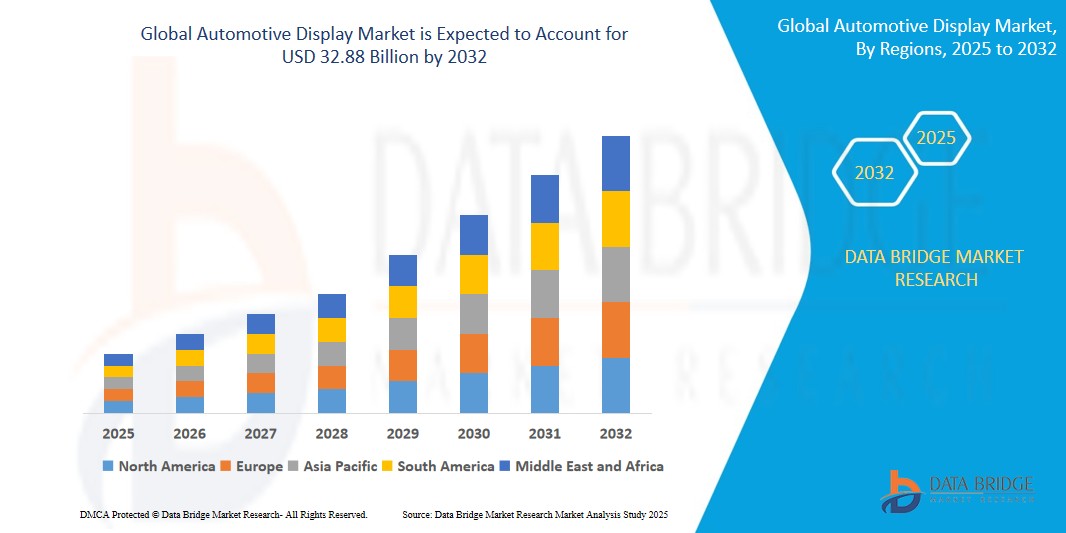
Automotive Display Market Size
- The global Automotive Display Market size was valued at USD 15.37 billion in 2024 and is expected to reach USD 32.88 billion by 2032, at a CAGR of 11.4% during the forecast period
- This growth is driven by factors such as the increasing demand for advanced driver-assistance systems (ADAS), rising consumer preference for connected vehicles, and growing integration of in-vehicle infotainment technologies.
Automotive Display Market Analysis
- Automotive displays are the type of prime display or indicators of the status, and any features employed on the vehicle. It also consists of the infotainment features on the display pane as it focuses on increasing the aesthetic appeal of the interiors of the vehicles.
- These displays are focused on acting as an information and entertainment liaison between the driver or passenger and the status of the vehicle in addition to the entertainment outlets.
- North America leads the automotive display market due to the constant adoption to advanced automotive solutions in the region.
- Asia-Pacific is expected to expand at a significant growth rate of over the forecast period of 2025 to 2032 owing to the rapidly increasing automobile industry within this region.
- Thin-Film-Transistor Liquid Crystal Display (TFT LCD) segment is expected to dominate the market with a market share of 55.21% due to cost-effectiveness, high resolution, and widespread adoption in mid-range and premium vehicles.
Report Scope and Automotive Display Market Segmentation
|
Attributes |
Automotive Display Key Market Insights |
|
Segments Covered |
|
|
Countries Covered |
North America
Europe
Asia-Pacific
Middle East and Africa
South America
|
|
Key Market Players |
|
|
Market Opportunities |
|
|
Value Added Data Infosets |
In addition to the insights on market scenarios such as market value, growth rate, segmentation, geographical coverage, and major players, the market reports curated by the Data Bridge Market Research also include import export analysis, production capacity overview, production consumption analysis, price trend analysis, climate change scenario, supply chain analysis, value chain analysis, raw material/consumables overview, vendor selection criteria, PESTLE Analysis, Porter Analysis, and regulatory framework. |
Automotive Display Market Trends
“Integration of AI and Voice-Controlled Interfaces”
- Another growing trend is the integration of artificial intelligence (AI) and voice-controlled interfaces into automotive displays. As cars become more connected and smarter, drivers expect systems that understand natural speech and provide relevant feedback without distraction. AI-powered voice assistants are being integrated directly into infotainment displays, enabling drivers to control navigation, climate, music, and even make calls hands-free. These features reduce the need to touch the screen while driving, improving safety.
- Companies are also using AI to personalize the in-car experience, adjusting screen layouts and content based on user habits. With the rise of connected and autonomous vehicles, this trend is only accelerating. Carmakers are partnering with tech giants to build smarter in-car ecosystems that respond intuitively to voice commands. This push toward conversational, AI-driven control is transforming the automotive display from a static screen to an intelligent assistant.
- For instance, Car screens are getting smarter thanks to AI and voice control—you can now talk to your car like you would to a smart speaker. Drivers can change music, get directions, or adjust the temperature without lifting a finger. This makes driving safer and more convenient. Cars are starting to “learn” your habits and personalize the display experience. It’s like having a co-pilot built right into the dashboard.
Automotive Display Market Dynamics
Driver
“Growing Adoption of Advanced Driver Assistance Systems (ADAS)”
- One of the biggest drivers of growth in the automotive display market is the rising use of Advanced Driver Assistance Systems (ADAS). These systems rely heavily on real-time visual data, which needs to be displayed clearly to the driver for functions like lane-keeping assist, adaptive cruise control, parking assist, and collision alerts. Automotive displays serve as the main interface between the driver and these features, making them essential to the user experience.
- As regulations around vehicle safety tighten globally, carmakers are under pressure to include more ADAS features even in mid-range vehicles. This, in turn, fuels demand for larger, high-resolution, and more responsive displays that can deliver detailed graphics and real-time feedback. The clearer and more intuitive the display, the safer and more confident the driver feels. As autonomous driving technologies continue to advance, the reliance on in-vehicle displays will grow even further. This evolution is turning displays from luxury add-ons into essential components of the modern driving experience.
For instance,
- In March 2025, Ford rolled out a new mid-range SUV with enhanced ADAS features shown through a 12-inch driver display. The screen shows lane alerts, parking sensors, and emergency braking status all in real time. This move came as part of Ford’s plan to offer ADAS across all models, not just luxury ones. The sleek display makes safety features more visible and easier to use. It’s clear that smarter, safer driving needs smarter displays too.
Opportunity
“Rising Demand for Electric Vehicles (EVs)”
- The growing popularity of electric vehicles (EVs) offers a major opportunity for the automotive display market. EVs typically feature advanced digital cockpits and large touchscreens that help monitor battery status, range, and energy consumption. Since EV buyers often expect modern and tech-forward interfaces, manufacturers are integrating larger and smarter displays into these vehicles.
- This trend is especially strong in regions like Europe, China, and the U.S., where government support for EV adoption is strong. Additionally, EV startups often prioritize user experience, pushing innovation in display design and user interface. As EV sales continue to rise, so does the demand for high-performance, customizable, and intuitive display systems. These displays play a critical role in enhancing driver interaction and brand identity. With sustainability and digitalization at the forefront, EVs offer an ideal platform for expanding automotive display technologies. This synergy opens up significant opportunities for display manufacturers to grow alongside the EV market.
For instance,
- In February 2025, Chinese EV giant BYD launched its new electric SUV model, the BYD Seal U, featuring a 15.6-inch rotating touchscreen display and fully digital instrument cluster. The company highlighted that consumer demand for advanced interfaces and real-time vehicle data influenced the design of the cockpit. BYD’s focus on integrating intelligent display systems reflects the broader EV market trend where user experience and interactivity are just as important as range and performance. With China being a leader in EV adoption, BYD's move showcases how EV growth is fueling demand for innovative, immersive in-car display technologies. This strategy also helps BYD compete globally by appealing to tech-savvy buyers.
Restraint/Challenge
“High Cost of Advanced Display Technologies”
- Advanced automotive displays such as OLED and 3D digital dashboards offer premium user experiences, but their high production and integration costs act as a major restraint for the broader market. These displays require sophisticated manufacturing processes, expensive materials, and high-resolution interfaces, which significantly increase the cost of the overall vehicle. While luxury and premium carmakers can absorb these costs, budget and mid-range automakers often find it challenging to offer such features without impacting profitability. The high cost also trickles down to consumers, making cars with advanced display systems less accessible to cost-sensitive buyers.
- As a result, mass-market adoption is slower than anticipated. Additionally, costs related to R&D, testing, and ensuring compliance with automotive safety standards add further financial strain. The price sensitivity of developing markets exacerbates this issue, where consumers are more focused on affordability than high-end tech features. This restricts the penetration of advanced display systems, particularly in emerging regions. Therefore, while the technology exists, affordability remains a bottleneck.
For instance,
- In December 2024, Hyundai Motor Company announced a delay in the rollout of its planned OLED dashboard displays for its mid-range models, citing high component costs and supply chain limitations. The company initially aimed to integrate these high-end displays into its Sonata and Tucson lines but faced challenges balancing production costs with competitive pricing in key markets like India and Southeast Asia. As OLED panels remain significantly more expensive than traditional LCDs, Hyundai decided to continue offering TFT displays in these segments to maintain affordability. This move reflects how the high cost of advanced display technologies can directly impact product strategy, especially for automakers trying to serve cost-sensitive markets.
Automotive Display Market Scope
The market is segmented on the basis technology, product, screen size and vehicle type.
|
Segmentation |
Sub-Segmentation |
|
Technology |
|
|
Продукт |
|
|
Размер экрана |
|
|
Тип транспортного средства |
|
Ожидается, что в 2025 году жидкокристаллические дисплеи на тонкопленочных транзисторах (TFT LCD) будут доминировать на рынке, занимая самую большую долю в сегменте.
Ожидается, что в 2025 году сегмент жидкокристаллических дисплеев на тонкопленочных транзисторах (TFT LCD) будет доминировать на рынке автомобильных дисплеев с наибольшей долей в 55,21% благодаря своей экономической эффективности, надежности и широкому распространению в моделях автомобилей среднего и экономичного класса для приборных панелей и информационно-развлекательных систем.
Ожидается, что в прогнозируемый период наибольшая доля рынка будет приходиться на пассивно-матричные органические светодиоды (PMOLED).
Ожидается, что сегмент пассивно-матричных органических светодиодов (PMOLED) займет наибольшую долю рынка автомобильных дисплеев в 51,34% в прогнозируемый период, что обусловлено их низким энергопотреблением, тонким дизайном и пригодностью для более простых приложений отображения, таких как индикаторы состояния и вспомогательные экраны в транспортных средствах.
Региональный анализ рынка автомобильных дисплеев
«Северная Америка занимает самую большую долю на рынке автомобильных дисплеев»
- Северная Америка занимает самую большую долю на рынке автомобильных дисплеев, что обусловлено высоким спросом на передовые технологии в автомобиле и высоким потребительским предпочтением роскошных и подключенных автомобилей. Хорошо развитая автомобильная промышленность региона, особенно в США, играет ключевую роль в этом доминировании, поскольку крупные автопроизводители интегрируют дисплеи высокого разрешения и инновационные информационно-развлекательные системы в свои автомобили. Кроме того, растущее внедрение электромобилей (EV) и передовых систем помощи водителю (ADAS) еще больше повышает спрос на сложные автомобильные дисплеи.
- Правительственные постановления, продвигающие функции безопасности и подключения, также способствуют росту рынка. Присутствие технологических стартапов и устоявшихся поставщиков в Северной Америке ускоряет инновации в технологиях отображения. Благодаря значительным инвестициям в автомобильные НИОКР регион продолжает лидировать на мировом рынке. Поскольку ожидания потребителей в отношении интеллектуальных и интерактивных интерфейсов для транспортных средств растут, ожидается, что доля рынка Северной Америки останется доминирующей.
«Прогнозируется, что в Азиатско-Тихоокеанском регионе будет зарегистрирован самый высокий среднегодовой темп роста на рынке автомобильных дисплеев»
- Прогнозируется, что Азиатско-Тихоокеанский регион зарегистрирует самый высокий среднегодовой темп роста на рынке автомобильных дисплеев, что обусловлено быстрым ростом автомобильного производства и растущим спросом на высокотехнологичные функции в транспортных средствах. Развивающиеся экономики региона, особенно Китай и Индия, наблюдают всплеск покупательной способности потребителей, что подпитывает спрос на передовые автомобильные дисплеи. Кроме того, рост электромобилей (ЭМ) и внедрение технологий подключенных транспортных средств в таких странах, как Китай, Япония и Южная Корея, являются ключевыми факторами роста. Сильная государственная поддержка зеленых технологий и интеллектуального транспорта дополнительно способствует расширению рынка.
- Автопроизводители в Азиатско-Тихоокеанском регионе все чаще интегрируют сложные информационно-развлекательные и защитные дисплеи, чтобы удовлетворить предпочтения потребителей. В регионе также находится несколько мировых производителей дисплеев, что позволяет локализовать производство и предлагать экономически эффективные решения. В результате ожидается, что рынок автомобильных дисплеев в Азиатско-Тихоокеанском регионе в ближайшие годы будет испытывать существенный рост.
Доля рынка автомобильных дисплеев
Конкурентная среда рынка содержит сведения о конкурентах. Включены сведения о компании, ее финансах, полученном доходе, рыночном потенциале, инвестициях в исследования и разработки, новых рыночных инициативах, глобальном присутствии, производственных площадках и объектах, производственных мощностях, сильных и слабых сторонах компании, запуске продукта, широте и широте продукта, доминировании приложений. Приведенные выше данные касаются только фокуса компаний на рынке.
Основными лидерами рынка, работающими на рынке, являются:
- Континенталь АГ,
- Корпорация Вистеон,
- Корпорация Panasonic,
- Корпорация ЯЗАКИ,
- 3М,
- КОРПОРАЦИЯ ДЕНСО,
- LG Display Co., Ltd.,
- Sharp Devices Европа,
- Ниппон Сейки Ко. Лтд.,
- BorgWarner Inc.,
- СмартКем,
- Роберт Бош ГмбХ,
- АЛЬП АЛЬПИН КО., ЛТД.,
- Гармин Лтд.,
- Валео,
- Япония Дисплей Инк.,
- Электробит, AU Optronics Corp.,
- Барко,
- ХАРМАН Интернешнл,
- Корпорация «Пионер»,
- Корпорация Иннолюкс
- Корпорация KYOCERA
Последние разработки на мировом рынке автомобильных дисплеев
- В январе 2025 года на выставке CES 2025 компания Continental представила Emotional Cockpit — концепцию дисплея, которая сочетает в себе передовые технологии с уникальными элементами дизайна от Swarovski. Эта концепция включает в себя два дисплея, обрамленные кристаллами Swarovski, и настраиваемую линию E Ink по всей длине приборной панели, предлагающую обширные возможности персонализации. Emotional Cockpit направлена на создание эмоциональной связи между водителем и автомобилем посредством интуитивного управления и взаимодействия с помощью искусственного интеллекта
- В феврале 2025 года компания Panasonic выпустила прозрачный OLED-дисплей, предназначенный для автомобильных приложений. Этот дисплей позволяет интегрировать информационные наложения, не загораживая обзор водителю, что повышает безопасность и удобство использования. Прозрачность дисплея обеспечивает бесшовную интеграцию в дизайн салона автомобиля
- In March 2025, YAZAKI introduced an advanced instrument cluster featuring a high-resolution TFT-LCD screen with customizable displays. This cluster provides drivers with real-time information on vehicle performance, navigation, and safety alerts, all within a sleek and modern interface. The customizable nature of the display allows for a personalized driving experience
- In April 2025, 3M launched an interactive head-up display film that can be applied to windshields to project critical driving information directly into the driver's line of sight. This film enhances safety by allowing drivers to access navigation, speed, and other vital information without taking their eyes off the road. The film's interactive capabilities enable touch control for certain functions
- In June 2025, LG Display introduced a flexible OLED display tailored for automotive applications. This display can be curved to fit various dashboard designs, offering automakers greater flexibility in interior design. The high-resolution display provides vibrant colors and deep contrasts, enhancing the overall user experience
SKU-
Получите онлайн-доступ к отчету на первой в мире облачной платформе рыночной аналитики

- Интерактивная панель анализа данных
- Панель анализа компании для возможностей с высоким потенциалом роста
- Доступ аналитика-исследователя для настройки и запросов
- Анализ конкурентов с помощью интерактивной панели
- Последние новости, обновления и анализ тенденций
- Используйте возможности сравнительного анализа для комплексного отслеживания конкурентов
Методология исследования
Сбор данных и анализ базового года выполняются с использованием модулей сбора данных с большими размерами выборки. Этап включает получение рыночной информации или связанных данных из различных источников и стратегий. Он включает изучение и планирование всех данных, полученных из прошлого заранее. Он также охватывает изучение несоответствий информации, наблюдаемых в различных источниках информации. Рыночные данные анализируются и оцениваются с использованием статистических и последовательных моделей рынка. Кроме того, анализ доли рынка и анализ ключевых тенденций являются основными факторами успеха в отчете о рынке. Чтобы узнать больше, пожалуйста, запросите звонок аналитика или оставьте свой запрос.
Ключевой методологией исследования, используемой исследовательской группой DBMR, является триангуляция данных, которая включает в себя интеллектуальный анализ данных, анализ влияния переменных данных на рынок и первичную (отраслевую экспертную) проверку. Модели данных включают сетку позиционирования поставщиков, анализ временной линии рынка, обзор рынка и руководство, сетку позиционирования компании, патентный анализ, анализ цен, анализ доли рынка компании, стандарты измерения, глобальный и региональный анализ и анализ доли поставщика. Чтобы узнать больше о методологии исследования, отправьте запрос, чтобы поговорить с нашими отраслевыми экспертами.
Доступна настройка
Data Bridge Market Research является лидером в области передовых формативных исследований. Мы гордимся тем, что предоставляем нашим существующим и новым клиентам данные и анализ, которые соответствуют и подходят их целям. Отчет можно настроить, включив в него анализ ценовых тенденций целевых брендов, понимание рынка для дополнительных стран (запросите список стран), данные о результатах клинических испытаний, обзор литературы, обновленный анализ рынка и продуктовой базы. Анализ рынка целевых конкурентов можно проанализировать от анализа на основе технологий до стратегий портфеля рынка. Мы можем добавить столько конкурентов, о которых вам нужны данные в нужном вам формате и стиле данных. Наша команда аналитиков также может предоставить вам данные в сырых файлах Excel, сводных таблицах (книга фактов) или помочь вам в создании презентаций из наборов данных, доступных в отчете.











