


Global Automotive Foam Market Segmentation, By Type (Polyurethane (PU) Foam, Polyolefin (PO) Foam and Others), Application (Seating, Door Panels, Bumper System and Others), End-Use (Car, Light Commercial Vehicle and Heavy Commercial Vehicle)- Industry Trends and Forecast to 2033
Automotive Foam Market Size
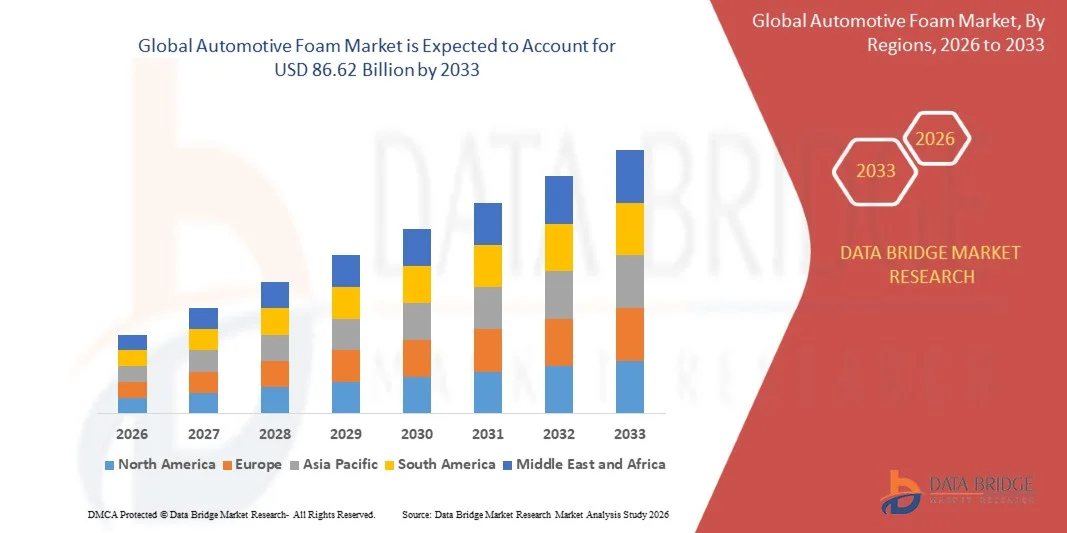
- The global automotive foam market size was valued at USD 38.94 billion in 2025 and is expected to reach USD 86.62 billion by 2033, at a CAGR of 10.51% during the forecast period
- The market growth is largely fuelled by the rising demand for lightweight materials in vehicles to improve fuel efficiency and reduce overall emissions
- Increasing adoption of automotive foams in seating, headrests, armrests, insulation, and interior components is further accelerating market expansion
Automotive Foam Market Analysis
- Automotive foams are widely used for vibration damping, thermal insulation, and enhanced passenger comfort, making them an essential material in modern vehicle manufacturing
- Continuous innovation in polyurethane, polypropylene, and polyethylene foams along with the shift toward sustainable and recyclable materials is supporting the long-term growth of the automotive foam market
- North America dominated the automotive foam market with the largest revenue share in 2025, driven by the strong presence of automotive manufacturers and increasing demand for lightweight materials in vehicle production
- Asia-Pacific region is expected to witness the highest growth rate in the global automotive foam market, driven by rapid urbanization, growing automotive production, and rising investments in lightweight and fuel-efficient vehicle technologies
- The Polyurethane (PU) Foam segment held the largest market revenue share in 2025 driven by its extensive use in automotive seating, headrests, armrests, and interior components. PU foam offers superior cushioning, durability, and lightweight properties, making it highly suitable for improving passenger comfort and vehicle performance across passenger and commercial vehicles
Report Scope and Automotive Foam Market Segmentation
|
Attributes |
Automotive Foam Key Market Insights |
|
Segments Covered |
|
|
Countries Covered |
North America
Europe
Asia-Pacific
Middle East and Africa
South America
|
|
Key Market Players |
• Johnson Controls (Ireland) |
|
Market Opportunities |
• Increasing Adoption Of Lightweight Materials In Electric Vehicles |
|
Value Added Data Infosets |
In addition to the insights on market scenarios such as market value, growth rate, segmentation, geographical coverage, and major players, the market reports curated by the Data Bridge Market Research also include import export analysis, production capacity overview, production consumption analysis, price trend analysis, climate change scenario, supply chain analysis, value chain analysis, raw material/consumables overview, vendor selection criteria, PESTLE Analysis, Porter Analysis, and regulatory framework. |
Automotive Foam Market Trends
“Increasing Demand for Lightweight and High-Performance Materials in Vehicles”
• The growing emphasis on vehicle lightweighting is significantly shaping the automotive foam market, as manufacturers increasingly adopt advanced foam materials to reduce vehicle weight and enhance fuel efficiency. Automotive foams such as polyurethane, polypropylene, and polyethylene provide excellent cushioning, insulation, and durability while maintaining lightweight properties. This trend is encouraging automotive manufacturers to incorporate foam materials in seating, headliners, door panels, and interior trims to improve overall vehicle performance and passenger comfort
• Rising consumer expectations for enhanced comfort and noise reduction are accelerating the demand for automotive foams in modern vehicles. These materials play a critical role in vibration damping, acoustic insulation, and improved seating ergonomics. Automakers are focusing on integrating high-performance foam solutions in vehicle interiors to provide better ride quality and enhanced passenger experience, particularly in premium and electric vehicle segments
• Sustainability and regulatory requirements are influencing the adoption of eco-friendly foam materials in the automotive industry. Manufacturers are increasingly investing in recyclable and bio-based foam technologies to reduce environmental impact and comply with emission regulations. This shift is also encouraging the development of innovative foam formulations that maintain performance while supporting sustainability objectives across the automotive value chain
• For instance, in 2024, Toyota and Volkswagen expanded the use of advanced polyurethane and recyclable foam materials in vehicle seating and interior components to enhance passenger comfort and reduce vehicle weight. These developments were introduced as part of broader initiatives to improve fuel efficiency and sustainability across new vehicle models. The integration of advanced foam technologies also helped manufacturers strengthen product differentiation and improve overall vehicle performance
• While the demand for automotive foams continues to grow, sustained market expansion depends on continuous innovation, cost-effective manufacturing, and the development of high-performance materials compatible with electric and autonomous vehicles. Manufacturers are focusing on improving foam durability, recyclability, and manufacturing efficiency to meet evolving automotive industry requirements
Automotive Foam Market Dynamics
Driver
“Rising Adoption of Lightweight Materials in Automotive Manufacturing”
• Increasing demand for lightweight vehicles is a major driver for the automotive foam market. Automotive manufacturers are actively adopting foam materials to reduce vehicle weight while maintaining structural integrity and passenger safety. Lightweight components help improve fuel efficiency, reduce carbon emissions, and enhance overall vehicle performance, making automotive foams an essential material in modern vehicle production
• Expanding applications in seating, headliners, door panels, instrument panels, and insulation components are supporting market growth. Automotive foams provide cushioning, thermal insulation, and noise reduction, enabling manufacturers to enhance passenger comfort and vehicle functionality. The increasing production of passenger cars and commercial vehicles globally is further driving the demand for advanced foam materials
• Automotive component manufacturers are investing in research and development to introduce innovative foam solutions with improved durability, resilience, and sustainability. These initiatives include the development of recyclable foams, bio-based materials, and advanced manufacturing processes that reduce environmental impact while maintaining product performance. Such innovations are strengthening the role of foam materials in next-generation vehicles
• For instance, in 2023, Ford and General Motors increased the integration of lightweight foam materials in vehicle interiors and structural components to support fuel efficiency targets and improve passenger comfort. These initiatives were aligned with broader strategies to enhance vehicle sustainability and optimize material efficiency in automotive manufacturing
• Although increasing vehicle production and lightweighting trends support market growth, long-term expansion depends on raw material availability, cost management, and advancements in foam manufacturing technologies. Continuous investment in innovation and sustainable material development will be essential to support future growth in the automotive foam market
Restraint/Challenge
“Fluctuating Raw Material Prices and Environmental Concerns”
• Volatility in the prices of raw materials such as polyurethane, polyethylene, and polypropylene remains a key challenge for the automotive foam market. These materials are largely derived from petrochemical feedstocks, and fluctuations in crude oil prices can directly impact production costs. Such price instability can affect profitability for manufacturers and influence pricing strategies across the automotive supply chain
• Environmental concerns regarding the disposal and recycling of foam materials also present challenges for the market. Certain conventional foam products are difficult to recycle, creating waste management issues and increasing regulatory scrutiny. Manufacturers must invest in sustainable alternatives and recycling technologies to address environmental concerns and meet evolving regulatory standards
• Supply chain disruptions and sourcing challenges can also influence market growth, particularly when raw material availability becomes limited. Automotive foam manufacturers rely on specialized production technologies and consistent supply of chemical intermediates, making them vulnerable to supply chain fluctuations. Companies must adopt diversified sourcing strategies and efficient logistics systems to ensure stable production
• For instance, in 2024, several automotive component manufacturers reported rising production costs due to fluctuations in petrochemical feedstock prices used in polyurethane foam production. This situation prompted manufacturers to explore alternative materials and increase investments in recyclable and bio-based foam technologies to reduce dependence on traditional raw materials
• Addressing these challenges will require technological innovation, improved recycling solutions, and the development of sustainable foam materials. Collaboration between automotive manufacturers, material suppliers, and research organizations will play a crucial role in ensuring long-term growth and environmental sustainability in the global automotive foam market.
Automotive Foam Market Scope
The market is segmented on the basis of type, application, and end-use.
• By Type
On the basis of type, the automotive foam market is segmented into Polyurethane (PU) Foam, Polyolefin (PO) Foam, and Others. The Polyurethane (PU) Foam segment held the largest market revenue share in 2025 driven by its extensive use in automotive seating, headrests, armrests, and interior components. PU foam offers superior cushioning, durability, and lightweight properties, making it highly suitable for improving passenger comfort and vehicle performance across passenger and commercial vehicles.
The Polyolefin (PO) Foam segment is expected to witness the fastest growth rate from 2026 to 2033, driven by its excellent thermal insulation, impact resistance, and recyclability. Polyolefin foams are increasingly used in automotive interiors, door trims, and protective components due to their lightweight structure and improved energy absorption properties, supporting vehicle safety and efficiency.
• By Application
On the basis of application, the automotive foam market is segmented into Seating, Door Panels, Bumper System, and Others. The Seating segment held the largest market revenue share in 2025 driven by the growing demand for enhanced passenger comfort and ergonomic vehicle interiors. Automotive foams used in seating systems provide cushioning, vibration damping, and improved durability, making them essential for both passenger and commercial vehicles.
The Bumper System segment is expected to witness the fastest growth rate from 2026 to 2033, driven by the increasing adoption of energy-absorbing materials for vehicle safety and crash protection. Foam materials are widely used in bumper systems to reduce impact forces and improve overall vehicle safety performance.
• By End-Use
On the basis of end-use, the automotive foam market is segmented into Car, Light Commercial Vehicle, and Heavy Commercial Vehicle. The Car segment held the largest market revenue share in 2025 driven by the high global production of passenger vehicles and increasing demand for comfortable and lightweight automotive interiors. Foam materials are widely integrated into various car components such as seats, headliners, and door panels to enhance passenger experience.
The Light Commercial Vehicle segment is expected to witness the fastest growth rate from 2026 to 2033, driven by the expansion of logistics, e-commerce, and transportation industries. Increasing production of light commercial vehicles and the demand for durable and lightweight materials are encouraging manufacturers to incorporate advanced foam solutions in vehicle components.
Automotive Foam Market Regional Analysis
• North America dominated the automotive foam market with the largest revenue share in 2025, driven by the strong presence of automotive manufacturers and increasing demand for lightweight materials in vehicle production
• Automotive manufacturers in the region highly value advanced foam materials for their ability to improve passenger comfort, reduce vehicle weight, and enhance acoustic and thermal insulation in modern vehicles
• This widespread adoption is further supported by technological advancements in automotive interiors, strong investments in electric vehicles, and the growing demand for enhanced safety and comfort features, establishing automotive foam as an essential component in vehicle manufacturing
U.S. Automotive Foam Market Insight
The U.S. automotive foam market captured the largest revenue share in 2025 within North America, fueled by the high production of passenger vehicles and strong demand for lightweight automotive components. Automakers are increasingly integrating advanced foam materials in seating systems, headliners, and interior trims to enhance passenger comfort and vehicle efficiency. The growing adoption of electric vehicles and the rising focus on improving in-cabin experience are further driving market growth. Moreover, increasing investments in automotive innovation and advanced manufacturing technologies are significantly contributing to the expansion of the automotive foam market in the U.S.
Europe Automotive Foam Market Insight
The Europe automotive foam market is expected to witness the fastest growth rate from 2026 to 2033, primarily driven by the region’s strong automotive manufacturing base and increasing focus on sustainable vehicle production. Automotive manufacturers are adopting lightweight foam materials to improve fuel efficiency and comply with stringent emission regulations. Rising demand for premium vehicles and enhanced interior comfort is also supporting the use of advanced foam solutions in vehicle components. The region is experiencing strong growth in both passenger and commercial vehicle production, encouraging greater adoption of automotive foams.
U.K. Automotive Foam Market Insight
The U.K. automotive foam market is expected to witness the fastest growth rate from 2026 to 2033, driven by increasing automotive innovation and rising demand for lightweight materials in vehicle manufacturing. The growing focus on electric vehicle production and improved vehicle comfort is encouraging manufacturers to integrate advanced foam materials in seating and interior components. In addition, the country’s strong research and development activities in automotive materials and sustainability initiatives are further supporting the adoption of high-performance foam technologies.
Germany Automotive Foam Market Insight
The Germany automotive foam market is expected to witness significant growth from 2026 to 2033, fueled by the country’s strong automotive industry and the presence of leading vehicle manufacturers. Increasing demand for lightweight, durable, and energy-absorbing materials is driving the use of automotive foams in seating, insulation, and safety components. Germany’s focus on innovation and advanced vehicle technologies is also encouraging the development of high-performance foam materials. Furthermore, the rising production of electric and premium vehicles is contributing to the expansion of the automotive foam market in the country.
Asia-Pacific Automotive Foam Market Insight
The Asia-Pacific automotive foam market is expected to witness the fastest growth rate from 2026 to 2033, driven by rapid industrialization, increasing vehicle production, and rising consumer demand for comfortable and technologically advanced vehicles. The region is becoming a major manufacturing hub for automotive components, supporting the large-scale adoption of foam materials in vehicle interiors and safety systems. Growing investments in automotive manufacturing and expanding electric vehicle production are also contributing to market growth across the region.
Japan Automotive Foam Market Insight
The Japan automotive foam market is expected to witness steady growth from 2026 to 2033 due to the country’s advanced automotive industry and strong focus on innovation and quality. Japanese automakers are increasingly adopting lightweight foam materials to improve vehicle efficiency, comfort, and safety. The integration of foam components in seating systems, dashboards, and interior trims is supporting improved passenger experience. Moreover, Japan’s growing investments in electric and hybrid vehicle technologies are encouraging the use of advanced foam materials in modern vehicle design.
China Automotive Foam Market Insight
The China automotive foam market accounted for the largest market revenue share in Asia-Pacific in 2025, attributed to the country’s massive automotive production capacity and rapidly growing vehicle demand. China has emerged as a major manufacturing hub for automobiles and automotive components, supporting the widespread use of foam materials in vehicle interiors and safety systems. Increasing consumer demand for comfortable and feature-rich vehicles is also driving the adoption of automotive foams. In addition, the country’s strong push toward electric vehicle production and automotive innovation is further accelerating market growth.
Automotive Foam Market Share
The Automotive Foam industry is primarily led by well-established companies, including:
• Johnson Controls (Ireland)
• Woodbridge (Canada)
• Lear Corp. (U.S.)
• Bridgestone Corporation (Japan)
• Armacell (Luxembourg)
• Rogers Communications (Canada)
• BASF SE (Germany)
• Recticel (Belgium)
• Vitafoam Nig. PLC (Nigeria)
• Saint-Gobain (France)
• Stepan Company (U.S.)
• NGCT Cleansys Pvt. Ltd. (India)
• ABRO Industries, Inc. (U.S.)
• BG Products, Inc. (U.S.)
• Auto Industrial Marine Chemicals, Inc. (U.S.)
• Dun & Bradstreet, Inc. (U.S.)
• 3M (U.S.)
• Radiator Specialty Company (U.S.)
• Cox Industries Inc. (U.S.)
• CRC Industries (U.S.)
Latest Developments in Global Automotive Foam Market
- In July 2025, Covestro AG (Germany) product launch, introduced its next-generation flame-retardant encapsulation polyurethane foam, Baysafe BEF, designed to enhance electric vehicle battery safety by preventing fire propagation between battery cells. The innovation focuses on improving thermal management and structural protection in EV battery packs. This development supports the growing demand for advanced safety materials in electric mobility applications. The launch strengthens Covestro’s position in high-performance automotive materials and accelerates innovation in the automotive foam market
- In April 2024, Huntsman Corporation (U.S.) product launch, introduced a new series of SHOKLESS™ lightweight polyurethane foam systems developed to protect electric vehicle batteries through potting, fixing cells, and encapsulating battery modules. These foams offer strong mechanical performance, rapid curing at low temperatures, and compatibility with standard manufacturing processes. The solution enhances structural stability and thermal protection within EV battery systems. This development supports automakers in improving vehicle safety and durability while expanding Huntsman’s footprint in advanced automotive foam technologies
- In September 2024, Huntsman Corporation (U.S.) expansion, invested in a new production facility in North America dedicated to high-performance automotive foams. The facility aims to increase production capacity and meet the rising demand for lightweight materials in modern vehicles. This investment enhances operational efficiency and supports cost-effective manufacturing. The expansion strengthens Huntsman’s regional supply capabilities and contributes to the growth of the automotive foam market across North America
- In August 2023, BASF SE (Germany) product launch, introduced a new range of bio-based polyurethane foams specifically developed for automotive applications. These sustainable materials are designed to reduce environmental impact while maintaining performance standards required for vehicle interiors and structural components. The development aligns with increasing industry demand for eco-friendly automotive materials. This initiative enhances BASF’s sustainable product portfolio and supports the transition toward greener automotive manufacturing
- In July 2022, Covestro AG (Germany) partnership, entered into a strategic collaboration with a leading automotive manufacturer to co-develop next-generation foam materials aimed at improving vehicle comfort, safety, and lightweight performance. The partnership focuses on combining expertise in material science and automotive engineering to accelerate innovation. Such collaborations enable faster development of advanced solutions for modern vehicles. This initiative is expected to strengthen technological advancement and competitiveness within the automotive foam market
SKU-
Получите онлайн-доступ к отчету на первой в мире облачной платформе рыночной аналитики

- Интерактивная панель анализа данных
- Панель анализа компании для возможностей с высоким потенциалом роста
- Доступ аналитика-исследователя для настройки и запросов
- Анализ конкурентов с помощью интерактивной панели
- Последние новости, обновления и анализ тенденций
- Используйте возможности сравнительного анализа для комплексного отслеживания конкурентов
Методология исследования
Сбор данных и анализ базового года выполняются с использованием модулей сбора данных с большими размерами выборки. Этап включает получение рыночной информации или связанных данных из различных источников и стратегий. Он включает изучение и планирование всех данных, полученных из прошлого заранее. Он также охватывает изучение несоответствий информации, наблюдаемых в различных источниках информации. Рыночные данные анализируются и оцениваются с использованием статистических и последовательных моделей рынка. Кроме того, анализ доли рынка и анализ ключевых тенденций являются основными факторами успеха в отчете о рынке. Чтобы узнать больше, пожалуйста, запросите звонок аналитика или оставьте свой запрос.
Ключевой методологией исследования, используемой исследовательской группой DBMR, является триангуляция данных, которая включает в себя интеллектуальный анализ данных, анализ влияния переменных данных на рынок и первичную (отраслевую экспертную) проверку. Модели данных включают сетку позиционирования поставщиков, анализ временной линии рынка, обзор рынка и руководство, сетку позиционирования компании, патентный анализ, анализ цен, анализ доли рынка компании, стандарты измерения, глобальный и региональный анализ и анализ доли поставщика. Чтобы узнать больше о методологии исследования, отправьте запрос, чтобы поговорить с нашими отраслевыми экспертами.
Доступна настройка
Data Bridge Market Research является лидером в области передовых формативных исследований. Мы гордимся тем, что предоставляем нашим существующим и новым клиентам данные и анализ, которые соответствуют и подходят их целям. Отчет можно настроить, включив в него анализ ценовых тенденций целевых брендов, понимание рынка для дополнительных стран (запросите список стран), данные о результатах клинических испытаний, обзор литературы, обновленный анализ рынка и продуктовой базы. Анализ рынка целевых конкурентов можно проанализировать от анализа на основе технологий до стратегий портфеля рынка. Мы можем добавить столько конкурентов, о которых вам нужны данные в нужном вам формате и стиле данных. Наша команда аналитиков также может предоставить вам данные в сырых файлах Excel, сводных таблицах (книга фактов) или помочь вам в создании презентаций из наборов данных, доступных в отчете.











