


Global Autonomous Luxury Vehicle Market Segmentation, By Component (Biometric Sensors, Camera Unit, LiDAR Sensors, Radar Sensors, and Ultrasonic Sensors), Body Type (Sedan, Hatchback, and SUV), Fuel Type (Internal Combustion Engine, Battery Electric Vehicle, Fuel Cell Electric Vehicle, Hybrid Vehicle, and Others), End User (Car Sharing and Personal Mobility)- Industry Trends and Forecast to 2033
Autonomous Luxury Vehicle Market Size
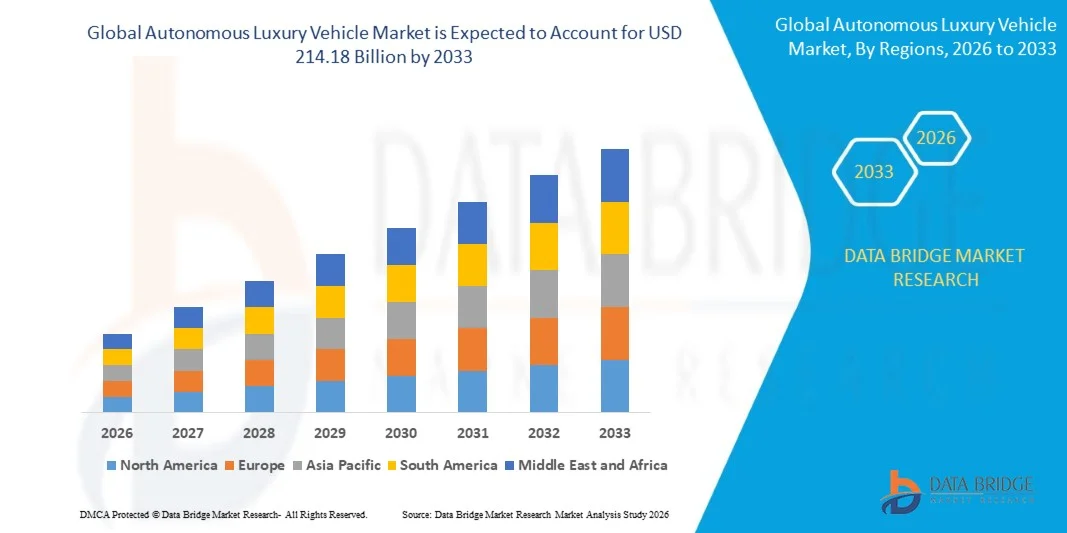
- The global autonomous luxury vehicle market size was valued at USD 17.92 billion in 2025 and is expected to reach USD 214.18 billion by 2033, at a CAGR of 36.36% during the forecast period
- The market growth is largely fuelled by the increasing integration of advanced driver assistance systems, artificial intelligence, and sensor technologies in premium vehicles to enhance safety and driving comfort
- Rising consumer demand for high-end vehicles equipped with autonomous capabilities, along with strong investments by automotive manufacturers in next-generation mobility solutions, is further supporting market expansion
Autonomous Luxury Vehicle Market Analysis
- Growing advancements in autonomous driving technologies such as LiDAR, radar, cameras, and AI-based navigation systems are enabling luxury vehicle manufacturers to introduce highly automated and intelligent vehicles with enhanced safety and performance
- Increasing collaborations between automotive companies and technology providers, along with supportive government regulations and investments in smart transportation infrastructure, are accelerating the development and commercialization of autonomous luxury vehicles globally
- North America dominated the autonomous luxury vehicle market with the largest revenue share in 2025, driven by strong demand for technologically advanced vehicles and the rapid adoption of autonomous driving technologies in premium automotive segments
- Asia-Pacific region is expected to witness the highest growth rate in the global autonomous luxury vehicle market, driven by rapid urbanization, expanding automotive production, increasing adoption of electric vehicles, and rising demand for advanced mobility technologies across countries such as China, Japan, and South Korea
- The LiDAR sensors segment held the largest market revenue share in 2025 driven by its high precision in mapping surroundings and detecting objects, which is essential for safe autonomous navigation. LiDAR technology enables luxury autonomous vehicles to generate accurate 3D environmental data, enhancing vehicle awareness and decision-making capabilities
Report Scope and Autonomous Luxury Vehicle Market Segmentation
|
Attributes |
Autonomous Luxury Vehicle Key Market Insights |
|
Segments Covered |
|
|
Countries Covered |
North America
Europe
Asia-Pacific
Middle East and Africa
South America
|
|
Key Market Players |
• Porsche Automobil Holding SE (Germany) |
|
Market Opportunities |
• Expansion Of Autonomous Mobility Services |
|
Value Added Data Infosets |
In addition to the insights on market scenarios such as market value, growth rate, segmentation, geographical coverage, and major players, the market reports curated by the Data Bridge Market Research also include in-depth expert analysis, geographically represented company-wise production and capacity, network layouts of distributors and partners, detailed and updated price trend analysis and deficit analysis of supply chain and demand. |
Autonomous Luxury Vehicle Market Trends
“Rising Integration of Artificial Intelligence and Advanced Autonomous Technologies”
• The growing integration of artificial intelligence, machine learning, and advanced sensor technologies is significantly shaping the autonomous luxury vehicle market, as manufacturers increasingly focus on delivering safer, more intelligent, and highly automated driving experiences. Autonomous luxury vehicles are gaining traction due to their ability to enhance safety, reduce driver workload, and provide premium comfort features. This trend is strengthening adoption among high-end consumers and encouraging automakers to invest in next-generation autonomous driving systems
• Increasing demand for connected and technologically advanced vehicles has accelerated the adoption of autonomous features in the luxury automotive segment. Affluent consumers are seeking vehicles equipped with advanced driver assistance systems, intelligent navigation, and automated parking solutions. This rising demand is prompting luxury automotive manufacturers to incorporate sophisticated software platforms and sensor technologies to deliver enhanced convenience, safety, and personalization
• Technological advancements in LiDAR, radar, cameras, and high-performance computing systems are influencing vehicle design and functionality. Automakers are focusing on developing vehicles capable of higher levels of driving automation while maintaining luxury comfort and premium performance. Companies are also investing in partnerships with technology providers to strengthen innovation and accelerate commercialization of autonomous mobility solutions
• For instance, in 2024, Mercedes-Benz in Germany and BMW Group expanded their autonomous luxury vehicle development programs by introducing advanced driver assistance and semi-autonomous driving features in their premium vehicle models. These developments were introduced to enhance safety, improve driving convenience, and meet rising consumer expectations for intelligent mobility solutions
• While the demand for autonomous luxury vehicles is growing, sustained market expansion depends on continued technological development, regulatory approvals, and consumer confidence in automated driving systems. Manufacturers are focusing on improving reliability, cybersecurity, and system integration to ensure safe and scalable deployment of autonomous luxury vehicles
Autonomous Luxury Vehicle Market Dynamics
Driver
“Growing Adoption of Autonomous Driving Technologies in Premium Vehicles”
• Rising advancements in autonomous driving technologies are a major driver for the autonomous luxury vehicle market. Automotive manufacturers are increasingly integrating advanced driver assistance systems, AI-based navigation, and automated driving capabilities into luxury vehicles to enhance safety and driving convenience. This trend is also encouraging significant investment in research and development to improve autonomous vehicle performance and reliability
• Expanding demand for enhanced safety, comfort, and personalized driving experiences is influencing market growth. Autonomous luxury vehicles offer advanced features such as adaptive cruise control, lane-keeping assistance, automated parking, and intelligent navigation systems. These capabilities enable manufacturers to deliver premium mobility experiences while addressing consumer expectations for advanced vehicle technology
• Automotive manufacturers and technology companies are actively promoting autonomous mobility solutions through product innovation, strategic collaborations, and investments in smart mobility ecosystems. These initiatives are supported by increasing consumer interest in connected vehicles and intelligent transportation systems, encouraging partnerships between automakers and technology providers to accelerate innovation
• For instance, in 2023, Tesla in the U.S. and Audi in Germany expanded the integration of advanced autonomous driving capabilities within their premium vehicle portfolios. The expansion followed rising consumer demand for intelligent mobility solutions and enhanced vehicle safety. Both companies also emphasized software-driven innovation and over-the-air updates to strengthen user experience and maintain technological leadership
• Although technological advancements support market growth, large-scale adoption depends on regulatory approvals, infrastructure readiness, and continued improvements in autonomous driving reliability. Investment in sensor technologies, software development, and vehicle connectivity will be essential for enabling the widespread deployment of autonomous luxury vehicles
Restraint/Challenge
“High Development Costs and Regulatory Uncertainty”
• The high cost associated with developing and integrating autonomous driving technologies remains a major challenge for the autonomous luxury vehicle market. Advanced sensors, artificial intelligence systems, and high-performance computing platforms significantly increase vehicle development and production costs. These factors can limit affordability and slow adoption even within the premium vehicle segment
• Regulatory uncertainty and evolving safety standards across different countries also create challenges for manufacturers. Governments and regulatory bodies are still developing frameworks for testing and deploying fully autonomous vehicles, which can delay product launches and market expansion. Manufacturers must comply with strict safety, testing, and certification requirements before introducing advanced autonomous features
• Infrastructure limitations and cybersecurity concerns also influence market growth, as autonomous vehicles require reliable digital infrastructure, high-speed connectivity, and advanced data management systems. Companies must invest heavily in secure software platforms, data protection systems, and robust vehicle-to-everything communication networks to ensure safe and reliable operation
• For instance, in 2024, regulatory authorities in regions such as the U.S. and Europe increased scrutiny on autonomous vehicle testing and safety validation programs involving manufacturers such as Waymo and General Motors’ Cruise division. These regulatory reviews were introduced to strengthen safety oversight and ensure responsible deployment of autonomous technologies, which in turn influenced development timelines for autonomous luxury vehicles
• Addressing these challenges will require continued collaboration between automotive manufacturers, technology providers, and regulatory bodies. Investment in advanced research, regulatory harmonization, and infrastructure development will be critical for unlocking the long-term growth potential of the global autonomous luxury vehicle market. Furthermore, strengthening cybersecurity frameworks and improving cost efficiency will support broader adoption of autonomous luxury mobility solutions.
Autonomous Luxury Vehicle Market Scope
The market is segmented on the basis of component, body type, fuel type, and end user.
• By Component
On the basis of component, the autonomous luxury vehicle market is segmented into biometric sensors, camera unit, LiDAR sensors, radar sensors, and ultrasonic sensors. The LiDAR sensors segment held the largest market revenue share in 2025 driven by its high precision in mapping surroundings and detecting objects, which is essential for safe autonomous navigation. LiDAR technology enables luxury autonomous vehicles to generate accurate 3D environmental data, enhancing vehicle awareness and decision-making capabilities.
The radar sensors segment is expected to witness the fastest growth rate from 2026 to 2033, driven by its strong performance in detecting objects during adverse weather conditions such as rain, fog, and snow. Radar sensors support advanced driver assistance features such as adaptive cruise control and collision avoidance, making them increasingly important for autonomous luxury vehicles.
• By Body Type
On the basis of body type, the autonomous luxury vehicle market is segmented into sedan, hatchback, and SUV. The SUV segment held the largest market revenue share in 2025 driven by rising consumer preference for spacious, premium vehicles equipped with advanced technologies. Luxury SUVs often integrate sophisticated autonomous features, enhanced safety systems, and high-performance capabilities, making them highly attractive among affluent consumers.
The sedan segment is expected to witness the fastest growth rate from 2026 to 2033, driven by increasing demand for premium autonomous sedans that combine comfort, performance, and advanced automation technologies. Automakers are introducing new luxury sedan models with enhanced autonomous driving capabilities and connected vehicle technologies to strengthen their market presence.
• By Fuel Type
On the basis of fuel type, the autonomous luxury vehicle market is segmented into internal combustion engine, battery electric vehicle, fuel cell electric vehicle, hybrid vehicle, and others. The battery electric vehicle segment held the largest market revenue share in 2025 driven by increasing investments in electric mobility and rising consumer preference for environmentally sustainable vehicles. Autonomous luxury vehicles are increasingly being integrated with electric powertrains to improve efficiency and reduce emissions.
The fuel cell electric vehicle segment is expected to witness the fastest growth rate from 2026 to 2033, driven by advancements in hydrogen fuel technologies and increasing focus on zero-emission mobility solutions. Fuel cell electric vehicles offer longer driving ranges and faster refueling times, making them a promising option for future autonomous luxury transportation.
• By End User
On the basis of end user, the autonomous luxury vehicle market is segmented into car sharing and personal mobility. The personal mobility segment held the largest market revenue share in 2025 driven by strong demand from high-income consumers seeking advanced autonomous features, enhanced comfort, and premium driving experiences. Luxury vehicle buyers are increasingly interested in vehicles equipped with intelligent automation and connected technologies.
The car sharing segment is expected to witness the fastest growth rate from 2026 to 2033, driven by the rapid expansion of shared mobility services and autonomous ride-hailing platforms. Autonomous luxury vehicles are expected to transform premium mobility services by offering safe, convenient, and technologically advanced transportation experiences for urban users.
Autonomous Luxury Vehicle Market Regional Analysis
• North America dominated the autonomous luxury vehicle market with the largest revenue share in 2025, driven by strong demand for technologically advanced vehicles and the rapid adoption of autonomous driving technologies in premium automotive segments
• Consumers in the region highly value advanced safety systems, intelligent driving assistance, and enhanced comfort features offered by autonomous luxury vehicles, which significantly improve driving convenience and overall travel experience
• This widespread adoption is further supported by high disposable incomes, strong presence of leading automotive manufacturers, and increasing investments in artificial intelligence and mobility technologies, establishing autonomous luxury vehicles as a key innovation in premium transportation
U.S. Autonomous Luxury Vehicle Market Insight
The U.S. autonomous luxury vehicle market captured the largest revenue share in 2025 within North America, fueled by strong technological innovation and increasing investments in autonomous vehicle development. Automotive manufacturers and technology companies are focusing on integrating advanced driver assistance systems, AI-powered navigation, and connected vehicle technologies. The presence of leading automotive and technology firms, along with supportive investments in autonomous mobility research, further propels the market. Moreover, the growing interest in electric autonomous vehicles and intelligent transportation solutions is significantly contributing to the market’s expansion.
Europe Autonomous Luxury Vehicle Market Insight
The Europe autonomous luxury vehicle market is expected to witness the fastest growth rate from 2026 to 2033, primarily driven by strict safety regulations and the increasing focus on sustainable and intelligent mobility solutions. The region’s strong automotive manufacturing base and rapid technological advancements are supporting the adoption of autonomous luxury vehicles. European consumers are increasingly attracted to vehicles offering advanced automation, safety, and connectivity features. The region is also witnessing increasing investments in autonomous driving research and smart transportation infrastructure.
U.K. Autonomous Luxury Vehicle Market Insight
The U.K. autonomous luxury vehicle market is expected to witness the fastest growth rate from 2026 to 2033, driven by the country’s growing focus on advanced mobility technologies and autonomous vehicle innovation. Government initiatives supporting autonomous vehicle testing and development are encouraging automotive companies to accelerate research and commercialization efforts. In addition, the increasing consumer demand for premium vehicles equipped with advanced safety and automation features is expected to stimulate market growth.
Germany Autonomous Luxury Vehicle Market Insight
The Germany autonomous luxury vehicle market is expected to witness the fastest growth rate from 2026 to 2033, fueled by the country’s strong automotive industry and leadership in engineering and innovation. Germany is home to several luxury vehicle manufacturers that are actively investing in autonomous driving technologies and intelligent mobility solutions. The integration of advanced sensors, artificial intelligence, and connected vehicle systems is supporting the development of next-generation autonomous luxury vehicles in the region.
Asia-Pacific Autonomous Luxury Vehicle Market Insight
The Asia-Pacific autonomous luxury vehicle market is expected to witness the fastest growth rate from 2026 to 2033, driven by rapid urbanization, rising disposable incomes, and increasing adoption of advanced automotive technologies in countries such as China, Japan, and South Korea. The region’s growing focus on smart mobility solutions and intelligent transportation systems is accelerating the adoption of autonomous luxury vehicles. In addition, expanding automotive production and technological innovation are strengthening market growth across the region.
Japan Autonomous Luxury Vehicle Market Insight
The Japan autonomous luxury vehicle market is expected to witness the fastest growth rate from 2026 to 2033 due to the country’s strong technological capabilities and emphasis on innovation in the automotive sector. Japanese manufacturers are investing heavily in autonomous driving technologies, advanced sensors, and artificial intelligence systems. The integration of autonomous systems with connected vehicle technologies and smart infrastructure is further supporting the development of advanced luxury mobility solutions.
China Autonomous Luxury Vehicle Market Insight
The China autonomous luxury vehicle market accounted for the largest market revenue share in Asia Pacific in 2025, attributed to the country’s rapidly expanding automotive industry and strong investments in autonomous vehicle technology. China is emerging as a major hub for electric and autonomous vehicle innovation, supported by government initiatives promoting smart mobility and intelligent transportation systems. The increasing demand for technologically advanced luxury vehicles among affluent consumers is further propelling the market in China.
Autonomous Luxury Vehicle Market Share
The Autonomous Luxury Vehicle industry is primarily led by well-established companies, including:
• Porsche Automobil Holding SE (Germany)
• Continental AG (Germany)
• BorgWarner Inc. (U.S.)
• VALEO (France)
• Cisco Systems, Inc. (U.S.)
• AUDI AG (Germany)
• BMW AG (Germany)
• Daimler AG (Germany)
• NIO (China)
• Tesla (U.S.)
• Changan Automobile Company Limited (China)
• BYD Company Ltd. (China)
• Baidu (China)
• SAIC Motor Corporation Limited (China)
• Waymo LLC (U.S.)
• BAIC Motor Corporation Ltd. (China)
• Robert Bosch GmbH (Germany)
• NXP Semiconductors (Netherlands)
• Infineon Technologies AG (Germany)
• Texas Instruments Incorporated (U.S.)
• Magna International Inc. (Canada)
• ZF Friedrichshafen AG (Germany)
• Renesas Electronics Corporation (Japan)
• Nippon Seiki Co. Ltd. (Japan)
• Pioneer Corporation (Japan)
• DENSO CORPORATION (Japan)
• Visteon Corporation (U.S.)
Latest Developments in Global Autonomous Luxury Vehicle Market
- In July 2026, Waymo LLC, Fleet Expansion, announced the expansion of its autonomous vehicle fleet with new models designed for premium transportation services. The initiative focuses on integrating luxury-oriented autonomous vehicles into ride-hailing platforms to enhance passenger comfort and safety. This development strengthens Waymo’s presence in high-end autonomous mobility services and supports the growth of premium autonomous transportation solutions
- In July 2025, Lucid Group, Uber Technologies Inc., and Nuro, Strategic Collaboration, announced plans to deploy 20,000 self-driving Lucid Gravity SUVs on Uber’s mobility platform across global markets. The initiative aims to integrate autonomous luxury vehicles into ride-hailing services, enhancing passenger experience and operational efficiency. This large-scale deployment is expected to accelerate the commercialization of autonomous luxury mobility services
- In October 2024, Hyundai Motor Company and Waymo LLC, Technology Partnership, launched a multi-year program to integrate the Waymo Driver autonomous system into the all-electric Hyundai IONIQ 5 for the Waymo One autonomous fleet. The collaboration focuses on improving vehicle autonomy, safety, and operational efficiency. This partnership strengthens the development of advanced autonomous electric vehicles and expands the deployment of driverless transportation services
- In August 2024, Cadillac, Product Development, introduced the Opulent Velocity concept vehicle featuring Level 4 autonomous driving capabilities and advanced augmented reality head-up display technology. The concept highlights Cadillac’s focus on combining luxury design with next-generation autonomous technologies. This development demonstrates the increasing integration of advanced digital interfaces and automation in premium vehicles
- In June 2024, BMW AG, Regulatory Approval, received approvals for its Level 2 Highway Assistant and Level 3 Personal Pilot L3 systems for the new BMW 7 Series luxury sedan. These systems enable hands-free driving under specific conditions and enhance vehicle automation capabilities. The approval strengthens BMW’s position in autonomous luxury vehicle innovation and supports the gradual commercialization of higher-level autonomous driving technologies
SKU-
Получите онлайн-доступ к отчету на первой в мире облачной платформе рыночной аналитики

- Интерактивная панель анализа данных
- Панель анализа компании для возможностей с высоким потенциалом роста
- Доступ аналитика-исследователя для настройки и запросов
- Анализ конкурентов с помощью интерактивной панели
- Последние новости, обновления и анализ тенденций
- Используйте возможности сравнительного анализа для комплексного отслеживания конкурентов
Методология исследования
Сбор данных и анализ базового года выполняются с использованием модулей сбора данных с большими размерами выборки. Этап включает получение рыночной информации или связанных данных из различных источников и стратегий. Он включает изучение и планирование всех данных, полученных из прошлого заранее. Он также охватывает изучение несоответствий информации, наблюдаемых в различных источниках информации. Рыночные данные анализируются и оцениваются с использованием статистических и последовательных моделей рынка. Кроме того, анализ доли рынка и анализ ключевых тенденций являются основными факторами успеха в отчете о рынке. Чтобы узнать больше, пожалуйста, запросите звонок аналитика или оставьте свой запрос.
Ключевой методологией исследования, используемой исследовательской группой DBMR, является триангуляция данных, которая включает в себя интеллектуальный анализ данных, анализ влияния переменных данных на рынок и первичную (отраслевую экспертную) проверку. Модели данных включают сетку позиционирования поставщиков, анализ временной линии рынка, обзор рынка и руководство, сетку позиционирования компании, патентный анализ, анализ цен, анализ доли рынка компании, стандарты измерения, глобальный и региональный анализ и анализ доли поставщика. Чтобы узнать больше о методологии исследования, отправьте запрос, чтобы поговорить с нашими отраслевыми экспертами.
Доступна настройка
Data Bridge Market Research является лидером в области передовых формативных исследований. Мы гордимся тем, что предоставляем нашим существующим и новым клиентам данные и анализ, которые соответствуют и подходят их целям. Отчет можно настроить, включив в него анализ ценовых тенденций целевых брендов, понимание рынка для дополнительных стран (запросите список стран), данные о результатах клинических испытаний, обзор литературы, обновленный анализ рынка и продуктовой базы. Анализ рынка целевых конкурентов можно проанализировать от анализа на основе технологий до стратегий портфеля рынка. Мы можем добавить столько конкурентов, о которых вам нужны данные в нужном вам формате и стиле данных. Наша команда аналитиков также может предоставить вам данные в сырых файлах Excel, сводных таблицах (книга фактов) или помочь вам в создании презентаций из наборов данных, доступных в отчете.











