



Global Cognitive Media Market Segmentation, By Component (Solutions and Services), Technology (Deep Learning and Machine Learning and Natural Language Processing), Deployment Mode (On-Premises and On-Demand), Organization Size (Large enterprises and Small and Medium Enterprises (SMEs)), Application (Network Optimization, Recommendation and Personalization, Content Management, Predictive Analysis, Customer Retention, Security Management, and Others) - Industry Trends and Forecast to 2033
What is the Global Cognitive Media Market Size and Growth Rate?
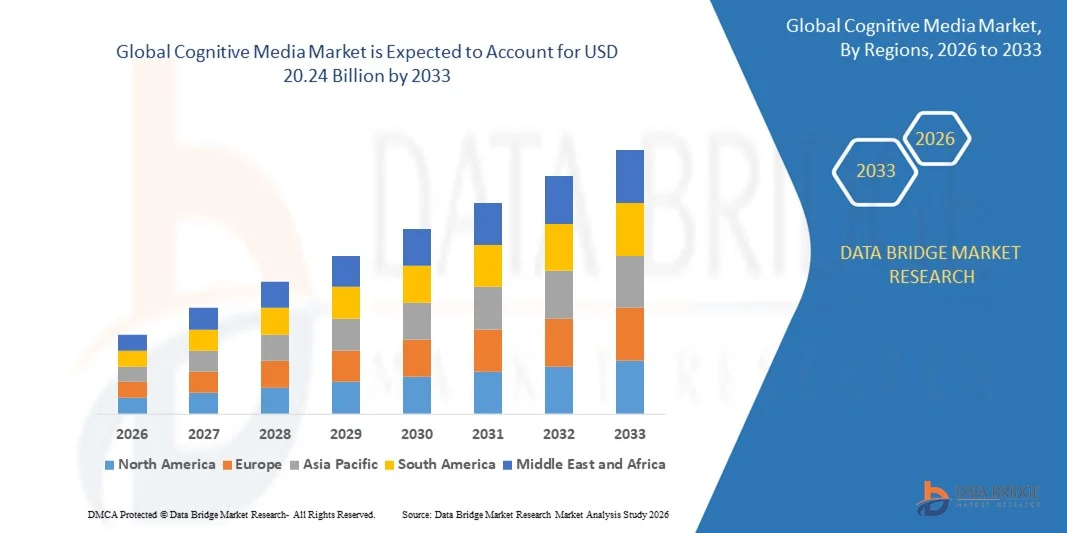
- The global Cognitive Media market size was valued at USD 2.97 billion in 2025 and is expected to reach USD 20.24 billion by 2033, at a CAGR of27.10% during the forecast period
- The rise in the digital transformation across the vertical acts as one of the major factors driving the growth of cognitive media market
- The rise in the automation of workflow in the media sector with the help of cognitive computing and increase in demand for enhanced content creation surging the adoption of cognitive computing accelerate the market growth
What are the Major Takeaways of Cognitive Media Market?
- The high use of cognitive computing to combat the rising pressure for detecting illegal content and surge in number of AI start-ups in the media industry is penetrating the way for intense competition further influence the market
- In addition, surge in investment, increase in use of virtualization and urbanization positively affect the cognitive media market. Furthermore, rise in investments in the media sector and need for new revenue streams for media companies extend profitable opportunities to the market players
- North America dominated the cognitive media market with a 32.36% revenue share in 2025, driven by strong adoption of artificial intelligence, cloud computing, advanced data analytics, and digital content platforms across the U.S. and Canada
- Asia-Pacific is projected to register the fastest CAGR of 9.47% from 2026 to 2033, driven by rapid digitalization, expanding internet penetration, strong growth in OTT platforms, and rising adoption of AI-driven advertising technologies across China, Japan, India, South Korea, and Southeast Asia
- The Solutions segment dominated the market with a 62.7% share in 2025, as enterprises increasingly deploy AI-powered media analytics platforms, content recommendation engines, automated tagging tools, and cognitive advertising systems
Report Scope and Cognitive Media Market Segmentation
|
Attributes |
Cognitive Media Key Market Insights |
|
Segments Covered |
|
|
Countries Covered |
North America
Europe
Asia-Pacific
Middle East and Africa
South America
|
|
Key Market Players |
|
|
Market Opportunities |
|
|
Value Added Data Infosets |
In addition to the insights on market scenarios such as market value, growth rate, segmentation, geographical coverage, and major players, the market reports curated by the Data Bridge Market Research also include in-depth expert analysis, pricing analysis, brand share analysis, consumer survey, demography analysis, supply chain analysis, value chain analysis, raw material/consumables overview, vendor selection criteria, PESTLE Analysis, Porter Analysis, and regulatory framework. |
What is the Key Trend in the Cognitive Media Market?
Increasing Shift Toward AI-Driven Personalization and Real-Time Content Intelligence
- The cognitive media market is witnessing strong adoption of AI-powered content analytics, natural language processing (NLP), and machine learning algorithms to enhance real-time media personalization and audience engagement
- Media companies are deploying predictive recommendation engines, automated content tagging, sentiment analysis, and adaptive advertising platforms to optimize user experiences across digital channels
- Growing integration of cloud-based cognitive platforms and big data analytics enables scalable processing of structured and unstructured media content
- For instance, leading technology providers are enhancing cognitive media solutions with real-time viewer analytics, AI-driven content moderation, speech-to-text conversion, and contextual advertising capabilities
- Increasing demand for hyper-personalized streaming, intelligent chatbots, and automated news generation is accelerating innovation across OTT platforms and digital publishing ecosystems
- As digital consumption expands globally, Cognitive Media solutions remain critical for intelligent content management, audience targeting, and data-driven decision-making
What are the Key Drivers of Cognitive Media Market?
- Rising demand for personalized digital experiences and data-driven advertising strategies is driving investment in AI-enabled media platforms
- For instance, in 2025, major technology vendors expanded their AI media toolkits with enhanced content recommendation engines, real-time analytics dashboards, and automated workflow capabilities
- Rapid growth of OTT streaming services, social media platforms, and digital broadcasting networks is significantly increasing demand for intelligent content processing tools across the U.S., Europe, and Asia-Pacific
- Advancements in deep learning, computer vision, and speech recognition technologies are improving media indexing, automated editing, and targeted distribution
- Increasing adoption of AI chatbots, virtual influencers, and immersive AR/VR media experiences is further expanding cognitive media applications
- Supported by continuous investments in cloud infrastructure, AI research, and digital transformation initiatives, the Cognitive Media market is projected to witness sustained long-term growth
Which Factor is Challenging the Growth of the Cognitive Media Market?
- High implementation and integration costs of advanced AI-driven analytics platforms and cognitive computing infrastructure limit adoption among small and mid-sized media enterprises
- For instance, during 2024–2025, increased cloud service costs, data storage expenses, and AI model training requirements raised operational expenditures for several media companies
- Complexity in managing large-scale multimedia datasets and ensuring real-time processing accuracy creates technical and scalability challenges
- Data privacy regulations, content governance requirements, and algorithmic bias concerns create compliance and ethical barriers
- Competition from traditional media analytics tools and open-source AI frameworks exerts pricing pressure and reduces differentiation
- To address these challenges, companies are focusing on scalable cloud-native architectures, transparent AI models, cost-efficient subscription models, and enhanced cybersecurity frameworks to accelerate global adoption of Cognitive Media solutions
How is the Cognitive Media Market Segmented?
The market is segmented on the basis of component, technology, deployment mode, organization size, and application.
- By Component
On the basis of component, the Cognitive Media market is segmented into Solutions and Services. The Solutions segment dominated the market with a 62.7% share in 2025, as enterprises increasingly deploy AI-powered media analytics platforms, content recommendation engines, automated tagging tools, and cognitive advertising systems. These solutions enable real-time audience insights, workflow automation, sentiment analysis, and data-driven content monetization, making them central to digital media transformation strategies. Strong adoption across OTT platforms, digital broadcasters, and social media networks supports segment leadership.
The Services segment is expected to grow at the fastest CAGR from 2026 to 2033, driven by rising demand for consulting, system integration, cloud deployment, model training, and managed AI services. As cognitive systems become more complex, organizations increasingly rely on third-party expertise for optimization, customization, and compliance management, accelerating long-term service revenue growth.
- By Technology
On the basis of technology, the market is segmented into Deep Learning & Machine Learning (ML) and Natural Language Processing (NLP). The Deep Learning & ML segment dominated the market with a 58.4% share in 2025, owing to its extensive use in predictive analytics, audience behavior modeling, automated video indexing, image recognition, and intelligent recommendation systems. These technologies enable advanced pattern detection and real-time personalization, significantly enhancing viewer engagement and advertising efficiency.
The Natural Language Processing segment is projected to grow at the fastest CAGR from 2026 to 2033, supported by increasing adoption of speech-to-text conversion, sentiment analysis, chatbot integration, automated news generation, and multilingual content moderation. Rising demand for voice-enabled platforms, conversational AI, and contextual content delivery is accelerating NLP deployment across global digital media ecosystems.
- By Organization Size
On the basis of organization size, the Cognitive Media market is segmented into Large Enterprises and Small & Medium Enterprises (SMEs). The Large Enterprises segment dominated the market with a 64.1% share in 2025, driven by substantial investments in AI infrastructure, cloud computing, and big data analytics. Major broadcasters, OTT providers, and global media houses leverage cognitive platforms for large-scale personalization, audience segmentation, and predictive revenue optimization. Their strong financial capabilities and digital transformation initiatives reinforce dominance.
The SMEs segment is expected to grow at the fastest CAGR from 2026 to 2033, fueled by increasing availability of cloud-based subscription models and AI-as-a-Service platforms. Affordable deployment options and scalable architectures are enabling smaller media firms and digital publishers to adopt cognitive technologies for targeted marketing and workflow automation.
- By Deployment Mode
On the basis of deployment mode, the market is segmented into On-Premises and On-Demand (Cloud-Based). The On-Premises segment dominated the market with a 55.6% share in 2025, particularly among large broadcasters and enterprises prioritizing data security, regulatory compliance, and infrastructure control. These deployments offer enhanced customization, data governance, and integration with legacy systems.
The On-Demand segment is projected to grow at the fastest CAGR from 2026 to 2033, driven by increasing adoption of cloud-native AI platforms, flexible pricing models, and scalable computing power. Growing preference for remote collaboration, real-time analytics access, and reduced capital expenditure is accelerating cloud-based cognitive media adoption across emerging markets.
- By Application
On the basis of application, the market is segmented into Network Optimization, Recommendation & Personalization, Content Management, Predictive Analysis, Customer Retention, Security Management, and Others. The Recommendation & Personalization segment dominated the market with a 34.9% share in 2025, supported by rising demand for customized streaming experiences, targeted advertising, and viewer engagement analytics across OTT and social media platforms.
The Predictive Analysis segment is expected to grow at the fastest CAGR from 2026 to 2033, driven by increasing use of AI for audience forecasting, churn prediction, advertising ROI optimization, and behavioral analytics. As competition intensifies among digital media providers, predictive intelligence solutions are becoming essential for revenue growth and customer lifecycle management.
Which Region Holds the Largest Share of the Cognitive Media Market?
- North America dominated the cognitive media market with a 32.36% revenue share in 2025, driven by strong adoption of artificial intelligence, cloud computing, advanced data analytics, and digital content platforms across the U.S. and Canada. High penetration of OTT streaming services, digital advertising ecosystems, and AI-powered recommendation engines continues to fuel demand for Cognitive Media solutions across broadcasting networks, social media platforms, and digital publishing houses
- Leading technology providers in North America are introducing advanced AI-driven personalization tools, real-time content analytics platforms, automated moderation systems, and predictive audience intelligence solutions, strengthening the region’s technological leadership. Continuous investment in generative AI, big data infrastructure, and immersive media technologies supports long-term market expansion
- Strong innovation ecosystems, high concentration of AI talent, established cloud infrastructure, and sustained venture capital funding further reinforce regional dominance in the global Cognitive Media landscape
U.S. Cognitive Media Market Insight
The U.S. is the largest contributor within North America, supported by rapid digital transformation across media, entertainment, advertising, and telecom sectors. Increasing deployment of AI-powered recommendation systems, automated content generation tools, real-time sentiment analytics, and programmatic advertising platforms drives strong demand. Presence of major cloud providers, streaming giants, and AI startups accelerates innovation in predictive content delivery, viewer behavior analytics, and customer retention optimization. Growing investment in generative AI, immersive media, and data-driven marketing further strengthens long-term market growth.
Canada Cognitive Media Market Insight
Canada contributes significantly to regional expansion, driven by growing adoption of AI in broadcasting, digital publishing, and telecom sectors. Media enterprises increasingly deploy cognitive platforms for multilingual content moderation, audience segmentation, and automated workflow management. Government-supported AI research initiatives, strong academic institutions, and expanding digital infrastructure enhance innovation capabilities. Rising demand for cloud-native analytics and personalized streaming experiences supports continued Cognitive Media adoption across the country.
Asia-Pacific Cognitive Media Market
Asia-Pacific is projected to register the fastest CAGR of 9.47% from 2026 to 2033, driven by rapid digitalization, expanding internet penetration, strong growth in OTT platforms, and rising adoption of AI-driven advertising technologies across China, Japan, India, South Korea, and Southeast Asia. Massive consumption of digital content, mobile-first user bases, and increasing investments in smart devices accelerate demand for cognitive analytics and personalization engines. Growth in e-commerce, gaming, digital broadcasting, and social commerce ecosystems further fuels regional market expansion.
China Cognitive Media Market Insight
China is the largest contributor within Asia-Pacific due to its vast digital population, strong e-commerce ecosystems, and rapid AI innovation. Expansion of short-video platforms, intelligent recommendation algorithms, and automated content moderation tools drives significant Cognitive Media deployment. Government-backed AI development programs and large-scale cloud infrastructure investments further strengthen market growth.
Japan Cognitive Media Market Insight
Japan demonstrates steady growth supported by advanced telecom networks, strong digital entertainment industries, and increasing adoption of AI-powered media analytics. High focus on content quality, precision targeting, and immersive media experiences drives demand for sophisticated cognitive solutions.
India Cognitive Media Market Insight
India is emerging as a high-growth hub, supported by expanding OTT subscriptions, rising digital advertising expenditure, and strong startup activity in AI and media analytics. Increasing smartphone penetration and multilingual content demand accelerate cognitive platform adoption.
South Korea Cognitive Media Market Insight
South Korea contributes significantly due to strong 5G infrastructure, advanced gaming ecosystems, and rapid AI adoption in digital media platforms. Innovation in smart advertising, streaming analytics, and immersive content technologies supports sustained Cognitive Media market growth.
Which are the Top Companies in Cognitive Media Market?
The cognitive media industry is primarily led by well-established companies, including:
- Microsoft (U.S.)
- IBM (U.S.)
- Amazon Web Services, Inc. (U.S.)
- Oracle (U.S.)
- SAP (Germany)
- General Electric (U.S.)
- Eaton plc (Ireland)
- Schneider Electric (France)
- Cisco (U.S.)
- Google LLC (U.S.)
- Siemens (Germany)
- SAS Institute, Inc. (U.S.)
- Salesforce, Inc. (U.S.)
- Open Text Corporation (Canada)
- Teradata (U.S.)
- Intel Corporation (U.S.)
- Atos SE (France)
- MicroStrategy Incorporated (U.S.)
- Alteryx (U.S.)
- TIBCO Software Inc. (U.S.)
What are the Recent Developments in Global Cognitive Media Market?
- In June 2025, Meta hired four senior researchers from OpenAI to establish a dedicated Superintelligence research team, strengthening its long-term artificial general intelligence strategy and competitive AI positioning. This move highlights intensifying competition in advanced AI development and strategic talent acquisition
- In June 2025, Disney and NBCUniversal filed a lawsuit against Midjourney, alleging large-scale copyright infringement related to AI-generated content, escalating legal scrutiny around generative AI platforms. This action underscores growing regulatory and intellectual property challenges within the AI-driven media landscape
- In June 2025, YouTube incorporated Google’s Veo 3 generative video model into YouTube Shorts to enable next-generation AI-powered content creation tools for creators and brands. This integration accelerates innovation in AI-assisted video production and short-form digital media expansion
- In May 2025, the U.S. Congress passed the TAKE IT DOWN Act, prohibiting the creation and distribution of non-consensual intimate deepfakes to strengthen digital safety and online privacy protections. This legislation reflects increasing government intervention in regulating AI-generated content and platform accountability
SKU-
Получите онлайн-доступ к отчету на первой в мире облачной платформе рыночной аналитики

- Интерактивная панель анализа данных
- Панель анализа компании для возможностей с высоким потенциалом роста
- Доступ аналитика-исследователя для настройки и запросов
- Анализ конкурентов с помощью интерактивной панели
- Последние новости, обновления и анализ тенденций
- Используйте возможности сравнительного анализа для комплексного отслеживания конкурентов
Методология исследования
Сбор данных и анализ базового года выполняются с использованием модулей сбора данных с большими размерами выборки. Этап включает получение рыночной информации или связанных данных из различных источников и стратегий. Он включает изучение и планирование всех данных, полученных из прошлого заранее. Он также охватывает изучение несоответствий информации, наблюдаемых в различных источниках информации. Рыночные данные анализируются и оцениваются с использованием статистических и последовательных моделей рынка. Кроме того, анализ доли рынка и анализ ключевых тенденций являются основными факторами успеха в отчете о рынке. Чтобы узнать больше, пожалуйста, запросите звонок аналитика или оставьте свой запрос.
Ключевой методологией исследования, используемой исследовательской группой DBMR, является триангуляция данных, которая включает в себя интеллектуальный анализ данных, анализ влияния переменных данных на рынок и первичную (отраслевую экспертную) проверку. Модели данных включают сетку позиционирования поставщиков, анализ временной линии рынка, обзор рынка и руководство, сетку позиционирования компании, патентный анализ, анализ цен, анализ доли рынка компании, стандарты измерения, глобальный и региональный анализ и анализ доли поставщика. Чтобы узнать больше о методологии исследования, отправьте запрос, чтобы поговорить с нашими отраслевыми экспертами.
Доступна настройка
Data Bridge Market Research является лидером в области передовых формативных исследований. Мы гордимся тем, что предоставляем нашим существующим и новым клиентам данные и анализ, которые соответствуют и подходят их целям. Отчет можно настроить, включив в него анализ ценовых тенденций целевых брендов, понимание рынка для дополнительных стран (запросите список стран), данные о результатах клинических испытаний, обзор литературы, обновленный анализ рынка и продуктовой базы. Анализ рынка целевых конкурентов можно проанализировать от анализа на основе технологий до стратегий портфеля рынка. Мы можем добавить столько конкурентов, о которых вам нужны данные в нужном вам формате и стиле данных. Наша команда аналитиков также может предоставить вам данные в сырых файлах Excel, сводных таблицах (книга фактов) или помочь вам в создании презентаций из наборов данных, доступных в отчете.











