Global Congestive Renal Failure (CRF) Market Segmentation, By Type (CRF With Cardiorenal Syndrome, CRF With Non-Cardiorenal Syndrome, and Others), Treatment (Surgery, Medication, and Others), Route of Administration (Oral, Parenteral, and Others), End-Users (Hospitals, Specialty Clinics, and Others), Distribution Channel (Hospital Pharmacy, Retail Pharmacy, and Others) - Industry Trends and Forecast to 2033
Congestive Renal Failure (CRF) Market Size
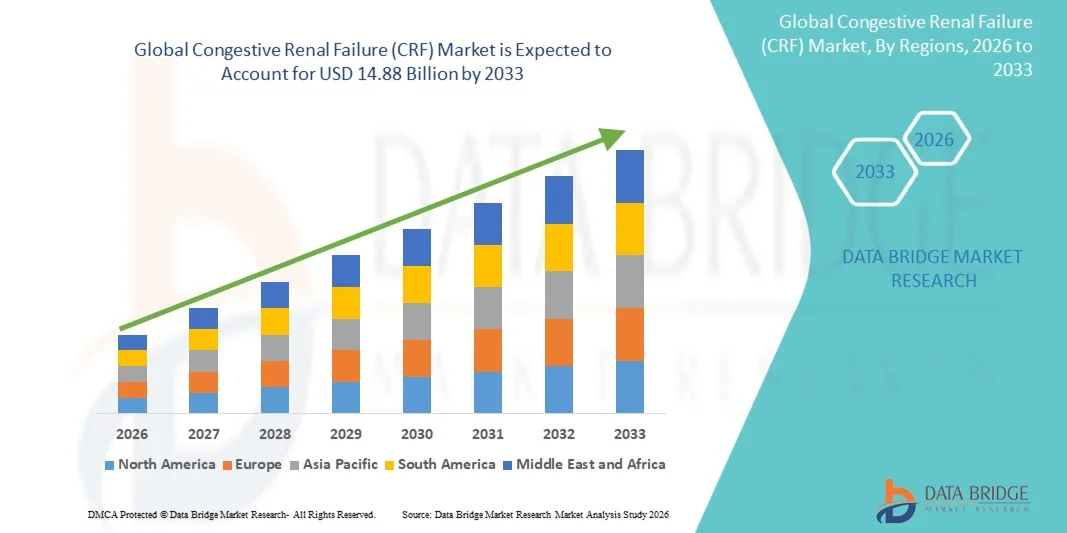
- The global congestive renal failure (CRF) market size was valued at USD 8.59 billion in 2025 and is expected to reach USD 14.88 billion by 2033, at a CAGR of 7.11% during the forecast period
- The market growth is largely fueled by the increasing prevalence of chronic kidney diseases and end-stage renal failure, along with rising cases of diabetes and hypertension, leading to growing demand for effective treatment and management solutions for Congestive Renal Failure (CRF)
- Furthermore, advancements in dialysis technologies, increasing adoption of renal replacement therapies, and growing awareness regarding early diagnosis and kidney care are establishing CRF management solutions as essential components of nephrology care. These converging factors are accelerating the uptake of Congestive Renal Failure (CRF) solutions, thereby significantly boosting the industry's growth
Congestive Renal Failure (CRF) Market Analysis
- Congestive Renal Failure (CRF) management solutions, including dialysis therapies, renal replacement systems, and pharmacological treatments, are increasingly vital components of modern nephrology care due to their role in managing kidney function decline, improving patient survival rates, and enhancing quality of life
- The escalating demand for CRF solutions is primarily fueled by the rising prevalence of chronic kidney disease, increasing incidence of diabetes and hypertension, aging population, and growing need for long-term renal care and management
- North America dominated the congestive renal failure (CRF) market with the largest revenue share of 38.7% in 2025, driven by advanced healthcare infrastructure, high dialysis adoption rates, strong reimbursement systems, and widespread availability of renal care facilities in the U.S.
- Asia-Pacific is expected to be the fastest growing region in the congestive renal failure (CRF) market during the forecast period due to rising patient population, increasing healthcare investments, improving dialysis accessibility, and growing awareness of kidney disease management
- The medication segment dominated the largest market revenue share of around 61.9% in 2025, driven by the widespread use of pharmacological therapies for managing CRF symptoms and slowing disease progression
Report Scope and Congestive Renal Failure (CRF) Market Segmentation
|
Attributes |
Congestive Renal Failure (CRF) Key Market Insights |
|
Segments Covered |
|
|
Countries Covered |
North America
Europe
Asia-Pacific
Middle East and Africa
South America
|
|
Key Market Players |
|
|
Market Opportunities |
|
|
Value Added Data Infosets |
In addition to the insights on market scenarios such as market value, growth rate, segmentation, geographical coverage, and major players, the market reports curated by the Data Bridge Market Research also include in-depth expert analysis, patient epidemiology, pipeline analysis, pricing analysis, and regulatory framework. |
Congestive Renal Failure (CRF) Market Trends
“Advancements in Renal Care Technologies and Treatment Innovation”
- A significant and accelerating trend in the global congestive renal failure (CRF) market is the continuous advancement in renal care technologies, including improved dialysis techniques, wearable dialysis devices, and next-generation kidney transplant management therapies
- For instance, the development of portable hemodialysis and home-based peritoneal dialysis solutions is improving patient mobility and quality of life while reducing hospital dependency
- Pharmaceutical companies are increasingly focusing on novel drug therapies that slow the progression of kidney failure and manage associated complications such as hypertension and anemia
- In addition, regenerative medicine and stem cell research are emerging as promising areas for long-term renal function restoration
- The integration of precision medicine approaches is enabling more personalized treatment strategies based on patient-specific disease progression and comorbidities
- These advancements are collectively improving survival rates and reshaping long-term disease management in chronic renal failure patients
Congestive Renal Failure (CRF) Market Dynamics
Driver
“Rising Prevalence of Chronic Kidney Disease and Growing Demand for Renal Replacement Therapies”
- The increasing global burden of chronic kidney disease (CKD), driven by diabetes, hypertension, obesity, and aging populations, is a major driver of the CRF market
- For instance, the growing incidence of lifestyle-related diseases is significantly increasing the number of patients progressing to end-stage renal disease requiring dialysis or kidney transplantation
- Expanding access to healthcare services and improved diagnostic capabilities are leading to earlier detection and higher treatment initiation rates
- Governments and healthcare organizations are also investing in dialysis centers and transplant programs to address the rising patient pool
- Furthermore, increasing awareness about kidney health and preventive screening is contributing to higher diagnosis rates globally
- Overall, the rising disease burden and expanding treatment infrastructure are expected to strongly drive market growth
Restraint/Challenge
“High Treatment Costs and Limited Access to Advanced Renal Care in Low-Income Regions”
- The high cost associated with long-term dialysis, kidney transplantation, and post-transplant care remains a significant barrier to market growth
- For instance, repeated dialysis sessions impose a substantial financial burden on patients, particularly in developing countries with limited insurance coverage
- Shortage of donor organs and long waiting times for kidney transplants further restrict access to effective treatment
- In addition, inadequate healthcare infrastructure in rural and underdeveloped regions limits availability of dialysis centers and nephrology specialists
- Patients often face delayed diagnosis and treatment due to lack of awareness and screening facilities
- Addressing these challenges through improved healthcare funding, expanded dialysis networks, and affordable treatment options will be critical for sustained market growth
Congestive Renal Failure (CRF) Market Scope
The market is segmented on the basis of type, treatment, route of administration, end-users, and distribution channel.
• By Type
On the basis of type, the Congestive Renal Failure (CRF) market is segmented into CRF with cardiorenal syndrome, CRF with non-cardiorenal syndrome, and others. The CRF with cardiorenal syndrome segment dominated the largest market revenue share of around 52.6% in 2025, driven by the strong clinical interconnection between cardiac and renal dysfunction. Increasing prevalence of chronic heart diseases and kidney disorders is supporting demand. High-risk patient population with comorbidities contributes significantly to this segment. Rising geriatric population is further increasing incidence rates. Growing awareness regarding early diagnosis is improving detection. Hospitals frequently manage such complex cases requiring intensive care. Advancements in diagnostic tools are enabling early identification. Increasing hospitalization rates for multi-organ failure cases are supporting growth. Rising healthcare expenditure is improving treatment access. Strong clinical focus on integrated care is further strengthening dominance.
The CRF with non-cardiorenal syndrome segment is expected to witness the fastest CAGR of around 8.4% from 2026 to 2033, driven by increasing cases of standalone renal failure. Rising prevalence of diabetes and hypertension is contributing to kidney dysfunction. Growing awareness regarding kidney health is boosting early diagnosis. Expanding screening programs are improving detection rates. Lifestyle changes and unhealthy diets are increasing risk factors. Improving access to nephrology care is supporting treatment adoption. Rising number of dialysis patients is contributing to growth. Technological advancements in renal care are enhancing outcomes. Increasing healthcare investments are further accelerating the segment.
• By Treatment
On the basis of treatment, the Congestive Renal Failure (CRF) market is segmented into surgery, medication, and others. The medication segment dominated the largest market revenue share of around 61.9% in 2025, driven by the widespread use of pharmacological therapies for managing CRF symptoms and slowing disease progression. Drugs such as antihypertensives, diuretics, and erythropoiesis-stimulating agents are commonly prescribed. Increasing prevalence of chronic kidney disease is supporting demand. Early-stage patients are primarily managed through medication. Growing awareness regarding disease management is boosting adoption. Availability of advanced drug therapies is enhancing treatment effectiveness. Rising healthcare access is improving medication usage. Hospitals and clinics rely heavily on drug-based management. Increasing geriatric population is further driving demand. Continuous innovation in renal therapeutics is supporting growth.
The surgery segment is expected to witness the fastest CAGR of around 7.9% from 2026 to 2033, driven by increasing demand for renal transplantation and corrective surgical procedures. Rising cases of end-stage renal disease are boosting transplant requirements. Growing donor programs are supporting availability. Advancements in surgical techniques are improving success rates. Increasing healthcare infrastructure is enabling complex procedures. Higher survival rates post-surgery are encouraging adoption. Expanding transplant centers are contributing to growth. Rising awareness regarding organ donation is supporting supply. Government initiatives are improving access to transplantation services.
• By Route of Administration
On the basis of route of administration, the Congestive Renal Failure (CRF) market is segmented into oral, parenteral, and others. The oral segment dominated the largest market revenue share of around 58.3% in 2025, driven by ease of administration and widespread use in long-term CRF management. Oral drugs are commonly used for controlling blood pressure and managing symptoms. High patient compliance supports adoption. Increasing availability of oral renal medications is boosting growth. Patients prefer non-invasive treatment options. Expanding retail pharmacy networks are improving access. Growing outpatient care is supporting usage. Cost-effectiveness of oral therapies is another key factor. Rising awareness regarding chronic disease management is contributing to demand.
The parenteral segment is expected to witness the fastest CAGR of around 8.7% from 2026 to 2033, driven by its use in severe and hospital-based CRF cases. Intravenous therapies are essential for critical patients. Increasing hospitalization rates are supporting demand. Rapid drug action in emergencies is boosting adoption. Growing use of dialysis-related injections is contributing to growth. Advancements in infusion technologies are improving outcomes. Rising ICU admissions for renal failure are supporting usage. Expansion of healthcare infrastructure is further driving growth. Increasing focus on acute care management is accelerating adoption.
• By End-Users
On the basis of end-users, the Congestive Renal Failure (CRF) market is segmented into hospitals, specialty clinics, and others. The hospitals segment dominated the largest market revenue share of around 57.8% in 2025, driven by the high number of CRF admissions and availability of advanced treatment infrastructure. Hospitals provide dialysis and intensive care support. Increasing prevalence of kidney failure is boosting patient inflow. Availability of nephrology specialists supports treatment quality. Government healthcare funding is strengthening hospital services. Rising emergency cases require hospital-based care. Expanding hospital networks are improving access. Increasing healthcare expenditure is supporting infrastructure development. Hospitals remain primary centers for advanced renal treatment.
The specialty clinics segment is expected to witness the fastest CAGR of around 8.5% from 2026 to 2033, driven by rising demand for focused kidney care services. These clinics provide personalized treatment plans. Growing awareness about chronic kidney disease is boosting visits. Increasing outpatient care preference is supporting growth. Expansion of dialysis and nephrology centers is contributing to demand. Technological advancements are improving diagnostic accuracy. Rising patient convenience is encouraging adoption. Improved accessibility in urban areas is further supporting growth. Increasing healthcare specialization is accelerating the segment.
• By Distribution Channel
On the basis of distribution channel, the Congestive Renal Failure (CRF) market is segmented into hospital pharmacy, retail pharmacy, and others. The hospital pharmacy segment held the largest market revenue share of around 48.6% in 2025, driven by high prescription volume within hospital settings. Patients prefer hospital pharmacies for immediate medication access. Strong integration with inpatient care supports distribution. Increasing hospitalization rates are boosting demand. Availability of specialized renal drugs is supporting growth. Hospitals ensure regulated and accurate dispensing. Rising number of CRF cases is contributing to usage. Expanding healthcare infrastructure is strengthening this channel.
The retail pharmacy segment is expected to witness the fastest CAGR of around 8.9% from 2026 to 2033, driven by increasing accessibility and convenience for long-term medication management. Patients prefer retail pharmacies for refill prescriptions. Expansion of pharmacy chains is improving availability. Growing awareness regarding chronic disease management is boosting demand. Increasing use of generic medicines is enhancing affordability. Rising outpatient treatment is supporting growth. Digital pharmacy platforms are further improving access. Urbanization and healthcare penetration are accelerating adoption. Growing patient preference for nearby pharmacies is strengthening the segment.
Congestive Renal Failure (CRF) Market Regional Analysis
- North America dominated the congestive renal failure (CRF) market with the largest revenue share of 38.7% in 2025, driven by advanced healthcare infrastructure, high dialysis adoption rates, strong reimbursement systems, and widespread availability of renal care facilities across the U.S. and Canada
- The region benefits from well-established nephrology care networks, strong presence of specialized hospitals and dialysis centers, and early adoption of advanced renal replacement therapies, which collectively enhance patient access to effective treatment options
- This dominance is further supported by high healthcare expenditure, favorable insurance coverage policies, and continuous clinical advancements in renal disease management, positioning North America as a leading market for CRF treatment solutions
U.S. Congestive Renal Failure (CRF) Market Insight
The U.S. congestive renal failure (CRF) market captured the largest revenue share in 2025 within North America, driven by a high prevalence of chronic kidney disease, strong healthcare infrastructure, and widespread access to dialysis and transplant services. The country has a well-established network of dialysis centers supported by leading healthcare providers and strong reimbursement frameworks. In addition, ongoing clinical research and increasing adoption of home dialysis therapies are further supporting market growth in the U.S.
Europe Congestive Renal Failure (CRF) Market Insight
The Europe congestive renal failure (CRF) market is projected to expand at a substantial CAGR throughout the forecast period, primarily driven by rising cases of diabetes and hypertension, which are key risk factors for kidney failure. The region benefits from universal healthcare systems in many countries, enabling better access to dialysis and renal care services. Increasing investments in healthcare infrastructure and growing awareness of early diagnosis are also contributing to market expansion across Europe.
U.K. Congestive Renal Failure (CRF) Market Insight
The U.K. congestive renal failure (CRF) market is anticipated to grow at a noteworthy CAGR during the forecast period, driven by strong public healthcare support through the National Health Service (NHS) and increasing burden of chronic kidney disease. The growing focus on early detection and preventive care, along with rising demand for dialysis services, is supporting market growth. In addition, advancements in home dialysis programs are improving patient convenience and treatment accessibility.
Germany Congestive Renal Failure (CRF) Market Insight
The Germany congestive renal failure (CRF) market is expected to expand at a considerable CAGR during the forecast period, fueled by a strong healthcare system, high awareness regarding kidney disease management, and advanced treatment infrastructure. Germany’s focus on medical innovation and efficient hospital care supports widespread access to dialysis and renal replacement therapies. Increasing prevalence of lifestyle-related diseases further contributes to market growth.
Asia-Pacific Congestive Renal Failure (CRF) Market Insight
The Asia-Pacific congestive renal failure (CRF) market is expected to be the fastest growing region during the forecast period of 2026 to 2033, driven by a rising patient population, increasing prevalence of diabetes and hypertension, improving healthcare infrastructure, and growing investments in dialysis services. Expanding awareness of kidney disease management and government initiatives to improve access to renal care are further accelerating market growth in the region.
Japan Congestive Renal Failure (CRF) Market Insight
The Japan congestive renal failure (CRF) market is gaining momentum due to the country’s aging population, advanced healthcare system, and high treatment accessibility. Japan has one of the highest dialysis penetration rates globally, supported by strong medical infrastructure and reimbursement support. Increasing focus on long-term disease management and innovation in renal care technologies is further driving market growth.
China Congestive Renal Failure (CRF) Market Insight
The China congestive renal failure (CRF) market accounted for the largest market revenue share in Asia Pacific in 2025, attributed to the large patient pool suffering from chronic kidney disease, rapid urbanization, and increasing healthcare investments. The expansion of dialysis centers, government support for healthcare infrastructure development, and rising awareness of kidney disease management are key factors driving market growth. In addition, improving affordability and availability of renal care services are further supporting market expansion in China.
Congestive Renal Failure (CRF) Market Share
The Congestive Renal Failure (CRF) industry is primarily led by well-established companies, including:
- Fresenius Medical Care AG & Co. KGaA (Germany)
- DaVita Inc. (U.S.)
- Baxter International Inc. (U.S.)
- B. Braun SE (Germany)
- Medtronic plc (Ireland)
- Nipro Corporation (Japan)
- Terumo Corporation (Japan)
- Asahi Kasei Corporation (Japan)
- Toray Industries, Inc. (Japan)
- Nikkiso Co., Ltd. (Japan)
- GE HealthCare Technologies Inc. (U.S.)
- Siemens Healthineers AG (Germany)
- BD (U.S.)
- Abbott Laboratories (U.S.)
- Johnson & Johnson (U.S.)
- Pfizer Inc. (U.S.)
- AstraZeneca plc (U.K.)
- Novartis AG (Switzerland)
- Sanofi S.A. (France)
- Fresenius Kabi AG (Germany)
Latest Developments in Global Congestive Renal Failure (CRF) Market
- In August 2023, Lupin Digital Health launched the Lyfe Digital Heart Failure Clinic in India, a digital therapeutics platform aimed at improving monitoring and management of chronic heart failure patients with associated renal complications. This initiative demonstrates the rising adoption of remote patient monitoring and digital care models in managing congestive renal failure and related chronic conditions
- In September 2025, Corstasis Therapeutics Inc. received U.S. FDA approval for ENBUMYST (bumetanide nasal spray) for the treatment of edema associated with congestive heart failure, hepatic disease, and renal disease including nephrotic syndrome in adults. This approval marked a significant advancement in outpatient management of fluid overload conditions commonly seen in congestive renal failure patients, offering a non-invasive and rapid-acting diuretic delivery system that improves patient convenience and adherence in renal and cardiac comorbid populations
- In September 2025, Aptar Pharma announced that its Unidose Liquid System was selected as the delivery platform for Enbumyst (bumetanide nasal spray) developed by Corstasis Therapeutics. This development highlighted the growing role of advanced drug delivery technologies in renal and cardiorenal disease management, enabling faster systemic absorption and improved therapeutic outcomes for patients suffering from fluid retention linked to congestive heart and renal failure
- In January 2026, Bayer submitted a regulatory request to the U.S. FDA seeking approval to expand the use of KERENDIA (finerenone) for patients with heart failure and reduced renal function (LVEF ≥40%). This development reflects the increasing focus on cardiorenal therapeutic overlap, where renal impairment and congestive heart failure are treated through integrated pharmacological strategies targeting inflammation and fibrosis pathways
SKU-
Получите онлайн-доступ к отчету на первой в мире облачной платформе рыночной аналитики
- Интерактивная панель анализа данных
- Панель анализа компании для возможностей с высоким потенциалом роста
- Доступ аналитика-исследователя для настройки и запросов
- Анализ конкурентов с помощью интерактивной панели
- Последние новости, обновления и анализ тенденций
- Используйте возможности сравнительного анализа для комплексного отслеживания конкурентов
Методология исследования
Сбор данных и анализ базового года выполняются с использованием модулей сбора данных с большими размерами выборки. Этап включает получение рыночной информации или связанных данных из различных источников и стратегий. Он включает изучение и планирование всех данных, полученных из прошлого заранее. Он также охватывает изучение несоответствий информации, наблюдаемых в различных источниках информации. Рыночные данные анализируются и оцениваются с использованием статистических и последовательных моделей рынка. Кроме того, анализ доли рынка и анализ ключевых тенденций являются основными факторами успеха в отчете о рынке. Чтобы узнать больше, пожалуйста, запросите звонок аналитика или оставьте свой запрос.
Ключевой методологией исследования, используемой исследовательской группой DBMR, является триангуляция данных, которая включает в себя интеллектуальный анализ данных, анализ влияния переменных данных на рынок и первичную (отраслевую экспертную) проверку. Модели данных включают сетку позиционирования поставщиков, анализ временной линии рынка, обзор рынка и руководство, сетку позиционирования компании, патентный анализ, анализ цен, анализ доли рынка компании, стандарты измерения, глобальный и региональный анализ и анализ доли поставщика. Чтобы узнать больше о методологии исследования, отправьте запрос, чтобы поговорить с нашими отраслевыми экспертами.
Доступна настройка
Data Bridge Market Research является лидером в области передовых формативных исследований. Мы гордимся тем, что предоставляем нашим существующим и новым клиентам данные и анализ, которые соответствуют и подходят их целям. Отчет можно настроить, включив в него анализ ценовых тенденций целевых брендов, понимание рынка для дополнительных стран (запросите список стран), данные о результатах клинических испытаний, обзор литературы, обновленный анализ рынка и продуктовой базы. Анализ рынка целевых конкурентов можно проанализировать от анализа на основе технологий до стратегий портфеля рынка. Мы можем добавить столько конкурентов, о которых вам нужны данные в нужном вам формате и стиле данных. Наша команда аналитиков также может предоставить вам данные в сырых файлах Excel, сводных таблицах (книга фактов) или помочь вам в создании презентаций из наборов данных, доступных в отчете.