


Global Cosmetic Antioxidants Market Segmentation, By Source (Natural Antioxidants and Chemically Derived Antioxidants), Type (Açai Oil, Alpha Lipoic Acid, Green And White Tea, Retinol, Vitamin C, Polyphenols, Zinc and Others), Application (Skin Care, Hair Care, Makeup and Other), Function (Hair Conditioning, Anti-Aging, Hair Cleansing, Moisturizing, Ultraviolet Protection and Anti-Inflammatory), Skin Type (Oily, Dry, Normal, Sensitive and Others), Ingredients (Organic and Inorganic), Price Range (Low, Medium and High/Premium), End Use (Residential and Commercial), Distribution Channel (Online and Offline) - Industry Trends and Forecast to 2033
What is the Global Cosmetic Antioxidants Market Size and Growth Rate?
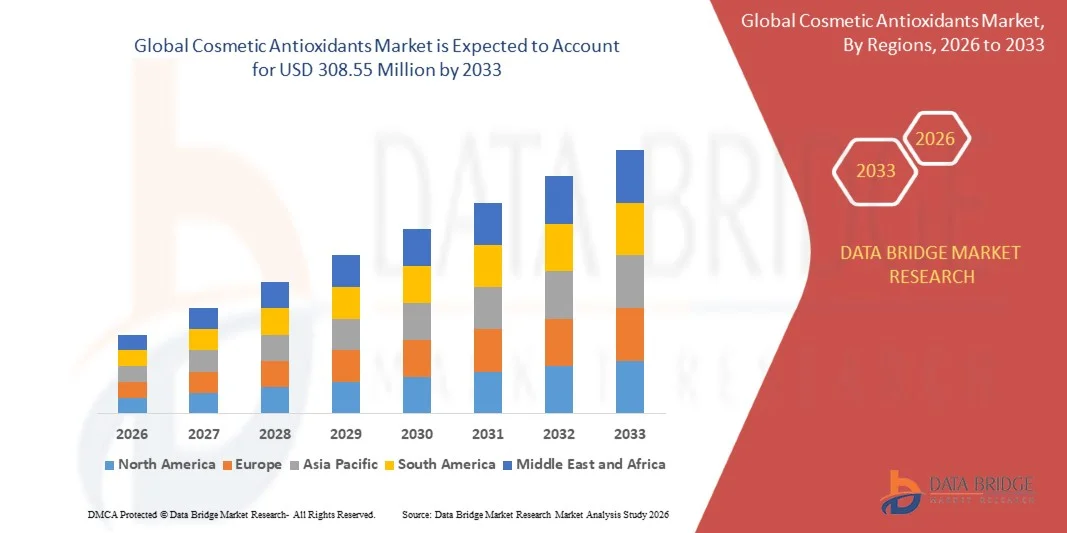
- The global cosmetic antioxidants market size was valued at USD 174.24 million in 2025 and is expected to reach USD 308.55 million by 2033, at a CAGR of 7.40% during the forecast period
- The growing personal care and cosmetic industry, particularly in Asia-Pacific, is driving up demand for cosmetic antioxidants. The rise of the middle and upper income classes, the emergence of new consumer targets such as seniors and men, the digital revolution, and e-commerce are some of the key drivers of the cosmetics market
What are the Major Takeaways of Cosmetic Antioxidants Market?
- Emerging economies' significant spending on cosmetics and personal care products boosts global demand. Increased income levels as a result of higher employment levels, minimum wages, and urbanisation are factors attributed to the growth. Furthermore, continued growths in organised retail, as well as the emergence of a young urban population coupled with rising disposable income in emerging economies, are expected to drive market growth
- Furthermore, rising aspirations, an increase in the number of working women, changing lifestyles, increased affordability of lifestyle-oriented and luxury products, increased product choice, and the availability of a specific product in e-commerce contributes to the market growth of cosmetic antioxidants market
- North America dominated the cosmetic antioxidants market with a 39.8% revenue share in 2025, driven by strong consumer awareness regarding skincare, anti-aging solutions, and premium personal care formulations across the U.S. and Canada
- Asia-Pacific is projected to register the fastest CAGR of 6.5% from 2026 to 2033, driven by rising disposable incomes, urbanization, strong beauty consciousness, and rapid expansion of skincare and cosmetics consumption across China, Japan, India, South Korea, and Southeast Asia
- The Natural Antioxidants segment dominated the market with a 58.6% share in 2025, driven by rising consumer preference for clean-label beauty products, plant-based ingredients, and sustainable personal care formulations
Report Scope and Cosmetic Antioxidants Market Segmentation
|
Attributes |
Cosmetic Antioxidants Key Market Insights |
|
Segments Covered |
|
|
Countries Covered |
North America
Europe
Asia-Pacific
Middle East and Africa
South America
|
|
Key Market Players |
|
|
Market Opportunities |
|
|
Value Added Data Infosets |
In addition to the insights on market scenarios such as market value, growth rate, segmentation, geographical coverage, and major players, the market reports curated by the Data Bridge Market Research also include in-depth expert analysis, pricing analysis, brand share analysis, consumer survey, demography analysis, supply chain analysis, value chain analysis, raw material/consumables overview, vendor selection criteria, PESTLE Analysis, Porter Analysis, and regulatory framework. |
What is the Key Trend in the Cosmetic Antioxidants Market?
“Increasing Shift Toward Natural, Multifunctional, and Clean-Label Cosmetic Antioxidants”
- The cosmetic antioxidants market is witnessing strong adoption of natural, plant-derived, and multifunctional antioxidant ingredients designed to improve product stability, extend shelf life, and enhance skin protection benefits in personal care formulations. Rising consumer preference for clean beauty and naturally sourced skincare ingredients is significantly accelerating market demand
- Manufacturers are introducing advanced antioxidant blends, vitamin-based actives, botanical extracts, and bio-fermented ingredients that offer improved oxidative stability, anti-aging properties, and compatibility with modern cosmetic formulations
- Growing demand for cost-efficient, lightweight, and high-performance skincare, haircare, and cosmetic formulations is driving usage across premium beauty brands, dermatological products, and mass-market cosmetics
- For instance, companies such as BASF SE, Croda International Plc, DSM, and Lonza Group are expanding their portfolios with vitamin E, vitamin C derivatives, and botanical antioxidant solutions
- Increasing need for anti-aging performance, UV protection support, and long-lasting product stability is accelerating the shift toward advanced cosmetic antioxidant solutions
- As beauty formulations become more sophisticated and ingredient-conscious, cosmetic antioxidants will remain vital for skin protection, product preservation, and premium formulation performance
What are the Key Drivers of Cosmetic Antioxidants Market?
- Rising demand for anti-aging, skin-brightening, and protective cosmetic products is one of the major growth drivers for the Cosmetic Antioxidants market. Antioxidants help protect skin from free radical damage, pollution stress, and premature aging
- For instance, in 2025, leading companies such as L'Oréal, The Estée Lauder Companies Inc., and Shiseido Co. Ltd. strengthened their skincare and premium cosmetic portfolios with antioxidant-enriched formulations
- Growing adoption of natural skincare, dermocosmetics, clean-label beauty, and premium anti-aging products is boosting demand across the U.S., Europe, and Asia-Pacific
- Advancements in microencapsulation, bioactive delivery systems, natural extract purification, and formulation stability technologies have strengthened performance, shelf life, and efficacy
- Rising use of vitamin E, tocopherols, polyphenols, carotenoids, and plant-based actives is creating demand for multifunctional antioxidant solutions
- Supported by steady investments in beauty innovation, premium skincare development, and clean beauty trends, the Cosmetic Antioxidants market is expected to witness strong long-term growth
Which Factor is Challenging the Growth of the Cosmetic Antioxidants Market?
- High costs associated with premium natural extracts, advanced actives, and bio-based antioxidant ingredients restrict adoption among price-sensitive product manufacturers
- For instance, during 2024–2025, fluctuations in botanical raw material prices, supply chain disruptions, and specialty ingredient costs increased manufacturing expenses for several global vendors
- Complexity in maintaining formulation stability, ingredient compatibility, and long-term efficacy increases product development challenges
- Limited awareness in emerging markets regarding premium antioxidant-based skincare benefits slows adoption
- Competition from synthetic preservatives, multifunctional active ingredients, and low-cost conventional formulations creates pricing pressure and reduces product differentiation
- To address these issues, companies are focusing on cost-optimized natural ingredients, advanced delivery technologies, and sustainable sourcing strategies to increase global adoption of cosmetic antioxidants
How is the Cosmetic Antioxidants Market Segmented?
The market is segmented on the basis of source, type, application, function, skin type, ingredients, price range, end use, and distribution channel.
• By Source
On the basis of source, the cosmetic antioxidants market is segmented into Natural Antioxidants and Chemically Derived Antioxidants. The Natural Antioxidants segment dominated the market with a 58.6% share in 2025, driven by rising consumer preference for clean-label beauty products, plant-based ingredients, and sustainable personal care formulations. Natural antioxidants such as vitamin E, green tea extracts, polyphenols, and botanical oils are extensively used in skincare and haircare products due to their anti-aging, soothing, and protective properties. Increasing demand for organic and premium beauty products further supports segment growth.
The Natural Antioxidants segment is also expected to grow at the fastest CAGR from 2026 to 2033, supported by the rapid expansion of clean beauty, vegan cosmetics, and herbal skincare solutions globally.
• By Type
On the basis of type, the market is segmented into Açai Oil, Alpha Lipoic Acid, Green and White Tea, Retinol, Vitamin C, Polyphenols, Zinc, and Others. The Vitamin C segment dominated the market with a 24.9% share in 2025, owing to its strong use in brightening serums, anti-aging creams, and skin repair formulations. Vitamin C remains highly preferred due to its antioxidant efficiency, collagen support, and protection against environmental stressors.
The Retinol segment is projected to grow at the fastest CAGR from 2026 to 2033, driven by increasing demand for anti-aging, wrinkle reduction, and skin renewal products.
• By Application
On the basis of application, the market is segmented into Skin Care, Hair Care, Makeup, and Other. The Skin Care segment dominated the market with a 46.8% share in 2025, supported by rising demand for anti-aging creams, sunscreens, serums, and moisturizers.
The Makeup segment is expected to grow at the fastest CAGR from 2026 to 2033, driven by rising demand for multifunctional beauty products with skin-protective benefits.
• By Function
On the basis of function, the market is segmented into Hair Conditioning, Anti-Aging, Hair Cleansing, Moisturizing, Ultraviolet Protection, and Anti-Inflammatory. The Anti-Aging segment dominated the market with a 31.4% share in 2025, driven by increasing demand for wrinkle-reduction and skin rejuvenation solutions.
The Ultraviolet Protection segment is expected to grow at the fastest CAGR, supported by increasing awareness of sun protection and pollution defense.
• By Skin Type
On the basis of skin type, the market is segmented into Oily, Dry, Normal, Sensitive, and Others. The Normal skin segment dominated with a 29.6% share in 2025, due to broad consumer usage across mass-market formulations.
The Sensitive skin segment is projected to grow at the fastest CAGR, driven by rising dermatological awareness and hypoallergenic product demand.
• By Ingredients
On the basis of ingredients, the market is segmented into Organic and Inorganic. The Organic segment dominated the market with a 55.2% share in 2025.
The Organic segment is also expected to grow at the fastest CAGR, supported by the clean beauty trend.
• By Price Range
On the basis of price range, the market is segmented into Low, Medium, and High/Premium. The Medium segment dominated the market with a 43.7% share in 2025.
The High/Premium segment is projected to grow at the fastest CAGR, driven by luxury skincare demand.
• By End Use
On the basis of end use, the market is segmented into Residential and Commercial. The Residential segment dominated the market with a 72.5% share in 2025.
The Commercial segment is expected to grow at the fastest CAGR, supported by salon and dermatology clinic expansion.
• By Distribution Channel
On the basis of distribution channel, the market is segmented into Online and Offline. The Offline segment dominated the market with a 61.3% share in 2025, supported by retail beauty stores and pharmacies.
The Online segment is projected to grow at the fastest CAGR from 2026 to 2033, driven by e-commerce expansion and D2C beauty brands.
Which Region Holds the Largest Share of the Cosmetic Antioxidants Market?
- North America dominated the cosmetic antioxidants market with a 39.8% revenue share in 2025, driven by strong consumer awareness regarding skincare, anti-aging solutions, and premium personal care formulations across the U.S. and Canada. High adoption of antioxidant-enriched creams, serums, moisturizers, and haircare products continues to fuel market demand across beauty retail stores, dermatology clinics, salons, and e-commerce platforms. The region benefits from the strong presence of global cosmetic brands, high disposable income, and continuous product innovation in clean-label and dermatologically tested beauty products
- Leading companies in North America are introducing vitamin-based, plant-derived, and multifunctional antioxidant formulations, strengthening the region’s technological and commercial advantage in the premium beauty and personal care space. Continuous investment in sustainable ingredients, anti-pollution skincare, and anti-aging formulations drives long-term market expansion
- High consumer spending, strong retail distribution, and rising demand for premium beauty solutions further reinforce regional market leadership
U.S. Cosmetic Antioxidants Market Insight
The U.S. is the largest contributor in North America, supported by strong demand for anti-aging skincare, clean beauty products, and dermatologist-recommended formulations. Increasing adoption of products containing vitamin C, retinol, polyphenols, and botanical extracts intensifies demand across skincare, makeup, and haircare applications. The presence of major cosmetic brands, advanced formulation laboratories, and a strong direct-to-consumer beauty ecosystem further drives market growth.
Canada Cosmetic Antioxidants Market Insight
Canada contributes significantly to regional growth, driven by rising awareness regarding skin health, sun protection, and anti-inflammatory cosmetic products. Consumers increasingly utilize cosmetic antioxidants in moisturizers, sunscreens, and premium skincare solutions. Government regulations regarding safe cosmetic ingredients and rising interest in clean-label beauty strengthen market adoption across the country.
Asia-Pacific Cosmetic Antioxidants Market
Asia-Pacific is projected to register the fastest CAGR of 6.5% from 2026 to 2033, driven by rising disposable incomes, urbanization, strong beauty consciousness, and rapid expansion of skincare and cosmetics consumption across China, Japan, India, South Korea, and Southeast Asia. High-volume demand for anti-aging creams, skin-brightening serums, and herbal skincare products significantly increases the need for cosmetic antioxidants. Growth in K-beauty, J-beauty, and Ayurvedic beauty solutions continues to accelerate regional demand.
China Cosmetic Antioxidants Market Insight
China is the largest contributor to Asia-Pacific due to massive growth in the skincare, cosmetics, and premium beauty industries. Rising demand for natural ingredients, anti-pollution skincare, and anti-aging formulations drives strong adoption of cosmetic antioxidants across domestic and international brands. Strong manufacturing capabilities and expanding digital beauty platforms further strengthen market penetration.
Japan Cosmetic Antioxidants Market Insight
Japan shows steady growth supported by its mature skincare market, strong preference for high-quality anti-aging formulations, and premium beauty standards. Increasing need for gentle, scientifically formulated products reinforces long-term market expansion.
India Cosmetic Antioxidants Market Insight
India is emerging as a major growth hub, driven by rapid expansion in herbal beauty, Ayurveda-based skincare, and online beauty retail platforms. Growing demand for antioxidant-rich creams, sunscreens, and serums is accelerating market penetration.
South Korea Cosmetic Antioxidants Market Insight
South Korea contributes significantly due to strong demand for K-beauty skincare innovations, anti-aging products, and multifunctional cosmetics. Technological innovation and strong export-driven beauty ecosystems support sustained market growth.
Which are the Top Companies in Cosmetic Antioxidants Market?
The cosmetic antioxidants industry is primarily led by well-established companies, including:
- Maybelline New York (U.S.)
- The Estée Lauder Companies Inc. (U.S.)
- MAC Cosmetics (U.S.)
- Revlon, Inc. (U.S.)
- Laura Mercier (U.S.)
- Unilever (U.K.)
- Clinique Laboratories, LLC (U.S.)
- Shiseido Co. Ltd. (Japan)
- L'Oréal (France)
- bareMinerals (U.S.)
- BASF SE (Germany)
- Kemin Industries, Inc. (U.S.)
- Barentz International BV (Netherlands)
- Eastman Chemical Company (U.S.)
- Lonza Group (Switzerland)
- DSM (Netherlands)
- Croda International Plc (U.K.)
What are the Recent Developments in Global Cosmetic Antioxidants Market?
- In August 2023, Natura & Co introduced its Chronos Intensive Antioxidant Serum, developed using Amazonian antioxidant extracts and advanced active ingredients to strengthen the skin’s natural defense mechanism and reduce the visible appearance of early aging signs such as fine lines and dullness. The launch highlights the growing industry focus on natural, bio-based antioxidant skincare solutions and premium anti-aging product innovation, further strengthening market demand
- In June 2023, Sofía Vergara launched Toty, a sun-care-focused beauty brand featuring SPF 50+ essentials, including skincare, sun protection, supplements, and makeup products aimed at preserving skin health and combating photoaging. This development underscores the increasing demand for antioxidant-enriched multifunctional skincare and UV-protection solutions, supporting market expansion
- In June 2023, DKSH entered into a distribution agreement with Bitop across Malaysia, Australia, New Zealand, and Singapore to expand the reach of advanced cosmetic ingredients in the Asia-Pacific market. This strategic collaboration strengthens regional supply chain capabilities and ingredient accessibility, contributing to faster market penetration
- In September 2022, Amour’s Secrets Skincare made its debut in the U.S. beauty industry, emphasizing natural, clean-label, non-toxic, and plant-based ingredients designed to refresh, rejuvenate, and enhance skin quality. This launch reflects the rising consumer shift toward clean beauty and antioxidant-rich skincare formulations, reinforcing long-term market growth
- In February 2022, Huda Beauty founders announced an investment in a new wellness brand through HB Investments, focusing on holistic beauty and wellness solutions. This initiative highlights the expanding convergence between beauty, wellness, and antioxidant-based personal care products, creating new growth opportunities in the market
SKU-
Получите онлайн-доступ к отчету на первой в мире облачной платформе рыночной аналитики

- Интерактивная панель анализа данных
- Панель анализа компании для возможностей с высоким потенциалом роста
- Доступ аналитика-исследователя для настройки и запросов
- Анализ конкурентов с помощью интерактивной панели
- Последние новости, обновления и анализ тенденций
- Используйте возможности сравнительного анализа для комплексного отслеживания конкурентов
Методология исследования
Сбор данных и анализ базового года выполняются с использованием модулей сбора данных с большими размерами выборки. Этап включает получение рыночной информации или связанных данных из различных источников и стратегий. Он включает изучение и планирование всех данных, полученных из прошлого заранее. Он также охватывает изучение несоответствий информации, наблюдаемых в различных источниках информации. Рыночные данные анализируются и оцениваются с использованием статистических и последовательных моделей рынка. Кроме того, анализ доли рынка и анализ ключевых тенденций являются основными факторами успеха в отчете о рынке. Чтобы узнать больше, пожалуйста, запросите звонок аналитика или оставьте свой запрос.
Ключевой методологией исследования, используемой исследовательской группой DBMR, является триангуляция данных, которая включает в себя интеллектуальный анализ данных, анализ влияния переменных данных на рынок и первичную (отраслевую экспертную) проверку. Модели данных включают сетку позиционирования поставщиков, анализ временной линии рынка, обзор рынка и руководство, сетку позиционирования компании, патентный анализ, анализ цен, анализ доли рынка компании, стандарты измерения, глобальный и региональный анализ и анализ доли поставщика. Чтобы узнать больше о методологии исследования, отправьте запрос, чтобы поговорить с нашими отраслевыми экспертами.
Доступна настройка
Data Bridge Market Research является лидером в области передовых формативных исследований. Мы гордимся тем, что предоставляем нашим существующим и новым клиентам данные и анализ, которые соответствуют и подходят их целям. Отчет можно настроить, включив в него анализ ценовых тенденций целевых брендов, понимание рынка для дополнительных стран (запросите список стран), данные о результатах клинических испытаний, обзор литературы, обновленный анализ рынка и продуктовой базы. Анализ рынка целевых конкурентов можно проанализировать от анализа на основе технологий до стратегий портфеля рынка. Мы можем добавить столько конкурентов, о которых вам нужны данные в нужном вам формате и стиле данных. Наша команда аналитиков также может предоставить вам данные в сырых файлах Excel, сводных таблицах (книга фактов) или помочь вам в создании презентаций из наборов данных, доступных в отчете.











