Global Crane-Heise Syndrome Market Segmentation, By Diagnosis (Ultrasonographic monitoring and Others), Distribution Channel (Hospital Pharmacy, Retail Pharmacy, online Pharmacies and Others) - Industry Trends and Forecast to 2033
Crane-Heise Syndrome Market Size
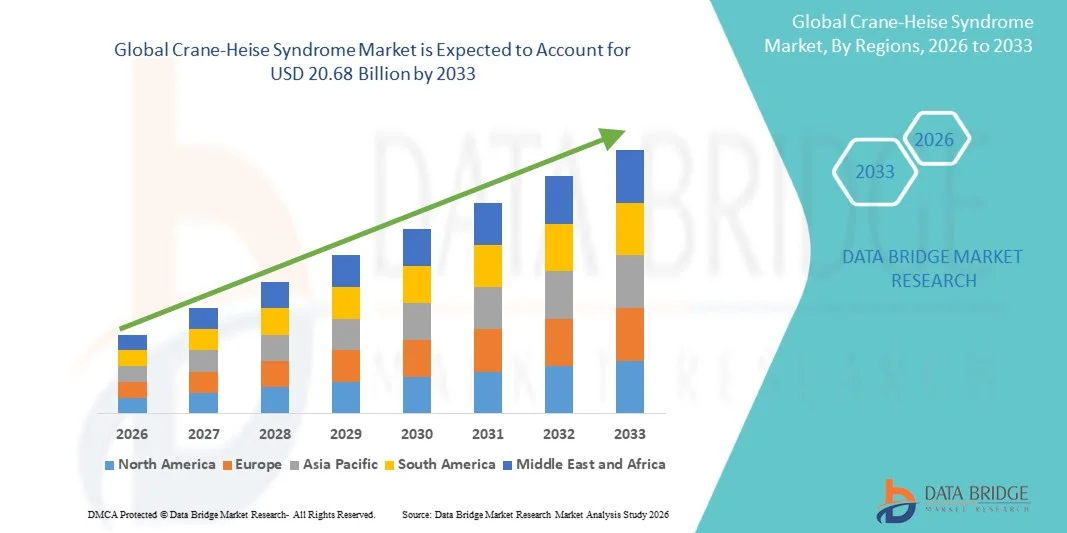
- The global crane-heise syndrome market size was valued at USD 12.50 billion in 2025 and is expected to reach USD 20.68 billion by 2033, at a CAGR of 6.50% during the forecast period
- The market growth is largely fueled by the increasing awareness and improved diagnosis of rare genetic skeletal disorders such as Crane-Heise syndrome, along with advancements in prenatal screening, genetic testing, and imaging technologies, leading to earlier and more accurate detection
- Furthermore, rising focus on supportive care management, multidisciplinary treatment approaches, and ongoing research into rare congenital syndromes is establishing better clinical pathways for patient care. These converging factors are accelerating the development and adoption of Crane-Heise syndrome management solutions, thereby significantly boosting the market growth
Crane-Heise Syndrome Market Analysis
- Crane-Heise syndrome, a rare and complex congenital disorder associated with craniofacial and skeletal abnormalities, is gaining increasing attention in the healthcare sector due to improved prenatal diagnostic techniques, genetic testing advancements, and growing awareness among clinicians
- The escalating demand for Crane-Heise syndrome management solutions is primarily fueled by rising focus on rare disease research, advancements in fetal imaging and genetic screening, and increasing need for multidisciplinary supportive care approaches to improve patient outcomes
- North America dominated the Crane-Heise Syndrome market with the largest revenue share of approximately 44.2% in 2025, characterized by advanced healthcare infrastructure, strong presence of specialized genetic research centers, and high adoption of prenatal diagnostic technologies, with the U.S. leading in rare disease management and clinical research
- Asia-Pacific is expected to be the fastest growing region in the Crane-Heise Syndrome market during the forecast period due to improving healthcare access, rising investments in genetic testing infrastructure, and increasing awareness of rare congenital disorders
- The ultrasonographic monitoring segment dominated the largest market revenue share of 61.3% in 2025, driven by its high accuracy, non-invasive nature, and ability to provide real-time visualization of fetal and skeletal abnormalities associated with Crane-Heise Syndrome
Report Scope and Crane-Heise Syndrome Market Segmentation
|
Attributes |
Crane-Heise Syndrome Key Market Insights |
|
Segments Covered |
|
|
Countries Covered |
North America
Europe
Asia-Pacific
Middle East and Africa
South America
|
|
Key Market Players |
|
|
Market Opportunities |
|
|
Value Added Data Infosets |
In addition to the insights on market scenarios such as market value, growth rate, segmentation, geographical coverage, and major players, the market reports curated by the Data Bridge Market Research also include in-depth expert analysis, patient epidemiology, pipeline analysis, pricing analysis, and regulatory framework. |
Crane-Heise Syndrome Market Trends
“Advancements in Rare Genetic Disorder Research and Clinical Understanding”
- A significant and accelerating trend in the global Crane-Heise Syndrome market is the increasing focus on rare genetic disorder research and improved clinical understanding of ultra-rare congenital conditions
- Due to the extreme rarity of Crane-Heise Syndrome, medical research is expanding to better define its genetic basis and associated developmental abnormalities
- For instance, advancements in genomic sequencing technologies are enabling researchers to study underlying genetic mutations linked to severe congenital skeletal and developmental syndromes, improving diagnostic accuracy and disease classification
- Growing collaboration between research institutions, pediatric specialists, and rare disease organizations is supporting better documentation of clinical cases and improving global knowledge sharing
- Furthermore, the use of patient registries and rare disease databases is helping track disease progression patterns and improve long-term clinical insights
- Increasing emphasis on multidisciplinary care approaches, including orthopedic management, respiratory support, and developmental therapies, is also improving patient care outcomes
- This trend toward enhanced research and clinical understanding is gradually shaping the global Crane-Heise Syndrome market landscape
Crane-Heise Syndrome Market Dynamics
Driver
“Rising Focus on Rare Diseases and Advancements in Diagnostic Capabilities”
- The increasing global focus on rare diseases, combined with improvements in diagnostic technologies, is a key driver for the Crane-Heise Syndrome market
- For instance, advancements in prenatal imaging techniques and genetic testing are enabling earlier detection of severe congenital anomalies associated with rare syndromes, supporting timely clinical intervention and counseling
- Growing awareness among healthcare professionals regarding rare genetic disorders is improving recognition and diagnosis rates of conditions like Crane-Heise Syndrome
- In addition, expansion of specialized pediatric and genetic care centers is enhancing access to expert diagnosis and management
- Supportive government initiatives and orphan disease research programs in regions such as North America and Europe are encouraging investment in rare disease studies
- Increasing demand for early and accurate diagnosis from families and caregivers is further contributing to market growth globally
Restraint/Challenge
“Extremely Limited Treatment Options and Diagnostic Challenges”
- The absence of specific curative treatments for Crane-Heise Syndrome remains a major challenge, as it is an ultra-rare and severe congenital disorder with limited therapeutic pathways
- A significant challenge is the difficulty in accurate and early diagnosis due to the rarity of the condition and overlapping symptoms with other congenital syndromes
- For instance, in many regions with limited access to advanced genetic testing, affected infants may be diagnosed only based on external clinical features without confirmation of the exact syndrome, leading to delayed or incomplete disease understanding
- The extremely small patient population limits large-scale clinical trials and reduces commercial incentives for drug development in this area
- In addition, management is largely supportive, focusing on symptom relief rather than curative treatment, which restricts long-term therapeutic progress
- High costs associated with specialized diagnostics, neonatal intensive care, and long-term supportive treatment can further limit access in low-resource settings
- Addressing these challenges through global research collaboration, improved diagnostic accessibility, and increased rare disease funding will be essential for advancing the Crane-Heise Syndrome market
Crane-Heise Syndrome Market Scope
The market is segmented on the basis of diagnosis and distribution channel.
• By Diagnosis
On the basis of diagnosis, the Crane-Heise Syndrome market is segmented into ultrasonographic monitoring and others. The ultrasonographic monitoring segment dominated the largest market revenue share of 61.3% in 2025, driven by its high accuracy, non-invasive nature, and ability to provide real-time visualization of fetal and skeletal abnormalities associated with Crane-Heise Syndrome. This diagnostic method is widely preferred in prenatal screening due to its safety and effectiveness in early detection. Increasing adoption of advanced imaging technologies in maternal healthcare further strengthens segment growth. Healthcare professionals rely on ultrasonography for continuous monitoring of fetal development and early identification of structural abnormalities. Rising awareness of genetic and congenital disorders is also contributing to higher screening rates. In addition, improved healthcare infrastructure and accessibility to diagnostic facilities are supporting segment dominance. Government initiatives promoting prenatal screening programs further enhance adoption. Continuous technological advancements in high-resolution imaging systems are improving diagnostic accuracy. The growing emphasis on early intervention and disease management is expected to sustain long-term demand.
The others segment is expected to witness the fastest CAGR of 9.4% from 2026 to 2033, driven by advancements in genetic testing, MRI-based imaging, and emerging diagnostic techniques. Increasing focus on comprehensive diagnostic approaches combining imaging and molecular testing is supporting segment growth. Technological innovations in fetal medicine are enabling more precise detection of rare syndromes. Rising investment in research and development for rare genetic disorders is further accelerating adoption. In addition, improved accessibility to advanced diagnostic tools in developed healthcare systems is contributing to growth. Growing awareness among clinicians regarding multi-modal diagnosis is also enhancing demand. As diagnostic precision becomes increasingly important, alternative methods beyond ultrasonography are gaining traction globally.
• By Distribution Channel
On the basis of distribution channel, the Crane-Heise Syndrome market is segmented into hospital pharmacy, retail pharmacy, online pharmacies, and others. The hospital pharmacy segment held the largest market revenue share of 55.6% in 2025, driven by the critical need for specialized care and prescription-based management of rare congenital conditions. Hospitals serve as the primary centers for diagnosis, treatment, and ongoing management of complex disorders like Crane-Heise Syndrome. The availability of multidisciplinary teams ensures coordinated care and effective treatment planning. Hospital pharmacies provide immediate access to essential medications and supportive therapies required during patient management. Increasing hospital admissions for congenital disorder diagnosis further supports segment growth. Government healthcare programs and institutional procurement systems also contribute to dominance. The integration of advanced diagnostic and therapeutic services within hospitals strengthens their role in treatment delivery. In addition, strong physician supervision ensures adherence to treatment protocols. Rising awareness and early diagnosis rates are further boosting hospital-based care demand.
The online pharmacies segment is expected to witness the fastest CAGR of 11.8% from 2026 to 2033, driven by rapid digitalization of healthcare services and increasing preference for convenient medication access. Online platforms offer home delivery, wider product availability, and cost-effective pricing, making them increasingly popular among patients and caregivers. The expansion of telemedicine services and electronic prescriptions is further accelerating growth. Rising internet penetration and smartphone usage globally are supporting the shift toward digital healthcare channels. Patients managing rare diseases benefit from easier access to specialized medications not always available in local pharmacies. Increasing trust in secure online payment systems and regulated e-pharmacy platforms is also contributing to adoption. In addition, healthcare reforms supporting digital distribution channels are strengthening market expansion. As convenience and accessibility continue to improve, online pharmacies are expected to grow significantly.
Crane-Heise Syndrome Market Regional Analysis
- North America dominated the crane-heise syndrome market with the largest revenue share of approximately 44.2% in 2025, characterized by advanced healthcare infrastructure, a strong presence of specialized genetic research centers, and high adoption of prenatal diagnostic technologies
- The region benefits from advanced clinical capabilities, early implementation of genetic screening programs, and strong collaboration between research institutions and healthcare providers
- The increasing focus on rare congenital disorder management and improved diagnostic accuracy further support market growth across North America. In addition, the U.S. continues to lead the region in rare disease research, prenatal diagnostics, and clinical management initiatives.
U.S. Crane-Heise Syndrome Market Insight
The U.S. crane-heise syndrome market captured the largest revenue share within North America in 2025, driven by its leadership in rare disease research and advanced prenatal diagnostic capabilities. The country has a strong network of specialized genetic centers and academic research institutions focused on identifying and managing rare congenital conditions. Increasing funding for genomic research, along with the availability of advanced imaging and molecular diagnostic tools, is improving early detection and clinical outcomes.
Europe Crane-Heise Syndrome Market Insight
The Europe crane-heise syndrome market is projected to expand at a substantial CAGR during the forecast period, supported by strong regulatory frameworks and growing emphasis on rare disease diagnosis and management. Government-backed healthcare initiatives and cross-border research collaborations are enhancing access to advanced genetic testing. In addition, increasing awareness among healthcare professionals is improving early identification of rare congenital syndromes.
U.K. Crane-Heise Syndrome Market Insight
The U.K. crane-heise syndrome market is anticipated to grow at a noteworthy CAGR, driven by strong public healthcare infrastructure and expanding rare disease screening programs. National healthcare initiatives and research funding are supporting advancements in genetic diagnostics. Moreover, collaboration between academic institutions and clinical centers is contributing to improved understanding and management of rare congenital disorders.
Germany Crane-Heise Syndrome Market Insight
The Germany crane-heise syndrome market is expected to expand at a considerable CAGR, fueled by the country’s strong emphasis on medical innovation and advanced diagnostic technologies. Germany’s well-developed healthcare infrastructure and focus on genetic research are enabling improved detection and management of rare syndromes. Increasing adoption of prenatal screening and molecular diagnostics is further supporting market expansion.
Asia-Pacific Crane-Heise Syndrome Market Insight
The Asia-Pacific crane-heise syndrome market is poised to grow at the fastest CAGR during the forecast period, driven by improving healthcare access, rising investments in genetic testing infrastructure, and increasing awareness of rare congenital disorders. Expanding healthcare systems and growing availability of diagnostic facilities are enabling earlier detection and better patient outcomes. Government initiatives aimed at strengthening maternal and fetal healthcare are further accelerating regional market growth.
Japan Crane-Heise Syndrome Market Insight
The Japan crane-heise syndrome market is gaining momentum due to the country’s advanced healthcare system and strong focus on precision medicine. Increasing use of prenatal screening technologies and genetic testing is improving early diagnosis of rare congenital conditions. In addition, Japan’s emphasis on high-quality healthcare and research-driven clinical practices is supporting market development.
China Crane-Heise Syndrome Market Insight
The China crane-heise syndrome market accounted for the largest revenue share in Asia-Pacific in 2025, attributed to rapid improvements in healthcare infrastructure and increasing investment in genetic research and diagnostic technologies. Growing awareness of rare congenital disorders and expanding access to prenatal screening are improving detection rates. Furthermore, government support and the development of domestic genetic testing capabilities are key factors driving market growth in China.
Crane-Heise Syndrome Market Share
The Crane-Heise Syndrome industry is primarily led by well-established companies, including:
- Pfizer Inc. (U.S.)
- Novartis AG (Switzerland)
- F. Hoffmann-La Roche Ltd. (Switzerland)
- Sanofi S.A. (France)
- GlaxoSmithKline plc (U.K.)
- AstraZeneca plc (U.K.)
- Bayer AG (Germany)
- Merck & Co., Inc. (U.S.)
- Eli Lilly and Company (U.S.)
- Takeda Pharmaceutical Company Limited (Japan)
- Abbott (U.S.)
- Thermo Fisher Scientific Inc. (U.S.)
- Siemens Healthineers AG (Germany)
- GE HealthCare (U.S.)
- Danaher Corporation (U.S.)
- Bio-Rad Laboratories, Inc. (U.S.)
- PerkinElmer, Inc. (U.S.)
- Charles River Laboratories International, Inc. (U.S.)
- Laboratory Corporation of America Holdings (U.S.)
- Invitae Corporation (U.S.)
Latest Developments in Global Crane-Heise Syndrome Market
- In July 2021, a clinical case report published in JBJS Case Connector documented the successful management of severe scoliosis in the oldest reported patient with Crane–Heise syndrome using posterior spinal fusion surgery. The study highlighted that despite extreme skeletal abnormalities, advanced orthopedic surgical techniques can improve functional outcomes and survival in selected cases, marking an important advancement in supportive treatment strategies
- In March 2023, a European Journal of Medical Genetics report detailed additional Crane–Heise syndrome case studies confirming that the condition remains genetically unresolved, with no identified molecular target. The study emphasized that treatment remains entirely supportive, focusing on orthopedic correction, respiratory management, and neonatal intensive care interventions, reinforcing the need for early prenatal diagnosis and multidisciplinary care
- In June 2023, clinical literature updates described expanded phenotypic understanding of Crane–Heise syndrome, including additional skeletal and craniofacial abnormalities identified in new fetal and neonatal cases. These findings improved diagnostic accuracy, enabling earlier intervention planning through ultrasound-based prenatal screening, though no disease-modifying therapy exists
- In April 2024, advancements in prenatal imaging techniques, particularly high-resolution fetal ultrasonography and 3D fetal MRI, were increasingly applied in suspected lethal skeletal dysplasias including Crane–Heise syndrome. These improvements enhanced early detection of skull mineralization defects and skeletal malformations, supporting better pregnancy management and counseling strategies
- In September 2024, genetic research updates continued to confirm that Crane–Heise syndrome has no established causative gene, despite advances in skeletal dysplasia genomics. This reinforced the classification of the disease as an unresolved autosomal recessive lethal disorder and shifted research focus toward broader skeletal development pathways
- In February 2025, rare disease management literature highlighted increased use of multidisciplinary neonatal supportive care protocols, including ventilatory support, orthopedic stabilization, and palliative care frameworks for lethal skeletal dysplasias such as Crane–Heise syndrome. These approaches aim to improve survival duration and quality of life in rare surviving cases
- In August 2025, ongoing rare disease registry initiatives and congenital anomaly surveillance programs improved case documentation of ultra-rare skeletal dysplasias, including Crane–Heise syndrome. These efforts are enhancing global epidemiological understanding and supporting future research into potential genetic pathways
- In October 2025, updated clinical reviews reiterated that Crane–Heise syndrome remains a genetically undefined lethal condition, with treatment limited to prenatal diagnosis, pregnancy management, and postnatal supportive care. Research continues to focus on distinguishing it from phenotypically similar disorders such as cleidocranial dysplasia and aminopterin embryopathy
SKU-
Получите онлайн-доступ к отчету на первой в мире облачной платформе рыночной аналитики
- Интерактивная панель анализа данных
- Панель анализа компании для возможностей с высоким потенциалом роста
- Доступ аналитика-исследователя для настройки и запросов
- Анализ конкурентов с помощью интерактивной панели
- Последние новости, обновления и анализ тенденций
- Используйте возможности сравнительного анализа для комплексного отслеживания конкурентов
Методология исследования
Сбор данных и анализ базового года выполняются с использованием модулей сбора данных с большими размерами выборки. Этап включает получение рыночной информации или связанных данных из различных источников и стратегий. Он включает изучение и планирование всех данных, полученных из прошлого заранее. Он также охватывает изучение несоответствий информации, наблюдаемых в различных источниках информации. Рыночные данные анализируются и оцениваются с использованием статистических и последовательных моделей рынка. Кроме того, анализ доли рынка и анализ ключевых тенденций являются основными факторами успеха в отчете о рынке. Чтобы узнать больше, пожалуйста, запросите звонок аналитика или оставьте свой запрос.
Ключевой методологией исследования, используемой исследовательской группой DBMR, является триангуляция данных, которая включает в себя интеллектуальный анализ данных, анализ влияния переменных данных на рынок и первичную (отраслевую экспертную) проверку. Модели данных включают сетку позиционирования поставщиков, анализ временной линии рынка, обзор рынка и руководство, сетку позиционирования компании, патентный анализ, анализ цен, анализ доли рынка компании, стандарты измерения, глобальный и региональный анализ и анализ доли поставщика. Чтобы узнать больше о методологии исследования, отправьте запрос, чтобы поговорить с нашими отраслевыми экспертами.
Доступна настройка
Data Bridge Market Research является лидером в области передовых формативных исследований. Мы гордимся тем, что предоставляем нашим существующим и новым клиентам данные и анализ, которые соответствуют и подходят их целям. Отчет можно настроить, включив в него анализ ценовых тенденций целевых брендов, понимание рынка для дополнительных стран (запросите список стран), данные о результатах клинических испытаний, обзор литературы, обновленный анализ рынка и продуктовой базы. Анализ рынка целевых конкурентов можно проанализировать от анализа на основе технологий до стратегий портфеля рынка. Мы можем добавить столько конкурентов, о которых вам нужны данные в нужном вам формате и стиле данных. Наша команда аналитиков также может предоставить вам данные в сырых файлах Excel, сводных таблицах (книга фактов) или помочь вам в создании презентаций из наборов данных, доступных в отчете.