


Global Creatinine Assay Kits Market
Размер рынка в млрд долларов США
CAGR :
% 
 USD
354.65 Billion
USD
582.54 Billion
2025
2033
USD
354.65 Billion
USD
582.54 Billion
2025
2033
 Прогнозируемый период Прогнозируемый период |
2026 –2033 |
 Размер рынка (базовый год) Размер рынка (базовый год) |
USD 354.65 Billion |
 Размер рынка (прогнозируемый год) Размер рынка (прогнозируемый год) |
USD 582.54 Billion |
 CAGR CAGR |
% |
| Основные игроки рынка |
|
Global Creatinine Assay Kits Market, By Type (Jaff e’s Kinetic Test Kits, Creatinine-Pap Test Kit, ELISA Test Kits), Sample (Blood/Serum, Urine, and Other Samples), Number of Creatinine Test Performed (Test Performed By Region and Test Performed By Type), End User (Hospitals, Clinics, Oncology Centers, Community Healthcare, and Others)- Industry Trends and Forecast to 2033
Creatinine Assay Kits Market Size
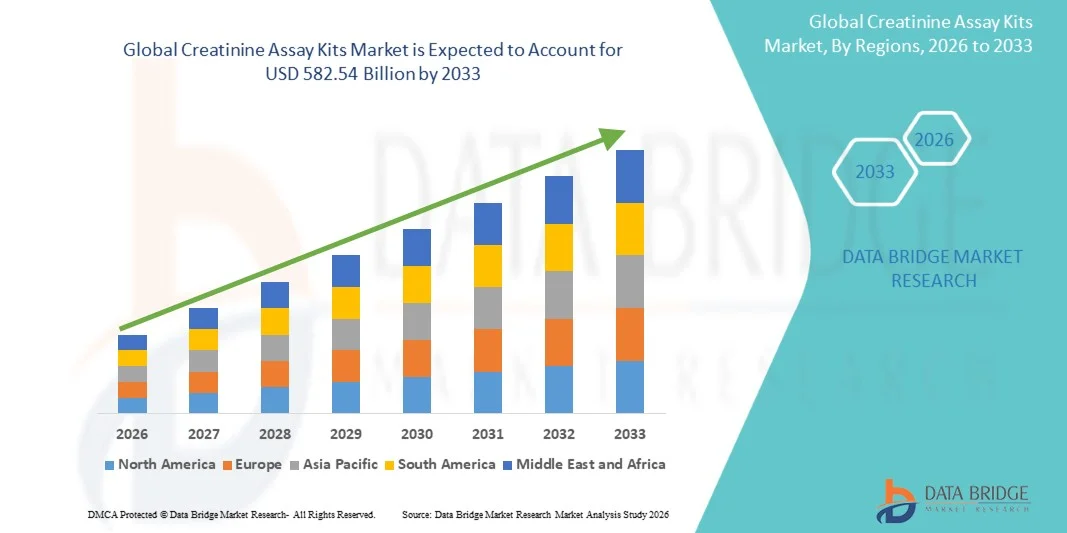
- The global creatinine assay kits market size was valued at USD 354.65 billion in 2025 and is expected to reach USD 582.54 billion by 2033, at a CAGR of 6.40% during the forecast period
- The market growth is largely fueled by the increasing prevalence of kidney-related disorders, rising demand for early detection and monitoring of renal function, and growing adoption of point-of-care diagnostic solutions in both hospitals and home healthcare settings
- Furthermore, the demand for user-friendly, rapid, and accurate creatinine testing solutions is supporting the adoption of Creatinine Assay Kits, with healthcare providers and patients seeking convenient methods to monitor renal health, thereby significantly boosting the industry’s growth
Creatinine Assay Kits Market Analysis
- Creatinine assay kits, offering rapid and accurate measurement of renal function, are increasingly vital components of clinical diagnostics in hospitals, laboratories, and home healthcare settings due to their enhanced convenience, reliability, and ease of use
- The escalating demand for creatinine assay kits is primarily fueled by rising incidences of kidney-related disorders, growing patient awareness of renal health, and a preference for quick and point-of-care testing solutions
- North America dominated the creatinine assay kits market with the largest revenue share of 45.5% in 2025, characterized by advanced healthcare infrastructure, high patient awareness, and a strong presence of key pharmaceutical and diagnostic companies, with the U.S. experiencing substantial growth in adoption of innovative assay kits and automated renal function monitoring systems
- Asia-Pacific is expected to be the fastest-growing region in the creatinine assay kits market during the forecast period, with a projected CAGR of 11.8%, driven by increasing healthcare expenditure, rising prevalence of chronic kidney diseases, and expanding access to both hospital-based and at-home testing solutions in countries such as China, India, and Japan
- The Blood/Serum segment held the largest market revenue share of 52.3% in 2025, driven by the clinical preference for serum creatinine as a standard marker for renal function assessment
Report Scope and Creatinine Assay Kits Market Segmentation
|
Attributes |
Creatinine Assay Kits Key Market Insights |
|
Segments Covered |
|
|
Countries Covered |
North America
Europe
Asia-Pacific
Middle East and Africa
South America
|
|
Key Market Players |
• Roche Diagnostics (Switzerland) |
|
Market Opportunities |
|
|
Value Added Data Infosets |
In addition to the insights on market scenarios such as market value, growth rate, segmentation, geographical coverage, and major players, the market reports curated by the Data Bridge Market Research also include in-depth expert analysis, patient epidemiology, pipeline analysis, pricing analysis, and regulatory framework. |
Creatinine Assay Kits Market Trends
“Increasing Adoption of Rapid and Point-of-Care Testing”
- A significant and accelerating trend in the global Creatinine Assay Kits market is the growing adoption of rapid, point-of-care (POC) diagnostic kits that provide quick and accurate creatinine measurements. These kits are increasingly being used in hospitals, clinics, and home healthcare settings due to their ability to deliver results within minutes, facilitating timely decision-making for patient care
- For instance, Abbott’s i-STAT system allows clinicians to measure creatinine levels at the patient’s bedside with minimal sample volume, while Roche’s Cobas Creatinine Plus assay offers rapid laboratory-based testing for high-throughput clinical environments. Such examples illustrate how both POC and laboratory-focused assays are being integrated to improve diagnostic efficiency
- Trends also indicate a shift toward non-invasive sampling techniques and miniaturized testing devices, which are more convenient for patients and reduce the need for extensive laboratory infrastructure
- Automation in creatinine measurement, combined with digital data reporting, is enabling faster patient monitoring and better management of kidney-related conditions
- There is also increasing incorporation of multiplex testing platforms that allow simultaneous assessment of creatinine alongside other renal biomarkers, improving diagnostic accuracy and workflow efficiency
Creatinine Assay Kits Market Dynamics
Driver
“Rising Prevalence of Kidney Diseases and Healthcare Awareness”
- The increasing prevalence of chronic kidney disease (CKD) and other renal disorders worldwide is a key driver for the growing demand for creatinine assay kits. Early detection and continuous monitoring of creatinine levels are critical for preventing disease progression and associated complications
- For instance, the Centers for Disease Control and Prevention (CDC) reports that approximately 15% of adults in the United States suffer from CKD, prompting hospitals and diagnostic centers to adopt efficient creatinine monitoring systems. Similarly, initiatives by organizations such as the National Kidney Foundation (NKF) encourage routine screening in high-risk populations, thereby driving market growth
- Increasing patient awareness about kidney health and rising routine check-ups in outpatient departments are contributing to higher test adoption
- The expansion of diagnostic infrastructure in emerging economies, along with better insurance coverage for laboratory testing, is further fueling demand
- Growing prevalence of comorbidities such as diabetes and hypertension, which impact kidney function, is also propelling the need for continuous monitoring through creatinine assays
Restraint/Challenge
“High Costs and Infrastructure Limitations in Developing Regions”
- Despite growing demand, the relatively high cost of advanced creatinine assay kits, especially automated POC systems, can limit adoption in cost-sensitive regions. This remains a major challenge for market expansion, particularly in developing countries
- For instance, automated systems such as Roche Cobas Integra or Siemens ADVIA Centaur Creatinine Assay require significant upfront investment and specialized maintenance, making them less accessible to smaller clinics or rural healthcare facilities
- Limited laboratory infrastructure, lack of trained personnel, and inconsistent supply chains in some regions further restrict the deployment of these advanced kits
- In addition, variations in regulatory approvals and quality standards across countries can delay market entry for new assay technologies
- Addressing these challenges through affordable kit options, simplified testing platforms, and targeted training programs will be vital for sustained market growth in the global creatinine assay kits sector
Creatinine Assay Kits Market Scope
The market is segmented on the basis of type, sample, number of tests performed, and end-user.
• By Type
On the basis of type, the Creatinine Assay Kits market is segmented into Jaffe’s Kinetic Test Kits, Creatinine-Pap Test Kits, and ELISA Test Kits. The Jaffe’s Kinetic Test Kits segment dominated the largest market revenue share of 45.6% in 2025, supported by its long-standing use in clinical laboratories for routine creatinine estimation. These kits are widely preferred due to their accuracy, reliability, and relatively low cost, making them accessible for hospitals and diagnostic centers. They offer fast turnaround times for creatinine measurement, enabling prompt patient management. Their compatibility with automated analyzers further enhances adoption in large-scale laboratories. Jaffe’s Kinetic kits are robust against variations in sample type and storage, increasing their utility in multi-center studies. Established protocols and regulatory approvals enhance confidence among clinicians. They also support high-throughput testing, important for hospitals with heavy patient load. Training requirements are minimal due to familiarity with methodology. The segment growth is further driven by increasing prevalence of kidney disorders and the need for routine monitoring of renal function. Consistent performance and widespread availability ensure the continued dominance of Jaffe’s Kinetic Test Kits.
The ELISA Test Kits segment is anticipated to witness the fastest CAGR of 13.2% from 2026 to 2033, fueled by rising demand for highly sensitive and specific assays for research and specialized diagnostics. ELISA kits are favored for their ability to detect low levels of creatinine in complex biological samples, including blood, urine, and tissue extracts. They are widely used in advanced clinical research, biomarker discovery, and preclinical studies. ELISA-based assays facilitate multiplexing, enabling simultaneous analysis of multiple parameters. Their automation compatibility reduces human error and increases reproducibility. The adoption is further supported by increasing investment in precision medicine and personalized diagnostics. Research institutes prefer ELISA kits for evaluating renal function in experimental models. Growing awareness about early detection of chronic kidney disease (CKD) boosts market adoption. ELISA kits are also increasingly used in clinical trials to monitor nephrotoxicity of new drugs. Online and retail distribution channels improve accessibility. Technological advancements in kit sensitivity and reduced assay times further accelerate growth. The rising focus on high-throughput and standardized testing ensures sustained CAGR for this segment.
• By Sample
On the basis of sample, the market is segmented into Blood/Serum, Urine, and Other Samples. The Blood/Serum segment held the largest market revenue share of 52.3% in 2025, driven by the clinical preference for serum creatinine as a standard marker for renal function assessment. Blood/serum samples provide accurate measurement of glomerular filtration rate (GFR) and are routinely collected during hospital visits and diagnostic checkups. They are compatible with both automated analyzers and manual assays, enhancing flexibility for laboratories. High reproducibility and standardization make them ideal for longitudinal monitoring of chronic kidney disease (CKD) patients. Blood/serum testing is integral to early diagnosis of acute kidney injury (AKI) and monitoring drug-induced nephrotoxicity. Hospitals and large diagnostic centers prefer this sample type due to ease of handling and minimal interference from other metabolites. Regulatory standards and clinical guidelines further reinforce usage. Patient and clinician familiarity encourages adoption. Sample stability under controlled conditions ensures reliable results. Increased hospital infrastructure and routine checkup programs support growth.
The Urine segment is expected to witness the fastest CAGR of 12.7% from 2026 to 2033, owing to the non-invasive nature of urine collection and the growing preference for point-of-care testing. Urine creatinine assays are widely used for kidney function assessment, especially in outpatient settings. They support early detection of renal abnormalities and help in estimating creatinine clearance. Adoption is further driven by increased use in home-based monitoring and chronic disease management. Urine samples are suitable for longitudinal studies and repeated measurements without invasive procedures. Homecare and remote monitoring solutions enhance demand. Laboratory automation for urine creatinine measurement reduces processing times. Urine-based assays are gaining traction in research and epidemiological studies. Rising awareness about kidney health and preventive care encourages adoption. Cost-effectiveness compared to blood-based testing supports rapid growth. Telemedicine platforms and home diagnostics further accelerate market uptake.
• By Number of Creatinine Tests Performed
On the basis of number of tests, the market is segmented into Test Performed By Region and Test Performed By Type. The Regional Tests segment dominated with 50.1% market share in 2025, supported by extensive hospital networks and large-scale health screening programs in North America and Europe. Centralized laboratories and government-led CKD screening initiatives contribute to high test volumes. Standardization of assay protocols across regions improves reliability and comparability. The availability of trained personnel and laboratory infrastructure enhances adoption. Regional healthcare policies mandate routine renal function tests in at-risk populations. The presence of multinational diagnostic companies ensures consistent supply of reagents. Increasing incidence of diabetes and hypertension drives test demand. Technological improvements in automated analyzers accelerate processing efficiency. Regulatory approvals and adherence to clinical guidelines reinforce usage. Adoption is further strengthened by increasing hospital networks and diagnostic chains. The segment also benefits from public awareness campaigns regarding kidney health.
The Test Performed By Type segment is expected to witness the fastest CAGR of 11.9% from 2026 to 2033, driven by rising utilization of ELISA and Jaffe’s Kinetic test types for specialized clinical and research applications. Growth is fueled by personalized medicine initiatives requiring precise quantification. Increasing prevalence of kidney disorders and chronic diseases supports expansion. Laboratories are adopting advanced assay types for higher accuracy and sensitivity. Research institutions prioritize standardized testing protocols for multi-center studies. Advanced testing methodologies facilitate early detection of nephrotoxicity in drug development. Digital platforms enable tracking and reporting of test types efficiently. Emerging markets show growing adoption due to affordable assay kits. High-throughput testing demand in large-scale studies supports growth. Technological innovations reduce processing time and error rates. Growing collaborations between hospitals and diagnostic companies accelerate adoption. Standardization and quality control improve reliability across diverse patient populations.
• By End-User
On the basis of end-user, the market is segmented into Hospitals, Clinics, Oncology Centers, Community Healthcare, and Others. The Hospitals segment dominated with 58.9% market share in 2025, driven by access to a wide range of assay kits, trained laboratory staff, and integrated patient management systems. Hospitals facilitate both routine and specialized testing, including high-throughput Jaffe’s Kinetic and ELISA assays. Insurance coverage and reimbursement policies enhance affordability. Hospital laboratories provide rapid turnaround times and maintain quality standards. They benefit from higher patient footfall and established monitoring programs for kidney disease. Hospitals are also preferred for research and clinical trials. Centralized infrastructure supports sample processing and storage. Hospitals often participate in preventive care campaigns and screening programs. The segment growth is sustained by rising incidence of CKD, diabetes, and hypertension. Advanced laboratory automation further improves efficiency and accuracy. Strategic collaborations with assay manufacturers strengthen kit availability.
The Clinics segment is expected to witness the fastest CAGR of 12.5% from 2026 to 2033, driven by the increasing demand for outpatient testing and localized renal health monitoring. Clinics provide convenient and quick access to routine creatinine assays, supporting early detection and preventive care. Adoption is supported by point-of-care testing devices and compact analyzers. Clinics cater to chronic patients seeking regular monitoring without hospital visits. Telehealth integration and home sample collection services further enhance clinic adoption. Growing awareness of kidney health and lifestyle-related kidney risks drives demand. Clinics offer flexibility for repeat testing and continuous patient monitoring. Increasing prevalence of CKD in urban populations fuels growth. Investment in clinic infrastructure and diagnostic tools supports market expansion. Partnerships with diagnostic companies improve supply of assay kits. Clinics also serve as hubs for preventive screenings and community health programs. Technological improvements in assay sensitivity and portability enhance clinic-based adoption.
Creatinine Assay Kits Market Regional Analysis
- North America dominated the creatinine assay kits market with the largest revenue share of 45.5% in 2025. This dominance is attributed to the region’s advanced healthcare infrastructure, high patient awareness regarding kidney health, and the strong presence of leading pharmaceutical and diagnostic companies
- The market, in particular, has witnessed remarkable growth due to widespread adoption of innovative assay kits and automated renal function monitoring systems in hospitals, clinics, and home-care environments
- Growing patient preference for rapid, reliable, and at-home testing solutions, coupled with technological advancements in assay kits, continues to drive market expansion
U.S. Creatinine Assay Kits Market Insight
The U.S. creatinine assay kits market captured the largest share within North America, propelled by the rapid uptake of automated diagnostic systems and home-based renal monitoring solutions. Increasing patient awareness about early detection of kidney disorders, strong healthcare R&D initiatives, and robust reimbursement policies are significant factors encouraging adoption. In addition, healthcare providers are investing in automated platforms that deliver precise, timely, and scalable creatinine measurements, further strengthening the market.
Europe Creatinine Assay Kits Market Insight
Europe creatinine assay kits market is anticipated to grow steadily throughout the forecast period, supported by rising awareness of renal health, established healthcare infrastructure, and the growing emphasis on early diagnostic interventions. Countries such as Germany and the U.K. are spearheading market growth due to the adoption of automated assay kits, laboratory modernization, and strong hospital and clinic networks.
U.K. Creatinine Assay Kits Market Insight
The U.K., the creatinine assay kits market is expanding steadily as patients and healthcare providers increasingly prioritize early kidney disease detection. Government initiatives supporting home-based and hospital-based renal diagnostics, along with a well-established healthcare and retail distribution network for assay kits, are driving adoption. The demand for convenient, accurate, and reliable at-home testing solutions is becoming more prominent among both consumers and healthcare providers.
Germany Creatinine Assay Kits Market Insight
Germany creatinine assay kits market is expected to witness robust market growth, driven by high patient awareness, advanced laboratory infrastructure, and an emphasis on technologically advanced and automated creatinine testing platforms. Hospitals and specialized diagnostic centers are increasingly incorporating automated assay kits into routine testing workflows, reflecting a shift towards precise, efficient, and scalable renal health monitoring solutions.
Asia Pacific Creatinine Assay Kits Market Insight
Asia-Pacific creatinine assay kits market is projected to be the fastest-growing region in the Creatinine Assay Kits market, with a CAGR of 11.8% during the forecast period. Growth in this region is fueled by rising healthcare expenditure, increasing prevalence of chronic kidney diseases, and the expanding availability of both hospital-based and at-home testing solutions. Rapid urbanization, growing middle-class populations, and improved healthcare accessibility in countries such as China, India, and Japan are further supporting market adoption.
Japan Creatinine Assay Kits Market Insight
Japan’s creatinine assay kits market growth is supported by the aging population, high healthcare awareness, and demand for convenient, precise, and automated kidney function testing. Integration of digital and automated assay kits in both clinical and home-care settings is increasingly common, ensuring patient-centric care and timely disease monitoring.
China Creatinine Assay Kits Market Insight
China creatinine assay kits market accounted for the largest revenue share in the Asia-Pacific region in 2025. The market is driven by rapid urbanization, rising healthcare expenditure, increasing middle-class awareness of kidney health, and strong government initiatives promoting diagnostic solutions. Both hospital-based and at-home creatinine testing are becoming widespread. In addition, the growing presence of domestic manufacturers offering cost-effective solutions is making assay kits more accessible to a broader population, further fueling growth.
Creatinine Assay Kits Market Share
The Creatinine Assay Kits industry is primarily led by well-established companies, including:
• Roche Diagnostics (Switzerland)
• Thermo Fisher Scientific (U.S.)
• Siemens Healthineers (Germany)
• Beckman Coulter (U.S.)
• Bio-Rad Laboratories (U.S.)
• Abbott Laboratories (U.S.)
• Agilent Technologies (U.S.)
• HyTest Ltd (Finland)
• Cusabio (China)
• Abcam (U.K.)
• DiaSys Diagnostic Systems (Germany)
• Randox Laboratories (U.K.)
• Merck KGaA (Germany)
• Quidel Corporation (U.S.)
• Enzo Life Sciences (U.S.)
• Atlas Medical (Sweden)
• Nova Biomedical (U.S.)
• Sigma-Aldrich (U.S.)
• Labcare Diagnostics (India)
• Creative Diagnostics (U.S.)
Latest Developments in Global Creatinine Assay Kits Market
- In August 2024, Abbott Laboratories announced the launch of a high‑sensitivity creatinine enzymatic assay kit for its ARCHITECT and Alinity clinical chemistry analyzers, designed to provide improved analytical performance for kidney function testing and broader clinical applications
- In September 2024, Abbott Laboratories received FDA clearance for its Alinity ci‑series creatinine assay, enabling commercial use of the assay in the United States and expanding access to high‑quality creatinine testing in clinical labs
- In November 2024, Roche Diagnostics launched the cobas c 311 analyzer with enhanced creatinine measurement capability, featuring improved precision and reduced sample volume requirements to support efficient renal function testing
- In July 2024, Siemens Healthineers expanded its diagnostics portfolio by introducing the Atellica Solution with integrated creatinine testing, offering high‑throughput renal panels with better automation and reduced turnaround time for clinical laboratories
SKU-
Получите онлайн-доступ к отчету на первой в мире облачной платформе рыночной аналитики

- Интерактивная панель анализа данных
- Панель анализа компании для возможностей с высоким потенциалом роста
- Доступ аналитика-исследователя для настройки и запросов
- Анализ конкурентов с помощью интерактивной панели
- Последние новости, обновления и анализ тенденций
- Используйте возможности сравнительного анализа для комплексного отслеживания конкурентов
Методология исследования
Сбор данных и анализ базового года выполняются с использованием модулей сбора данных с большими размерами выборки. Этап включает получение рыночной информации или связанных данных из различных источников и стратегий. Он включает изучение и планирование всех данных, полученных из прошлого заранее. Он также охватывает изучение несоответствий информации, наблюдаемых в различных источниках информации. Рыночные данные анализируются и оцениваются с использованием статистических и последовательных моделей рынка. Кроме того, анализ доли рынка и анализ ключевых тенденций являются основными факторами успеха в отчете о рынке. Чтобы узнать больше, пожалуйста, запросите звонок аналитика или оставьте свой запрос.
Ключевой методологией исследования, используемой исследовательской группой DBMR, является триангуляция данных, которая включает в себя интеллектуальный анализ данных, анализ влияния переменных данных на рынок и первичную (отраслевую экспертную) проверку. Модели данных включают сетку позиционирования поставщиков, анализ временной линии рынка, обзор рынка и руководство, сетку позиционирования компании, патентный анализ, анализ цен, анализ доли рынка компании, стандарты измерения, глобальный и региональный анализ и анализ доли поставщика. Чтобы узнать больше о методологии исследования, отправьте запрос, чтобы поговорить с нашими отраслевыми экспертами.
Доступна настройка
Data Bridge Market Research является лидером в области передовых формативных исследований. Мы гордимся тем, что предоставляем нашим существующим и новым клиентам данные и анализ, которые соответствуют и подходят их целям. Отчет можно настроить, включив в него анализ ценовых тенденций целевых брендов, понимание рынка для дополнительных стран (запросите список стран), данные о результатах клинических испытаний, обзор литературы, обновленный анализ рынка и продуктовой базы. Анализ рынка целевых конкурентов можно проанализировать от анализа на основе технологий до стратегий портфеля рынка. Мы можем добавить столько конкурентов, о которых вам нужны данные в нужном вам формате и стиле данных. Наша команда аналитиков также может предоставить вам данные в сырых файлах Excel, сводных таблицах (книга фактов) или помочь вам в создании презентаций из наборов данных, доступных в отчете.












