


Global Fall Detection System Market Segmentation, By Product Type (Automatic Fall Detection System and Manual Fall Detection System), Algorithm (Simple Threshold and Machine Learning), Component (Accelerometers and Gyroscopes, Unimodal/Bimodal Sensors, and Multimodal Sensors), System (Wearable Systems, Non-Wearable Systems, In-Home Landline System, and In-Home Cellular Systems), End-User (Home Care Settings, Hospitals and Senior Assisted Living Facilities, Lone Workers, and Others) - Industry Trends and Forecast to 2033
Fall Detection System Market Size
- The global fall detection system market size was valued at USD 346.83 million in 2025 and is expected to reach USD 1100.71 million by 2033, at a CAGR of 15.53% during the forecast period
- The market growth is largely fueled by the increasing adoption of connected healthcare devices and advancements in AI‑enabled monitoring technologies, leading to enhanced safety and real-time fall detection in both home care and clinical settings
- Furthermore, rising demand from aging populations for reliable, easy-to-use, and integrated fall detection solutions is establishing these systems as essential components of elderly care and patient monitoring. These converging factors are accelerating the adoption of fall detection technologies, thereby significantly driving market growth
Fall Detection System Market Analysis
- Fall detection systems, providing real-time alerts and monitoring for individuals at risk of falls, are increasingly critical in both residential care and healthcare facilities due to their ability to reduce injuries, enable timely intervention, and integrate with mobile apps and cloud-based platforms
- The escalating demand for fall detection solutions is primarily fueled by the growing elderly population, rising awareness of patient safety, and increasing preference for remote and automated monitoring systems that enhance independent living and clinical care efficiency
- North America dominated the fall detection system market with a share of 39.05% in 2025, due to a growing focus on elderly care, hospital safety protocols, and rising awareness of remote patient monitoring solutions
- Asia-Pacific is expected to be the fastest growing region in the fall detection system market during the forecast period due to rising urbanization, growing elderly population, and increasing healthcare expenditure in countries such as China, Japan, and India
- Automatic fall detection system segment dominated the market with a market share of 60.84% in 2025, due to its ability to instantly detect falls without human intervention, providing immediate alerts to caregivers or medical personnel. Consumers prefer automatic systems for their reliability, especially in senior care and hospital settings, where timely response is critical to preventing serious injuries
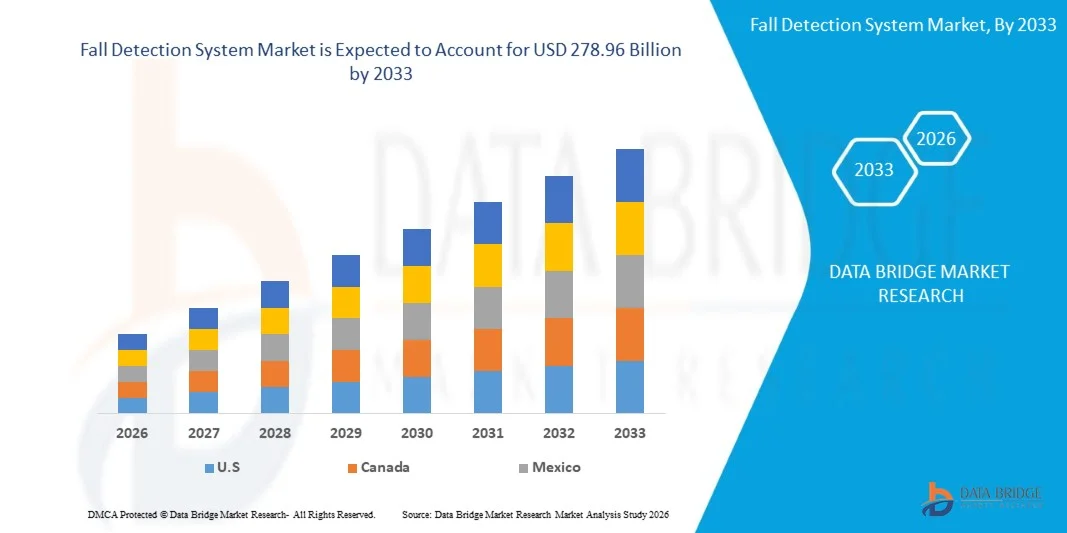
Report Scope and Fall Detection System Market Segmentation
|
Attributes |
Fall Detection System Key Market Insights |
|
Segments Covered |
|
|
Countries Covered |
North America
Europe
Asia-Pacific
Middle East and Africa
South America
|
|
Key Market Players |
|
|
Market Opportunities |
|
|
Value Added Data Infosets |
In addition to the insights on market scenarios such as market value, growth rate, segmentation, geographical coverage, and major players, the market reports curated by the Data Bridge Market Research also include in-depth expert analysis, geographically represented company-wise production and capacity, network layouts of distributors and partners, detailed and updated price trend analysis and deficit analysis of supply chain and demand. |
Fall Detection System Market Trends
“Rising Adoption of AI-Enabled and Wearable Fall Detection Solutions”
- A prominent trend in the fall detection system market is the growing adoption of AI-driven and wearable fall detection solutions, driven by the rising need for proactive elderly care and real-time health monitoring. These solutions are increasingly integrated into smart healthcare ecosystems to ensure rapid detection and emergency response in residential and clinical settings
- For instance, Philips Healthcare offers wearable fall detection devices with AI-based analytics that monitor motion patterns and alert caregivers instantly. Such devices enhance patient safety and reduce response time during emergencies
- Wearable sensors and smart devices are being integrated into telehealth platforms, enabling continuous monitoring of vulnerable populations and seamless communication with healthcare providers. This integration positions fall detection systems as key enablers for remote elderly care
- Healthcare institutions are increasingly deploying networked fall detection solutions in hospitals, assisted living facilities, and home care settings, where systems provide automated alerts and activity tracking. This trend is accelerating adoption of AI-enhanced monitoring and predictive analytics
- The market is witnessing innovation in multi-sensor solutions that combine accelerometers, gyroscopes, and AI algorithms to improve detection accuracy and minimize false alarms. These solutions are contributing to higher confidence among caregivers and patients in system reliability
- The growing interest in wearable and IoT-enabled fall detection solutions is driving the development of compact, user-friendly devices that can be easily worn or embedded in everyday items. This trend is supporting broader market acceptance and positioning fall detection systems as integral tools for preventive healthcare
Fall Detection System Market Dynamics
Driver
“Growing Aging Population and Increasing Demand for Remote Elderly Care”
- The expanding global elderly population and rising awareness of preventive healthcare are driving demand for advanced fall detection systems that support independent living. These systems enable caregivers to monitor patients remotely and provide timely intervention, enhancing safety and quality of life
- For instance, GreatCall’s Lively Mobile Plus device incorporates fall detection with 24/7 monitoring, supporting remote elderly care in the U.S. Such offerings are increasingly adopted in assisted living and home care programs
- Healthcare providers are integrating fall detection solutions with telehealth and remote patient monitoring platforms to optimize clinical workflows and reduce hospitalization rates. This is reinforcing the importance of connected care technologies in elderly support
- Government initiatives to improve senior healthcare services in countries such as Japan and Germany are boosting investments in fall detection technologies. These policies encourage adoption by subsidizing devices and integrating them into public health programs
- Rising consumer awareness of safety-enhancing technologies and home healthcare solutions is fueling the preference for wearable and smart monitoring systems. This trend is expected to sustain market growth over the forecast period
Restraint/Challenge
“High Cost of Advanced Fall Detection Systems”
- The fall detection system market faces challenges due to the high costs associated with AI-enabled devices, wearable sensors, and integrated monitoring platforms. These expenses can limit adoption in price-sensitive markets and among individual consumers
- For instance, Philips’ AI-based fall detection devices carry premium pricing due to advanced sensor technologies and software analytics. The high investment can deter smaller healthcare providers and home users
- The need for continuous data processing, cloud connectivity, and integration with emergency response services further increases the total cost of ownership. This financial barrier can affect widespread adoption in developing regions
- Maintenance, software updates, and staff training requirements add to operational expenses for healthcare institutions deploying fall detection systems. These ongoing costs contribute to cautious procurement strategies
- Affordability concerns remain a key challenge as manufacturers strive to balance system sophistication, reliability, and accessibility. Addressing cost barriers is critical to expanding market penetration and ensuring broader usage of fall detection solutions
Fall Detection System Market Scope
The market is segmented on the basis of product type, algorithm, component, system, and end-user.
• By Product Type
On the basis of product type, the fall detection system market is segmented into automatic fall detection systems and manual fall detection systems. The automatic fall detection system segment dominated the market with the largest revenue share of 60.84% in 2025, driven by its ability to instantly detect falls without human intervention, providing immediate alerts to caregivers or medical personnel. Consumers prefer automatic systems for their reliability, especially in senior care and hospital settings, where timely response is critical to preventing serious injuries. The segment benefits from continuous advancements in sensor technologies and integration with mobile apps, cloud platforms, and wearable devices, enhancing real-time monitoring and data analytics. In addition, the growing focus on elderly care and independent living is further fueling demand for automatic detection systems.
The manual fall detection system segment is anticipated to witness the fastest growth rate from 2026 to 2033, fueled by rising adoption in home care and personal monitoring applications. Manual systems are often cost-effective, allowing users to alert caregivers via wearable pendants or buttons, which appeals to budget-conscious consumers. Their simplicity, ease of installation, and compatibility with existing healthcare infrastructure also contribute to their growing popularity. For instance, companies such as Philips Lifeline are expanding their manual fall detection offerings to cater to home care settings with user-friendly interfaces and remote monitoring features.
• By Algorithm
On the basis of algorithm, the fall detection system market is segmented into simple threshold-based algorithms and machine learning algorithms. The simple threshold algorithm segment dominated the market in 2025 due to its straightforward design, low computational requirements, and proven reliability in detecting abrupt movements and potential falls. These algorithms are widely adopted in wearable devices and non-wearable monitoring systems, offering cost-effective solutions for both home and clinical environments. Their established performance across various user demographics and integration with existing monitoring systems enhances market confidence.
The machine learning algorithm segment is expected to witness the fastest growth from 2026 to 2033, driven by its superior accuracy and adaptability to individual user behavior. Machine learning models can analyze complex motion patterns and reduce false alarms, providing more personalized monitoring. For instance, companies such as SafelyYou leverage AI-driven fall detection to continuously improve detection accuracy in senior living facilities. The growing investment in AI and smart healthcare solutions is accelerating adoption of machine learning-based systems across multiple end-users.
• By Component
On the basis of component, the fall detection system market is segmented into accelerometers and gyroscopes, unimodal/bimodal sensors, and multimodal sensors. The accelerometers and gyroscopes segment dominated the market in 2025, driven by their fundamental role in capturing motion dynamics and orientation changes accurately. These sensors are widely used in wearable devices, providing real-time monitoring of falls with minimal power consumption and high reliability. Their compatibility with both automatic and manual systems, along with integration with mobile apps, enhances user adoption.
The multimodal sensor segment is anticipated to witness the fastest growth rate from 2026 to 2033, fueled by its ability to combine multiple sensing technologies to improve detection accuracy and reduce false positives. Multimodal systems integrate accelerometers, gyroscopes, cameras, and pressure sensors to provide comprehensive monitoring solutions. For instance, companies such as Vayyar Imaging employ multimodal sensors in in-home monitoring systems to detect falls without requiring wearable devices, offering convenience and enhanced safety for seniors.
• By System
On the basis of system, the fall detection system market is segmented into wearable systems, non-wearable systems, in-home landline systems, and in-home cellular systems. The wearable system segment dominated the market in 2025 due to its portability, real-time monitoring capabilities, and ease of integration with smartphones and cloud-based platforms. Wearable systems are highly preferred in hospitals, senior care facilities, and for lone workers, providing immediate alerts to caregivers or emergency services. Their continuous technological advancements, such as compact design and extended battery life, further support adoption.
The non-wearable system segment is expected to witness the fastest growth from 2026 to 2033, driven by increasing deployment in smart homes and public spaces where wearables may be inconvenient. Non-wearable systems use sensors embedded in floors, furniture, or rooms, offering contactless monitoring and improved compliance. For instance, companies such as GreatCall have introduced non-wearable systems in senior living communities to provide seamless fall detection without requiring users to wear devices constantly.
• By End-User
On the basis of end-user, the fall detection system market is segmented into home care settings, hospitals and senior assisted living facilities, lone workers, and others. The hospitals and senior assisted living facilities segment dominated the market in 2025, driven by high demand for patient safety, regulatory requirements, and the need to minimize response time during fall incidents. Institutions prioritize advanced monitoring systems with high accuracy, integration with hospital IT infrastructure, and real-time alert capabilities. The adoption is further supported by growing aging populations and increased healthcare expenditure globally.
The home care settings segment is anticipated to witness the fastest growth rate from 2026 to 2033, fueled by the rising trend of aging-in-place and the demand for remote patient monitoring. Home care solutions provide peace of mind to families while ensuring seniors can live independently with safety support. For instance, companies such as LifeFone offer home-based fall detection systems with cloud connectivity, mobile alerts, and 24/7 monitoring, enhancing adoption in residential settings.
Fall Detection System Market Regional Analysis
- North America dominated the fall detection system market with the largest revenue share of 39.05% in 2025, driven by a growing focus on elderly care, hospital safety protocols, and rising awareness of remote patient monitoring solutions
- Consumers and healthcare providers in the region highly value reliable, real-time fall detection systems that ensure rapid response and integration with mobile apps and cloud platforms
- This widespread adoption is further supported by advanced healthcare infrastructure, high disposable incomes, and a tech-savvy population, establishing fall detection systems as essential for residential, hospital, and assisted living settings
U.S. Fall Detection System Market Insight
The U.S. fall detection system market captured the largest revenue share within North America in 2025, fueled by increasing geriatric population and the widespread implementation of connected healthcare solutions. Hospitals and senior care facilities are prioritizing fall prevention strategies, integrating wearable and non-wearable detection systems for real-time alerts. The growing preference for in-home monitoring for seniors, supported by mobile and cloud-based platforms, is further propelling market growth. Moreover, advancements in AI and sensor technology are enabling higher accuracy and reduced false alarms, driving adoption across residential and clinical settings.
Europe Fall Detection System Market Insight
The Europe fall detection system market is projected to expand at a substantial CAGR during the forecast period, primarily driven by stringent healthcare regulations and rising demand for patient safety in hospitals and senior care facilities. The growing aging population and increasing awareness of home-based healthcare solutions are fostering adoption. Consumers are also drawn to systems offering remote monitoring, real-time alerts, and integration with telehealth platforms. The market is witnessing strong growth across residential care, hospitals, and assisted living facilities, with both wearable and non-wearable systems being adopted in new and renovated setups.
U.K. Fall Detection System Market Insight
The U.K. fall detection system market is expected to grow at a notable CAGR, driven by heightened awareness of elderly safety, home care adoption, and integration of smart healthcare technologies. Both homeowners and healthcare institutions are investing in reliable fall detection systems to ensure timely intervention. The increasing trend of aging-in-place, along with the adoption of connected healthcare devices, is supporting market expansion. The U.K.’s robust healthcare infrastructure and strong digital health initiatives are expected to continue stimulating growth.
Germany Fall Detection System Market Insight
The Germany fall detection system market is anticipated to expand at a considerable CAGR, fueled by increasing awareness of geriatric care, hospital patient safety protocols, and demand for technologically advanced monitoring solutions. Germany’s well-established healthcare infrastructure and emphasis on innovation and patient-centric solutions support adoption. Integration of fall detection systems with wearable devices, mobile platforms, and in-home monitoring solutions is becoming increasingly prevalent. There is also a growing preference for privacy-focused, non-intrusive systems in both residential and clinical settings.
Asia-Pacific Fall Detection System Market Insight
The Asia-Pacific fall detection system market is poised to grow at the fastest CAGR during the forecast period of 2026 to 2033, driven by rising urbanization, growing elderly population, and increasing healthcare expenditure in countries such as China, Japan, and India. Government initiatives promoting digital health and smart home monitoring are encouraging adoption of fall detection systems. The region is also emerging as a hub for manufacturing affordable and advanced wearable and non-wearable detection devices, increasing accessibility across residential and clinical sectors.
Japan Fall Detection System Market Insight
The Japan fall detection system market is gaining momentum due to the country’s high elderly population, focus on independent living for seniors, and demand for connected healthcare solutions. Japanese consumers and healthcare facilities are adopting wearable and in-home monitoring systems that provide immediate alerts and integration with smart devices. The market growth is also supported by advancements in AI-driven fall detection and integration with home IoT ecosystems. Aging demographics are expected to sustain demand for user-friendly and secure fall detection solutions across residential and hospital settings.
China Fall Detection System Market Insight
The China fall detection system market accounted for the largest revenue share in Asia-Pacific in 2025, attributed to rapid urbanization, increasing geriatric population, and high adoption of smart healthcare technologies. Hospitals, assisted living facilities, and residential care providers are increasingly integrating fall detection systems to enhance patient safety. Government support for digital health and telemedicine, along with local manufacturing of cost-effective devices, is driving adoption. The growing emphasis on smart homes and aging-in-place solutions is further propelling market growth.
Fall Detection System Market Share
The fall detection system industry is primarily led by well-established companies, including:
- Tunstall Group (U.K.)
- Koninklijike Phlips N.V. (Netherlands)
- ADT (U.S.)
- Medical Guardian LLC. (U.S.)
- Connect America (U.S.)
- SafeGuardian Medical Alarms & Help Alert Systems (U.S.)
- Bay Alarm Medical (U.S.)
- LifeFone Medical Alert Services (U.S.)
- LifeStation, Inc. (U.S.)
- AlertONE Service Inc. (U.S.)
- Semtech Corporation (U.S.)
- Legrand (France)
- Mytrex, Inc. (U.S.)
- Rescue Alert (U.S.)
- Galaxy Medical Alert Systems (Canada)
- MobileHelp (U.S.)
Latest Developments in Global Fall Detection System Market
- In February 2026, German healthtech company Gardia secured €8.5 million in Series A funding to scale its AI‑powered fall‑detection wristband technology and expand across Europe and international markets. This investment is expected to accelerate product development and broaden deployment, allowing seniors to access advanced fall monitoring in both personal and care‑facility settings. The funding highlights strong market confidence in wearable fall detection solutions and emphasizes the growing focus on preventive elderly care through AI‑enhanced devices. Expansion through partnerships with healthcare providers is expected to increase market penetration across the region
- In March 2025, FallCall Solutions partnered with RANiX Co., Ltd. to launch an AI‑powered radar system aimed at preventing hospital‑bed falls. The compact radar monitors movement, heart rate, and respiratory patterns, triggering alerts before a fall occurs. By enabling proactive fall prevention rather than solely reactive alerts, this system is expected to reduce hospital fall incidents and associated healthcare costs. Integration with mobile apps and emergency response platforms enhances interoperability and strengthens adoption of preventive fall management solutions
- In July 2024, Amsterdam-based Gamgee introduced its Wi‑Fi Fall Protection system, an AI-driven fall detection solution leveraging existing Wi‑Fi networks to monitor seniors and send instant alerts to caregivers via an app. This system expands the market by providing a non-wearable option suitable for seniors who resist traditional wearables, improving usability and adoption in home care environments. Real-time AI analytics combined with ubiquitous Wi‑Fi infrastructure enhances remote monitoring capabilities and broadens fall detection options for residential and assisted living settings
- In February 2024, Mount Prospect Senior Living partnered with SafelyYou, Inc. to implement real-time AI video technology for dementia care and remote clinical support. This integration elevates fall response protocols and reassures families through continuous monitoring and data-driven insights, reinforcing the role of AI video solutions in senior living communities. The collaboration also strengthens the attractiveness of assisted living facilities by offering higher safety standards
- In November 2023, MOBOTIX AG collaborated with Kepler Vision Technologies to embed intelligent sensors within the MOBOTIX c71 Hemispheric Indoor Camera for elderly care and hospices. The sensors improve detection accuracy for falls and bed exits, helping reduce staff workload and increase operational efficiency. This development reflects a growing trend of incorporating fall detection into existing surveillance infrastructure for cost-effective care facility solutions
SKU-
Получите онлайн-доступ к отчету на первой в мире облачной платформе рыночной аналитики

- Интерактивная панель анализа данных
- Панель анализа компании для возможностей с высоким потенциалом роста
- Доступ аналитика-исследователя для настройки и запросов
- Анализ конкурентов с помощью интерактивной панели
- Последние новости, обновления и анализ тенденций
- Используйте возможности сравнительного анализа для комплексного отслеживания конкурентов
Методология исследования
Сбор данных и анализ базового года выполняются с использованием модулей сбора данных с большими размерами выборки. Этап включает получение рыночной информации или связанных данных из различных источников и стратегий. Он включает изучение и планирование всех данных, полученных из прошлого заранее. Он также охватывает изучение несоответствий информации, наблюдаемых в различных источниках информации. Рыночные данные анализируются и оцениваются с использованием статистических и последовательных моделей рынка. Кроме того, анализ доли рынка и анализ ключевых тенденций являются основными факторами успеха в отчете о рынке. Чтобы узнать больше, пожалуйста, запросите звонок аналитика или оставьте свой запрос.
Ключевой методологией исследования, используемой исследовательской группой DBMR, является триангуляция данных, которая включает в себя интеллектуальный анализ данных, анализ влияния переменных данных на рынок и первичную (отраслевую экспертную) проверку. Модели данных включают сетку позиционирования поставщиков, анализ временной линии рынка, обзор рынка и руководство, сетку позиционирования компании, патентный анализ, анализ цен, анализ доли рынка компании, стандарты измерения, глобальный и региональный анализ и анализ доли поставщика. Чтобы узнать больше о методологии исследования, отправьте запрос, чтобы поговорить с нашими отраслевыми экспертами.
Доступна настройка
Data Bridge Market Research является лидером в области передовых формативных исследований. Мы гордимся тем, что предоставляем нашим существующим и новым клиентам данные и анализ, которые соответствуют и подходят их целям. Отчет можно настроить, включив в него анализ ценовых тенденций целевых брендов, понимание рынка для дополнительных стран (запросите список стран), данные о результатах клинических испытаний, обзор литературы, обновленный анализ рынка и продуктовой базы. Анализ рынка целевых конкурентов можно проанализировать от анализа на основе технологий до стратегий портфеля рынка. Мы можем добавить столько конкурентов, о которых вам нужны данные в нужном вам формате и стиле данных. Наша команда аналитиков также может предоставить вам данные в сырых файлах Excel, сводных таблицах (книга фактов) или помочь вам в создании презентаций из наборов данных, доступных в отчете.











