



Global Food Testing Kits Market Segmentation, By Target Tested (Pathogens, Meat Species, GMOS, Allergens, Mycotoxins, Pesticides, and Others), Technology (PCR-Based, Immunoassay-Based, and Enzyme Substrate-Based), Sample (Meat, Poultry & Seafood, Dairy Products, Cereals, Grains, Pulses, Nuts, Seeds, Spices, and Others) - Industry Trends and Forecast to 2033
Food Testing Kits Market Size
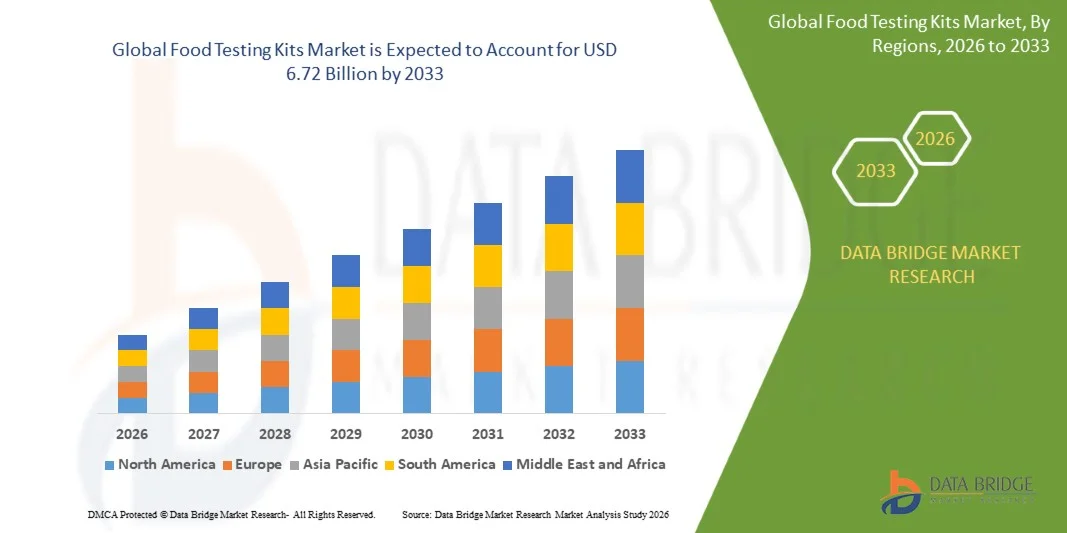
- The global food testing kits market size was valued at USD 3.62 billion in 2025 and is expected to reach USD 6.72 billion by 2033, at a CAGR of 8.02% during the forecast period
- The market growth is largely fueled by the increasing emphasis on food safety regulations and the rising incidence of foodborne illnesses, leading to higher adoption of rapid and reliable food testing solutions across global supply chains
- Furthermore, growing consumer awareness regarding food quality, transparency, and contamination risks is driving demand for advanced testing kits among food manufacturers and regulatory bodies. These factors are accelerating the adoption of food testing technologies, thereby significantly boosting the market growth
Food Testing Kits Market Analysis
- Food testing kits are diagnostic tools used to detect contaminants such as pathogens, allergens, GMOs, pesticides, and toxins in food products, ensuring compliance with safety standards and maintaining product quality across the food industry
- The escalating demand for food testing kits is primarily fueled by stringent regulatory frameworks, increasing global trade of food products, and the need for rapid, accurate, and cost-effective testing solutions to prevent contamination and ensure consumer safety
- North America dominated the food testing kits market with a share of 40.8% in 2025, due to stringent food safety regulations, high awareness regarding food quality, and the presence of advanced testing infrastructure
- Asia-Pacific is expected to be the fastest growing region in the food testing kits market during the forecast period due to rapid urbanization, increasing food consumption, and rising awareness regarding food safety in countries such as China, India, and Japan
- Pathogens segment dominated the market with a market share of 43% in 2025, due to the increasing incidence of foodborne illnesses and stringent food safety regulations across global supply chains. Governments and regulatory bodies emphasize routine pathogen testing to detect bacteria such as Salmonella and E. coli, ensuring consumer safety and compliance. Food manufacturers and processors heavily rely on pathogen testing kits to maintain quality standards and avoid product recalls
Report Scope and Food Testing Kits Market Segmentation
|
Attributes |
Food Testing Kits Key Market Insights |
|
Segments Covered |
|
|
Countries Covered |
North America
Europe
Asia-Pacific
Middle East and Africa
South America
|
|
Key Market Players |
|
|
Market Opportunities |
|
|
Value Added Data Infosets |
In addition to the insights on market scenarios such as market value, growth rate, segmentation, geographical coverage, and major players, the market reports curated by the Data Bridge Market Research also include in-depth expert analysis, pricing analysis, brand share analysis, consumer survey, demography analysis, supply chain analysis, value chain analysis, raw material/consumables overview, vendor selection criteria, PESTLE Analysis, Porter Analysis, and regulatory framework. |
Food Testing Kits Market Trends
“Rising Adoption of Rapid and PCR-Based Food Testing Technologies”
- A significant trend in the food testing kits market is the increasing adoption of rapid and PCR-based technologies, driven by the growing need for accurate, time-efficient, and sensitive detection of contaminants across complex food supply chains. These technologies are enhancing the ability of food manufacturers and regulatory bodies to ensure safety compliance while reducing testing turnaround time
- For instance, Thermo Fisher Scientific and Bio-Rad Laboratories offer advanced PCR-based food testing kits that enable precise detection of pathogens such as Salmonella and Listeria, supporting faster decision-making and improved food safety outcomes
- The increasing demand for real-time testing solutions is encouraging the integration of rapid diagnostic kits within food processing facilities to minimize delays and prevent contamination risks. This is strengthening operational efficiency and enabling proactive quality control measures across production lines
- The expansion of global food trade is intensifying the need for standardized and high-throughput testing technologies capable of handling large sample volumes with consistent accuracy. This trend is promoting the adoption of automated PCR systems and rapid assay kits across laboratories and production environments
- Food manufacturers are focusing on implementing advanced testing technologies to comply with stringent international regulations and maintain brand reputation in competitive markets. This is further accelerating the shift from conventional testing methods toward modern molecular diagnostics
- The growing emphasis on food safety, combined with technological advancements in detection methods, is reinforcing the importance of rapid and PCR-based testing solutions. This trend is positioning these technologies as essential components in ensuring food quality, regulatory compliance, and consumer protection across the global market
Food Testing Kits Market Dynamics
Driver
“Increasing Stringency of Global Food Safety Regulations”
- The increasing enforcement of strict food safety regulations across global markets is driving the demand for food testing kits, as governments and regulatory agencies aim to reduce the incidence of foodborne illnesses and ensure consumer protection. These regulations mandate routine testing of food products for contaminants, encouraging widespread adoption of testing solutions
- For instance, the U.S. Food and Drug Administration enforces the Food Safety Modernization Act, requiring food producers to implement preventive controls and regular testing protocols, which significantly boosts the demand for reliable food testing kits across the industry
- The growing number of food recalls and contamination incidents is prompting authorities to strengthen compliance requirements and enforce stricter monitoring systems. This is increasing the reliance on advanced testing kits to ensure consistent quality and safety standards
- Food exporters are required to meet stringent international safety standards to access global markets, which is driving the adoption of certified testing solutions across production and distribution stages. This is supporting the expansion of testing practices within the food industry
- The continuous evolution of regulatory frameworks is ensuring sustained demand for food testing kits, as companies invest in advanced solutions to meet compliance requirements and minimize risks associated with contamination and product recalls
Restraint/Challenge
“High Cost of Advanced Testing Kits and Infrastructure”
- The food testing kits market faces challenges due to the high cost associated with advanced testing technologies, including PCR-based systems and automated diagnostic equipment, which require significant capital investment. These costs can limit adoption, particularly among small and medium-sized food enterprises
- For instance, QIAGEN provides high-precision molecular testing solutions that involve sophisticated instruments and reagents, increasing the overall cost of implementation and maintenance for laboratories and food manufacturers
- The requirement for skilled personnel and specialized laboratory infrastructure further adds to operational expenses, making it difficult for smaller organizations to adopt advanced testing solutions. This creates a barrier to widespread implementation across developing regions
- Maintenance, calibration, and quality assurance processes associated with high-end testing equipment contribute to ongoing costs, impacting the overall affordability of these technologies. This can restrict continuous usage in cost-sensitive environments
- The high overall cost structure continues to pose a constraint on market growth, as companies must balance the need for accurate testing with financial feasibility. These challenges emphasize the importance of developing cost-effective solutions to ensure broader adoption across the global food industry
Food Testing Kits Market Scope
The market is segmented on the basis of target tested, technology, and sample.
• By Target Tested
On the basis of target tested, the food testing kits market is segmented into pathogens, meat species, GMOs, allergens, mycotoxins, pesticides, and others. The pathogens segment dominated the largest market revenue share of 43% in 2025, driven by the increasing incidence of foodborne illnesses and stringent food safety regulations across global supply chains. Governments and regulatory bodies emphasize routine pathogen testing to detect bacteria such as Salmonella and E. coli, ensuring consumer safety and compliance. Food manufacturers and processors heavily rely on pathogen testing kits to maintain quality standards and avoid product recalls. The growing complexity of food distribution networks further strengthens the demand for rapid and accurate pathogen detection solutions.
The allergens segment is anticipated to witness the fastest growth rate from 2026 to 2033, fueled by the rising prevalence of food allergies and increasing consumer awareness regarding ingredient transparency. Food producers are under pressure to clearly label allergen content, driving the adoption of allergen testing kits across processing facilities. Regulatory mandates in developed and emerging markets are also enforcing strict allergen control measures. The expansion of packaged and processed food consumption further accelerates the need for reliable allergen detection technologies.
• By Technology
On the basis of technology, the food testing kits market is segmented into PCR-based, immunoassay-based, and enzyme substrate-based. The PCR-based segment held the largest market revenue share in 2025 driven by its high sensitivity, accuracy, and ability to detect even minute levels of contaminants in food samples. PCR technology is widely used for identifying pathogens and genetically modified organisms with precise and rapid results. Laboratories and food safety authorities prefer PCR-based kits due to their reliability and compliance with stringent testing standards. Continuous advancements in molecular diagnostics further enhance the adoption of PCR technologies in food testing applications.
The immunoassay-based segment is expected to witness the fastest CAGR from 2026 to 2033, driven by its cost-effectiveness, ease of use, and suitability for on-site testing. These kits provide quick results without the need for complex laboratory infrastructure, making them ideal for small and medium-sized food enterprises. Increasing demand for rapid screening methods in supply chains supports the growth of immunoassay-based solutions. The portability and user-friendly nature of these kits contribute significantly to their rising adoption across diverse food testing environments.
• By Sample
On the basis of sample, the food testing kits market is segmented into meat, poultry & seafood, dairy products, cereals, grains, pulses, nuts, seeds, spices, and others. The meat, poultry & seafood segment dominated the largest market revenue share in 2025, driven by the high risk of contamination and strict regulatory scrutiny in animal-based food products. These food categories are highly susceptible to pathogens, antibiotics, and chemical residues, necessitating frequent and rigorous testing. Increasing global consumption of protein-rich diets further amplifies the demand for testing kits in this segment. Food exporters and processors prioritize testing to meet international safety standards and avoid trade restrictions.
The dairy products segment is anticipated to witness the fastest growth rate from 2026 to 2033, fueled by rising consumption of milk-based products and the need to ensure quality and safety across supply chains. Dairy products are prone to microbial contamination and adulteration, increasing the reliance on advanced testing solutions. Regulatory bodies enforce strict quality checks in dairy processing, encouraging the adoption of rapid testing kits. The expansion of packaged dairy consumption and cold chain logistics further drives the growth of this segment.
Food Testing Kits Market Regional Analysis
- North America dominated the food testing kits market with the largest revenue share of 40.8% in 2025, driven by stringent food safety regulations, high awareness regarding food quality, and the presence of advanced testing infrastructure
- Food manufacturers and regulatory authorities in the region emphasize rigorous testing practices to prevent contamination and ensure compliance with safety standards across the supply chain
- The widespread adoption of rapid testing technologies, supported by strong government oversight, high consumer awareness, and the presence of major food processing companies, establishes food testing kits as essential tools across industries
U.S. Food Testing Kits Market Insight
The U.S. food testing kits market captured the largest revenue share in 2025 within North America, fueled by strict regulatory frameworks enforced by agencies such as the FDA and USDA. Food producers are increasingly adopting advanced testing kits to ensure compliance with safety standards and avoid costly recalls. The growing demand for packaged and processed food further drives the need for routine testing. In addition, technological advancements in rapid testing methods and the integration of automation in food safety processes are significantly contributing to market expansion.
Europe Food Testing Kits Market Insight
The Europe food testing kits market is projected to expand at a substantial CAGR throughout the forecast period, primarily driven by stringent food safety laws and increasing consumer demand for transparency in food labeling. The region’s strong regulatory framework mandates comprehensive testing for contaminants, allergens, and GMOs. Rising consumption of processed and convenience foods is further encouraging manufacturers to adopt reliable testing solutions. The market is witnessing steady growth across food processing and export sectors, supported by technological advancements in testing methods.
U.K. Food Testing Kits Market Insight
The U.K. food testing kits market is anticipated to grow at a noteworthy CAGR during the forecast period, driven by increasing concerns regarding food safety, traceability, and quality assurance. The rising demand for allergen-free and clean-label food products is encouraging manufacturers to adopt advanced testing kits. Strong regulatory compliance requirements and a well-established food retail sector further support market growth. The growing preference for rapid and on-site testing solutions is also contributing to increased adoption.
Germany Food Testing Kits Market Insight
The Germany food testing kits market is expected to expand at a considerable CAGR during the forecast period, fueled by high standards for food quality and safety along with strong industrial food production capabilities. The country’s focus on technological innovation supports the adoption of advanced PCR and immunoassay-based testing solutions. Increasing exports of food products necessitate strict compliance with international safety standards. The integration of efficient testing processes within manufacturing facilities is further strengthening market growth.
Asia-Pacific Food Testing Kits Market Insight
The Asia-Pacific food testing kits market is poised to grow at the fastest CAGR during the forecast period of 2026 to 2033, driven by rapid urbanization, increasing food consumption, and rising awareness regarding food safety in countries such as China, India, and Japan. Government initiatives to improve food quality standards and strengthen regulatory frameworks are accelerating market adoption. The expansion of the food processing industry and growing export activities further boost demand for testing kits. Increasing affordability and accessibility of testing technologies are also contributing to regional growth.
Japan Food Testing Kits Market Insight
The Japan food testing kits market is gaining momentum due to strong consumer awareness, strict regulatory standards, and a high focus on food quality and safety. The country’s advanced technological landscape supports the adoption of precise and rapid testing methods. Increasing demand for packaged and ready-to-eat food products is driving routine testing practices. The integration of automated testing solutions in food processing facilities is further enhancing market expansion.
China Food Testing Kits Market Insight
The China food testing kits market accounted for the largest market revenue share in Asia Pacific in 2025, attributed to rapid industrialization of the food sector and increasing government focus on food safety regulations. Rising consumer awareness regarding food contamination and quality is encouraging manufacturers to adopt advanced testing kits. The expansion of domestic food production and export activities further drives the need for reliable testing solutions. The presence of local manufacturers offering cost-effective testing kits also supports significant market growth in China.
Food Testing Kits Market Share
The food testing kits industry is primarily led by well-established companies, including:
- Thermo Fisher Scientific Inc. (U.S.)
- Food Hygiene and Health Laboratory (U.K.)
- Intertek Group plc. (U.K.)
- Microbac Laboratories Inc. (U.S.)
- Mérieux NutriSciences Corporation (France)
- Romer Labs Inc. (Austria)
- SGS S.A. (Switzerland)
- AsureQuality Ltd (New Zealand)
- ALS Limited (Australia)
- 3M (U.S.)
- Bio-Rad Laboratories (U.S.)
- Eurofins Scientific (Luxembourg)
- Agilent Technologies (U.S.)
- PerkinElmer Inc. (U.S.)
- QIAGEN (Germany)
- EnviroLogix (U.S.)
- NEOGEN Corporation (U.S.)
- Bureau Veritas S.A. (France)
- IFP Institut für Produktqualität (Germany)
- MilliporeSigma (U.S.)
Latest Developments in Global Food Testing Kits Market
- In March 2025, Bio-Rad Laboratories introduced the XP-Design Assay Salmonella Serotyping Solution, significantly strengthening its molecular diagnostics capabilities by enabling highly accurate and rapid identification of Salmonella strains in food samples. This advancement improves traceability and outbreak response for food manufacturers and regulatory bodies, reducing the risk of large-scale recalls. The solution enhances laboratory efficiency by minimizing turnaround time and supports the broader shift toward precision-based food safety testing, thereby accelerating the adoption of advanced PCR technologies across the global market
- In June 2024, Thermo Fisher Scientific expanded its food safety testing portfolio with new rapid detection solutions designed to deliver faster and scalable testing outcomes for complex food matrices. This development enables food producers to conduct high-throughput testing with improved accuracy, ensuring compliance with stringent safety regulations. The enhanced automation and integration capabilities reduce manual intervention and operational costs, encouraging wider deployment across large-scale food processing industries and strengthening the demand for technologically advanced testing kits
- In October 2023, QIAGEN launched advanced sample preparation and PCR-based solutions tailored for food testing applications, improving the efficiency and sensitivity of contaminant detection processes. These solutions streamline laboratory workflows by reducing preparation time and increasing reproducibility of results, which is critical for maintaining consistent food quality standards. The innovation supports laboratories in handling higher testing volumes while maintaining precision, thereby contributing to the growing reliance on molecular diagnostics in food safety management
- In August 2022, bioMérieux introduced enhanced multiplex PCR-based pathogen detection solutions that allow simultaneous identification of multiple foodborne contaminants within a single test cycle. This capability significantly reduces testing time and operational costs for food manufacturers and laboratories, improving overall productivity. The development addresses the increasing need for comprehensive and rapid testing solutions, supporting stricter regulatory compliance and driving the transition toward multi-target testing technologies in the global market
- In May 2021, Eurofins Scientific expanded its food testing capabilities by introducing advanced rapid testing services and technologies aimed at improving both laboratory-based and on-site food analysis. This expansion enhances real-time monitoring of food safety across supply chains, enabling quicker identification of contaminants and quality issues. The improved accessibility and efficiency of testing services support food producers in maintaining consistent quality standards, thereby increasing the adoption of outsourced and service-based food testing solutions worldwide
SKU-
Получите онлайн-доступ к отчету на первой в мире облачной платформе рыночной аналитики

- Интерактивная панель анализа данных
- Панель анализа компании для возможностей с высоким потенциалом роста
- Доступ аналитика-исследователя для настройки и запросов
- Анализ конкурентов с помощью интерактивной панели
- Последние новости, обновления и анализ тенденций
- Используйте возможности сравнительного анализа для комплексного отслеживания конкурентов
Методология исследования
Сбор данных и анализ базового года выполняются с использованием модулей сбора данных с большими размерами выборки. Этап включает получение рыночной информации или связанных данных из различных источников и стратегий. Он включает изучение и планирование всех данных, полученных из прошлого заранее. Он также охватывает изучение несоответствий информации, наблюдаемых в различных источниках информации. Рыночные данные анализируются и оцениваются с использованием статистических и последовательных моделей рынка. Кроме того, анализ доли рынка и анализ ключевых тенденций являются основными факторами успеха в отчете о рынке. Чтобы узнать больше, пожалуйста, запросите звонок аналитика или оставьте свой запрос.
Ключевой методологией исследования, используемой исследовательской группой DBMR, является триангуляция данных, которая включает в себя интеллектуальный анализ данных, анализ влияния переменных данных на рынок и первичную (отраслевую экспертную) проверку. Модели данных включают сетку позиционирования поставщиков, анализ временной линии рынка, обзор рынка и руководство, сетку позиционирования компании, патентный анализ, анализ цен, анализ доли рынка компании, стандарты измерения, глобальный и региональный анализ и анализ доли поставщика. Чтобы узнать больше о методологии исследования, отправьте запрос, чтобы поговорить с нашими отраслевыми экспертами.
Доступна настройка
Data Bridge Market Research является лидером в области передовых формативных исследований. Мы гордимся тем, что предоставляем нашим существующим и новым клиентам данные и анализ, которые соответствуют и подходят их целям. Отчет можно настроить, включив в него анализ ценовых тенденций целевых брендов, понимание рынка для дополнительных стран (запросите список стран), данные о результатах клинических испытаний, обзор литературы, обновленный анализ рынка и продуктовой базы. Анализ рынка целевых конкурентов можно проанализировать от анализа на основе технологий до стратегий портфеля рынка. Мы можем добавить столько конкурентов, о которых вам нужны данные в нужном вам формате и стиле данных. Наша команда аналитиков также может предоставить вам данные в сырых файлах Excel, сводных таблицах (книга фактов) или помочь вам в создании презентаций из наборов данных, доступных в отчете.











