


Global Fibre Reinforced Plastic (FRP) Bridge Market Segmentation, By Fibre Type (Glass Fibre, Carbon Fibre), Resin Type (Vinyl Ester, Polyester, Others), Manufacturing Process (Pultrusion, Hand Lay-Up), Application (Deck, Girders, Rebars), Bridge Type (Vehicular, Pedestrian) - Industry Trends and Forecast to 2032
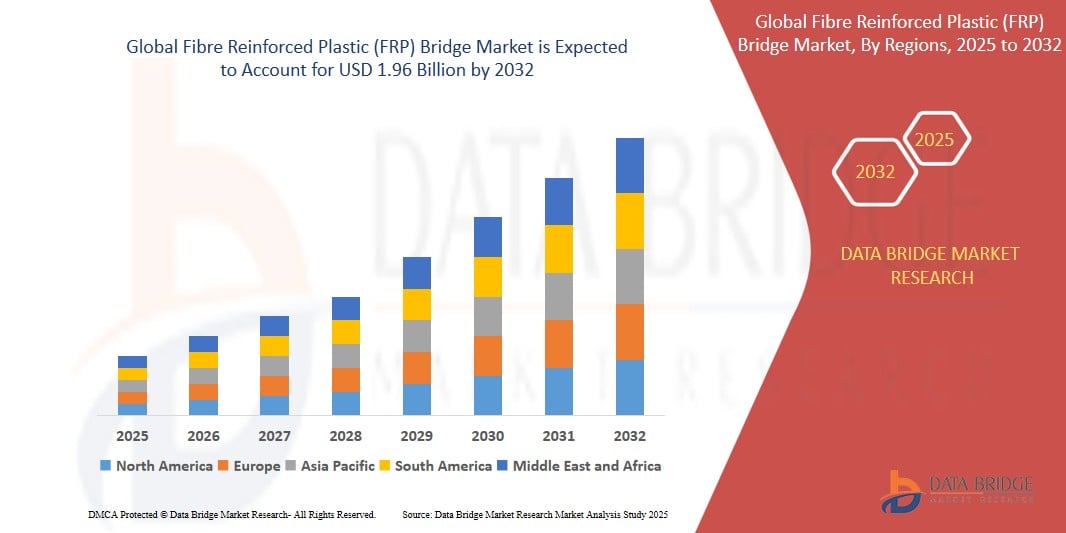
Fibre Reinforced Plastic (FRP) Bridge Market Size
- The Global Fibre Reinforced Plastic (FRP) Bridge Market was valued at USD 1.10 billion in 2024 and is expected to reach USD by 2032
- During the forecast period of 2025 to 2032, the Global Fibre Reinforced Plastic (FRP) Bridge Market is expected to grow at a steady 7.5% CAGR, primarily driven increasing infrastructure development, particularly in emerging economies like India and China, and the adoption of FRP bridges due to their lightweight, durable, and corrosion-resistant properties. These advantages make FRP bridges ideal for challenging environments and sustainable construction practices.
Fibre Reinforced Plastic (FRP) Bridge Market Analysis
- Fibre Reinforced Plastic (FRP) bridges are gaining traction due to their superior strength-to-weight ratio, corrosion resistance, and low maintenance requirements, making them ideal for both temporary and permanent infrastructure applications.
- Government investments in sustainable and long-lasting infrastructure, particularly in the transportation sector, are driving demand. FRP bridges are increasingly being used in pedestrian walkways, highway overpasses, and rural connectivity projects.
- Technological advancements in composite materials and modular bridge construction have reduced installation time and overall costs, encouraging broader adoption in both developed and developing regions.
- Asia-Pacific is emerging as the fastest-growing region in the FRP bridge market, led by rapid urbanization, infrastructure modernization initiatives, and growing awareness of eco-friendly construction alternatives in countries like China, India, and South Korea.
Report Scope and Fibre Reinforced Plastic (FRP) Bridge Market Segmentation
|
Attributes |
Flavored Pretzel Key Market Insights |
|
Segments Covered |
|
|
Countries Covered |
North America
Europe
Asia-Pacific
Middle East and Africa
South America
|
|
Key Market Players |
|
|
Market Opportunities |
|
|
Value Added Data Infosets |
In addition to the insights on market scenarios such as market value, growth rate, segmentation, geographical coverage, and major players, the market reports curated by the Data Bridge Market Research also include in-depth expert analysis, pricing analysis, brand share analysis, consumer survey, demography analysis, supply chain analysis, value chain analysis, raw material/consumables overview, vendor selection criteria, PESTLE Analysis, Porter Analysis, and regulatory framework. |
Fibre Reinforced Plastic (FRP) Bridge Market Trends
“Rising Adoption of Sustainable and Corrosion-Resistant Infrastructure Solutions”
- The Fibre Reinforced Plastic (FRP) Bridge Market is experiencing increased demand due to the growing preference for long-lasting, low-maintenance, and environmentally friendly construction materials. FRP bridges offer corrosion resistance, making them ideal for harsh environments like coastal and industrial zones.
- Governments and municipalities are prioritizing sustainable infrastructure, encouraging the replacement of aging steel and concrete bridges with FRP alternatives to extend lifespan and reduce overall lifecycle costs.
Fibre Reinforced Plastic (FRP) Bridge Market Dynamics
Driver
“Rising Demand for Lightweight, Durable, and Low-Maintenance Bridge Solutions”
- The global Fibre Reinforced Plastic (FRP) Bridge Market is expanding rapidly due to increasing demand for lightweight and corrosion-resistant alternatives to traditional steel and concrete. Urban infrastructure upgrades, especially in flood-prone and coastal regions, are driving adoption.
- FRP bridges offer superior benefits including high strength-to-weight ratio, ease of installation, and long-term durability with minimal maintenance—making them ideal for pedestrian, cycling, and light vehicle bridges in both urban and rural settings.
- Sustainability-focused infrastructure programs are promoting the use of eco-friendly construction materials. FRP bridges align with green building initiatives due to their extended lifespan and recyclability, appealing to both government bodies and private developers.
- Technological advancements in resin formulations, pultrusion techniques, and prefabricated modular designs have significantly reduced production and installation costs, enabling broader market penetration across budget-sensitive projects.
- Strategic collaborations between composite manufacturers, construction firms, and government agencies are accelerating the deployment of FRP bridges, particularly in the U.S., Europe, and fast-developing economies in Asia-Pacific.
- Asia-Pacific and Latin America are witnessing growing demand for FRP bridge installations, driven by infrastructure modernization, increased public funding, and a focus on resilient construction to combat climate-related risks.
Opportunity
“Expanding Infrastructure Needs Creating Opportunities for FRP Bridge Adoption”
- The global push for resilient, cost-effective infrastructure—especially in developing economies—is creating strong growth opportunities for FRP bridge solutions. Rapid urbanization, climate-related challenges, and the need for quick-installation bridges are driving market expansion.
- FRP bridges' light weight and corrosion resistance make them highly attractive for applications in remote, coastal, and flood-prone areas where traditional construction materials often fail or require extensive maintenance.
- Rising government investments in smart cities, rural development, and green infrastructure projects are opening doors for public-private partnerships, where FRP technology can be deployed as a scalable and sustainable solution.
- Educational and awareness programs led by industry bodies and manufacturers are increasing acceptance of FRP technology among engineers, architects, and policymakers, especially in Asia-Pacific, Africa, and Latin America.
- The growing trend of modular and prefabricated construction aligns well with FRP bridges, allowing for faster deployment and reduced on-site labor—an important factor in regions with workforce shortages or urgent transport needs.
- Markets such as India, Indonesia, Brazil, and Sub-Saharan Africa offer significant untapped potential, driven by expanding road networks, disaster recovery efforts, and international funding from development banks and climate resilience initiatives.
Restraint/Challenge
“High Costs and Limited Awareness Hindering Widespread FRP Bridge Adoption”
- The adoption of Fibre Reinforced Plastic (FRP) bridges is restrained by high initial material and manufacturing costs compared to conventional steel and concrete alternatives, making them less attractive for budget-sensitive infrastructure projects.
- Limited awareness and familiarity among civil engineers, contractors, and public authorities regarding FRP technology’s long-term benefits continue to hinder market penetration, particularly in regions where traditional construction dominates.
- Despite their durability, FRP materials often face skepticism due to a lack of standardized design codes, regulatory clarity, and field performance data in large-scale applications, leading to hesitancy in public procurement.
- Repair and modification of FRP bridges require specialized skills and equipment, creating a technical barrier for smaller municipalities or regions with limited access to advanced construction capabilities.
- Inconsistent supply chains and a relatively small number of experienced manufacturers in certain geographies lead to longer lead times and increased logistical costs for large infrastructure projects.
- Fluctuations in the cost of raw materials such as resin and glass/carbon fibers—exacerbated by geopolitical tensions and supply disruptions—can impact production planning and pricing predictability for FRP bridge components.
Fibre Reinforced Plastic (FRP) Bridge Market Scope
The market is segmented on the basis of fibre type, resin type, manufacturing process and application, bridge type.
|
Segmentation |
Sub-Segmentation |
|
By Fibre Type |
|
|
Resin Type |
|
|
Manufacturing Process
|
|
|
Application |
|
|
Bridge Type |
|
Fibre Reinforced Plastic (FRP) Bridge Market Regional Analysis
“North America is the Dominant Region in the Fibre Reinforced Plastic (FRP) Bridge Market”
- The United States holds a dominant share of the market, with numerous FRP bridge projects implemented across state and federal levels. Aging infrastructure, combined with federal investments in resilient and low-maintenance solutions, continues to drive demand.
- Canada also contributes significantly to regional growth, emphasizing sustainable construction practices, especially in remote and harsh environments where FRP’s lightweight and corrosion-resistant qualities offer clear logistical and performance advantages.
- The region's robust civil engineering sector and strict regulatory standards support innovation in bridge design and material testing, allowing FRP bridge solutions to gain credibility and scalability through standardized codes and pilot projects.
- Public-private partnerships and infrastructure stimulus programs are accelerating the adoption of FRP bridges in North America, especially for pedestrian, cycling, and rural vehicle bridges where rapid deployment is essential.
- FRP bridges designed with climate resilience in mind—such as flood- and salt-resistant applications—are seeing increased deployment, particularly in coastal states and regions prone to extreme weather events.
“Asia-Pacific is Projected to Register the Highest Growth Rate in the Fibre Reinforced Plastic (FRP) Bridge Market”
- The Asia-Pacific region is expected to experience the highest growth rate in the Global Fibre Reinforced Plastic (FRP) Bridge Market, driven by rapid urbanization, increased infrastructure spending, and strong government focus on durable and low-maintenance construction materials in countries like China, India, and Southeast Asia.
- Massive investments in transportation networks, smart cities, and rural connectivity programs are fueling demand for lightweight, corrosion-resistant bridge solutions, particularly in flood-prone and remote areas where traditional materials are less effective.
- As public infrastructure budgets expand, particularly in India and China, demand for cost-effective and fast-deployable bridges is rising. FRP’s modular nature and reduced construction time align well with regional development goals.
- The growing influence of international infrastructure firms and technology transfer from North America and Europe is accelerating the adoption of FRP bridge technology in Asia-Pacific, with governments increasingly prioritizing long-term durability over short-term cost savings.
Fibre Reinforced Plastic (FRP) Bridge Market Share
The market competitive landscape provides details by competitor. Details included are company overview, company financials, revenue generated, market potential, investment in research and development, new market initiatives, global presence, production sites and facilities, production capacities, company strengths and weaknesses, product launch, product width and breadth, application dominance. The above data points provided are only related to the companies' focus related to market.
The Major Market Leaders Operating in the Market Are:
- Strongwell Corporation (U.S.)
- Creative Pultrusions, Inc. (U.S.)
- Bedford Reinforced Plastics (U.S.)
- CTS Bridges Ltd (U.K.)
- Composite Advantage, LLC (U.S.)
- Hughes Brothers, Inc. (U.S.)
- B&B FRP Manufacturing Inc. (U.S.)
- Fiberline Composites A/S (Denmark)
- FiberCore Europe (Netherlands)
- Exel Composites (Finland)
- RS Technologies Inc. (Canada)
- Diversified Structural Composites (U.S.)
- Kenway Corporation (U.S.)
- Martin Marietta Composites, Inc. (U.S.)
- AIT Bridges (U.S.)
Latest Developments in Global Fibre Reinforced Plastic (FRP) Bridge Market
- In March 2024, Jindal Advanced Materials announced plans to expand its FRP rebar manufacturing capacity to 1 lakh metric tonnes, aiming to meet growing demand for sustainable construction materials in infrastructure projects.
- In February 2024, Creative Pultrusions, Inc. collaborated with government agencies in India to deliver modular FRP pedestrian bridges for flood-prone rural areas, ensuring quick deployment and enhanced connectivity.
- In January 2024, the Indian Institute of Technology Hyderabad developed a hybrid FRP solution designed to extend the lifespan of aging bridges, offering an affordable and efficient method for structural rehabilitation.
- In December 2023, the European Union launched a research initiative focused on advancing the durability of FRP materials for bridge construction, with an emphasis on eco-friendly, long-lasting solutions.
- In November 2023, a leading global FRP manufacturer partnered with construction firms in the United States to implement the first large-scale installation of FRP composite pedestrian bridges in a coastal urban area.
SKU-
Получите онлайн-доступ к отчету на первой в мире облачной платформе рыночной аналитики

- Интерактивная панель анализа данных
- Панель анализа компании для возможностей с высоким потенциалом роста
- Доступ аналитика-исследователя для настройки и запросов
- Анализ конкурентов с помощью интерактивной панели
- Последние новости, обновления и анализ тенденций
- Используйте возможности сравнительного анализа для комплексного отслеживания конкурентов
Методология исследования
Сбор данных и анализ базового года выполняются с использованием модулей сбора данных с большими размерами выборки. Этап включает получение рыночной информации или связанных данных из различных источников и стратегий. Он включает изучение и планирование всех данных, полученных из прошлого заранее. Он также охватывает изучение несоответствий информации, наблюдаемых в различных источниках информации. Рыночные данные анализируются и оцениваются с использованием статистических и последовательных моделей рынка. Кроме того, анализ доли рынка и анализ ключевых тенденций являются основными факторами успеха в отчете о рынке. Чтобы узнать больше, пожалуйста, запросите звонок аналитика или оставьте свой запрос.
Ключевой методологией исследования, используемой исследовательской группой DBMR, является триангуляция данных, которая включает в себя интеллектуальный анализ данных, анализ влияния переменных данных на рынок и первичную (отраслевую экспертную) проверку. Модели данных включают сетку позиционирования поставщиков, анализ временной линии рынка, обзор рынка и руководство, сетку позиционирования компании, патентный анализ, анализ цен, анализ доли рынка компании, стандарты измерения, глобальный и региональный анализ и анализ доли поставщика. Чтобы узнать больше о методологии исследования, отправьте запрос, чтобы поговорить с нашими отраслевыми экспертами.
Доступна настройка
Data Bridge Market Research является лидером в области передовых формативных исследований. Мы гордимся тем, что предоставляем нашим существующим и новым клиентам данные и анализ, которые соответствуют и подходят их целям. Отчет можно настроить, включив в него анализ ценовых тенденций целевых брендов, понимание рынка для дополнительных стран (запросите список стран), данные о результатах клинических испытаний, обзор литературы, обновленный анализ рынка и продуктовой базы. Анализ рынка целевых конкурентов можно проанализировать от анализа на основе технологий до стратегий портфеля рынка. Мы можем добавить столько конкурентов, о которых вам нужны данные в нужном вам формате и стиле данных. Наша команда аналитиков также может предоставить вам данные в сырых файлах Excel, сводных таблицах (книга фактов) или помочь вам в создании презентаций из наборов данных, доступных в отчете.











