


Global Home Automation Market Segmentation, By Component (Product and Services), Technology (Wired, Wireless, and Power Line-Based), End User (Residential and Commercial), Application (Lighting, Safety and Security, HVAC, Entertainment, and Others) – Industry Trends and Forecast to 2032
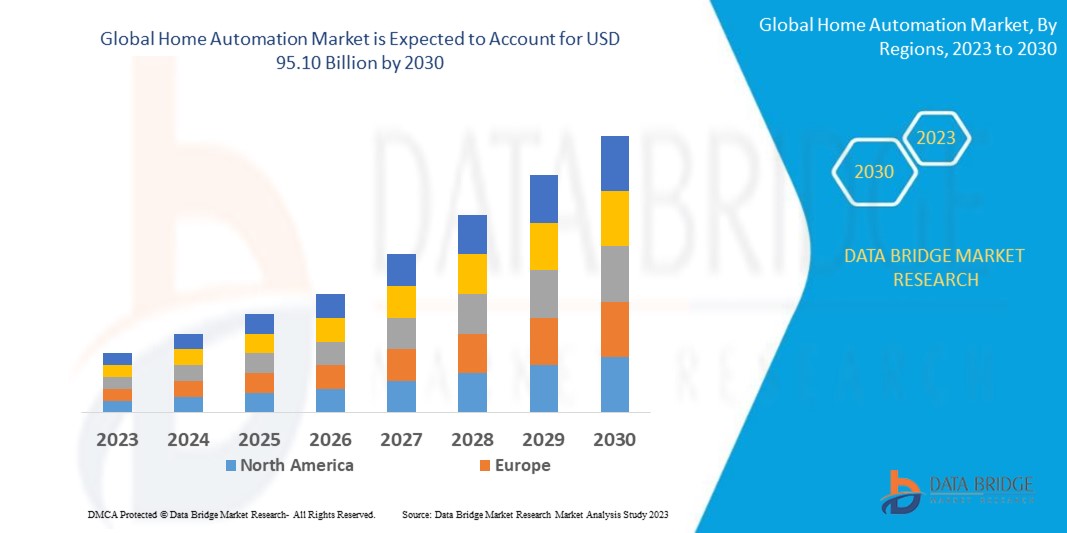
Home Automation Market Analysis
The global home automation market has witnessed significant growth in recent years, driven by advancements in technology and rising consumer demand for enhanced convenience and energy efficiency. Home automation integrates smart devices and systems to provide seamless control over lighting, security, heating, ventilation, and air conditioning (HVAC), entertainment, and more. The increasing adoption of Internet of Things (IoT) technology and wireless communication has enabled homeowners to manage their systems remotely through smartphones and voice-controlled assistants such as Amazon Alexa, Google Assistant, and Apple HomeKit.
Technological advancements, such as AI-driven automation, smart sensors, and real-time monitoring, have transformed homes into connected ecosystems. Energy efficiency is a key driver, as smart systems optimize resource usage, reducing costs and environmental impact. For instance, smart thermostats can learn user preferences and adjust heating or cooling automatically.
The market is also benefiting from growing awareness of security solutions, with smart locks, surveillance cameras, and motion sensors becoming integral to modern home designs. Leading players are investing in innovations such as centralized control hubs and enhanced device interoperability, further driving market growth. With expanding adoption in residential and commercial sectors, the home automation market continues to evolve, offering a smarter, more efficient future.
Home Automation Market Size
The global home automation market size was valued at USD 54.30 billion in 2024 and is projected to reach USD 80.83 billion by 2032, with a CAGR of 5.10 % during the forecast period of 2025 to 2032. In addition to the insights on market scenarios such as market value, growth rate, segmentation, geographical coverage, and major players, the market reports curated by the Data Bridge Market Research also include depth expert analysis, patient epidemiology, pipeline analysis, pricing analysis, and regulatory framework.
Home Automation Market Trends
“Growing Integration of Artificial Intelligence (AI)”
A significant trend shaping the home automation market is the growing integration of Artificial Intelligence (AI) with smart home systems. AI-driven automation enhances the functionality of home devices by learning user behaviors, optimizing energy consumption, and providing predictive maintenance. For instance, AI-enabled thermostats, such as Google Nest, analyze user habits and external weather conditions to create personalized heating and cooling schedules, improving energy efficiency while reducing costs. Similarly, AI-powered voice assistants, such as Amazon Alexa and Apple Siri, enable seamless control of lighting, security, and entertainment systems through natural language commands. The incorporation of machine learning in these devices allows them to adapt and improve over time, delivering a highly personalized user experience. As consumers increasingly demand smarter, more intuitive solutions, the fusion of AI with IoT technology is accelerating the adoption of home automation systems, driving innovation and reshaping the market landscape for both residential and commercial applications.
Report Scope and Home Automation Market Segmentation
|
Attributes |
Home Automation Key Market Insights |
|
Segments Covered |
|
|
Countries Covered |
U.S., Canada and Mexico in North America, Germany, France, U.K., Netherlands, Switzerland, Belgium, Russia, Italy, Spain, Turkey, Rest of Europe in Europe, China, Japan, India, South Korea, Singapore, Malaysia, Australia, Thailand, Indonesia, Philippines, Rest of Asia-Pacific (APAC) in the Asia-Pacific (APAC), Saudi Arabia, U.A.E., South Africa, Egypt, Israel, Rest of Middle East and Africa (MEA) as a part of Middle East and Africa (MEA), Brazil, Argentina and Rest of South America as part of South America |
|
Key Market Players |
Johnson Controls (Ireland), Honeywell International Inc. (U.S.), Schneider Electric (France), Siemens (Germany), Legrand (France), Apple Inc. (U.S.), Resideo Technologies Inc. (U.S.), Robert Bosch GmbH (Germany), ABB (Switzerland), Loxone Electronics GmbH (Austria), Vivint, Inc. (U.S.), Nice North America (Italy), Fantasia Trading LLC (U.K.), The Domotics - Luxury Home Automation (India), OKOS SOLUTIONS, LLC (U.S.), Snap One, LLC (U.S.), Crestron Electronics, Inc. (U.S.), Ingersoll Rand (U.S.), Leviton Manufacturing Co., Inc. (U.S.), and Lutron Electronics Co., Inc. (U.S.) |
|
Market Opportunities |
|
|
Value Added Data Infosets |
In addition to the insights on market scenarios such as market value, growth rate, segmentation, geographical coverage, and major players, the market reports curated by the Data Bridge Market Research also include in-depth expert analysis, geographically represented company-wise production and capacity, network layouts of distributors and partners, detailed and updated price trend analysis and deficit analysis of supply chain and demand. |
Home Automation Market Definition
Home automation refers to the use of advanced technology and smart devices to control and manage various household functions automatically and remotely. These systems integrate appliances, lighting, security, heating, ventilation, and air conditioning (HVAC), and entertainment devices into a single, cohesive network.
Home Automation Market Dynamics
Drivers
- Rising Demand for Energy Efficiency
The growing awareness around the environmental impact of excessive energy consumption is a major driver for the home automation market. As more consumers look for ways to reduce their carbon footprint and save on utility costs, energy-efficient home automation solutions are becoming increasingly popular. Smart thermostats such as Nest and Ecobee enable users to adjust heating and cooling remotely and learn the user's preferences and adjust automatically to optimize energy use. This contributes to reduced energy bills, helping homeowners save money while simultaneously supporting global sustainability efforts. As energy conservation becomes a priority, the demand for smart systems that reduce overall energy consumption will continue to grow, pushing the market forward.
- Increased Adoption of IoT and Smart Devices
The expansion of the Internet of Things (IoT) has revolutionized how consumers interact with their home environments, driving the growth of the home automation market. IoT devices, including smart thermostats, lighting systems, and connected appliances, offer enhanced convenience and control. Smart speakers, such as Amazon Alexa and Google Assistant, allow users to integrate and control various home systems with simple voice commands, enhancing the overall user experience. Moreover, these devices provide real-time monitoring and automation, making everyday tasks more efficient. As affordability and accessibility increase, IoT devices are no longer considered a luxury, but rather a standard feature in modern homes, thereby fueling the widespread adoption of home automation systems and driving the market's growth.
Opportunities
- Growing Focus on Home Security
As concerns over personal safety and property protection continue to rise, home security systems have become a key focus for homeowners, driving the growth of the home automation market. The increasing adoption of smart security products such as video doorbells, surveillance cameras, and automated locks offers significant peace of mind by providing real-time monitoring and control. Devices such as the Ring doorbell allow homeowners to view visitors remotely and communicate through their smartphones, while smart locks provide keyless entry with enhanced security features. ADT, a leader in home security, has also integrated smart home automation features into its offerings, providing an all-in-one solution for security and convenience. This heightened demand for advanced security systems creates a market opportunity for companies to innovate and develop new, integrated smart home solutions that cater to consumers' growing concerns over safety.
- Growing Disposable Income and Lifestyle Changes
Rising disposable income and a shift in consumer priorities towards luxury, convenience, and technological sophistication are driving the demand for home automation solutions. As lifestyles evolve, more people are seeking to enhance their living environments with smart systems that offer comfort and ease. Automated entertainment systems, such as smart TVs and voice-controlled home theaters, are becoming commonplace in modern homes, while advanced climate control solutions such as smart thermostats and automated blinds offer personalized comfort. Consumers are increasingly investing in customized smart home systems that integrate various functions, enhancing their overall quality of life. As purchasing power increases, the demand for high-end, feature-rich smart home systems continues to rise, creating substantial market opportunities for manufacturers in the home automation space.
Restraints/Challenges
- High Initial Cost
The high initial costs associated with home automation systems are one of the key barriers to widespread adoption. Smart home devices, including smart thermostats, security cameras, lighting controls, and home automation hubs, typically require significant upfront investment, which can deter price-sensitive consumers. For instance, a fully integrated home automation system can cost thousands of dollars, including both the devices themselves and the installation services required. In addition, older homes may require extensive retrofitting or wiring updates to support smart systems, further driving up installation costs. These initial expenses can be a deterrent, especially for middle-income households, making home automation technologies less accessible and limiting market penetration. As a result, while the demand for smart home products is growing, the high costs remain a significant hurdle for many consumers who might otherwise benefit from the convenience, security, and energy efficiency these systems offer.
- Security and Privacy Concerns
Security and privacy concerns are growing as more home automation devices become connected to the internet, creating vulnerabilities that can be exploited by cybercriminals. Many smart home products, such as security cameras, voice assistants, and smart door locks, are constantly collecting and transmitting data, which raises questions about data security and consumer privacy. For instance, there have been instances where smart home devices, such as Amazon Alexa or Ring cameras, were hacked, exposing users' personal data and compromising the safety of their homes. Consumers worry about potential breaches, where hackers could gain access to live video feeds or even control smart locks, leading to safety risks. These concerns about cybersecurity and data privacy are significant market challenges as they create hesitation among potential customers who are wary of exposing their private information. Without proper safeguards and transparent privacy policies, consumers may choose to avoid smart home products altogether, limiting market expansion.
This market report provides details of new recent developments, trade regulations, import-export analysis, production analysis, value chain optimization, market share, impact of domestic and localized market players, analyses opportunities in terms of emerging revenue pockets, changes in market regulations, strategic market growth analysis, market size, category market growths, application niches and dominance, product approvals, product launches, geographic expansions, technological innovations in the market. To gain more info on the market contact Data Bridge Market Research for an Analyst Brief, our team will help you take an informed market decision to achieve market growth.
Home Automation Market Scope
The market is segmented on the basis of component, technology, end user, and application. The growth amongst these segments will help you analyse meagre growth segments in the industries and provide the users with a valuable market overview and market insights to help them make strategic decisions for identifying core market applications.
Component
- Product
- Services
Technology
- Wired
- Wireless
- Power Line-Based
End User
- Residential
- Commercial
Application
- Lighting
- Safety and Security
- HVAC
- Entertainment
- Others
Home Automation Market Regional Analysis
The market is analysed and market size insights and trends are provided by country, component, technology, end user, and application as referenced above.
The countries covered in the market report are U.S., Canada and Mexico in North America, Germany, France, U.K., Netherlands, Switzerland, Belgium, Russia, Italy, Spain, Turkey, Rest of Europe in Europe, China, Japan, India, South Korea, Singapore, Malaysia, Australia, Thailand, Indonesia, Philippines, Rest of Asia-Pacific (APAC) in the Asia-Pacific (APAC), Saudi Arabia, U.A.E., South Africa, Egypt, Israel, Rest of Middle East and Africa (MEA) as a part of Middle East and Africa (MEA), Brazil, Argentina and Rest of South America as part of South America.
North America dominates the Home Automation market, driven by advanced technological infrastructure and a high level of consumer awareness regarding smart home solutions. The region's strong adoption of IoT devices, such as smart thermostats, security systems, and energy management tools, contributes significantly to market growth. Moreover, increasing investments in home automation technologies and the presence of key market players in the U.S. and Canada further bolster the region's leadership. Rising demand for energy-efficient and convenient living solutions also enhances the penetration of home automation systems across North America.
Asia-Pacific is witnessing the fastest growth in the global home automation market due to rapid urbanization, increasing disposable incomes, and the growing adoption of smart technologies in countries such as China, India, and Japan. The region's expanding middle-class population is driving demand for enhanced home convenience, safety, and energy efficiency. In addition, government initiatives promoting smart city projects and sustainable development are boosting the adoption of home automation solutions. For instance, the proliferation of IoT-enabled devices and smart home systems, such as voice-controlled lighting and security systems, is further fueling market growth in the Asia-Pacific region.
The country section of the report also provides individual market impacting factors and changes in regulation in the market domestically that impacts the current and future trends of the market. Data points such as down-stream and upstream value chain analysis, technical trends and porter's five forces analysis, case studies are some of the pointers used to forecast the market scenario for individual countries. Also, the presence and availability of global brands and their challenges faced due to large or scarce competition from local and domestic brands, impact of domestic tariffs and trade routes are considered while providing forecast analysis of the country data.
Home Automation Market Share
The market competitive landscape provides details by competitor. Details included are company overview, company financials, revenue generated, market potential, investment in research and development, new market initiatives, global presence, production sites and facilities, production capacities, company strengths and weaknesses, product launch, product width and breadth, application dominance. The above data points provided are only related to the companies' focus related to market.
Home Automation Market Leaders Operating in the Market Are:
- Johnson Controls (Ireland)
- Honeywell International Inc. (U.S.)
- Schneider Electric (France)
- Siemens (Germany)
- Legrand (France)
- Apple Inc. (U.S.)
- Resideo Technologies Inc. (U.S.)
- Robert Bosch GmbH (Germany)
- ABB (Switzerland)
- Loxone Electronics GmbH (Austria)
- Vivint, Inc. (U.S.)
- Nice North America (Italy)
- Fantasia Trading LLC (U.K.)
- The Domotics - Luxury Home Automation (India)
- OKOS SOLUTIONS, LLC (U.S.)
- Snap One, LLC (U.S.)
- Crestron Electronics, Inc. (U.S.)
- Ingersoll Rand (U.S.)
- Leviton Manufacturing Co., Inc. (U.S.)
- Lutron Electronics Co., Inc. (U.S.)
Latest Developments in Home Automation Market
- In May 2024, Resideo Technologies, Habitat for Humanity, and Arrow Electronics collaborated on a state-of-the-art smart home project in Denver, Colorado, integrating next-generation technologies in affordable housing with energy-efficient systems, smart appliances, and advanced home control solutions to enhance residents' comfort
- In July 2023, Schneider Electric signed a Memorandum of Understanding (MoU) with Samridhi Group, delivering innovative and eco-friendly smart home solutions by developing energy-efficient homes with Schneider Electric's Wiser Smart Home Solution, Unica Pure wiring devices, and low-voltage switchgear, among other products
- In August 2023, Yale Home launched the Yale Assure Smart Deadbolts, offering advanced access control with touchscreens and compatibility with Amazon Alexa, Google Assistant, and Apple HomeKit, including models such as the Yale Assure Lock SL and the Yale Assure Lock Touchscreen Deadbolt with tailored features for diverse needs
- In March 2023, Johnson Controls introduced the IQ4 NS (No Screen) system, a security and home automation solution designed for residential and small commercial use, integrating intrusion detection, video surveillance, access control, and smart home functionalities such as lighting and thermostat management
- In January 2023, Schneider Electric unveiled Schneider Home, a comprehensive energy management system that includes a home battery, high-power solar inverter, smart electrical panel, EV charger, and connected outlets and light switches, all seamlessly controlled through the Schneider Home app
SKU-
Получите онлайн-доступ к отчету на первой в мире облачной платформе рыночной аналитики

- Интерактивная панель анализа данных
- Панель анализа компании для возможностей с высоким потенциалом роста
- Доступ аналитика-исследователя для настройки и запросов
- Анализ конкурентов с помощью интерактивной панели
- Последние новости, обновления и анализ тенденций
- Используйте возможности сравнительного анализа для комплексного отслеживания конкурентов
Методология исследования
Сбор данных и анализ базового года выполняются с использованием модулей сбора данных с большими размерами выборки. Этап включает получение рыночной информации или связанных данных из различных источников и стратегий. Он включает изучение и планирование всех данных, полученных из прошлого заранее. Он также охватывает изучение несоответствий информации, наблюдаемых в различных источниках информации. Рыночные данные анализируются и оцениваются с использованием статистических и последовательных моделей рынка. Кроме того, анализ доли рынка и анализ ключевых тенденций являются основными факторами успеха в отчете о рынке. Чтобы узнать больше, пожалуйста, запросите звонок аналитика или оставьте свой запрос.
Ключевой методологией исследования, используемой исследовательской группой DBMR, является триангуляция данных, которая включает в себя интеллектуальный анализ данных, анализ влияния переменных данных на рынок и первичную (отраслевую экспертную) проверку. Модели данных включают сетку позиционирования поставщиков, анализ временной линии рынка, обзор рынка и руководство, сетку позиционирования компании, патентный анализ, анализ цен, анализ доли рынка компании, стандарты измерения, глобальный и региональный анализ и анализ доли поставщика. Чтобы узнать больше о методологии исследования, отправьте запрос, чтобы поговорить с нашими отраслевыми экспертами.
Доступна настройка
Data Bridge Market Research является лидером в области передовых формативных исследований. Мы гордимся тем, что предоставляем нашим существующим и новым клиентам данные и анализ, которые соответствуют и подходят их целям. Отчет можно настроить, включив в него анализ ценовых тенденций целевых брендов, понимание рынка для дополнительных стран (запросите список стран), данные о результатах клинических испытаний, обзор литературы, обновленный анализ рынка и продуктовой базы. Анализ рынка целевых конкурентов можно проанализировать от анализа на основе технологий до стратегий портфеля рынка. Мы можем добавить столько конкурентов, о которых вам нужны данные в нужном вам формате и стиле данных. Наша команда аналитиков также может предоставить вам данные в сырых файлах Excel, сводных таблицах (книга фактов) или помочь вам в создании презентаций из наборов данных, доступных в отчете.











