


Global Induced Pluripotent Market Segmentation, By Product Category (Cell Culture, Differentiation, Reprogramming, Engineering, Cell Analysis and Others), Cell Type (Hepatocytes, Fibroblasts, Keratinocytes, Amniotic Cells, Neurons and Others), Application (Drug Development, Regenerative Medicine, Toxicity Testing, Academic Research and Stem Cell Bio-Banking), End-User (Academic and Research Institutes, Biotechnology Companies and Hospitals) - Industry Trends and Forecast to 2033
Induced Pluripotent Market Size
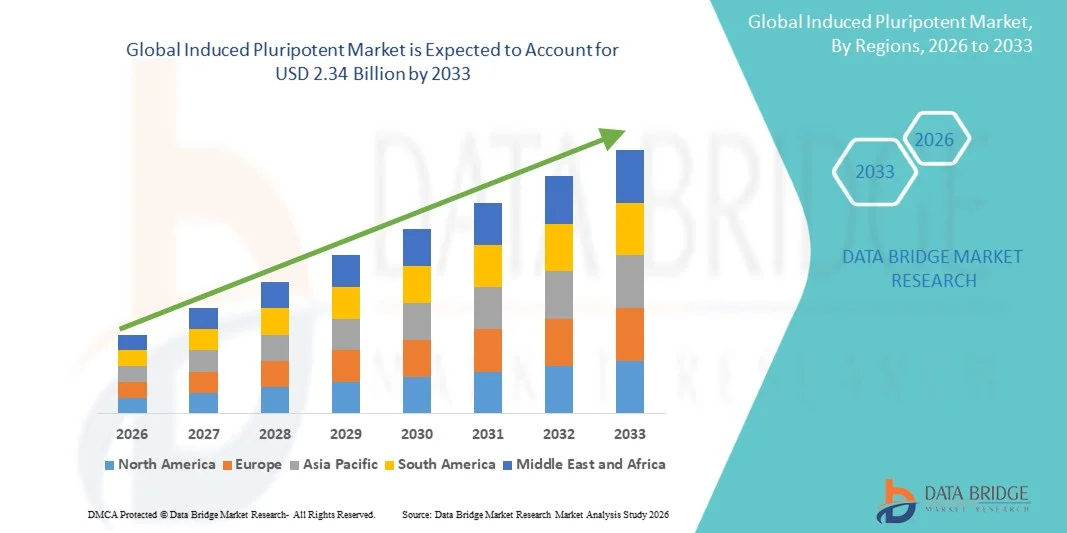
- The global Induced Pluripotent market size was valued at USD 1.10 billion in 2025 and is expected to reach USD 2.34 billion by 2033, at a CAGR of 9.90% during the forecast period
- The market growth is largely fueled by the increasing adoption of advanced cellular technologies and rapid progress in regenerative medicine, leading to expanded applications of induced pluripotent cells in disease modeling, drug discovery, and personalized therapies across research and clinical settings
- Furthermore, the rising demand for patient-specific therapeutic solutions, coupled with growing investments in stem cell research and biotechnology, is establishing induced pluripotent solutions as a critical component of modern biomedical research. These converging factors are accelerating the uptake of induced pluripotent solutions, thereby significantly boosting the market growth
Induced Pluripotent Market Analysis
- Induced pluripotent cells (iPSCs), which are adult cells reprogrammed to a pluripotent state, are increasingly important in biomedical research and regenerative medicine due to their ability to differentiate into multiple cell types and support applications in disease modeling, drug discovery, and personalized therapies
- The escalating demand for induced pluripotent solutions is primarily driven by growing investments in stem cell research, expanding regenerative medicine applications, and increasing adoption of patient-specific therapies in both research and clinical settings
- North America dominated the induced pluripotent market with a revenue share of approximately 40.00% in 2025, supported by strong research infrastructure, high funding for stem cell studies, and the presence of key biotechnology and pharmaceutical companies. The U.S. continues to lead due to extensive clinical research and innovation in iPSC-based applications
- Asia-Pacific is expected to be the fastest-growing region in the induced pluripotent market during the forecast period, driven by increasing government support, rising biotechnology investments, and rapid expansion of research capabilities in countries such as China, Japan, and India
- The Fibroblasts segment held the largest market revenue share of 38.7% in 2025, driven by their high reprogramming efficiency and extensive use in generating stable iPSC lines
Report Scope and Induced Pluripotent Market Segmentation
|
Attributes |
Induced Pluripotent Key Market Insights |
|
Segments Covered |
|
|
Countries Covered |
North America
Europe
Asia-Pacific
Middle East and Africa
South America
|
|
Key Market Players |
• Thermo Fisher Scientific Inc. (U.S.) |
|
Market Opportunities |
|
|
Value Added Data Infosets |
In addition to the insights on market scenarios such as market value, growth rate, segmentation, geographical coverage, and major players, the market reports curated by the Data Bridge Market Research also include in-depth expert analysis, patient epidemiology, pipeline analysis, pricing analysis, and regulatory framework. |
Induced Pluripotent Market Trends
“Rising Adoption in Regenerative Medicine and Drug Discovery”
- A key trend in the global induced pluripotent market is the increasing adoption of iPSCs in regenerative medicine, disease modeling, and drug discovery applications. Researchers and pharmaceutical companies are leveraging iPSC technology to develop personalized therapies, screen drug toxicity, and model genetic diseases, which is significantly accelerating market growth. This trend is contributing to a paradigm shift in precision medicine, enabling therapies that are tailored to individual patient profiles
- For instance, in March 2024, Takeda Pharmaceuticals collaborated with Kyoto University to use iPSC-derived cardiomyocytes for drug safety testing, demonstrating the practical application of iPSCs in preclinical drug development. Similarly, in 2025, a European biotech startup used iPSC-derived neurons to model Alzheimer’s disease, which helped identify promising new drug candidates
- Furthermore, the trend is supported by increasing public-private partnerships and collaborations between biotech startups and established pharmaceutical firms, aiming to expand the therapeutic scope of iPSCs. Companies are now exploring applications in liver regeneration, retinal diseases, and autoimmune disorders
- Advancements in automated iPSC culture systems, bioprinting technologies, and high-throughput screening platforms are further enhancing the usability and scalability of iPSCs. These innovations are helping laboratories achieve consistent cell quality while reducing manual labor, thereby broadening iPSC adoption across research institutions globally
- In addition, educational and training programs in regenerative medicine and stem cell biology are growing, helping build skilled personnel capable of working with iPSCs, which further drives market penetration
Induced Pluripotent Market Dynamics
Driver
“Expanding Research Funding and Government Support”
- The Induced Pluripotent market is strongly driven by increasing research funding from both government bodies and private organizations
- Investments in biotechnology, stem cell research grants, and initiatives promoting regenerative medicine are providing critical support for the growth of iPSC technologies. This financial backing facilitates large-scale studies, accelerates clinical trials, and improves laboratory infrastructure
- For instance, in June 2025, the U.S. National Institutes of Health (NIH) awarded $45 million in grants to support iPSC-based disease modeling for neurological disorders, aiming to develop safer and more effective drug candidates. Similarly, the Japanese Agency for Medical Research allocated funding for iPSC-based regenerative therapy programs targeting spinal cord injuries, boosting both research activity and clinical readiness
- In addition, regulatory encouragement in regions like Japan, with frameworks for fast-track approval of regenerative therapies, is further motivating companies and academic institutions to adopt iPSC technology for therapeutic applications. The European Union is also promoting stem cell research through Horizon Europe programs, supporting cross-border collaborations
- Corporate investment is another key driver. Several pharmaceutical giants are establishing dedicated iPSC research centers to integrate these cells into drug development pipelines. These efforts are driving faster commercialization and increasing confidence among investors in iPSC-based platforms
- The growing trend of personalized medicine and precision therapeutics is also encouraging the use of iPSCs for patient-specific drug testing and therapy development, further expanding the market
Restraint/Challenge
“High Cost and Regulatory Hurdles”
- Despite significant growth, the Induced Pluripotent market faces challenges from the high cost of iPSC generation, culturing, and validation processes. Maintaining quality, purity, and pluripotency of the cells requires specialized equipment and expertise, which can limit accessibility, particularly for smaller research labs or institutions in developing regions
- For instance, in September 2024, a report highlighted that several mid-sized research laboratories in India had to delay iPSC-based experiments due to budget constraints and the high cost of GMP-compliant cell lines. Similarly, European hospitals have expressed concern over the expensive scale-up processes required to produce clinically relevant iPSC batches
- In addition, stringent regulatory requirements for stem cell research and therapeutic applications pose a challenge to market expansion. Compliance with safety, ethical, and quality standards is essential but may slow down the development and commercialization of iPSC-based products
- Technical challenges such as genetic instability, differentiation variability, and immunogenicity risks can also hinder large-scale adoption. Addressing these challenges requires continuous research, advanced quality control systems, and standardization protocols
- Moreover, lack of public awareness and ethical concerns about stem cell applications in certain regions may affect market penetration. Initiatives to educate the public and clarify ethical regulations are necessary to overcome these restraints
- Overcoming these challenges requires technological innovations that reduce production costs, streamlined regulatory pathways, and stronger collaborations between research organizations, pharmaceutical companies, and regulatory authorities to enable faster clinical application and commercialization
Induced Pluripotent Market Scope
The market is segmented on the basis of product category, cell type, application, and end-user.
• By Product Category
On the basis of product category, the Induced Pluripotent market is segmented into Cell Culture, Differentiation, Reprogramming, Engineering, Cell Analysis, and Others. The Cell Culture segment dominated the largest market revenue share of 41.5% in 2025, driven by its essential role in maintaining viable iPSC lines for research and therapeutic purposes. Researchers and pharmaceutical companies heavily rely on standardized culture media and reagents to ensure reproducibility and cell stability. The segment benefits from continuous advancements in media formulations and supplements that enhance cell growth and differentiation potential. High adoption in academic and industrial research projects further supports demand. In addition, the segment is supported by frequent usage and recurring procurement, contributing to stable revenue streams. Standardized protocols and commercial availability enhance convenience for end users. Strong collaborations between product manufacturers and research institutions also drive market dominance. Growing investments in stem cell research globally support expansion. The segment’s foundational role in iPSC workflows ensures continued leadership.
The Reprogramming segment is expected to witness the fastest CAGR of 23.2% from 2026 to 2033, fueled by rising demand for patient-specific iPSC generation for disease modeling and personalized medicine. Advances in viral and non-viral reprogramming technologies are improving efficiency and safety. The segment benefits from increasing focus on therapeutic applications, including regenerative medicine and cell therapy development. Academic and biotechnology sectors are expanding reprogramming capabilities. Increased government funding and private investments support innovation. Technological improvements in automated and high-throughput platforms enhance adoption. Growing prevalence of chronic and genetic disorders drives demand for patient-specific models. Pharmaceutical companies use reprogrammed iPSCs extensively in drug screening and toxicity testing. The rising focus on precision medicine further accelerates growth. Overall, reprogramming is positioned as the fastest-growing product category in the market.
• By Cell Type
On the basis of cell type, the Induced Pluripotent market is segmented into Hepatocytes, Fibroblasts, Keratinocytes, Amniotic Cells, Neurons, and Others. The Fibroblasts segment held the largest market revenue share of 38.7% in 2025, driven by their high reprogramming efficiency and extensive use in generating stable iPSC lines. Fibroblast-derived iPSCs are widely adopted for disease modeling, drug screening, and regenerative applications. The segment benefits from standardized isolation and culture protocols. In addition, fibroblasts are easily obtainable via minimally invasive skin biopsies, supporting broad adoption. The segment is widely used across academic, pharmaceutical, and clinical research settings. Ongoing research in personalized medicine and tissue engineering further supports growth. Cost-effective protocols and availability of commercial kits enhance accessibility. Strong collaborations with biotech and pharmaceutical companies also strengthen the segment. Continuous advancements in fibroblast reprogramming maintain market dominance.
The Neurons segment is anticipated to witness the fastest CAGR of 22.9% from 2026 to 2033, fueled by increasing demand for neurological disease modeling and neurotoxicity testing. iPSC-derived neurons allow the study of disorders such as Alzheimer’s, Parkinson’s, and autism in patient-specific cellular models. The segment benefits from growing focus on drug discovery for CNS disorders. Technological innovations in differentiation protocols enhance yield and reproducibility. Academic and pharmaceutical research institutes are investing heavily in neuronal iPSC studies. The segment also supports regenerative therapies and personalized medicine initiatives. Increasing prevalence of neurological disorders further accelerates adoption. Strong government and private funding in neuroscience research promotes growth. As CNS-focused studies expand, neuron-derived iPSCs are expected to grow rapidly.
• By Application
On the basis of application, the Induced Pluripotent market is segmented into Drug Development, Regenerative Medicine, Toxicity Testing, Academic Research, and Stem Cell Bio-Banking. The Drug Development segment accounted for the largest market revenue share of 35.6% in 2025, driven by extensive adoption of iPSCs for high-throughput drug screening and efficacy studies. iPSCs provide human-relevant models that improve prediction of drug safety and effectiveness. Pharmaceutical companies rely on these models to reduce reliance on animal testing. The segment benefits from continuous R&D investment and technological advancements. Academic institutions also contribute to growth through collaborative research projects. Increasing prevalence of chronic diseases boosts the need for novel therapeutics. Availability of patient-specific iPSCs enhances personalized medicine efforts. High reproducibility and standardized protocols support adoption. The segment’s central role in drug discovery maintains market leadership.
The Regenerative Medicine segment is expected to witness the fastest CAGR of 24.5% from 2026 to 2033, fueled by increasing interest in cell-based therapies and tissue engineering applications. iPSCs enable the generation of patient-specific cells, reducing immune rejection risk. Advancements in 3D bioprinting and scaffold technologies enhance applicability in regenerative therapies. Clinical trials and government support for regenerative medicine are increasing adoption. Biotechnology and pharmaceutical companies are investing in developing innovative treatments. Rising prevalence of degenerative and chronic conditions accelerates demand. Academic research in stem cell therapeutics further supports growth. The segment also benefits from public-private partnerships for translational research. As regenerative medicine matures, this segment is poised for rapid expansion.
• By End-User
On the basis of end-user, the Induced Pluripotent market is segmented into Academic and Research Institutes, Biotechnology Companies, and Hospitals. The Biotechnology Companies segment dominated the largest market revenue share of 48.3% in 2025, driven by extensive use of iPSCs in R&D, drug discovery, and therapeutic development. These companies invest heavily in specialized equipment, kits, and skilled personnel for efficient workflows. The segment benefits from collaborations with academic institutions and contract research organizations. Rising focus on personalized medicine further supports growth. Government grants and private investments enable advanced research projects. Pharmaceutical partnerships boost adoption and application scope. Continuous innovation in cell technologies strengthens segment capabilities. Biotechnology companies’ operational scale and investment capacity maintain market dominance.
The Academic and Research Institutes segment is anticipated to witness the fastest CAGR of 23.8% from 2026 to 2033, fueled by growing stem cell research activities and increased funding support. Universities and public research organizations are exploring applications in disease modeling, toxicity testing, and regenerative therapies. The segment benefits from government initiatives and grant programs. Expansion of laboratory infrastructure in emerging markets further drives adoption. Academic-industry collaborations accelerate innovation and translational research. Increased awareness of iPSC potential among researchers supports growth. Technological advancements and availability of standardized kits enhance usability. The rising number of publications and clinical studies contributes to segment expansion. As research investments increase globally, this segment is expected to grow rapidly.
Induced Pluripotent Market Regional Analysis
- North America dominated the induced pluripotent market with the largest revenue share of approximately 40.00% in 2025, supported by strong research infrastructure, high funding for stem cell studies, and the presence of key biotechnology and pharmaceutical companies. The region benefits from advanced laboratory facilities, highly skilled researchers, and access to cutting-edge technologies that enable high-quality iPSC generation and applications
- Consumers and research institutions in the region are increasingly leveraging iPSCs for regenerative medicine, disease modeling, and drug discovery. For instance, in 2024, the Massachusetts General Hospital used iPSC-derived cardiomyocytes to screen potential cardiotoxic effects of new drugs, demonstrating the practical application of these cells in high-stakes research
- The market continues to lead due to extensive clinical research and innovation in iPSC-based applications, with collaborations between academic institutions and biotech firms fostering rapid commercialization of iPSC therapies. Additionally, regulatory support for stem cell research, including grants from the NIH and other funding bodies, encourages experimental therapies and precision medicine initiatives
U.S. Induced Pluripotent Market Insight
The U.S. induced pluripotent market captured the largest revenue share within North America in 2025, driven by the extensive patient population, active clinical trials, and pioneering research programs in stem cell therapies. Hospitals, research institutions, and biotechnology companies are utilizing iPSCs for personalized medicine, disease modeling, and regenerative therapies. For instance, in 2025, Stanford University partnered with a leading biotech firm to develop iPSC-derived liver cells for studying non-alcoholic fatty liver disease, highlighting the growing clinical and research applications of iPSCs. Moreover, the integration of AI-driven data analytics in stem cell research is helping scientists optimize differentiation protocols, accelerate drug testing, and improve reproducibility, further boosting market demand.
Europe Induced Pluripotent Market Insight
The Europe induced pluripotent market is projected to expand at a substantial CAGR throughout the forecast period, supported by increasing investments in stem cell research and regulatory frameworks that encourage ethical biomedical innovation. The demand is primarily driven by research in regenerative medicine, disease modeling, and pharmaceutical development. For instance, in Germany, the Max Planck Institute successfully used iPSC-derived neurons to study neurodegenerative disorders, enabling identification of potential therapeutic targets. European research institutions are collaborating extensively with biotech startups and pharmaceutical companies to advance the clinical applications of iPSCs, while public funding and EU programs, such as Horizon Europe, provide significant support for cross-border regenerative medicine projects.
U.K. Induced Pluripotent Market Insight
The U.K. induced pluripotent market is anticipated to grow at a noteworthy CAGR, driven by high research activity in regenerative medicine and government-backed initiatives supporting stem cell innovation. The growing focus on personalized medicine and drug development is creating substantial demand for high-quality iPSCs. For instance, in 2025, Cambridge University researchers used iPSC-derived retinal cells to explore therapies for age-related macular degeneration, reflecting the increasing application of iPSCs in clinical research. The U.K.’s strong biotech ecosystem, combined with supportive regulatory frameworks and a growing network of stem cell research centers, is facilitating faster translation of laboratory research into potential therapeutic applications.
Germany Induced Pluripotent Market Insight
The Germany induced pluripotent market is expected to expand at a considerable CAGR, fueled by a well-established research infrastructure, government grants, and rising interest in regenerative therapies. The country’s emphasis on sustainability and precision medicine promotes the development of iPSC-derived products for clinical and pharmaceutical applications. Institutions such as the Fraunhofer Institute are leveraging iPSCs for liver and cardiac tissue engineering, driving innovation in organoid-based disease modeling and drug toxicity testing. Germany’s robust collaboration between universities, research institutions, and biotech startups ensures continuous advancements in iPSC technology and supports commercialization of novel therapies.
Asia-Pacific Induced Pluripotent Market Insight
The Asia-Pacific induced pluripotent market is poised to grow at the fastest CAGR during the forecast period, driven by increasing government support, rising biotechnology investments, and rapid expansion of research capabilities in countries such as China, Japan, and India. The region is witnessing growing awareness of regenerative medicine, personalized therapies, and drug discovery applications. In 2025, China’s Institute of Stem Cell Research developed iPSC-derived pancreatic beta cells for diabetes studies, highlighting the rapid progress of iPSC applications in the region. Similarly, Japan’s Kyoto University continues to lead in iPSC clinical trials for spinal cord injuries and retinal diseases. The APAC region is also benefiting from cost-effective manufacturing facilities, skilled scientific talent, and expanding collaborations between domestic and international biotech firms, further driving market adoption and research output.
Japan Induced Pluripotent Market Insight
The Japan induced pluripotent market is gaining momentum due to strong government support, established clinical research infrastructure, and a culture of advanced biomedical innovation. Japan’s emphasis on regenerative medicine, stem cell therapies, and aging population needs is fueling the adoption of iPSCs. For instance, in 2024, RIKEN Center for Developmental Biology advanced iPSC-derived retinal therapies for macular degeneration patients, demonstrating the country’s leadership in regenerative medicine research. The presence of dedicated stem cell banks and clinical research centers, alongside regulatory frameworks that enable faster clinical translation, is strengthening Japan’s market growth.
China Induced Pluripotent Market Insight
The China induced pluripotent market accounted for the largest revenue share in Asia Pacific in 2025, driven by expanding research initiatives, government-backed funding, and the increasing prevalence of liver, cardiac, and neurological disorders that can benefit from iPSC-based research.
For instance, in 2025, a biotech consortium in Shanghai used iPSC-derived cardiomyocytes to screen cardiac drugs, accelerating the pace of pharmaceutical development. Strong domestic manufacturing capabilities, large patient populations, and supportive policies for biotechnology and regenerative medicine are helping China rapidly advance both research and clinical applications of iPSCs.
Induced Pluripotent Market Share
The Induced Pluripotent industry is primarily led by well-established companies, including:
• Thermo Fisher Scientific Inc. (U.S.)
• Lonza Group AG (Switzerland)
• Merck KGaA (Germany)
• GE Healthcare (U.K.)
• STEMCELL Technologies Inc. (Canada)
• ReproCELL Inc. (Japan)
• Fujifilm Cellular Dynamics, Inc. (U.S.)
• Axol Bioscience Ltd. (U.K.)
• Cellartis AB (Sweden)
• Life Technologies Corporation (U.S.)
• Ncardia BV (Netherlands)
• Astellas Pharma Inc. (Japan)
• Cellular Dynamics International, Inc. (U.S.)
• Cytiva (Sweden)
• Pluristem Therapeutics Inc. (Israel)
Latest Developments in Global Induced Pluripotent Market
- In April 2025, Kyoto University’s iPS Cell Research Foundation completed and began operations of its automated facility in Osaka (“Yanai my iPS Factory”), designed to produce patient‑specific iPSCs from blood cells using automated culture systems, significantly reducing manufacturing costs and enabling larger scale production for research and future clinical applications, reflecting a major step toward industrial‑level iPSC supply
- In June 2025, the same Yanai my iPS Cell Factory formally opened, equipped with 14 automated culture devices and storage infrastructure, with goals to reduce iPSC production time from months to weeks and dramatically lower costs per patient, supporting broader clinical research and personalized regenerative therapy development
- In March 2025, Pluristyx announced that its PSXi013 GMP‑compliant induced pluripotent stem cell line became immediately available for commercial use, allowing researchers and biopharma companies to access standardized clinical‑grade iPSC material for drug discovery and translational research
- In May 2025, a Korean biotech company YiPSCELL reportedly commenced an early clinical trial using iPSC‑based therapy in osteoarthritis patients, representing one of the first iPSC applications in musculoskeletal regenerative research in the region
- In February 2025, major industry analyses reported the continued expansion of clinical‑grade iPSC biobanks and manufacturing infrastructure globally, with governments in Asia committing funding to automate iPSC production and reduce manufacturing costs by an order of magnitude for future therapeutic use
- In February 2026, Japan’s Ministry of Health, Labour and Welfare granted conditional, time‑limited approval to the first two iPSC‑derived regenerative medicine products—ReHeart (a cardiomyocyte sheet therapy) and Amchepry (an iPSC‑derived dopaminergic cell product for Parkinson’s disease)—marking the world’s first regulatory approvals of therapies based on reprogrammed human iPS cells
SKU-
Получите онлайн-доступ к отчету на первой в мире облачной платформе рыночной аналитики
- Интерактивная панель анализа данных
- Панель анализа компании для возможностей с высоким потенциалом роста
- Доступ аналитика-исследователя для настройки и запросов
- Анализ конкурентов с помощью интерактивной панели
- Последние новости, обновления и анализ тенденций
- Используйте возможности сравнительного анализа для комплексного отслеживания конкурентов
Методология исследования
Сбор данных и анализ базового года выполняются с использованием модулей сбора данных с большими размерами выборки. Этап включает получение рыночной информации или связанных данных из различных источников и стратегий. Он включает изучение и планирование всех данных, полученных из прошлого заранее. Он также охватывает изучение несоответствий информации, наблюдаемых в различных источниках информации. Рыночные данные анализируются и оцениваются с использованием статистических и последовательных моделей рынка. Кроме того, анализ доли рынка и анализ ключевых тенденций являются основными факторами успеха в отчете о рынке. Чтобы узнать больше, пожалуйста, запросите звонок аналитика или оставьте свой запрос.
Ключевой методологией исследования, используемой исследовательской группой DBMR, является триангуляция данных, которая включает в себя интеллектуальный анализ данных, анализ влияния переменных данных на рынок и первичную (отраслевую экспертную) проверку. Модели данных включают сетку позиционирования поставщиков, анализ временной линии рынка, обзор рынка и руководство, сетку позиционирования компании, патентный анализ, анализ цен, анализ доли рынка компании, стандарты измерения, глобальный и региональный анализ и анализ доли поставщика. Чтобы узнать больше о методологии исследования, отправьте запрос, чтобы поговорить с нашими отраслевыми экспертами.
Доступна настройка
Data Bridge Market Research является лидером в области передовых формативных исследований. Мы гордимся тем, что предоставляем нашим существующим и новым клиентам данные и анализ, которые соответствуют и подходят их целям. Отчет можно настроить, включив в него анализ ценовых тенденций целевых брендов, понимание рынка для дополнительных стран (запросите список стран), данные о результатах клинических испытаний, обзор литературы, обновленный анализ рынка и продуктовой базы. Анализ рынка целевых конкурентов можно проанализировать от анализа на основе технологий до стратегий портфеля рынка. Мы можем добавить столько конкурентов, о которых вам нужны данные в нужном вам формате и стиле данных. Наша команда аналитиков также может предоставить вам данные в сырых файлах Excel, сводных таблицах (книга фактов) или помочь вам в создании презентаций из наборов данных, доступных в отчете.











