


Global Infrared Imaging Market Segmentation, By Technology (Cooled and Uncooled Infrared Imaging), Wavelength (Near Infrared (NIR), Shortwave Infrared (SWIR), Mid-Wave Infrared (MWIR), and Long-Wave Infrared (LWIR)), Application (Security and Surveillance, Monitoring, and Inspection and Detection), Vertical (Industrial and Non-Industrial) - Industry Trends and Forecast to 2033
Infrared Imaging Market Size
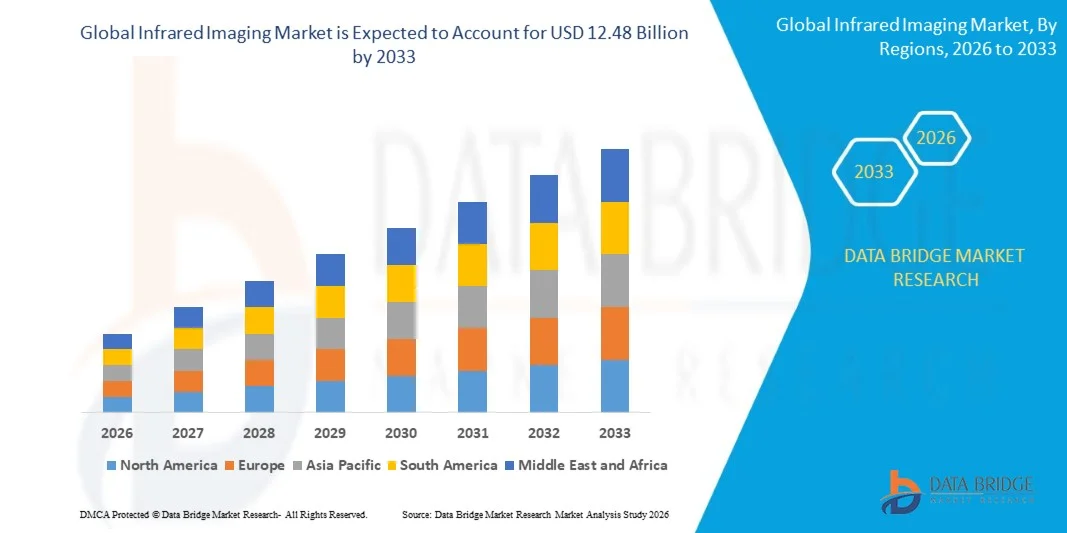
- The global infrared imaging market size was valued at USD 7.35 billion in 2025 and is expected to reach USD 12.48 billion by 2033, at a CAGR of 6.85% during the forecast period
- The market growth is largely fueled by the increasing adoption of advanced surveillance, industrial monitoring, and defense applications, coupled with technological advancements in infrared detector and imaging systems. The integration of infrared imaging with AI, IoT, and drone technologies is enhancing real-time monitoring and operational efficiency across multiple sectors, driving higher market penetration
- Furthermore, rising demand for precise, non-contact thermal measurement solutions in industries such as energy, manufacturing, healthcare, and security is establishing infrared imaging as a critical tool for inspection, predictive maintenance, and safety applications. These converging factors are accelerating the deployment of infrared imaging systems, thereby significantly boosting the market’s expansion
Infrared Imaging Market Analysis
- Infrared imaging systems capture and visualize thermal radiation from objects, enabling temperature detection, monitoring, and analysis in real time. These systems are deployed across security and surveillance, industrial monitoring, medical diagnostics, and research applications, offering high accuracy, enhanced safety, and operational efficiency
- The escalating demand for infrared imaging is primarily fueled by growing industrial automation, increasing defense and security investments, and rising adoption in healthcare and environmental monitoring. In addition, technological innovations such as uncooled microbolometer detectors, portable thermal cameras, and high-resolution MWIR/LWIR imaging solutions are further supporting market growth across commercial, industrial, and government sectors
- North America dominated the infrared imaging market with a share of 47.6% in 2025, due to strong adoption across defense, industrial, and security sectors, as well as increased government and private investments in advanced imaging technologies
- Asia-Pacific is expected to be the fastest growing region in the infrared imaging market during the forecast period due to increasing urbanization, industrial modernization, and technological adoption in countries such as China, Japan, and India
- Uncooled infrared imaging segment dominated the market with a market share of 58.8% in 2025, due to its compact design, lower cost, and minimal maintenance requirements compared with cooled systems. Uncooled infrared cameras are widely adopted in industrial monitoring, building inspections, and security applications due to their ease of deployment and consistent performance in diverse environmental conditions. The segment’s popularity is further supported by advancements in microbolometer technology, enhancing image resolution and sensitivity
Report Scope and Infrared Imaging Market Segmentation
|
Attributes |
Infrared Imaging Key Market Insights |
|
Segments Covered |
|
|
Countries Covered |
North America
Europe
Asia-Pacific
Middle East and Africa
South America
|
|
Key Market Players |
|
|
Market Opportunities |
|
|
Value Added Data Infosets |
In addition to the insights on market scenarios such as market value, growth rate, segmentation, geographical coverage, and major players, the market reports curated by the Data Bridge Market Research also include in-depth expert analysis, geographically represented company-wise production and capacity, network layouts of distributors and partners, detailed and updated price trend analysis and deficit analysis of supply chain and demand. |
Infrared Imaging Market Trends
“Rising Adoption of Uncooled Infrared Imaging Systems”
- A key trend in the infrared imaging market is the growing preference for uncooled infrared imaging systems due to their compact design, lower power consumption, and cost-effectiveness compared with cooled systems. These systems are increasingly being used in industrial inspection, security, and surveillance applications, where portability and rapid deployment are critical
- For instance, FLIR Systems supplies advanced uncooled infrared cameras that are widely utilized in building inspections, predictive maintenance, and perimeter security monitoring. These systems enhance operational efficiency while reducing the total cost of ownership for end users
- The deployment of uncooled systems in automotive and transportation applications is expanding as they provide reliable thermal detection for driver-assistance and night-vision systems. This adoption is reinforcing infrared imaging as a critical technology for improving safety and operational awareness on roads
- The healthcare sector is leveraging infrared thermal cameras for diagnostic and patient monitoring applications, where real-time temperature mapping is vital. These applications are driving innovation in portable and high-sensitivity uncooled infrared devices
- Industrial facilities are increasingly integrating infrared imaging into predictive maintenance and process monitoring systems to detect overheating, electrical faults, and mechanical wear. This is strengthening demand for systems that offer both accuracy and ease of integration
- The market is witnessing a growing trend toward compact and handheld infrared imaging devices for security personnel and law enforcement agencies, enhancing situational awareness and rapid threat detection. The rising adoption of these portable devices is shaping the future growth trajectory of the infrared imaging industry
Infrared Imaging Market Dynamics
Driver
“Growing Demand for Industrial and Security Monitoring Applications”
- The increasing need for continuous monitoring in industrial plants and critical infrastructure is driving the adoption of infrared imaging systems for detecting thermal anomalies, preventing equipment failures, and ensuring operational safety. These applications are vital for minimizing downtime and avoiding costly disruptions
- For instance, FLIR Systems provides thermal cameras that are extensively used in oil and gas facilities for equipment monitoring and leak detection. These applications improve safety standards and operational efficiency while enabling early detection of potential hazards
- Security and surveillance sectors are expanding the use of infrared imaging for perimeter monitoring, threat detection, and crowd management. High-resolution infrared systems enable precise monitoring under low-light or challenging environmental conditions
- Infrastructure management is also benefiting from infrared imaging through monitoring electrical grids, pipelines, and transportation assets for early fault detection. This proactive approach is reducing maintenance costs and extending equipment lifespan
- The increasing demand for smart building solutions and automated monitoring systems is encouraging adoption of thermal imaging cameras for energy audits, HVAC inspection, and fire detection. These applications position infrared imaging as a core technology for modern industrial and security frameworks
Restraint/Challenge
“High Cost of Advanced Infrared Imaging Solutions”
- The infrared imaging market faces challenges due to the high cost of advanced thermal cameras, particularly cooled systems, which require sophisticated manufacturing processes and expensive sensor materials. These high upfront costs can limit adoption among small and medium-sized enterprises
- For instance, FLIR Systems’ high-end cooled infrared cameras involve complex assembly and sensor technologies, resulting in significant investment requirements for buyers. This cost barrier affects widespread adoption in price-sensitive markets
- Advanced systems also require ongoing maintenance, calibration, and software support, further adding to the total cost of ownership. These factors create hesitation among potential users and slow market penetration
- The reliance on specialized detector materials, precision optics, and electronics makes production expensive and limits price flexibility. Manufacturers are challenged to balance performance, reliability, and affordability to meet diverse customer requirements
- Market growth can be restrained in regions with budget constraints, as organizations may opt for less capable thermal solutions or delay upgrades. Overcoming cost barriers through innovation and economies of scale remains a key challenge for the industry
Infrared Imaging Market Scope
The market is segmented on the basis of technology, wavelength, application, and vertical.
• By Technology
On the basis of technology, the Infrared Imaging market is segmented into cooled and uncooled infrared imaging. The uncooled segment dominated the largest market revenue share of 58.8% in 2025, driven by its compact design, lower cost, and minimal maintenance requirements compared with cooled systems. Uncooled infrared cameras are widely adopted in industrial monitoring, building inspections, and security applications due to their ease of deployment and consistent performance in diverse environmental conditions. The segment’s popularity is further supported by advancements in microbolometer technology, enhancing image resolution and sensitivity. End-users often prefer uncooled systems for applications requiring quick setup, mobility, and energy efficiency without sacrificing detection capabilities.
The cooled segment is anticipated to witness the fastest growth rate from 2026 to 2033, fueled by rising demand in high-precision military, defense, and aerospace applications. For instance, FLIR Systems has expanded its cooled infrared camera portfolio to support long-range surveillance and target acquisition, driving adoption in strategic sectors. Cooled infrared imaging provides superior sensitivity and resolution in extreme conditions, making it essential for applications requiring accurate thermal measurements. The technology’s capability to detect small temperature differences over long distances enhances operational safety and efficiency in industrial and defense environments. Increasing government investments and technological innovation further accelerate the growth of cooled infrared imaging solutions.
• By Wavelength
On the basis of wavelength, the Infrared Imaging market is segmented into near-infrared (NIR), shortwave infrared (SWIR), mid-wave infrared (MWIR), and long-wave infrared (LWIR). The LWIR segment dominated the largest market revenue share in 2025, driven by its ability to detect thermal radiation in complete darkness and through smoke or fog. LWIR cameras are extensively used in security, firefighting, and industrial monitoring, as they provide reliable imaging for both stationary and moving objects under harsh environmental conditions. The segment’s adoption is further boosted by cost-effective uncooled LWIR detectors and compatibility with existing security infrastructure. Users favor LWIR systems for their performance consistency, ease of integration, and capability to deliver actionable thermal imaging data for critical applications.
The MWIR segment is expected to witness the fastest growth rate from 2026 to 2033, fueled by its application in defense, aerospace, and industrial process monitoring where high-resolution and long-range detection are crucial. For instance, FLIR Systems’ MWIR cameras are employed for precise industrial inspections and border surveillance, enhancing operational accuracy. MWIR imaging offers superior thermal contrast and sensitivity, making it suitable for detecting subtle temperature variations in complex scenarios. Increasing adoption in advanced scientific research, defense missions, and high-end industrial operations contributes to its accelerated growth. Technological advancements in sensor design and cooling mechanisms further support the expansion of MWIR systems globally.
• By Application
On the basis of application, the Infrared Imaging market is segmented into security and surveillance, monitoring, and inspection and detection. The security and surveillance segment dominated the largest market revenue share in 2025, driven by the growing need for advanced threat detection and perimeter monitoring. Infrared cameras enable reliable detection of intruders in low-light or zero-visibility environments, making them critical for government, commercial, and residential security. Integration with AI-based analytics and smart monitoring systems enhances situational awareness and rapid response capabilities. The segment’s growth is further supported by increased investments in critical infrastructure protection and smart city initiatives, which rely heavily on infrared imaging for safety and operational efficiency.
The inspection and detection segment is anticipated to witness the fastest growth rate from 2026 to 2033, fueled by rising demand in industrial and manufacturing sectors for predictive maintenance and quality control. For instance, FLIR Systems has introduced advanced inspection cameras for electrical, mechanical, and process monitoring applications, improving safety and reducing downtime. Infrared inspection allows non-contact temperature measurement and defect detection, enabling early identification of faults and efficiency optimization. Growing awareness of workplace safety standards and government regulations also drives the adoption of infrared-based inspection solutions. Industrial automation and digitization trends are expected to further accelerate segment growth.
• By Vertical
On the basis of vertical, the Infrared Imaging market is segmented into industrial and non-industrial sectors. The industrial segment dominated the largest market revenue share in 2025, driven by extensive use in manufacturing, energy, and chemical processing for monitoring machinery, detecting leaks, and ensuring operational safety. Infrared imaging provides real-time thermal data that helps prevent equipment failures and maintain process efficiency. The segment’s adoption is further supported by rising investments in predictive maintenance and automation solutions, as well as the growing need for energy-efficient operations across industries. Companies increasingly leverage infrared technology to improve reliability and reduce operational costs.
The non-industrial segment is expected to witness the fastest growth rate from 2026 to 2033, fueled by rising adoption in healthcare, defense, and security sectors. For instance, FLIR Systems’ non-industrial infrared cameras are used in medical diagnostics and border surveillance, expanding the application scope beyond traditional industrial use. Infrared imaging in non-industrial verticals enables enhanced situational awareness, early detection of anomalies, and safety improvements. Technological advancements in portable and compact infrared devices support higher accessibility and adoption. Increasing focus on public safety, emergency response, and medical applications further drives the rapid expansion of this segment.
Infrared Imaging Market Regional Analysis
- North America dominated the infrared imaging market with the largest revenue share of 47.6% in 2025, driven by strong adoption across defense, industrial, and security sectors, as well as increased government and private investments in advanced imaging technologies
- Organizations and end-users in the region highly value the precision, reliability, and real-time monitoring capabilities offered by infrared imaging systems, which support applications such as surveillance, predictive maintenance, and critical infrastructure inspection
- This widespread adoption is further supported by high technological awareness, significant R&D funding, and established industrial and defense infrastructure, positioning infrared imaging as a preferred solution for advanced security, monitoring, and inspection tasks
U.S. Infrared Imaging Market Insight
The U.S. infrared imaging market captured the largest revenue share in North America in 2025, fueled by rising defense budgets, smart city initiatives, and the increasing need for industrial process monitoring. Commercial and government entities are increasingly relying on high-resolution infrared systems for border security, facility surveillance, and predictive maintenance. The growing integration of infrared imaging with AI-based analytics, drones, and IoT devices is further accelerating adoption. Moreover, ongoing technological innovation by companies such as FLIR Systems and Teledyne Technologies enhances the availability of sophisticated yet accessible solutions across industrial and security applications.
Europe Infrared Imaging Market Insight
The Europe infrared imaging market is projected to expand at a substantial CAGR during the forecast period, primarily driven by defense modernization programs, stringent industrial safety regulations, and increasing adoption in energy and manufacturing sectors. Urbanization and industrial automation trends are promoting demand for thermal inspection and monitoring solutions. European end-users are also adopting infrared imaging to enhance workplace safety, optimize operations, and ensure regulatory compliance. The region’s focus on energy efficiency, advanced manufacturing, and smart infrastructure contributes to strong market growth across multiple applications.
U.K. Infrared Imaging Market Insight
The U.K. infrared imaging market is expected to grow at a noteworthy CAGR during the forecast period, driven by rising security concerns, adoption in industrial monitoring, and investment in defense technologies. Infrared imaging is increasingly deployed in surveillance systems, critical infrastructure monitoring, and predictive maintenance applications. The U.K.’s emphasis on technological integration, smart building initiatives, and digital security fosters market expansion. The growing trend of AI-enabled thermal analytics further enhances the value proposition for both commercial and government end-users.
Germany Infrared Imaging Market Insight
The Germany infrared imaging market is expected to expand at a considerable CAGR during the forecast period, fueled by strong industrial automation adoption, energy sector modernization, and defense spending. German companies prioritize advanced monitoring systems to improve operational efficiency and workplace safety, supporting infrared imaging adoption. Integration with Industry 4.0 infrastructure, smart factories, and environmentally conscious solutions is driving demand. In addition, consumer awareness and regulatory compliance requirements contribute to steady growth in industrial and security verticals.
Asia-Pacific Infrared Imaging Market Insight
The Asia-Pacific infrared imaging market is poised to grow at the fastest CAGR during the forecast period of 2026 to 2033, driven by increasing urbanization, industrial modernization, and technological adoption in countries such as China, Japan, and India. Rising demand for smart surveillance, energy monitoring, and predictive maintenance solutions is encouraging adoption across commercial, industrial, and defense sectors. The region is also emerging as a manufacturing hub for infrared imaging components, improving affordability and accessibility. Government initiatives promoting smart cities and industrial automation further support market expansion.
Japan Infrared Imaging Market Insight
The Japan infrared imaging market is gaining momentum due to the country’s high-tech culture, advanced industrial base, and emphasis on automation and security. Adoption is driven by smart factories, industrial inspection, and infrastructure monitoring, supported by integration with IoT and AI-based analytics. Japan’s focus on energy efficiency, workplace safety, and technological innovation encourages continued market growth. The aging population also stimulates demand for user-friendly, precise thermal imaging solutions in healthcare and public safety applications.
China Infrared Imaging Market Insight
The China infrared imaging market accounted for the largest revenue share in Asia-Pacific in 2025, attributed to rapid industrialization, urbanization, and widespread technological adoption. Rising demand in manufacturing, energy, and security sectors, combined with government investment in smart cities and infrastructure monitoring, is driving market expansion. Domestic manufacturers are producing cost-effective infrared imaging solutions, increasing accessibility for commercial and industrial users. The growing middle class, urban expansion, and focus on safety and efficiency further propel the market across residential, commercial, and industrial applications.
Infrared Imaging Market Share
The infrared imaging industry is primarily led by well-established companies, including:
- Xenics (Belgium)
- Lynred (France)
- FLIR Systems, Inc. (U.S.)
- Leonardo S.p.A. (Italy)
- L3Harris Technologies, Inc. (U.S.)
- Axis Communications AB (Sweden)
- BAE Systems (U.K.)
- Testo SE & Co. KGaA (Germany)
- Fluke Corporation (U.S.)
- JENOPTIK AG (Germany)
- HT Italia S.r.l. (Italy)
- Allied Vision Technologies GmbH (Germany)
- Zhejiang Dali Technology Co., Ltd. (China)
- FluxData Inc. (U.S.)
- CorDEX Instruments (U.K.)
- IRCameras LLC (U.S.)
- Keysight Technologies (U.S.)
Latest Developments in Global Infrared Imaging Market
- In May 2023, Leonardo DRS, Inc. showcased the application of its advanced high-precision radiometer technology to measure Earth's surface temperature from space. The deployment of the Multiband Uncooled SmallSat Imaging Radiometer (MUSIR) payload for a demonstration mission with NASA highlights the growing relevance of small and cost-effective satellite infrared imaging solutions. This development is expected to accelerate the adoption of uncooled infrared systems for space-based Earth observation and reinforce market demand for compact, high-performance thermal imaging technologies
- In November 2022, Teledyne FLIR, part of Teledyne Technologies Incorporated, partnered with RealWear to launch the world’s first fully hands-free voice-controlled thermal imaging camera module. Alongside this, Ulefone released the Power Armor 18T 5G Android phone, the first mobile device integrating a Lepton 3.5 thermal imaging camera module. These innovations expand the reach of infrared imaging into wearable and mobile consumer applications, enhancing accessibility and demonstrating the market’s shift toward compact, user-friendly, and on-the-go thermal imaging solutions
- In May 2021, Lynred, a French provider of infrared detectors, was awarded a contract by Thales Alenia Space to supply its large Short-Wave Infrared (SWIR) detector, NGP (Next-Generation Panchromatic), for the CO2M mission under Europe’s Copernicus program. This collaboration reinforces the importance of high-precision SWIR detectors in large-scale Earth observation initiatives, driving market growth in space-based infrared imaging applications and highlighting the strategic demand for reliable, advanced sensors in government and environmental monitoring projects
- In April 2021, Lynred was selected by Airbus Defense & Space (ADS) to develop a new linear Short-Wave Infrared (SWIR) array for the European Copernicus Land Surface Temperature Monitoring (LSTM) mission. This initiative emphasizes the critical role of tailored SWIR detector technology in enhancing imaging performance for satellite-based monitoring. The development underlines the market trend toward specialized infrared imaging solutions for large-scale environmental and scientific applications, promoting innovation in detector design and high-accuracy imaging systems
- In April 2021, Excelitas Technologies Corp. made its debut sale of the OrcIR, a high-definition (HD) MWIR camera combining small-pitch sensor technology with a continuous zoom lens for long-range imaging. This launch strengthens the industrial and defense segments of the infrared imaging market by offering compact, high-performance MWIR solutions capable of precise thermal detection at extended distances. The OrcIR’s capabilities are expected to boost demand for advanced MWIR systems in surveillance, monitoring, and inspection applications globally
SKU-
Получите онлайн-доступ к отчету на первой в мире облачной платформе рыночной аналитики

- Интерактивная панель анализа данных
- Панель анализа компании для возможностей с высоким потенциалом роста
- Доступ аналитика-исследователя для настройки и запросов
- Анализ конкурентов с помощью интерактивной панели
- Последние новости, обновления и анализ тенденций
- Используйте возможности сравнительного анализа для комплексного отслеживания конкурентов
Методология исследования
Сбор данных и анализ базового года выполняются с использованием модулей сбора данных с большими размерами выборки. Этап включает получение рыночной информации или связанных данных из различных источников и стратегий. Он включает изучение и планирование всех данных, полученных из прошлого заранее. Он также охватывает изучение несоответствий информации, наблюдаемых в различных источниках информации. Рыночные данные анализируются и оцениваются с использованием статистических и последовательных моделей рынка. Кроме того, анализ доли рынка и анализ ключевых тенденций являются основными факторами успеха в отчете о рынке. Чтобы узнать больше, пожалуйста, запросите звонок аналитика или оставьте свой запрос.
Ключевой методологией исследования, используемой исследовательской группой DBMR, является триангуляция данных, которая включает в себя интеллектуальный анализ данных, анализ влияния переменных данных на рынок и первичную (отраслевую экспертную) проверку. Модели данных включают сетку позиционирования поставщиков, анализ временной линии рынка, обзор рынка и руководство, сетку позиционирования компании, патентный анализ, анализ цен, анализ доли рынка компании, стандарты измерения, глобальный и региональный анализ и анализ доли поставщика. Чтобы узнать больше о методологии исследования, отправьте запрос, чтобы поговорить с нашими отраслевыми экспертами.
Доступна настройка
Data Bridge Market Research является лидером в области передовых формативных исследований. Мы гордимся тем, что предоставляем нашим существующим и новым клиентам данные и анализ, которые соответствуют и подходят их целям. Отчет можно настроить, включив в него анализ ценовых тенденций целевых брендов, понимание рынка для дополнительных стран (запросите список стран), данные о результатах клинических испытаний, обзор литературы, обновленный анализ рынка и продуктовой базы. Анализ рынка целевых конкурентов можно проанализировать от анализа на основе технологий до стратегий портфеля рынка. Мы можем добавить столько конкурентов, о которых вам нужны данные в нужном вам формате и стиле данных. Наша команда аналитиков также может предоставить вам данные в сырых файлах Excel, сводных таблицах (книга фактов) или помочь вам в создании презентаций из наборов данных, доступных в отчете.











