


Global Nanocomposites Market Segmentation, By Product (CNT, Nanoclay, Metal/Metal Oxides, Ceramics, and Others), Application (Packaging, Automotive, Electronics & Electrical, Energy, Construction, Military, and Others), Resin (Thermosets and Thermoplastics) - Industry Trends and Forecast to 2033
What is the Global Nanocomposites Market Size and Growth Rate?
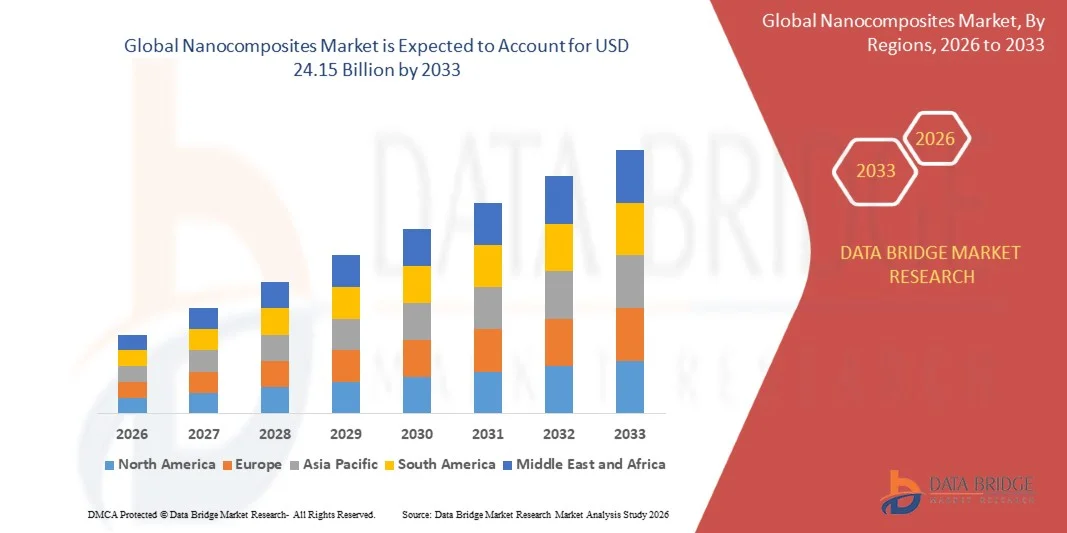
- The global nanocomposites market size was valued at USD 10.25 billion in 2025 and is expected to reach USD 24.15 billion by 2033, at a CAGR of 11.3% during the forecast period
- Major factors that are expected to boost the growth of the nanocomposites market in the forecast period are the rise in the usage of nanocomposites in the packaging industry. Furthermore, the improved physical and mechanical properties is further anticipated to propel the growth of the nanocomposites market
What are the Major Takeaways of Nanocomposites Market?
- The increase in the demand for nanocomposites in the automotive industry is further estimated to cushion the growth of the nanocomposites market. On the other hand, the growing environmental and health safety issues is further projected to impede the growth of the nanocomposites market in the timeline period
- In addition, the advancement of bio-based nanocomposites and growing high-value applications of graphene-based nanocomposites will further provide potential opportunities for the growth of the nanocomposites market in the coming years. However, the high research & development and processing costs might further challenge the growth of the nanocomposites market in the near future
- North America dominated the Nanocomposites market with a 41.8% revenue share in 2025, driven by strong demand from the automotive, aerospace, electronics, packaging, and defence sectors across the U.S. and Canada
- Asia-Pacific is projected to register the fastest CAGR of 7.9% from 2026 to 2033, driven by rapid industrialization, large-scale electronics manufacturing, automotive production growth, and expanding construction activities across China, Japan, India, South Korea, and Southeast Asia
- The Nanoclay segment dominated the market with a 38.6% share in 2025, as it remains widely preferred across packaging, automotive, and construction applications due to its superior barrier properties, mechanical reinforcement, and cost-effectiveness
Report Scope and Nanocomposites Market Segmentation
|
Attributes |
Nanocomposites Key Market Insights |
|
Segments Covered |
|
|
Countries Covered |
North America
Europe
Asia-Pacific
Middle East and Africa
South America
|
|
Key Market Players |
|
|
Market Opportunities |
|
|
Value Added Data Infosets |
In addition to the insights on market scenarios such as market value, growth rate, segmentation, geographical coverage, and major players, the market reports curated by the Data Bridge Market Research also include in-depth expert analysis, pricing analysis, brand share analysis, consumer survey, demography analysis, supply chain analysis, value chain analysis, raw material/consumables overview, vendor selection criteria, PESTLE Analysis, Porter Analysis, and regulatory framework. |
What is the Key Trend in the Nanocomposites Market?
“Increasing Shift Toward Lightweight, High-Performance, and Multi-Functional Materials”
- The nanocomposites market is witnessing strong adoption of lightweight, high-strength, and thermally stable materials across automotive, aerospace, electronics, and packaging industries
- Manufacturers are increasingly developing polymer-, metal-, and ceramic-based nanocomposites integrated with nanoclay, carbon nanotubes, graphene, and metal oxides to improve mechanical strength, conductivity, and barrier properties
- Growing emphasis on fuel efficiency, miniaturization of electronic devices, and durable packaging solutions is accelerating product adoption across industrial applications
- For instance, companies such as BASF SE, Arkema, Evonik Industries, Cabot Corporation, and 3M are expanding advanced nanomaterial portfolios to support next-generation industrial applications
- Rising demand for multi-functional materials offering superior strength, flame resistance, corrosion resistance, and electrical conductivity is driving innovation in the market
- As industries continue to prioritize lightweight engineering materials and sustainable high-performance composites, nanocomposites will remain critical for future product development and advanced manufacturing
What are the Key Drivers of Nanocomposites Market?
- Rising demand for lightweight yet high-strength materials in automotive and aerospace sectors to improve fuel efficiency and structural performance is a major growth driver
- For instance, during 2024–2025, leading manufacturers increased focus on nanoclay and carbon nanotube reinforced composites for EV components, aerospace panels, and durable electronics materials
- Growing adoption across electronics & semiconductors, packaging, energy storage, and medical devices is significantly boosting market demand globally
- Advancements in nanotechnology, dispersion techniques, and scalable manufacturing processes have enhanced performance consistency and commercial viability
- Increasing use of graphene, metal oxide nanoparticles, and nanofibers in batteries, sensors, coatings, and smart materials is creating strong long-term opportunities
- Supported by rising investments in advanced materials R&D, industrial innovation, and sustainable product development, the Nanocomposites market is expected to witness strong long-term growth
Which Factor is Challenging the Growth of the Nanocomposites Market?
- High costs associated with nanomaterial production, processing, and uniform particle dispersion continue to restrict large-scale adoption in cost-sensitive industries
- For instance, during 2024–2025, fluctuations in raw material pricing, nanoparticle synthesis costs, and complex fabrication requirements increased overall production expenses for several global manufacturers
- Technical challenges related to agglomeration of nanoparticles, dispersion uniformity, and large-scale manufacturing consistency affect product performance and commercialization
- Regulatory concerns regarding environmental impact, worker safety, and disposal of nanomaterials create compliance challenges across regions
- Competition from conventional composites, advanced polymers, and alternative lightweight materials adds pricing pressure and limits differentiation
- To address these issues, companies are focusing on cost-optimized manufacturing, sustainable nanomaterials, and improved dispersion technologies to accelerate global adoption of nanocomposites
How is the Nanocomposites Market Segmented?
The market is segmented on the basis of product, application, and resin.
• By Product
On the basis of product, the nanocomposites market is segmented into CNT, Nanoclay, Metal/Metal Oxides, Ceramics, and Others. The Nanoclay segment dominated the market with a 38.6% share in 2025, as it remains widely preferred across packaging, automotive, and construction applications due to its superior barrier properties, mechanical reinforcement, and cost-effectiveness. Nanoclay-based nanocomposites are extensively used to improve tensile strength, flame resistance, and moisture barriers in polymers, making them highly suitable for industrial-scale manufacturing. Their relatively lower cost compared to advanced carbon nanomaterials has supported broad commercial adoption across multiple industries.
The CNT (Carbon Nanotubes) segment is expected to grow at the fastest CAGR from 2026 to 2033, driven by rising demand for lightweight conductive materials in electronics, EV batteries, aerospace structures, and advanced coatings. Increasing use of CNTs for enhancing electrical conductivity, thermal stability, and structural performance is accelerating segment growth globally.
• By Application
On the basis of application, the market is segmented into Packaging, Automotive, Electronics & Electrical, Energy, Construction, Military, and Others. The Packaging segment dominated the market with a 29.8% share in 2025, supported by strong demand for high-barrier, lightweight, and durable packaging materials across food & beverage, pharmaceuticals, and consumer goods industries. Nanocomposites are widely used in packaging films and containers to improve oxygen resistance, moisture protection, shelf life, and product durability. Growing demand for sustainable and lightweight packaging solutions continues to strengthen this segment’s market leadership.
The Electronics & Electrical segment is projected to grow at the fastest CAGR from 2026 to 2033, driven by increasing use of nanocomposites in semiconductors, sensors, printed circuit boards, flexible electronics, and conductive coatings. Rapid advancements in miniaturized devices, wearable electronics, and high-performance components are expected to significantly boost demand in this segment.
• By Resin
On the basis of resin, the market is segmented into Thermosets and Thermoplastics. The Thermoplastics segment dominated the market with a 57.4% share in 2025, driven by extensive use in automotive components, consumer electronics, packaging, and industrial applications. Thermoplastic nanocomposites offer excellent processability, recyclability, impact resistance, and lightweight properties, making them highly suitable for mass production and cost-efficient manufacturing processes. Their compatibility with nanoclay, CNT, and metal oxide fillers further supports widespread adoption.
The Thermosets segment is expected to grow at the fastest CAGR from 2026 to 2033, propelled by rising applications in aerospace, defence, wind energy, and structural composites where high thermal resistance, dimensional stability, and mechanical strength are essential. Increasing demand for advanced performance materials in harsh operating environments is driving strong future growth in this segment.
Which Region Holds the Largest Share of the Nanocomposites Market?
- North America dominated the Nanocomposites market with a 41.8% revenue share in 2025, driven by strong demand from the automotive, aerospace, electronics, packaging, and defence sectors across the U.S. and Canada. The region has witnessed significant adoption of advanced lightweight materials to improve fuel efficiency, structural strength, thermal resistance, and product durability across industrial applications
- Leading companies in North America are continuously investing in nanomaterial innovation, graphene- and CNT-based composites, and advanced polymer engineering, strengthening the region’s technological advantage. Strong presence of major material science companies, research institutes, and industrial manufacturing hubs continues to support market leadership
- High R&D spending, rapid commercialization of nanotechnology, and strong focus on next-generation lightweight materials further reinforce the region’s dominance in the global market
U.S. Nanocomposites Market Insight
The U.S. is the largest contributor in North America, supported by strong growth in automotive lightweighting, aerospace composites, electronics manufacturing, and advanced packaging materials. Rising use of nanocomposites in EV battery systems, structural components, semiconductors, and defence-grade materials continues to drive market expansion. Presence of leading players such as 3M, Cabot Corporation, and Dow further strengthens regional growth.
Canada Nanocomposites Market Insight
Canada contributes significantly to regional growth, driven by increasing investments in advanced materials research, aerospace manufacturing, construction applications, and industrial coatings. Growing use of nanocomposites in durable infrastructure materials and energy systems supports long-term adoption.
Asia-Pacific Nanocomposites Market
Asia-Pacific is projected to register the fastest CAGR of 7.9% from 2026 to 2033, driven by rapid industrialization, large-scale electronics manufacturing, automotive production growth, and expanding construction activities across China, Japan, India, South Korea, and Southeast Asia. Rising demand for lightweight automotive components, flexible electronics, smart packaging, and high-performance construction materials is significantly accelerating regional market growth. Increasing government support for advanced manufacturing, EV production, renewable energy infrastructure, and domestic nanotechnology development continues to create strong market opportunities
China Nanocomposites Market Insight
China is the largest contributor to Asia-Pacific due to massive investments in electronics manufacturing, automotive production, packaging materials, and industrial infrastructure. Strong domestic manufacturing capabilities and large-scale use of polymer nanocomposites continue to support rapid market expansion.
Japan Nanocomposites Market Insight
Japan shows steady growth supported by advanced automotive engineering, precision electronics, robotics, and specialty material innovation. High focus on quality materials and lightweight product design strengthens nanocomposite demand.
India Nanocomposites Market Insight
India is emerging as a major growth hub, driven by expanding automotive manufacturing, electronics assembly, construction modernization, and government-backed industrial development initiatives. Rising use of nanocomposites in packaging, infrastructure, and EV components is accelerating market penetration.
South Korea Nanocomposites Market Insight
South Korea contributes significantly due to strong demand from consumer electronics, semiconductors, EV batteries, and advanced display technologies. Continuous innovation in high-performance materials supports sustained market growth.
Which are the Top Companies in Nanocomposites Market?
The nanocomposites industry is primarily led by well-established companies, including:
- 3M (U.S.)
- Arkema Group (France)
- BASF SE (Germany)
- Cabot Corporation (U.S.)
- DowDuPont, Inc. (U.S.)
- DSM (Netherlands)
- Elementis Specialties Inc. (U.K.)
- eSpin Technologies, Inc. (U.S.)
- Evonik Industries AG (Germany)
- Foster Corporation (U.S.)
- Hybrid Plastics, Inc. (U.S.)
- Inframat Corporation (U.S.)
- InMat, Inc. (U.S.)
- Nanocor, Inc. (U.S.)
- Nanocyl S.A. (Belgium)
- Nanophase Technologies Corporation (U.S.)
- Powdermet, Inc. (U.S.)
- RTP Company (U.S.)
- Showa Denko K.K (Japan)
- TNO (Netherlands)
- Unitika Ltd (Japan)
- Zyvex Technologies (U.S.)
What are the Recent Developments in Global Nanocomposites Market?
- In May 2024, DuPont Tedlar showcased its portfolio of easy-to-clean, highly durable, customizable, and safety-focused solutions for aircraft interiors at the Aircraft Interiors Expo 2024 in Hamburg, Germany, in collaboration with other DuPont business divisions, strengthening its position in advanced material solutions for the aerospace interiors market and supporting future growth in high-performance nanocomposite applications
- In May 2024, Cabot Corporation introduced its REPLASBLAK universal circular black masterbatches, manufactured using certified sustainable materials under its EVOLVE Sustainable Solutions platform, reinforcing the company’s commitment to delivering high-performance, reliable, and circular material solutions for the plastics industry, thereby accelerating sustainable innovation and long-term expansion in the nanocomposites market
SKU-
Получите онлайн-доступ к отчету на первой в мире облачной платформе рыночной аналитики

- Интерактивная панель анализа данных
- Панель анализа компании для возможностей с высоким потенциалом роста
- Доступ аналитика-исследователя для настройки и запросов
- Анализ конкурентов с помощью интерактивной панели
- Последние новости, обновления и анализ тенденций
- Используйте возможности сравнительного анализа для комплексного отслеживания конкурентов
Методология исследования
Сбор данных и анализ базового года выполняются с использованием модулей сбора данных с большими размерами выборки. Этап включает получение рыночной информации или связанных данных из различных источников и стратегий. Он включает изучение и планирование всех данных, полученных из прошлого заранее. Он также охватывает изучение несоответствий информации, наблюдаемых в различных источниках информации. Рыночные данные анализируются и оцениваются с использованием статистических и последовательных моделей рынка. Кроме того, анализ доли рынка и анализ ключевых тенденций являются основными факторами успеха в отчете о рынке. Чтобы узнать больше, пожалуйста, запросите звонок аналитика или оставьте свой запрос.
Ключевой методологией исследования, используемой исследовательской группой DBMR, является триангуляция данных, которая включает в себя интеллектуальный анализ данных, анализ влияния переменных данных на рынок и первичную (отраслевую экспертную) проверку. Модели данных включают сетку позиционирования поставщиков, анализ временной линии рынка, обзор рынка и руководство, сетку позиционирования компании, патентный анализ, анализ цен, анализ доли рынка компании, стандарты измерения, глобальный и региональный анализ и анализ доли поставщика. Чтобы узнать больше о методологии исследования, отправьте запрос, чтобы поговорить с нашими отраслевыми экспертами.
Доступна настройка
Data Bridge Market Research является лидером в области передовых формативных исследований. Мы гордимся тем, что предоставляем нашим существующим и новым клиентам данные и анализ, которые соответствуют и подходят их целям. Отчет можно настроить, включив в него анализ ценовых тенденций целевых брендов, понимание рынка для дополнительных стран (запросите список стран), данные о результатах клинических испытаний, обзор литературы, обновленный анализ рынка и продуктовой базы. Анализ рынка целевых конкурентов можно проанализировать от анализа на основе технологий до стратегий портфеля рынка. Мы можем добавить столько конкурентов, о которых вам нужны данные в нужном вам формате и стиле данных. Наша команда аналитиков также может предоставить вам данные в сырых файлах Excel, сводных таблицах (книга фактов) или помочь вам в создании презентаций из наборов данных, доступных в отчете.











