


Global Nanomagents Market Segmentation, By Type (Sensors, Biosensors and Bioassays, Giant Magneto Resistive Sensors, Separation, Data Storage, Hard Disks, MRAM, and Others), End User (Medical and Bio-Tech, Transportation, Electronics, Manufacturing and Processing Industry, and Others) - Industry Trends and Forecast to 2033
Nanomagents Market Size
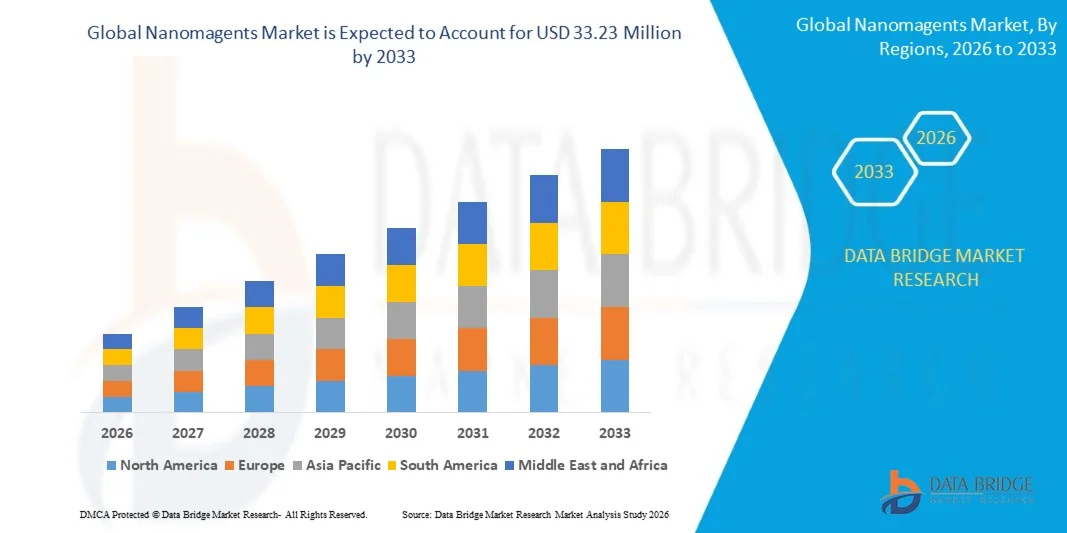
- The global nanomagents market size was valued at USD 19.71 million in 2025 and is expected to reach USD 33.23 million by 2033, at a CAGR of 6.75% during the forecast period
- The market growth is largely fueled by the increasing integration of nanomagnet technology in advanced electronics, data storage, and spintronic devices, driving demand for higher performance and energy-efficient components
- Furthermore, rising adoption of high-density memory, hard disk drives, and magnetic sensors in consumer electronics and industrial applications is positioning nanomagnets as a critical material for next-generation devices. These converging factors are accelerating innovation and commercialization, thereby significantly boosting market growth
Nanomagents Market Analysis
- Nanomagnets are nanoscale magnetic materials used to manipulate magnetic fields for data storage, sensing, and spintronic applications. They enable higher data density, lower power consumption, and enhanced device miniaturization across electronics, healthcare, and industrial sectors
- The escalating demand for nanomagnets is primarily fueled by the growth of high-performance computing, automotive electronics, and magnetic storage industries, along with increasing investments in research for spintronic and quantum technologies
- North America dominated the nanomagents market with a share of around 40% in 2025, due to high adoption of advanced electronics, data storage solutions, and industrial automation technologies
- Asia-Pacific is expected to be the fastest growing region in the nanomagents market during the forecast period due to rapid industrialization, expanding electronics manufacturing, and growing healthcare and research applications in countries such as China, Japan, and India
- Sensors segment dominated the market with a market share of 39% in 2025, due to its widespread adoption across electronics, automotive, and healthcare applications. Sensors incorporating nanomagnets provide high sensitivity, miniaturization, and energy-efficient operation, making them ideal for precise detection and measurement in industrial and research settings
Report Scope and Nanomagents Market Segmentation
|
Attributes |
Nanomagents Key Market Insights |
|
Segments Covered |
|
|
Countries Covered |
North America
Europe
Asia-Pacific
Middle East and Africa
South America
|
|
Key Market Players |
|
|
Market Opportunities |
|
|
Value Added Data Infosets |
In addition to the insights on market scenarios such as market value, growth rate, segmentation, geographical coverage, and major players, the market reports curated by the Data Bridge Market Research also include in-depth expert analysis, geographically represented company-wise production and capacity, network layouts of distributors and partners, detailed and updated price trend analysis and deficit analysis of supply chain and demand. |
Nanomagents Market Trends
“Rising Integration of Nanomagnets in Spintronic and High-Density Memory Devices”
- A significant trend in the nanomagnets market is the growing incorporation of nanomagnet materials into spintronic devices, MRAM (Magnetoresistive Random Access Memory), and high-density storage solutions, driven by the demand for faster, energy-efficient, and miniaturized electronic components. This integration is positioning nanomagnets as essential for next-generation electronics across computing, automotive, and industrial sectors
- For instance, IBM and Hitachi develop spintronic MRAM devices leveraging nanoscale magnetic materials that offer high-speed, non-volatile memory solutions. These devices improve data retention, reduce energy consumption, and support advanced computing applications
- The adoption of nanomagnets in hard disk drives and magnetic sensors is expanding as devices require higher data density and precise magnetic field manipulation. This is establishing nanomagnets as critical materials for enhancing performance and storage efficiency in conventional and emerging digital systems
- The automotive industry is integrating nanomagnet-based sensors for electric vehicles, autonomous driving, and advanced driver-assistance systems (ADAS), where accurate magnetic field detection and miniaturized components are essential. This trend is accelerating innovation in automotive electronics and sensor reliability
- Healthcare and medical technology sectors are leveraging nanomagnets for biosensing, MRI contrast enhancement, and targeted drug delivery systems, where precise magnetic control is crucial. This integration is promoting research and commercialization of magnet-based biomedical applications
- The market is witnessing strong growth in research-driven applications such as quantum computing and spintronic logic devices, where nanomagnets enable low-power operation and high-speed data processing. This rising integration is positioning nanomagnets as foundational elements for future computing and storage technologies
Nanomagents Market Dynamics
Driver
“Growing Demand for Energy-Efficient and High-Performance Electronics”
- The increasing need for high-performance, low-energy electronic components across computing, telecommunications, and consumer electronics is driving the demand for nanomagnet-based solutions. These materials enable faster switching speeds, reduced power consumption, and higher reliability in advanced memory and sensor devices
- For instance, Samsung Electronics and Intel are integrating nanomagnet-based MRAM technologies in next-generation processors and memory modules. These solutions provide non-volatile, high-speed performance that meets the increasing computational demands of AI, IoT, and cloud applications
- Rising adoption of electric vehicles and renewable energy systems is fueling the need for nanomagnet components in high-efficiency motors, actuators, and magnetic sensors. These devices improve energy utilization and system longevity while supporting sustainable industrial growth
- The expansion of IoT devices and edge computing applications is increasing reliance on energy-efficient memory and sensor solutions. Nanomagnets offer advantages in size reduction and power savings, aligning with the miniaturization trend in electronics
- Growing investments in spintronic and quantum computing research are accelerating commercialization of nanomagnet technologies. These initiatives are fostering advanced applications where conventional magnetic materials are insufficient
Restraint/Challenge
“High Manufacturing Costs and Technical Complexity”
- The nanomagnets market faces challenges due to the complexity of fabricating nanoscale magnetic materials, which require precise deposition, patterning, and characterization techniques. These specialized processes elevate manufacturing costs and limit large-scale production flexibility
- For instance, companies such as IPG Photonics and Novanta invest in advanced nanofabrication and laser-based magnetic processing to achieve high-quality nanomagnet structures. These methods demand sophisticated equipment, skilled labor, and controlled environments, increasing operational expenses
- Achieving uniform magnetic properties and reliability at the nanoscale requires stringent quality control measures, which further add to production timelines and costs. These factors constrain rapid commercialization and scalability for industrial applications
- The dependence on rare or specialized materials for high-performance nanomagnets increases supply chain vulnerability and cost variability. Manufacturers must balance material selection with economic feasibility while maintaining device performance
- The market continues to face challenges in integrating nanomagnets into existing electronic architectures without compromising device stability or efficiency. These technical and economic hurdles collectively pressure manufacturers to optimize processes, reduce costs, and advance research to support broader adoption
Nanomagents Market Scope
The market is segmented on the basis of type and end user.
• By Type
On the basis of type, the nanomagnets market is segmented into sensors, biosensors and bioassays, giant magneto resistive (GMR) sensors, separation, data storage, hard disks, MRAM, and others. The sensors segment dominated the largest market revenue share of 39% in 2025, driven by its widespread adoption across electronics, automotive, and healthcare applications. Sensors incorporating nanomagnets provide high sensitivity, miniaturization, and energy-efficient operation, making them ideal for precise detection and measurement in industrial and research settings. The growing demand for smart, connected devices has further accelerated the integration of nanomagnetic sensors in IoT-enabled systems. In addition, their compatibility with advanced manufacturing processes and versatility in multiple environmental conditions has reinforced their market dominance.
The biosensors and bioassays segment is anticipated to witness the fastest growth rate from 2026 to 2033, fueled by rising applications in medical diagnostics, healthcare monitoring, and biotechnology research. Nanomagnet-based biosensors enhance detection accuracy at the molecular level, providing rapid and sensitive results for disease markers, pathogens, and biological compounds. For instance, companies such as MagQu have developed nanomagnetic biosensor platforms enabling point-of-care diagnostics and lab-on-chip applications. Increasing investment in personalized medicine and the demand for non-invasive diagnostic tools are also driving this growth. Their ability to integrate with microfluidic devices and lab automation systems further supports expanding adoption in bioanalytical research.
• By End User
On the basis of end user, the nanomagnets market is segmented into medical and bio-tech, transportation, electronics, manufacturing and processing industry, and others. The electronics segment dominated the largest market revenue share in 2025, driven by the rising use of nanomagnets in hard disks, MRAM devices, and data storage technologies. Nanomagnet-enabled components support higher storage density, faster read/write speeds, and reduced power consumption, addressing growing consumer demand for compact and high-performance electronics. Integration in sensors, wearable devices, and mobile electronics has further strengthened their adoption. In addition, collaborations between electronics manufacturers and nanotechnology firms have enhanced product reliability and scalability.
The medical and bio-tech segment is expected to witness the fastest growth rate from 2026 to 2033, fueled by increasing applications in diagnostics, imaging, targeted drug delivery, and lab-on-chip systems. Nanomagnets improve the precision of magnetic resonance imaging (MRI), enable rapid separation of biomolecules, and allow efficient tracking of therapeutic agents. For instance, companies such as Ocean Nanotech have commercialized nanomagnet-based solutions for biomedical research and diagnostics. Growing healthcare infrastructure, increasing investment in research and development, and rising prevalence of chronic diseases are contributing to the accelerated adoption in this sector. Their compatibility with automated laboratory processes and minimal sample requirements make them highly attractive for bio-tech applications.
Nanomagents Market Regional Analysis
- North America dominated the nanomagents market with the largest revenue share of around 40% in 2025, driven by high adoption of advanced electronics, data storage solutions, and industrial automation technologies
- Consumers and businesses in the region highly value high-performance memory devices, sensors, and MRAM applications enabled by nanomagnets for precision and efficiency
- This widespread adoption is further supported by strong R&D infrastructure, high technological awareness, and favorable government policies promoting innovation, establishing nanomagnets as a key component in electronics, medical, and transportation sectors
U.S. Nanomagnets Market Insight
The U.S. nanomagnets market captured the largest revenue share in 2025 within North America, fueled by significant investments in electronics, semiconductor devices, and biomedical research. Companies are increasingly deploying nanomagnet-enabled sensors, MRAM, and data storage solutions to enhance performance and reduce energy consumption. The growing preference for miniaturized, high-speed, and energy-efficient technologies across healthcare, automotive, and IT sectors is driving the market. Moreover, collaborations between U.S. nanotechnology firms and global electronics manufacturers are further strengthening product innovation and market expansion.
Europe Nanomagnets Market Insight
The Europe nanomagnets market is projected to expand at a substantial CAGR throughout the forecast period, driven by rising applications in industrial automation, automotive electronics, and medical devices. Stringent regulations on energy efficiency and sustainability are encouraging adoption of nanomagnet-enabled solutions. Countries such as Germany, France, and the Netherlands are investing heavily in research and development, fostering innovation in nanomagnetic sensors, MRAM, and data storage technologies. The market growth is also supported by the increasing integration of nanomagnets in smart manufacturing and precision instrumentation across multiple industries.
U.K. Nanomagnets Market Insight
The U.K. nanomagnets market is anticipated to grow at a noteworthy CAGR during the forecast period, driven by rising adoption of high-performance electronic components and biomedical research tools. Companies and research institutions in the region are increasingly leveraging nanomagnets in MRAM, hard disks, and biosensor applications. The U.K.’s emphasis on innovation, technological infrastructure, and research funding is expected to continue supporting market growth, along with strong interest in IoT-enabled and energy-efficient devices across commercial and industrial applications.
Germany Nanomagnets Market Insight
The Germany nanomagnets market is expected to expand at a considerable CAGR during the forecast period, fueled by industrial modernization, automotive electronics, and medical technology applications. Germany’s strong manufacturing base, research initiatives, and emphasis on sustainable and high-performance technologies promote the adoption of nanomagnet-based solutions. Integration of nanomagnets in MRAM, data storage, and sensor devices is increasingly prevalent, and a focus on precision, reliability, and energy efficiency aligns with local consumer and industrial expectations.
Asia-Pacific Nanomagnets Market Insight
The Asia-Pacific nanomagnets market is poised to grow at the fastest CAGR during the forecast period of 2026 to 2033, driven by rapid industrialization, expanding electronics manufacturing, and growing healthcare and research applications in countries such as China, Japan, and India. The region’s emergence as a hub for semiconductor and memory device production is boosting the demand for nanomagnet-based solutions. Government initiatives promoting digitalization, smart manufacturing, and advanced research infrastructure are further enhancing adoption. Moreover, increasing affordability and local production of nanomagnet components are making them accessible to a broader end-user base.
Japan Nanomagnets Market Insight
The Japan nanomagnets market is gaining momentum due to the country’s strong electronics and semiconductor industry, focus on precision instrumentation, and increasing research in biomedical and industrial applications. Japanese companies are leveraging nanomagnet technologies for MRAM, sensors, and high-density data storage devices. Rapid urbanization and demand for energy-efficient, miniaturized components in both residential and industrial sectors are fueling growth. The integration of nanomagnet-enabled solutions in IoT devices, robotics, and healthcare technologies is also contributing significantly to market expansion.
China Nanomagnets Market Insight
The China nanomagnets market accounted for the largest revenue share in Asia-Pacific in 2025, driven by rapid urbanization, industrial modernization, and significant adoption of electronics and data storage technologies. China is a leading hub for MRAM, hard disk, and sensor production, and nanomagnets are increasingly incorporated into industrial, transportation, and medical applications. Government support for high-tech manufacturing and smart electronics, coupled with competitive domestic production capabilities, is accelerating market growth. The availability of cost-effective nanomagnet solutions and expanding industrial and research infrastructure are further propelling adoption across multiple sectors.
Nanomagents Market Share
The nanomagents industry is primarily led by well-established companies, including:
- Novanta Inc (U.S.)
- Coherent, Inc. (U.S.)
- IPG Photonics Corporation (U.S.)
- Amkor Technology (U.S.)
- LG Electronics (South Korea)
- OSRAM GmbH (Germany)
- Samsung Electronics (South Korea)
- Han’s Laser Technology Industry Group Co Ltd (China)
- Tokyo Electron Limited (Japan)
- Hitachi Ltd (Japan)
Latest Developments in Global Nanomagents Market
- In March 2026, Everspin Technologies introduced its UNISYST MRAM product family, marking a significant expansion in nanomagnet-based memory solutions. The unified memory architecture combines code and data storage in a single platform, offering high endurance, low latency, and energy efficiency. This development is set to drive wider adoption of MRAM in edge AI, industrial automation, aerospace, and other high-performance applications, as it addresses limitations of traditional flash and enables more compact, reliable embedded systems
- In March 2026, Everspin Technologies completed production qualification of its 64Mb xSPI STT‑MRAM, with plans for higher-density 128Mb and 256Mb versions. This strengthens the company’s MRAM portfolio by providing automotive-grade, high-density memory solutions. The expansion enhances market confidence in nanomagnet-based storage and positions MRAM as a viable alternative for mission-critical applications requiring high speed, reliability, and low power consumption
- In June 2025, Micromem Technologies advanced its collaboration with the University of Toronto to develop nanowire sensor technology, enhancing commercialization of high-performance nanomagnet-based sensors. The R&D partnership focuses on improving sensitivity and reliability, expanding opportunities in industrial, medical, and commercial sensor applications. This collaboration strengthens the innovation pipeline for magnetic sensing devices and supports broader adoption of nanomagnet technologies in emerging high-tech sectors
- In April 2024, Everspin unveiled the PERSYST brand for its MRAM persistent memory lineup, creating a clearer product identity and simplifying selection for customers. The branding initiative is expected to boost market penetration by making MRAM solutions more recognizable across industrial IoT, robotics, networking, and AI-driven applications. It also reinforces Everspin’s leadership in the nanomagnet-based memory market and helps attract new enterprise customers seeking energy-efficient, non-volatile memory options
- In April 2024, Everspin’s PERSYST 1 Gb STT‑MRAM was integrated into IBM’s next-generation FlashCore Modules, improving data integrity, reliability, and endurance for enterprise storage systems. This integration validates MRAM as a high-performance nanomagnet memory technology for large-scale data centers, accelerating market acceptance and adoption in critical IT infrastructure applications where durability and speed are essential
SKU-
Получите онлайн-доступ к отчету на первой в мире облачной платформе рыночной аналитики

- Интерактивная панель анализа данных
- Панель анализа компании для возможностей с высоким потенциалом роста
- Доступ аналитика-исследователя для настройки и запросов
- Анализ конкурентов с помощью интерактивной панели
- Последние новости, обновления и анализ тенденций
- Используйте возможности сравнительного анализа для комплексного отслеживания конкурентов
Методология исследования
Сбор данных и анализ базового года выполняются с использованием модулей сбора данных с большими размерами выборки. Этап включает получение рыночной информации или связанных данных из различных источников и стратегий. Он включает изучение и планирование всех данных, полученных из прошлого заранее. Он также охватывает изучение несоответствий информации, наблюдаемых в различных источниках информации. Рыночные данные анализируются и оцениваются с использованием статистических и последовательных моделей рынка. Кроме того, анализ доли рынка и анализ ключевых тенденций являются основными факторами успеха в отчете о рынке. Чтобы узнать больше, пожалуйста, запросите звонок аналитика или оставьте свой запрос.
Ключевой методологией исследования, используемой исследовательской группой DBMR, является триангуляция данных, которая включает в себя интеллектуальный анализ данных, анализ влияния переменных данных на рынок и первичную (отраслевую экспертную) проверку. Модели данных включают сетку позиционирования поставщиков, анализ временной линии рынка, обзор рынка и руководство, сетку позиционирования компании, патентный анализ, анализ цен, анализ доли рынка компании, стандарты измерения, глобальный и региональный анализ и анализ доли поставщика. Чтобы узнать больше о методологии исследования, отправьте запрос, чтобы поговорить с нашими отраслевыми экспертами.
Доступна настройка
Data Bridge Market Research является лидером в области передовых формативных исследований. Мы гордимся тем, что предоставляем нашим существующим и новым клиентам данные и анализ, которые соответствуют и подходят их целям. Отчет можно настроить, включив в него анализ ценовых тенденций целевых брендов, понимание рынка для дополнительных стран (запросите список стран), данные о результатах клинических испытаний, обзор литературы, обновленный анализ рынка и продуктовой базы. Анализ рынка целевых конкурентов можно проанализировать от анализа на основе технологий до стратегий портфеля рынка. Мы можем добавить столько конкурентов, о которых вам нужны данные в нужном вам формате и стиле данных. Наша команда аналитиков также может предоставить вам данные в сырых файлах Excel, сводных таблицах (книга фактов) или помочь вам в создании презентаций из наборов данных, доступных в отчете.











