


Global Non-mydriatic Handheld Fundus Camera Market, By Type(Optical System, Image Acquisition System), Application(Fundus Imaging, Fluorescein Angiography) – Industry Trends and Forecast to 2029
Market Analysis and Size
Ophthalmologists must use an adequate retinal camera for accurate diagnosis and treatment of numerous eye-related disorders. A fundus camera is a type of ocular imaging device that combines a high-resolution camera and a low-power microscope. Fundus cameras are commonly used for fundus imaging, fluorescein angiography, paired optic disc pictures, and external photographing. Fundus cameras are commonly used to test for and diagnose retinal problems such as diabetic retinopathy, retinal detachment, glaucoma, and age-related macular degeneration. For screening and diagnosis, fundus cameras are used by ophthalmologists, optometrists, and others.
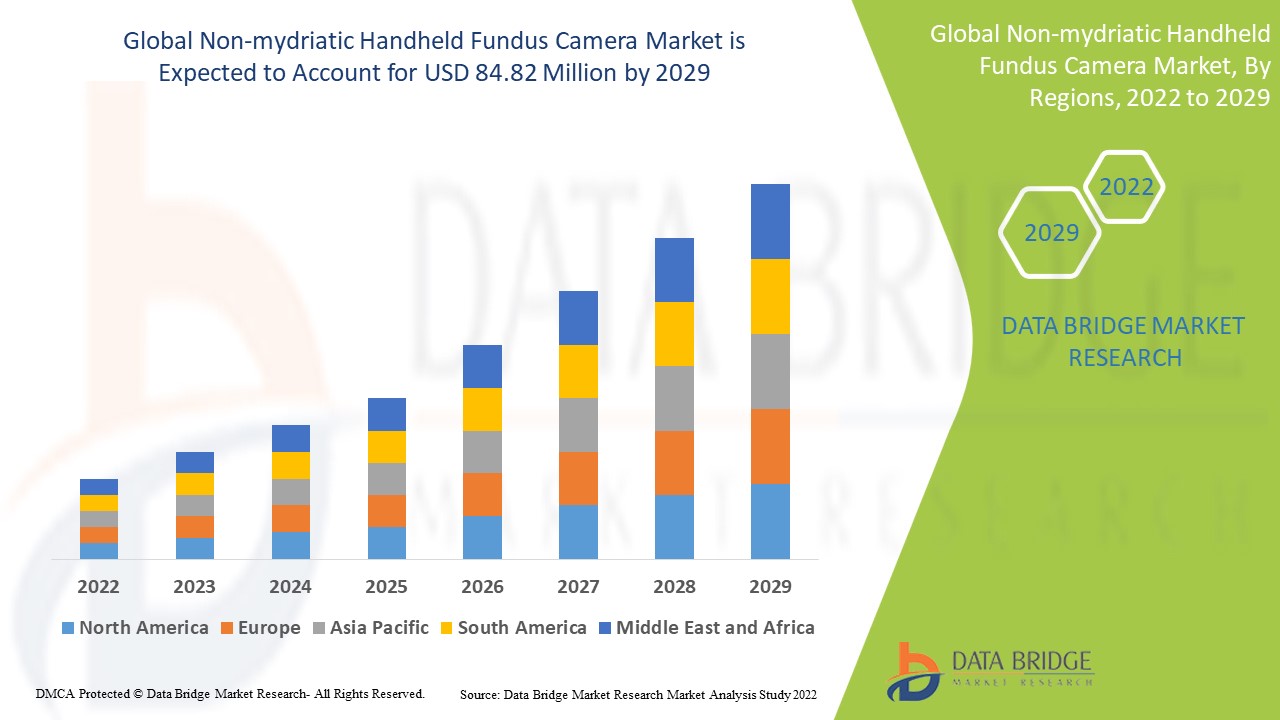
Data Bridge Market Research analyses that the non-mydriatic handheld fundus camera market which was USD 39 million in 2021, would rocket up to USD 84.82 million by 2029, and is expected to undergo a CAGR of 10.20% during the forecast period 2022 to 2029. In addition to the market insights such as market value, growth rate, market segments, geographical coverage, market players, and market scenario, the market report curated by the Data Bridge Market Research team also includes in-depth expert analysis, patient epidemiology, pipeline analysis, pricing analysis, and regulatory framework.
Report Scope and Market Segmentation
|
Report Metric |
Details |
|
Forecast Period |
2022 to 2029 |
|
Base Year |
2021 |
|
Historic Years |
2020 (Customizable to 2014 - 2019) |
|
Quantitative Units |
Revenue in USD Million, Volumes in Units, Pricing in USD |
|
Segments Covered |
Type (Optical System, Image Acquisition System), Application (Fundus Imaging, Fluorescein Angiography) |
|
Countries Covered |
U.S., Canada and Mexico in North America, Germany, France, U.K., Netherlands, Switzerland, Belgium, Russia, Italy, Spain, Turkey, Rest of Europe in Europe, China, Japan, India, South Korea, Singapore, Malaysia, Australia, Thailand, Indonesia, Philippines, Rest of Asia-Pacific (APAC) in the Asia-Pacific (APAC), Saudi Arabia, U.A.E, South Africa, Egypt, Israel, Rest of Middle East and Africa (MEA) as a part of Middle East and Africa (MEA), Brazil, Argentina and Rest of South America as part of South America |
|
Market Players Covered |
Canon, Inc. (Japan), Carl Zeiss Meditec, Inc. (U.S), CenterVue SpA (Italy), Clarity Medical (India), NIDEK CO., LTD. (Japan), Optomed Oy Ltd. (Finland), Optovue, Inc. (U.S), Topcon Corporation (Japan), Robert Bosch GmbH (Germany), OPTOPOL Technology (Poland), Topcon (Japan), MediWorks (U.S), Canton Optics (China), Kowa, Company Ltd. (Japan), Suzhou MicroClear Medical Instruments Co., Ltd (China), RAYMOND (India), Huvitz Corp. (South Korea) |
|
Market Opportunities |
|
Market Definition
A fundus or retinal camera allows practitioners to see the retina in greater detail and store the images for comparison and subsequent research. Both the patient and the practitioner have access to in-depth studies of the illness and can then take steps to treat it. Fundus cameras are simple devices that can capture precise retinal images. The reflecting qualities of the retina are used by a non-mydriatic fundus camera to offer details and store images. The findings obtained using a non-mydriatic fundus camera are superior to those obtained with other equipment such as slit lamps, and in most circumstances, pupil dilation is not required.
Non-mydriatic Handheld Fundus Camera Market Dynamics
Drivers
- Technological and digital advancements
The market is propelled forward by the continuous pace of technical improvements, rising awareness of eye care, an ageing population, and favourable government initiatives. Different medical device regulators in Japan and the United States, for example, require fundus imaging cameras to be changed every four years. This not only keeps the instrument in good working order, but it also helps with therapy and diagnosis. Digital technology and artificial intelligence are two further elements that are fueling the growth of non-mydriatic handheld fundus cameras.
- Increasing geriatric population
Diabetic retinopathy is common, and technical developments are quick. Another factor driving the growth of the fundus camera market is the introduction of sophisticated equipment along with the presence of significant players in this region.
- Usage of fundus cameras
These cameras are available as handheld devices or as tabletops and manufacturers are introducing new high-performance cameras. Many manufacturers are trying to design miniature tabletop fundus cameras, which can show live eye images to help alignment using infrared illumination.
Opportunities
Optometrists, ophthalmologists, and other medical practitioners employ fundus cameras. Manufacturers are introducing new high-performance cameras, which are available as handheld devices or tabletops. Many companies are attempting to market miniature tabletop fundus cameras that can display live eye pictures and assist with alignment using infrared illumination. A seamless auto mosaic function, optical red-free filter, compensating lens switch, anterior para location, and split aligning focus are among the features being developed by manufacturers. This is also likely to fuel non-mydriatic portable fundus cameras' market growth.
Restraints/Challenges
The Patient Protection and Affordable Care Act imposes a 2.5 percent excise duty on all medical devices in North America, which may be a barrier to the market expansion of fundus cameras in this region.
This non-mydriatic handheld fundus camera market report provides details of new recent developments, trade regulations, import-export analysis, production analysis, value chain optimization, market share, impact of domestic and localized market players, analyses opportunities in terms of emerging revenue pockets, changes in market regulations, strategic market growth analysis, market size, category market growths, application niches and dominance, product approvals, product launches, geographic expansions, technological innovations in the market. To gain more info on the non-mydriatic handheld fundus camera market contact Data Bridge Market Research for an Analyst Brief, our team will help you take an informed market decision to achieve market growth.
Covid-19 impact on Non-mydriatic Handheld Fundus Camera Market
In the wake of the COVID-19 issue, the global market for non-mydriatic handheld fundus cameras, which was anticipated to be worth USD 138.8 million in 2022, is expected to increase to USD192.6 million by 2026, with a CAGR of 7.9% over the analysis period. One of the report's sectors, Ophthalmology Clinics, is expected to increase at an 8.2 percent CAGR to reach USD128.6 million by the conclusion of the analysis period. After a detailed examination of the pandemic's commercial ramifications and the resulting economic crisis, the Hospitals segment's growth is revised to a revised 7.6% CAGR for the next seven years. This sector now has 21.5 percent of the global market for non-mydriatic handheld fundus cameras.
Global Non-mydriatic Handheld Fundus Camera Market Scope
The non-mydriatic handheld fundus camera market is segmented on the basis of type and application. The growth amongst these segments will help you analyze meagre growth segments in the industries and provide the users with a valuable market overview and market insights to help them make strategic decisions for identifying core market applications.
Type
- Optical System
- Image Acquisition System
Application
- Fundus Imaging
- Fluorescein Angiography
Non-mydriatic Handheld Fundus Camera Market Regional Analysis/Insights
The non-mydriatic handheld fundus camera market is analysed and market size insights and trends are provided by country, type and application as referenced above.
The countries covered in the non-mydriatic handheld fundus camera market report are U.S., Canada and Mexico in North America, Germany, France, U.K., Netherlands, Switzerland, Belgium, Russia, Italy, Spain, Turkey, Rest of Europe in Europe, China, Japan, India, South Korea, Singapore, Malaysia, Australia, Thailand, Indonesia, Philippines, Rest of Asia-Pacific (APAC) in the Asia-Pacific (APAC), Saudi Arabia, U.A.E, South Africa, Egypt, Israel, Rest of Middle East and Africa (MEA) as a part of Middle East and Africa (MEA), Brazil, Argentina and Rest of South America as part of South America.
North America is dominating the non-mydriatic handheld fundus cameras market. Due to increased geriatric population, high incidence of diabetic retinopathy and rapid pace of technological advancements.
Asia-Pacific is expected to record high growth in demand for non-mydriatic fundus cameras due to rising awareness and developing healthcare infrastructure. Growing medical tourism is also a factor in the growth of the fundus camera market in Asia-Pacific.
The country section of the report also provides individual market impacting factors and changes in regulation in the market domestically that impacts the current and future trends of the market. Data points like down-stream and upstream value chain analysis, technical trends and porter's five forces analysis, case studies are some of the pointers used to forecast the market scenario for individual countries. Also, the presence and availability of global brands and their challenges faced due to large or scarce competition from local and domestic brands, impact of domestic tariffs and trade routes are considered while providing forecast analysis of the country data.
Competitive Landscape and Non-mydriatic Handheld Fundus Camera Market Share Analysis
The non-mydriatic handheld fundus camera market competitive landscape provides details by competitor. Details included are company overview, company financials, revenue generated, market potential, investment in research and development, new market initiatives, global presence, production sites and facilities, production capacities, company strengths and weaknesses, product launch, product width and breadth, application dominance. The above data points provided are only related to the companies' focus related to non-mydriatic handheld fundus camera market.
Some of the major players operating in the non-mydriatic handheld fundus camera market are:
- Canon, Inc. (Japan)
- Carl Zeiss Meditec, Inc. (U.S)
- CenterVue SpA (Italy)
- Clarity Medical (India)
- NIDEK CO., LTD. (Japan)
- Optomed Oy Ltd. (Finland)
- Optovue, Inc. (U.S)
- Topcon Corporation (Japan)
- Robert Bosch GmbH (Germany)
- OPTOPOL Technology (Poland)
- Topcon (Japan)
- MediWorks (U.S)
- Canton Optics (China)
- Kowa, Company Ltd. (Japan)
- Suzhou MicroClear Medical Instruments Co., Ltd (China)
- RAYMOND (India)
- Huvitz Corp. (South Korea)
SKU-
Получите онлайн-доступ к отчету на первой в мире облачной платформе рыночной аналитики

- Интерактивная панель анализа данных
- Панель анализа компании для возможностей с высоким потенциалом роста
- Доступ аналитика-исследователя для настройки и запросов
- Анализ конкурентов с помощью интерактивной панели
- Последние новости, обновления и анализ тенденций
- Используйте возможности сравнительного анализа для комплексного отслеживания конкурентов
Методология исследования
Сбор данных и анализ базового года выполняются с использованием модулей сбора данных с большими размерами выборки. Этап включает получение рыночной информации или связанных данных из различных источников и стратегий. Он включает изучение и планирование всех данных, полученных из прошлого заранее. Он также охватывает изучение несоответствий информации, наблюдаемых в различных источниках информации. Рыночные данные анализируются и оцениваются с использованием статистических и последовательных моделей рынка. Кроме того, анализ доли рынка и анализ ключевых тенденций являются основными факторами успеха в отчете о рынке. Чтобы узнать больше, пожалуйста, запросите звонок аналитика или оставьте свой запрос.
Ключевой методологией исследования, используемой исследовательской группой DBMR, является триангуляция данных, которая включает в себя интеллектуальный анализ данных, анализ влияния переменных данных на рынок и первичную (отраслевую экспертную) проверку. Модели данных включают сетку позиционирования поставщиков, анализ временной линии рынка, обзор рынка и руководство, сетку позиционирования компании, патентный анализ, анализ цен, анализ доли рынка компании, стандарты измерения, глобальный и региональный анализ и анализ доли поставщика. Чтобы узнать больше о методологии исследования, отправьте запрос, чтобы поговорить с нашими отраслевыми экспертами.
Доступна настройка
Data Bridge Market Research является лидером в области передовых формативных исследований. Мы гордимся тем, что предоставляем нашим существующим и новым клиентам данные и анализ, которые соответствуют и подходят их целям. Отчет можно настроить, включив в него анализ ценовых тенденций целевых брендов, понимание рынка для дополнительных стран (запросите список стран), данные о результатах клинических испытаний, обзор литературы, обновленный анализ рынка и продуктовой базы. Анализ рынка целевых конкурентов можно проанализировать от анализа на основе технологий до стратегий портфеля рынка. Мы можем добавить столько конкурентов, о которых вам нужны данные в нужном вам формате и стиле данных. Наша команда аналитиков также может предоставить вам данные в сырых файлах Excel, сводных таблицах (книга фактов) или помочь вам в создании презентаций из наборов данных, доступных в отчете.











