



Global Spinal Machined Bone Allograft Market Segmentation, By Product Type (Gel, Putty, and Putty with Chips), End-Users (Spine Surgery and Trauma Surgery)- Industry Trends and Forecast to 2033
Spinal Machined Bone Allograft Market Size
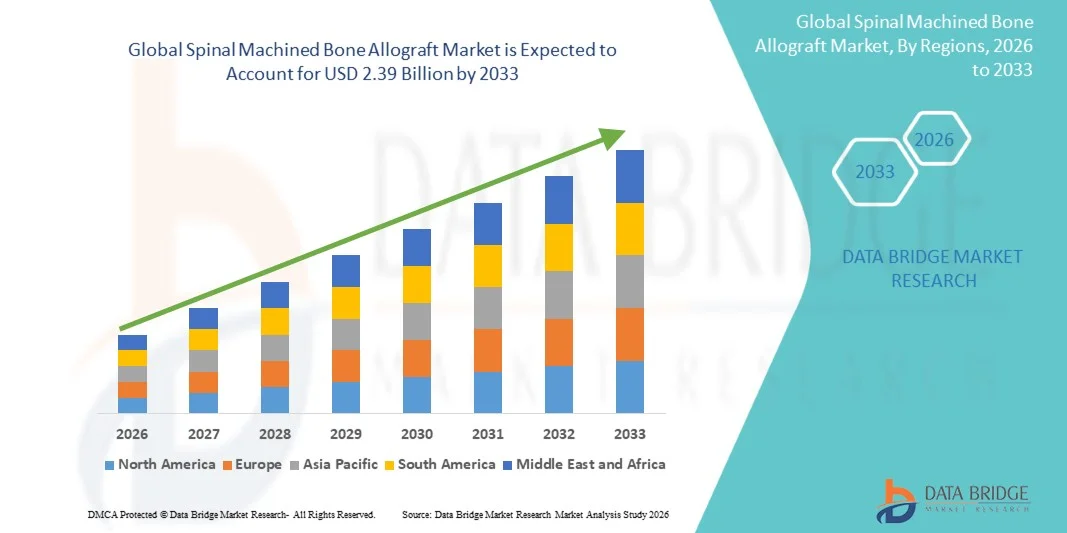
- The global spinal machined bone allograft market size was valued at USD 1.55 billion in 2025 and is expected to reach USD 2.39 billion by 2033, at a CAGR of 5.60% during the forecast period
- The market growth is largely fueled by the increasing prevalence of spinal disorders, degenerative disc diseases, and trauma cases, which are driving the demand for spinal fusion procedures and bone grafting solutions
- Furthermore, advancements in graft processing technologies, rising adoption of minimally invasive spine surgeries, and the growing preference for biologically compatible and osteoconductive materials are establishing machined bone allografts as a critical component in spinal reconstruction procedures, thereby significantly boosting the industry's growth
Spinal Machined Bone Allograft Market Analysis
- Spinal machined bone allografts, derived from processed human donor bone and engineered into standardized formats such as gel, putty, and putty with chips, are increasingly essential in spinal fusion procedures due to their osteoconductive properties, ease of handling, and ability to support bone regeneration in complex spinal reconstruction surgeries
- The escalating demand for spinal machined bone allografts is primarily driven by the rising prevalence of degenerative spinal conditions, increasing geriatric population, and growing number of spinal fusion surgeries worldwide, along with a strong clinical preference for biologically compatible graft substitutes over synthetic alternatives
- North America dominated the spinal machined bone allograft market with the largest revenue share of 40.6% in 2025, supported by advanced healthcare infrastructure, high adoption of spine surgeries, favorable reimbursement policies, and the strong presence of established tissue banks and medical device companies
- Asia-Pacific is expected to be the fastest growing region in the spinal machined bone allograft market during the forecast period due to increasing urbanization, expanding healthcare infrastructure, rising healthcare expenditure, and growing awareness and adoption of advanced spinal surgical procedures
- The putty segment dominated the spinal machined bone allograft market with a market share of 44.2% in 2025, attributed to its superior handling characteristics, moldability, and widespread clinical preference for use in spinal fusion procedures requiring ease of application and effective defect filling
Report Scope and Spinal Machined Bone Allograft Market Segmentation
|
Attributes |
Spinal Machined Bone Allograft Key Market Insights |
|
Segments Covered |
|
|
Countries Covered |
North America
Europe
Asia-Pacific
Middle East and Africa
South America
|
|
Key Market Players |
|
|
Market Opportunities |
|
|
Value Added Data Infosets |
In addition to the insights on market scenarios such as market value, growth rate, segmentation, geographical coverage, and major players, the market reports curated by the Data Bridge Market Research also include in-depth expert analysis, patient epidemiology, pipeline analysis, pricing analysis, and regulatory framework |
Spinal Machined Bone Allograft Market Trends
“Advancements in Processing Technologies and Customized Graft Formats”
- A significant and accelerating trend in the global spinal machined bone allograft market is the advancement in tissue processing technologies and the increasing availability of standardized graft formats such as putty, gel, and putty with chips, improving usability in spinal fusion procedures
- For instance, modern processing techniques enhance sterility, consistency, and osteoconductive properties of allografts, enabling surgeons to achieve better integration and fusion outcomes in complex spinal surgeries
- Improved processing methods are enabling better preservation of the natural bone matrix while enhancing handling characteristics, allowing surgeons to mold and apply grafts more efficiently during minimally invasive procedures
- The integration of these advanced graft forms into surgical workflows supports faster procedures and improved clinical outcomes, as surgeons can select products tailored to specific defect sizes and anatomical requirements
- This trend toward more refined, ready-to-use, and application-specific allograft formats is fundamentally reshaping surgeon preferences and driving adoption across hospitals and specialty spine centers
- The demand for standardized and easy-to-use spinal machined bone allografts is growing rapidly across healthcare facilities, as clinicians increasingly prioritize efficiency, consistency, and improved patient recovery outcomes
- Furthermore, growing collaboration between tissue banks and medical device companies is enhancing innovation in graft design and distribution, improving global accessibility and product availability
Spinal Machined Bone Allograft Market Dynamics
Driver
“Rising Prevalence of Spinal Disorders and Increasing Surgical Interventions”
- The increasing prevalence of degenerative spine conditions, trauma cases, and age-related orthopedic disorders is a significant driver for the heightened demand for spinal machined bone allografts
- For instance, in recent years, the growing number of spinal fusion procedures performed globally reflects the rising clinical need for effective bone graft substitutes in reconstructive spine surgeries
- As patients seek improved mobility and pain relief, spinal machined bone allografts offer biologically compatible solutions that support bone regeneration and fusion, making them a preferred choice among surgeons
- Furthermore, the expanding aging population worldwide is contributing to a higher incidence of spinal degeneration, thereby increasing the volume of surgical interventions requiring bone grafting materials
- The growing awareness among healthcare providers regarding the benefits of allografts over autografts, including reduced donor site morbidity, is further propelling market adoption
- Collectively, the rise in spinal procedures, coupled with advancements in surgical techniques and graft materials, is significantly accelerating the growth of the spinal machined bone allograft market
- In addition, increasing healthcare expenditure and improved access to advanced spine care in emerging economies are further supporting the adoption of spinal grafting solutions
- Moreover, favorable clinical outcomes associated with allografts in fusion procedures are encouraging surgeons to increasingly prefer these products over alternative grafting options
Restraint/Challenge
“Limited Donor Availability and Stringent Regulatory Compliance”
- Concerns surrounding the limited availability of donor bone tissue and the stringent regulatory requirements governing tissue procurement and processing pose significant challenges to market expansion
- For instance, the dependence on human donor material creates supply constraints, which can impact the consistent availability of spinal machined bone allografts across different regions
- Strict regulatory frameworks and quality standards for tissue banks and processing facilities increase operational complexity and compliance costs for manufacturers
- Furthermore, variability in donor tissue quality and the need for rigorous screening and sterilization processes can limit scalability and affect production timelines
- These regulatory and supply-side challenges, combined with ethical considerations related to tissue donation, may slow down market growth in certain regions
- Overcoming these challenges through improved donor registration systems, standardized processing protocols, and efficient regulatory alignment will be critical for ensuring sustainable market development
- Moreover, logistics and cold-chain requirements for storing and transporting allografts can further add to operational complexities and costs
- In addition, limited awareness and uneven distribution of tissue banking infrastructure in developing regions can restrict market penetration and accessibility
Spinal Machined Bone Allograft Market Scope
The market is segmented on the basis of product type and end-users.
- By Product Type
On the basis of product type, the spinal machined bone allograft market is segmented into gel, putty, and putty with chips. The putty segment dominated the market with the largest market revenue share of 44.2% in 2025, driven by its superior handling characteristics, moldability, and ease of application during spinal fusion procedures. Surgeons prefer putty due to its ability to conform to irregular defects, ensuring optimal graft placement and improved fusion outcomes. Its ready-to-use nature reduces preparation time in operating rooms and enhances procedural efficiency. In addition, putty allografts offer consistent composition and structural stability, making them highly reliable in both minimally invasive and open spine surgeries. The widespread availability of putty formats across hospitals and specialty spine centers further strengthens its dominant position. Increasing clinical preference for user-friendly graft materials continues to support its sustained adoption across global markets.
The gel segment is expected to witness the fastest growth rate during the forecast period, driven by its enhanced injectability and ability to be used in minimally invasive surgical procedures. Gel-based allografts are particularly suitable for applications requiring precise placement in confined or hard-to-reach anatomical sites. Their flowable nature allows surgeons to deliver the graft through small incisions, aligning with the growing trend toward minimally invasive spine surgeries. Furthermore, gel formulations often provide improved handling in complex surgical environments and can be combined with other biomaterials to enhance bone regeneration. Rising demand for advanced graft materials that offer flexibility, ease of use, and compatibility with modern surgical techniques is accelerating the adoption of gel-based allografts. Increasing technological advancements in graft formulation and delivery systems are also contributing to the rapid growth of this segment.
- By End-Users
On the basis of end-users, the spinal machined bone allograft market is segmented into spine surgery and trauma surgery. The spine surgery segment dominated the market with the largest market revenue share of 70% in 2025, primarily due to the high volume of spinal fusion procedures performed globally for degenerative disc diseases, spinal deformities, and chronic back pain. Spine surgeries often require structural bone grafts to achieve proper vertebral fusion, making machined allografts a critical component in these procedures. The increasing aging population and rising incidence of spinal disorders are further driving demand within this segment. Hospitals and specialized spine centers are increasingly adopting advanced graft materials to improve surgical outcomes and reduce recovery times. The strong clinical preference for allografts in spinal fusion procedures, due to reduced donor site morbidity compared to autografts, further reinforces the dominance of this segment. Continuous advancements in spine surgery techniques and expanding access to healthcare services are expected to sustain its leading position.
The trauma surgery segment is expected to witness the fastest growth rate during the forecast period, driven by the rising incidence of accidents, fractures, and orthopedic injuries worldwide. Trauma cases often require bone grafting to repair complex bone defects and support healing, making spinal machined bone allografts increasingly relevant in emergency and reconstructive procedures. The growing number of road accidents, sports injuries, and workplace-related injuries is contributing to higher demand for trauma-related surgical interventions. In addition, improvements in emergency care infrastructure and trauma management systems are enabling faster and more effective treatment, further boosting graft utilization. Surgeons are increasingly relying on allografts for their availability and effectiveness in restoring bone integrity without the need for additional surgical sites. The expansion of trauma care facilities, particularly in emerging markets, is also supporting the rapid growth of this segment.
Spinal Machined Bone Allograft Market Regional Analysis
- North America dominated the spinal machined bone allograft market with the largest revenue share of 40.6% in 2025, supported by advanced healthcare infrastructure, high adoption of spine surgeries, favorable reimbursement policies, and the strong presence of established tissue banks and medical device companies
- Healthcare providers in the region highly value the structural support, osteoconductive properties, and clinical reliability offered by machined bone allografts, particularly in complex spinal reconstruction surgeries
- This widespread adoption is further supported by well-established healthcare infrastructure, favorable reimbursement frameworks, the presence of leading tissue banks and manufacturers, and a growing preference for biologically compatible graft substitutes in both residential and commercial healthcare settings
U.S. Spinal Machined Bone Allograft Market Insight
The U.S. spinal machined bone allograft market captured the largest revenue share in North America in 2025, driven by the high volume of spinal fusion procedures and strong adoption of advanced bone grafting solutions in clinical practice. Healthcare providers in the country highly prioritize biologically compatible and structurally reliable graft materials that enhance fusion outcomes in complex spine surgeries. The presence of advanced healthcare infrastructure, leading hospitals, and well-established tissue banks supports widespread availability and utilization of machined bone allografts. In addition, favorable reimbursement policies and strong insurance coverage encourage patients to opt for advanced spinal treatments. The growing preference for minimally invasive spine surgeries and technologically advanced surgical techniques is further boosting demand. Continuous innovation from key industry players and increasing awareness of advanced grafting options are also contributing to the sustained growth of the U.S. market.
Europe Spinal Machined Bone Allograft Market Insight
The Europe spinal machined bone allograft market is projected to expand at a substantial CAGR throughout the forecast period, primarily driven by stringent healthcare standards, increasing prevalence of spinal disorders, and a growing aging population. The demand for effective and biologically compatible grafting solutions is rising as healthcare systems across the region emphasize improved surgical outcomes and patient safety. Europe’s well-developed medical infrastructure and strong regulatory frameworks support the adoption of high-quality allograft products in both public and private healthcare settings. Furthermore, increasing investments in orthopedic and spine care, along with the rising number of spinal surgeries, are contributing to market expansion. The region is also witnessing growing adoption across hospitals and specialized spine clinics, supported by advancements in surgical techniques and graft processing technologies.
U.K. Spinal Machined Bone Allograft Market Insight
The U.K. spinal machined bone allograft market is anticipated to grow at a noteworthy CAGR during the forecast period, driven by increasing demand for advanced spine care and a rising burden of degenerative spinal conditions. The growing focus on improving patient outcomes and reducing recovery times is encouraging the use of machined bone allografts in spinal fusion procedures. Healthcare providers in the U.K. are increasingly adopting biologically compatible graft materials that minimize complications associated with autografts. In addition, the presence of a well-structured healthcare system and expanding access to specialized orthopedic treatments are supporting market growth. Increasing awareness among surgeons regarding the benefits of allografts, along with continuous advancements in surgical practices, is further contributing to the adoption of these products across hospitals and surgical centers.
Germany Spinal Machined Bone Allograft Market Insight
The Germany spinal machined bone allograft market is expected to expand at a considerable CAGR during the forecast period, fueled by a strong emphasis on technological innovation, high-quality healthcare services, and increasing demand for advanced spinal treatments. Germany’s well-established healthcare infrastructure and focus on precision medicine are promoting the adoption of machined bone allografts in spine surgeries. The rising incidence of spinal disorders, coupled with an aging population, is contributing to the growing need for effective bone grafting solutions. In addition, the country’s emphasis on regulatory compliance and product quality ensures the use of safe and reliable graft materials. Integration of advanced surgical techniques and growing preference for minimally invasive procedures are further supporting market expansion across hospitals and specialty orthopedic centers.
Asia-Pacific Spinal Machined Bone Allograft Market Insight
The Asia-Pacific spinal machined bone allograft market is poised to grow at the fastest CAGR during the forecast period, driven by increasing urbanization, rising healthcare expenditure, and expanding access to advanced medical procedures in countries such as China, India, and Japan. The region’s growing population and increasing prevalence of spinal disorders are contributing to higher demand for spinal fusion surgeries and related grafting materials. Governments across APAC are investing in healthcare infrastructure and promoting digitalization, which is enhancing the adoption of advanced orthopedic solutions. Furthermore, the presence of cost-effective manufacturing capabilities and improving availability of medical technologies are making spinal machined bone allografts more accessible. Rising awareness among patients and healthcare professionals, along with the expansion of private healthcare facilities, is further accelerating market growth in the region.
Japan Spinal Machined Bone Allograft Market Insight
The Japan spinal machined bone allograft market is gaining momentum due to the country’s aging population, advanced healthcare system, and strong focus on high-quality medical treatments. The increasing prevalence of degenerative spine conditions is driving demand for spinal surgeries that require effective bone grafting solutions. Japanese healthcare providers emphasize precision, safety, and reliability, which supports the adoption of machined bone allografts in clinical practice. In addition, the integration of advanced surgical technologies and minimally invasive techniques is further boosting the use of these grafts. The country’s well-established medical infrastructure and continuous innovation in orthopedic procedures are contributing to steady market growth across hospitals and specialized spine care centers.
India Spinal Machined Bone Allograft Market Insight
The India spinal machined bone allograft market accounted for a significant share in Asia Pacific in 2025, attributed to rapid urbanization, increasing healthcare awareness, and a growing middle-class population. The rising prevalence of spinal disorders and trauma cases is driving demand for affordable and effective bone grafting solutions in the country. India’s expanding healthcare infrastructure, along with the growth of private hospitals and specialty spine centers, is supporting the adoption of advanced surgical materials. Government initiatives aimed at improving healthcare access and promoting medical infrastructure development are further contributing to market growth. In addition, increasing availability of cost-effective graft products and the presence of domestic tissue banks are making spinal machined bone allografts more accessible to a broader patient base.
Spinal Machined Bone Allograft Market Share
The Spinal Machined Bone Allograft industry is primarily led by well-established companies, including:
- Medtronic (Ireland)
- Stryker (U.S.)
- Zimmer Biomet (U.S.)
- NuVasive, Inc. (U.S.)
- Globus Medical, Inc. (U.S.)
- Orthofix Medical Inc. (U.S.)
- SeaSpine Holdings Corporation (U.S.)
- RTI Surgical Holdings, Inc. (U.S.)
- Xtant Medical Holdings, Inc. (U.S.)
- AlloSource (U.S.)
- LifeNet Health (U.S.)
- Wright Medical Group N.V. (U.S.)
- Baxter (U.S.)
- Arthrex, Inc. (U.S.)
- Exactech, Inc. (U.S.)
- Organogenesis Inc. (U.S.)
- Kuros Biosciences (Netherlands)
- Aesculap, Inc. (U.S.)
- Alphatec Holdings, Inc. (U.S.)
What are the Recent Developments in Global Spinal Machined Bone Allograft Market?
- In December 2025, Eastern India inaugurated its first private bone bank facility, expanding access to structural corticocancellous blocks, morselised grafts, and cancellous chips used in spinal fusion and reconstructive surgeries a key infrastructure development enhancing regional allograft availability
- In October 2025, Aurora Spine introduced its Aurora Biologics Division, a vertically integrated biologics portfolio that expands the company’s offerings in spinal implants and biologic grafts, aimed at improving clinical outcomes and driving growth in spine surgery solutions. This strategic launch strengthens the company’s position in the biologics segment of the spinal surgery market
- In June 2025, Cerapedics received PMA approval from the U.S. FDA for its PearlMatrix™ P-15 Peptide Enhanced Bone Graft, the first bone growth accelerator proven to substantially increase fusion speed in lumbar fusion (TLIF) procedures. This regulatory milestone introduces a novel biologic bone graft option that enhances osteogenic activity, representing a significant advancement in spinal fusion graft technology
- In April 2025, Spine Wave announced the commercial launch of Tempest® DCF Demineralized Cortical Fibers, a new allograft product composed entirely of human cortical bone designed to enhance osteoconductive and osteoinductive potential for spinal fusion surgeries. This product broadens the company’s biologics portfolio and supports improved graft performance in clinical use
- In April 2021, Ventris Medical announced the first use of Allocell® AF, a next-generation osteoinductive fiber allograft engineered for enhanced handling and biologic responsiveness in spinal fusion procedures, marking an innovation in allograft product design
SKU-
Получите онлайн-доступ к отчету на первой в мире облачной платформе рыночной аналитики

- Интерактивная панель анализа данных
- Панель анализа компании для возможностей с высоким потенциалом роста
- Доступ аналитика-исследователя для настройки и запросов
- Анализ конкурентов с помощью интерактивной панели
- Последние новости, обновления и анализ тенденций
- Используйте возможности сравнительного анализа для комплексного отслеживания конкурентов
Методология исследования
Сбор данных и анализ базового года выполняются с использованием модулей сбора данных с большими размерами выборки. Этап включает получение рыночной информации или связанных данных из различных источников и стратегий. Он включает изучение и планирование всех данных, полученных из прошлого заранее. Он также охватывает изучение несоответствий информации, наблюдаемых в различных источниках информации. Рыночные данные анализируются и оцениваются с использованием статистических и последовательных моделей рынка. Кроме того, анализ доли рынка и анализ ключевых тенденций являются основными факторами успеха в отчете о рынке. Чтобы узнать больше, пожалуйста, запросите звонок аналитика или оставьте свой запрос.
Ключевой методологией исследования, используемой исследовательской группой DBMR, является триангуляция данных, которая включает в себя интеллектуальный анализ данных, анализ влияния переменных данных на рынок и первичную (отраслевую экспертную) проверку. Модели данных включают сетку позиционирования поставщиков, анализ временной линии рынка, обзор рынка и руководство, сетку позиционирования компании, патентный анализ, анализ цен, анализ доли рынка компании, стандарты измерения, глобальный и региональный анализ и анализ доли поставщика. Чтобы узнать больше о методологии исследования, отправьте запрос, чтобы поговорить с нашими отраслевыми экспертами.
Доступна настройка
Data Bridge Market Research является лидером в области передовых формативных исследований. Мы гордимся тем, что предоставляем нашим существующим и новым клиентам данные и анализ, которые соответствуют и подходят их целям. Отчет можно настроить, включив в него анализ ценовых тенденций целевых брендов, понимание рынка для дополнительных стран (запросите список стран), данные о результатах клинических испытаний, обзор литературы, обновленный анализ рынка и продуктовой базы. Анализ рынка целевых конкурентов можно проанализировать от анализа на основе технологий до стратегий портфеля рынка. Мы можем добавить столько конкурентов, о которых вам нужны данные в нужном вам формате и стиле данных. Наша команда аналитиков также может предоставить вам данные в сырых файлах Excel, сводных таблицах (книга фактов) или помочь вам в создании презентаций из наборов данных, доступных в отчете.











