



Global Stereotactic X-ray Market Segmentation, By Product Type (Biopsy Needles, Guidance Systems, and Others), Test Type (Vacuum-Assisted Core Biopsy, and Core-Needle Aspiration), End- Users (Hospitals, Ambulatory Surgical Centers, and Specialty Clinics)- Industry Trends and Forecast to 2033
Stereotactic X-ray Market Size
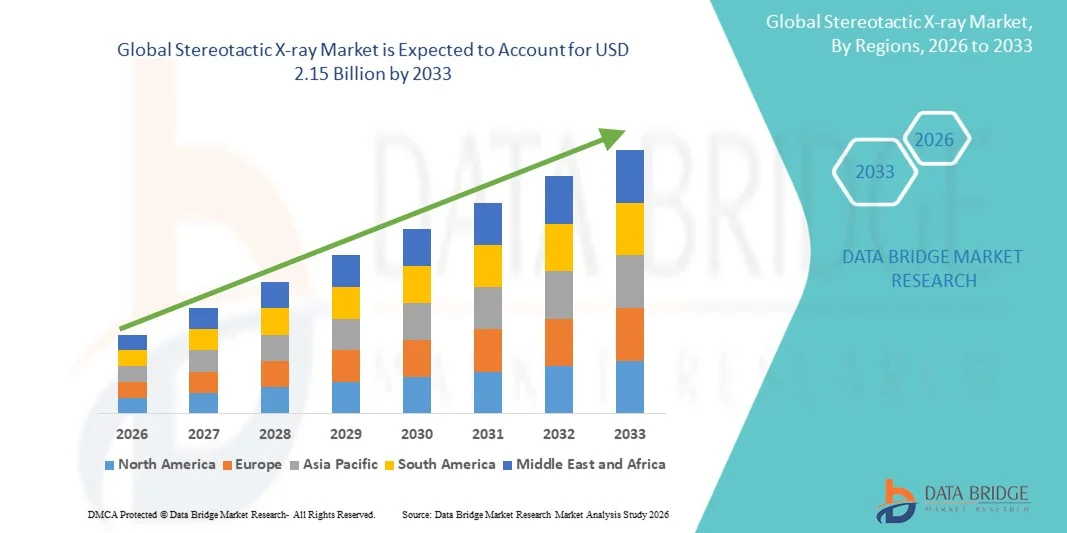
- The global stereotactic X-ray market size was valued at USD 1.61 billion in 2025 and is expected to reach USD 2.15 billion by 2033, at a CAGR of 3.7% during the forecast period
- The market growth is largely fueled by the increasing prevalence of breast cancer and other conditions requiring precise diagnostic imaging, along with the rising demand for minimally invasive and highly accurate imaging technologies in clinical settings
- Furthermore, advancements in imaging systems, integration of digital technologies, and growing adoption of early detection and screening programs are strengthening the utilization of stereotactic X-ray systems in hospitals and diagnostic centers, thereby supporting steady market expansion
Stereotactic X-ray Market Analysis
- Stereotactic X-ray systems, providing image-guided diagnostic and biopsy support for precise lesion localization, are increasingly essential components of modern medical imaging workflows in hospitals and diagnostic centers due to their high accuracy, minimally invasive approach, and ability to improve clinical outcomes in oncology and related fields
- The escalating demand for stereotactic X-ray systems is primarily fueled by the rising prevalence of cancer, growing emphasis on early detection and screening programs, and increasing adoption of advanced imaging technologies that enable accurate vacuum-assisted and core-needle biopsy procedures
- North America dominated the stereotactic X-ray market with the largest revenue share of 38.2% in 2025, characterized by advanced healthcare infrastructure, high adoption of breast cancer screening programs, favorable reimbursement policies, and the strong presence of leading medical imaging companies, with the U.S. witnessing significant utilization across hospitals and imaging centers driven by continuous technological advancements and digital integration
- Asia-Pacific is expected to be the fastest growing region in the stereotactic X-ray market during the forecast period due to expanding healthcare infrastructure, rising awareness of early disease detection, increasing healthcare expenditure, and growing access to advanced diagnostic imaging technologies in emerging economies
- Biopsy needles segment dominated the stereotactic X-ray market with a share of 50.8% in 2025, driven by their critical role in enabling accurate tissue sampling, high diagnostic precision, and widespread use in minimally invasive procedures such as vacuum-assisted core biopsy and core-needle aspiration
Report Scope and Stereotactic X-ray Market Segmentation
|
Attributes |
Stereotactic X-ray Key Market Insights |
|
Segments Covered |
|
|
Countries Covered |
North America
Europe
Asia-Pacific
Middle East and Africa
South America
|
|
Key Market Players |
|
|
Market Opportunities |
|
|
Value Added Data Infosets |
In addition to the insights on market scenarios such as market value, growth rate, segmentation, geographical coverage, and major players, the market reports curated by the Data Bridge Market Research also include in-depth expert analysis, patient epidemiology, pipeline analysis, pricing analysis, and regulatory framework |
Stereotactic X-ray Market Trends
“Advancements in Image-Guided Precision and Digital Integration”
- A significant and accelerating trend in the global stereotactic X-ray market is the increasing integration of advanced digital imaging technologies and computer-aided systems with stereotactic biopsy platforms, enhancing procedural accuracy and workflow efficiency in diagnostic settings
- For instance, modern stereotactic X-ray systems such as those used in breast biopsy procedures incorporate digital detectors and real-time imaging to improve lesion localization and reduce procedure time
- The incorporation of advanced imaging software and AI-assisted tools enables radiologists to better identify target areas, improve diagnostic confidence, and minimize repeat procedures, thereby optimizing clinical outcomes
- Furthermore, the integration of stereotactic systems with hospital information systems and PACS platforms facilitates seamless data sharing, centralized patient management, and improved coordination across diagnostic departments
- Another emerging trend is the growing preference for minimally invasive outpatient diagnostic procedures, where stereotactic X-ray systems are increasingly being adopted in ambulatory surgical centers to reduce hospital stays and improve patient throughput
- This trend toward technologically advanced, digitally connected stereotactic imaging solutions is reshaping expectations for diagnostic precision, efficiency, and patient comfort in minimally invasive procedures
Stereotactic X-ray Market Dynamics
Driver
“Growing Need Due to Rising Cancer Prevalence and Demand for Early Diagnosis”
- The increasing prevalence of cancer, particularly breast cancer, coupled with the growing emphasis on early and accurate diagnosis, is a significant driver for the heightened demand for stereotactic X-ray systems
- For instance, in recent years, healthcare providers have expanded breast cancer screening programs that rely heavily on stereotactic-guided biopsy systems for precise tissue sampling and early detection
- As patients and clinicians prioritize minimally invasive diagnostic procedures, stereotactic X-ray systems offer improved accuracy, reduced complications, and higher diagnostic yield compared to conventional biopsy techniques
- Furthermore, the rising awareness regarding preventive healthcare and government-led screening initiatives is encouraging wider adoption of advanced imaging technologies in both developed and emerging markets
- The ability of stereotactic X-ray systems to support vacuum-assisted and core-needle biopsy procedures, along with their integration into modern diagnostic workflows, continues to propel their adoption across hospitals and diagnostic centers
- In addition, continuous technological advancements by key manufacturers, including improvements in imaging resolution and workflow automation, are further enhancing clinical efficiency and driving market growth
Restraint/Challenge
“High Equipment Cost and Limited Accessibility in Emerging Regions”
- Concerns surrounding the high capital investment required for stereotactic X-ray systems, along with the need for specialized training and infrastructure, pose a significant challenge to broader market penetration
- For instance, advanced stereotactic imaging systems equipped with digital detectors and guidance technologies often require substantial upfront costs, which can limit adoption among smaller healthcare facilities and clinics
- Addressing cost-related barriers through financing options, refurbished equipment availability, and scalable system designs is crucial for expanding market reach. In addition, the relatively limited access to advanced diagnostic infrastructure in developing regions can restrict the widespread deployment of stereotactic X-ray technologies
- While technological advancements are improving system efficiency and usability, the requirement for trained radiologists and technicians remains a constraint in regions with limited healthcare workforce availability
- Overcoming these challenges through cost optimization, increased training programs, and expansion of healthcare infrastructure will be vital for sustaining long-term market growth
- Moreover, regulatory approvals and compliance requirements for medical imaging equipment can further delay product commercialization and adoption in certain regions, adding another layer of complexity for market players
Stereotactic X-ray Market Scope
The market is segmented on the basis of product type, test type, and end-users.
- By Product Type
On the basis of product type, the stereotactic X-ray market is segmented into biopsy needles, guidance systems, and others. The biopsy needles segment dominated the market with the largest market revenue share of 50.8% in 2025, driven by their critical role in enabling accurate tissue sampling during stereotactic procedures such as vacuum-assisted core biopsy and core-needle aspiration. Biopsy needles are widely preferred due to their precision, minimal invasiveness, and high diagnostic yield, making them essential in cancer detection workflows, particularly in breast biopsy procedures. Their compatibility with a wide range of stereotactic imaging systems and continuous product innovations further strengthen their dominance in clinical applications.
The guidance systems segment is anticipated to witness the fastest growth rate during the forecast period, fueled by increasing demand for high-precision imaging support and real-time navigation during biopsy procedures. Guidance systems enhance procedural accuracy by enabling radiologists to precisely localize lesions and guide needle placement, reducing procedural errors and repeat interventions. The growing integration of digital imaging technologies, AI-assisted navigation tools, and advanced visualization capabilities is accelerating the adoption of guidance systems across hospitals and diagnostic centers. In addition, rising investments in healthcare infrastructure and the need for improved workflow efficiency are further contributing to the rapid growth of this segment.
- By Test Type
On the basis of test type, the stereotactic X-ray market is segmented into vacuum-assisted core biopsy and core-needle aspiration. The vacuum-assisted core biopsy segment dominated the market with the largest revenue share in 2025, driven by its ability to obtain larger and more accurate tissue samples in a single procedure. This technique is widely preferred in breast cancer diagnosis due to its high diagnostic accuracy, reduced need for repeat procedures, and ability to target non-palpable lesions with precision. Its minimally invasive nature, combined with shorter procedure times and improved patient outcomes, has made it the standard approach in many clinical settings. Increasing adoption of advanced imaging-guided biopsy systems further reinforces the dominance of this segment.
The core-needle aspiration segment is expected to witness the fastest growth rate during the forecast period, supported by its cost-effectiveness, simplicity, and suitability for a variety of diagnostic applications. This technique is widely used in settings where quick and less complex sampling is required, particularly in resource-constrained environments. Growing awareness of early disease detection and expanding access to diagnostic services in emerging markets are contributing to the increased adoption of core-needle aspiration procedures. In addition, advancements in needle design and imaging guidance are improving procedural accuracy, further driving the growth of this segment.
- By End-Users
On the basis of end-users, the stereotactic X-ray market is segmented into hospitals, ambulatory surgical centers, and specialty clinics. The hospitals segment dominated the market with the largest revenue share in 2025, driven by the availability of advanced imaging infrastructure, skilled healthcare professionals, and comprehensive diagnostic and treatment facilities. Hospitals serve as primary centers for cancer diagnosis and biopsy procedures, where stereotactic X-ray systems are extensively used for accurate lesion localization and tissue sampling. The high patient influx, coupled with established reimbursement frameworks and access to advanced technologies, further supports the dominance of hospitals in this market.
The ambulatory surgical centers (ASCs) segment is anticipated to witness the fastest growth rate during the forecast period, fueled by the growing shift toward outpatient care and minimally invasive diagnostic procedures. ASCs offer cost-effective alternatives to hospitals, with shorter waiting times and efficient patient throughput, making them increasingly attractive for stereotactic biopsy procedures. The rising demand for same-day diagnostic services, coupled with advancements in compact and portable stereotactic imaging systems, is accelerating adoption in these settings. In addition, the expansion of healthcare infrastructure and increasing investments in outpatient care facilities are further supporting the rapid growth of this segment.
Stereotactic X-ray Market Regional Analysis
- North America dominated the stereotactic X-ray market with the largest revenue share of 38.2% in 2025, characterized by advanced healthcare infrastructure, high adoption of breast cancer screening programs, favorable reimbursement policies, and the strong presence of leading medical imaging companies
- Healthcare providers in the region highly value the precision, reliability, and minimally invasive nature of stereotactic X-ray systems, which are widely used in biopsy procedures for early and accurate lesion detection
- This widespread adoption is further supported by favorable reimbursement policies, high healthcare expenditure, a technologically advanced medical ecosystem, and the presence of leading imaging equipment manufacturers, establishing stereotactic X-ray systems as a key diagnostic tool across hospitals and imaging centers
U.S. Stereotactic X-ray Market Insight
The U.S. stereotactic X-ray market captured the largest revenue share of 80% within North America in 2025, fueled by the high prevalence of breast cancer, widespread adoption of advanced diagnostic imaging technologies, and well-established healthcare infrastructure. Healthcare providers in the country increasingly prioritize minimally invasive and highly accurate biopsy procedures, driving strong utilization of stereotactic X-ray systems in hospitals and diagnostic centers. The presence of leading medical imaging companies, along with favorable reimbursement frameworks and continuous technological advancements, further supports market growth. In addition, the integration of digital imaging, AI-assisted tools, and advanced guidance systems is significantly enhancing procedural accuracy and efficiency across clinical settings.
Europe Stereotactic X-ray Market Insight
The Europe stereotactic X-ray market is projected to expand at a steady CAGR throughout the forecast period, primarily driven by increasing emphasis on early cancer detection and stringent healthcare standards across the region. The rising incidence of cancer, coupled with well-established screening programs, is fostering the adoption of stereotactic biopsy systems in hospitals and diagnostic centers. European healthcare systems place strong emphasis on precision diagnostics, patient safety, and minimally invasive procedures, which aligns well with stereotactic X-ray technologies. In addition, growing investments in healthcare infrastructure and the modernization of imaging facilities are contributing to the steady growth of this market across both Western and Eastern Europe.
U.K. Stereotactic X-ray Market Insight
The U.K. stereotactic X-ray market is anticipated to grow at a notable CAGR during the forecast period, driven by increasing awareness of early cancer diagnosis and the presence of structured national screening programs, particularly for breast cancer. The country’s National Health Service (NHS) plays a significant role in facilitating access to advanced diagnostic imaging technologies, supporting the adoption of stereotactic biopsy systems. In addition, the demand for minimally invasive procedures, combined with the availability of skilled radiologists and modern healthcare facilities, is encouraging the use of stereotactic X-ray systems. The integration of digital imaging solutions and ongoing upgrades in diagnostic infrastructure are further contributing to market expansion in the U.K.
Germany Stereotactic X-ray Market Insight
The Germany stereotactic X-ray market is expected to expand at a considerable CAGR during the forecast period, fueled by strong healthcare infrastructure, high standards of medical care, and increasing focus on early disease detection. Germany’s emphasis on technological innovation and precision medicine supports the adoption of advanced stereotactic imaging systems in both public and private healthcare facilities. The growing incidence of cancer, along with well-organized screening initiatives, is driving demand for accurate biopsy procedures. Furthermore, the integration of stereotactic systems with digital imaging platforms and hospital information systems is enhancing workflow efficiency and diagnostic accuracy, aligning with Germany’s preference for high-quality, reliable medical technologies.
Asia-Pacific Stereotactic X-ray Market Insight
The Asia-Pacific stereotactic X-ray market is poised to grow at the fastest CAGR of 8% during the forecast period of 2026 to 2033, driven by increasing cancer prevalence, expanding healthcare infrastructure, and rising awareness of early diagnosis in countries such as China, Japan, and India. The region is witnessing rapid improvements in diagnostic imaging capabilities, supported by government initiatives and growing investments in healthcare modernization. In addition, the increasing availability of cost-effective stereotactic systems and the expansion of private healthcare providers are accelerating adoption across emerging economies. The growing patient population and improving access to advanced medical technologies further contribute to the strong growth potential of this region.
Japan Stereotactic X-ray Market Insight
The Japan stereotactic X-ray market is gaining momentum due to the country’s aging population, high healthcare standards, and strong focus on early cancer detection and precision diagnostics. The demand for stereotactic biopsy systems is supported by advanced healthcare infrastructure and widespread adoption of cutting-edge imaging technologies in hospitals and specialized diagnostic centers. Japan’s emphasis on minimally invasive procedures and high diagnostic accuracy aligns well with stereotactic X-ray applications. In addition, the integration of digital imaging systems and continuous technological innovation in medical devices are further supporting the growth of this market, particularly in breast cancer screening and oncology diagnostics.
India Stereotactic X-ray Market Insight
The India stereotactic X-ray market accounted for a significant share within the Asia-Pacific region in 2025, attributed to rapid urbanization, increasing healthcare expenditure, and rising awareness of cancer screening and early diagnosis. India is witnessing growing demand for advanced diagnostic imaging solutions across both urban and semi-urban healthcare facilities. The expansion of private healthcare providers, along with government initiatives aimed at improving cancer care infrastructure, is supporting the adoption of stereotactic biopsy systems. In addition, the availability of cost-effective medical imaging solutions and the increasing number of diagnostic centers are making stereotactic X-ray technologies more accessible to a larger patient population.
Stereotactic X-ray Market Share
The Stereotactic X-ray industry is primarily led by well-established companies, including:
- Koninklijke Philips N.V. (Netherlands)
- GE HealthCare (U.S.)
- Hologic, Inc. (U.S.)
- Brainlab (Germany)
- Elekta AB (Sweden)
- Carestream Health (U.S.)
- FUJIFILM Holdings Corporation (Japan)
- Shimadzu Corporation (Japan)
- Agfa-Gevaert Group (Belgium)
- Samsung Medison Co., Ltd. (South Korea)
- Konica Minolta, Inc. (Japan)
- Shenzhen Mindray Bio-Medical Electronics Co., Ltd. (China)
- Varex Imaging Corporation (U.S.)
- MinXray, Inc. (U.S.)
- Acteon Group (France)
- Medtronic (Ireland)
- Accuray Incorporated (U.S.)
- Total Imaging Systems (U.S.)
- CIVCO Medical Solutions (U.S.)
What are the Recent Developments in Global Stereotactic X-ray Market?
- In April 2026, Stereotaxis, Inc. announced that it received U.S. FDA 510(k) clearance and launched its new Synchrony System, a next-generation imaging platform designed to enhance precision in interventional procedures, including those guided by stereotactic X-ray imaging. This launch reflects ongoing innovation in image-guided diagnostic and therapeutic technologies
- In December 2025, RSNA 2025 showcased major developments in X-ray imaging, including advances in mobile digital radiography, premium flat panel detectors (FPDs), and AI imaging tools developments that underpin improved stereotactic X-ray capabilities and workflows in diagnostic settings
- In June 2025, research was published on the commissioning and first high-dose rate irradiations of a compact X-ray tube for microbeam/minibeam radiation therapy, representing a technological advance in X-ray sources that could influence future stereotactic and image-guided therapy platforms
- In March 2025, a press release highlighted that advanced stereotactic X-ray technology was transforming precision medicine with enhanced diagnostic accuracy and minimally invasive options, signaling broad adoption of next-generation imaging and guidance systems across healthcare institutions
- In January 2024, ClearPoint Neuro, Inc. announced that the U.S. FDA granted 510(k) clearance for its SmartFrame OR™ Stereotactic System, the company’s first product designed specifically for operating room use. The system supports precise navigation for biopsies and other stereotactic procedures using preoperative imaging, expanding access to advanced stereotactic guidance technologies in clinical settings
SKU-
Получите онлайн-доступ к отчету на первой в мире облачной платформе рыночной аналитики

- Интерактивная панель анализа данных
- Панель анализа компании для возможностей с высоким потенциалом роста
- Доступ аналитика-исследователя для настройки и запросов
- Анализ конкурентов с помощью интерактивной панели
- Последние новости, обновления и анализ тенденций
- Используйте возможности сравнительного анализа для комплексного отслеживания конкурентов
Методология исследования
Сбор данных и анализ базового года выполняются с использованием модулей сбора данных с большими размерами выборки. Этап включает получение рыночной информации или связанных данных из различных источников и стратегий. Он включает изучение и планирование всех данных, полученных из прошлого заранее. Он также охватывает изучение несоответствий информации, наблюдаемых в различных источниках информации. Рыночные данные анализируются и оцениваются с использованием статистических и последовательных моделей рынка. Кроме того, анализ доли рынка и анализ ключевых тенденций являются основными факторами успеха в отчете о рынке. Чтобы узнать больше, пожалуйста, запросите звонок аналитика или оставьте свой запрос.
Ключевой методологией исследования, используемой исследовательской группой DBMR, является триангуляция данных, которая включает в себя интеллектуальный анализ данных, анализ влияния переменных данных на рынок и первичную (отраслевую экспертную) проверку. Модели данных включают сетку позиционирования поставщиков, анализ временной линии рынка, обзор рынка и руководство, сетку позиционирования компании, патентный анализ, анализ цен, анализ доли рынка компании, стандарты измерения, глобальный и региональный анализ и анализ доли поставщика. Чтобы узнать больше о методологии исследования, отправьте запрос, чтобы поговорить с нашими отраслевыми экспертами.
Доступна настройка
Data Bridge Market Research является лидером в области передовых формативных исследований. Мы гордимся тем, что предоставляем нашим существующим и новым клиентам данные и анализ, которые соответствуют и подходят их целям. Отчет можно настроить, включив в него анализ ценовых тенденций целевых брендов, понимание рынка для дополнительных стран (запросите список стран), данные о результатах клинических испытаний, обзор литературы, обновленный анализ рынка и продуктовой базы. Анализ рынка целевых конкурентов можно проанализировать от анализа на основе технологий до стратегий портфеля рынка. Мы можем добавить столько конкурентов, о которых вам нужны данные в нужном вам формате и стиле данных. Наша команда аналитиков также может предоставить вам данные в сырых файлах Excel, сводных таблицах (книга фактов) или помочь вам в создании презентаций из наборов данных, доступных в отчете.











