


Global Textile Dyes Market Segmentation, By Dye Type (Direct, Reactive, Disperse, VAT, Acid, and Sulphur), Fiber Type (Cellulose, Polyester, Wool, Polyamide, Acrylic, and Acetate), Application (Clothing & Apparels, Home Textiles, and Industrial Textiles) - Industry Trends and Forecast to 2033
Textile Dyes Market Size
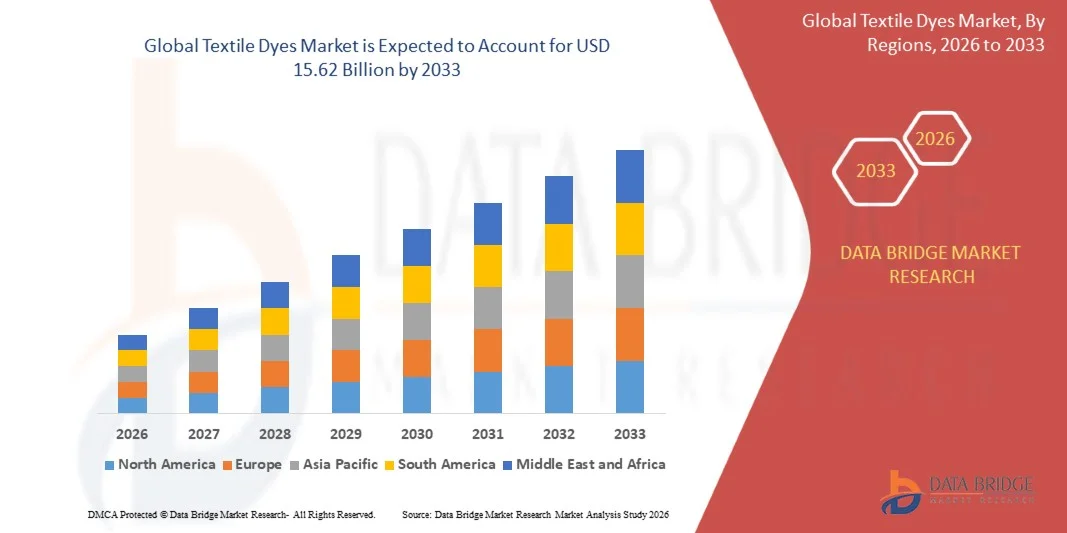
- The global textile dyes market size was valued at USD 9.30 billion in 2025 and is expected to reach USD 15.62 billion by 2033, at a CAGR of 6.70% during the forecast period
- The market growth is largely fueled by the expanding global textile and apparel manufacturing industry, coupled with increasing demand for vibrant, durable, and sustainable fabrics. Technological advancements in dyeing processes, such as low-water, low-energy, and digital dyeing solutions, are enhancing production efficiency and reducing environmental impact, thereby supporting market expansion
- Furthermore, rising consumer awareness of eco-friendly and low-impact textile products is driving manufacturers to adopt sustainable dyeing solutions and advanced chemical formulations. These converging factors are accelerating the adoption of innovative textile dyes, significantly boosting the industry’s growth
Textile Dyes Market Analysis
- Textile dyes are chemical substances used to impart color to natural and synthetic fibers, including cotton, polyester, wool, and polyamide. Modern dyes encompass a wide range of types, including reactive, disperse, acid, and pigment-based dyes, each designed for specific fiber compatibility, performance, and durability requirements
- The escalating demand for textile dyes is primarily fueled by growth in apparel and home textile production, rising exports from developing regions, and increasing adoption of sustainable and high-performance dyeing technologies. Manufacturers are also investing in innovations to meet stricter environmental regulations while delivering vibrant, long-lasting, and cost-efficient coloration solutions
- Asia-Pacific dominated the textile dyes market with a share of around 45% in 2025, due to rapid growth in the textile and apparel manufacturing sectors, increasing demand for vibrant and sustainable dyes, and a strong presence of textile production hubs
- North America is expected to be the fastest growing region in the textile dyes market during the forecast period due to robust demand for textile dyes in apparel, home textiles, and technical fabrics
- Cellulose segment dominated the market with a market share of 41.7% in 2025, due to the widespread use of cotton and other natural fibers in clothing and home textiles. Cellulose fibers’ compatibility with reactive and direct dyes ensures vibrant and durable coloration, supporting consumer demand for high-quality fabrics. The segment also benefits from growing awareness of natural fibers and eco-friendly textile processing methods
Report Scope and Textile Dyes Market Segmentation
|
Attributes |
Textile Dyes Key Market Insights |
|
Segments Covered |
|
|
Countries Covered |
North America
Europe
Asia-Pacific
Middle East and Africa
South America
|
|
Key Market Players |
|
|
Market Opportunities |
|
|
Value Added Data Infosets |
In addition to the insights on market scenarios such as market value, growth rate, segmentation, geographical coverage, and major players, the market reports curated by the Data Bridge Market Research also include import export analysis, production capacity overview, production consumption analysis, price trend analysis, climate change scenario, supply chain analysis, value chain analysis, raw material/consumables overview, vendor selection criteria, PESTLE Analysis, Porter Analysis, and regulatory framework. |
Textile Dyes Market Trends
“Growing Adoption of Sustainable and Eco-Friendly Dyeing Solutions”
- A significant trend in the textile dyes market is the increasing adoption of sustainable and eco-friendly dyeing solutions, driven by stricter environmental regulations and growing consumer demand for responsible fashion. This trend is encouraging manufacturers to shift toward low-impact processes that reduce water consumption and chemical waste
- For instance, Archroma has introduced a range of sustainable dye products under its “EarthColors” portfolio, which are derived from natural raw materials and comply with global ecological standards. These dyes help textile producers meet environmental compliance and appeal to environmentally conscious brands
- The market is witnessing higher integration of digital and waterless dyeing technologies that minimize effluent generation and energy usage, positioning eco-friendly solutions as critical for sustainable textile production
- Fashion and apparel brands are increasingly partnering with chemical suppliers to implement circular dyeing processes where dye recovery and reuse reduce environmental impact. This collaborative approach is accelerating the adoption of green textile solutions across global supply chains
- Growing consumer awareness about the environmental footprint of textiles is driving brands to adopt certified dyes, such as OEKO-TEX® and GOTS-compliant products. This is fostering transparency and strengthening market trust in sustainable dyes
- The trend toward sustainable textiles is expanding in emerging markets as governments encourage eco-friendly practices and incentivize low-impact manufacturing. These initiatives are creating new growth opportunities for manufacturers of sustainable and innovative dye solutions
Textile Dyes Market Dynamics
Driver
“Expansion of Global Textile and Apparel Manufacturing”
- The global expansion of textile and apparel manufacturing is driving the demand for diverse and high-quality dye solutions, as manufacturers require efficient and scalable coloring technologies to meet production targets. This growth is particularly pronounced in countries with rising industrialization and export-oriented textile sectors
- For instance, Huntsman Corporation supplies reactive, acid, and disperse dyes to textile manufacturers in India and Bangladesh, supporting large-scale fabric production and export demands. Their dye solutions enable consistent quality, fast processing, and compliance with international standards
- Increasing investments in modern textile parks and production facilities are enhancing dye application efficiency and supporting higher-volume output. This infrastructure growth fuels demand for innovative dye technologies that reduce processing time and improve color fastness
- Rising fashion trends and shorter product life cycles necessitate a broad palette of dyes and specialty finishes to meet consumer expectations. This requirement is boosting production volumes and diversifying demand across reactive, acid, and disperse dye categories
- The expansion of e-commerce and global fashion retail is driving rapid production cycles, which encourages adoption of dyes that provide faster processing and high reproducibility. These factors strengthen market growth and underscore the critical role of dye suppliers in global textile supply chains
Restraint/Challenge
“High Raw Material Costs and Environmental Compliance Requirements”
- The textile dyes market faces challenges due to high costs of raw materials such as synthetic intermediates, which are influenced by petrochemical price volatility. These costs impact overall dye pricing and profitability for manufacturers
- For instance, DyStar faces cost pressures from fluctuating aniline and reactive intermediates prices while ensuring compliance with environmental regulations in Europe and Asia. These constraints require balancing operational efficiency with ecological responsibility
- Stringent environmental regulations on effluent treatment, chemical discharge, and worker safety impose additional compliance costs on dye manufacturers and textile processors. Adhering to REACH, ZDHC, and local wastewater standards adds operational complexity
- The dependence on imported raw materials in certain regions exposes manufacturers to supply chain disruptions and pricing instability. This reliance complicates procurement planning and affects market competitiveness
- Managing both high input costs and environmental compliance continues to challenge the industry, requiring innovation in eco-efficient chemistries, process optimization, and cost management. These combined pressures influence strategic decisions and shape the overall market landscape
Textile Dyes Market Scope
The market is segmented on the basis of dye type, fiber type, and application.
• By Dye Type
On the basis of dye type, the textile dyes market is segmented into direct, reactive, disperse, VAT, acid, and sulphur dyes. The reactive dye segment dominated the largest market revenue share in 2025, driven by its excellent color yield, strong affinity for cellulose fibers, and superior wash and light fastness. Textile manufacturers prefer reactive dyes for their vibrant shades and long-lasting performance in apparel and home textiles. The segment also benefits from growing demand in high-quality clothing production and the ease of integration with automated dyeing systems. Reactive dyes’ versatility across different fiber types and applications further reinforces their leading position in the market.
The disperse dye segment is anticipated to witness the fastest growth rate from 2026 to 2033, fueled by increasing demand in polyester and synthetic fiber applications. For instance, companies such as Huntsman Corporation are expanding their disperse dye portfolios to cater to fast fashion and sportswear segments. Disperse dyes offer superior dyeing efficiency, uniformity, and bright coloration for synthetic fibers, making them a preferred choice for modern textile manufacturing. Their adoption is further driven by technological advancements in low-water and energy-efficient dyeing processes, meeting sustainability targets in the textile industry.
• By Fiber Type
On the basis of fiber type, the textile dyes market is segmented into cellulose, polyester, wool, polyamide, acrylic, and acetate fibers. The cellulose fiber segment dominated the largest market revenue share of 41.7% in 2025, attributed to the widespread use of cotton and other natural fibers in clothing and home textiles. Cellulose fibers’ compatibility with reactive and direct dyes ensures vibrant and durable coloration, supporting consumer demand for high-quality fabrics. The segment also benefits from growing awareness of natural fibers and eco-friendly textile processing methods. Manufacturers prefer cellulose fibers for their ease of dyeing and broad application in fashion, upholstery, and decorative textiles, strengthening their dominant market position.
The polyester fiber segment is expected to witness the fastest CAGR from 2026 to 2033, driven by increasing production of synthetic textiles and performance wear. For instance, Archroma has introduced advanced disperse dyes specifically for polyester fabrics, offering high color yield and energy-efficient processing. Polyester fibers provide excellent mechanical strength, durability, and moisture-wicking properties, making them suitable for sportswear, workwear, and fast-fashion clothing. Rising consumer preference for synthetic textiles with vibrant colors and longevity further accelerates the adoption of polyester-dye combinations in the global market.
• By Application
On the basis of application, the textile dyes market is segmented into clothing & apparels, home textiles, and industrial textiles. The clothing & apparels segment dominated the largest market revenue share in 2025, due to the high global consumption of fashion and apparel products and the increasing need for vibrant, durable, and colorfast fabrics. Dye manufacturers prioritize this segment for its volume-driven demand and diverse requirements across casual, formal, and sportswear categories. The segment’s dominance is reinforced by rising trends in fast fashion, e-commerce-driven apparel sales, and integration of innovative dyeing techniques that enhance fabric aesthetics and performance.
The home textiles segment is anticipated to witness the fastest growth rate from 2026 to 2033, fueled by increasing consumer spending on interior décor and soft furnishings. For instance, Dystar has been actively supplying reactive and disperse dyes for curtains, upholstery, and bedding textiles. Home textiles require consistent coloration, wash fastness, and eco-friendly dyeing solutions, driving demand for advanced dye types and fiber compatibility. Growing urbanization, rising disposable incomes, and an emphasis on aesthetically appealing home décor continue to expand the adoption of textile dyes in the home textiles sector.
Textile Dyes Market Regional Analysis
- Asia-Pacific dominated the textile dyes market with the largest revenue share of around 45% in 2025, driven by rapid growth in the textile and apparel manufacturing sectors, increasing demand for vibrant and sustainable dyes, and a strong presence of textile production hubs
- The region’s cost-effective manufacturing landscape, rising investments in dyeing technologies, and growing exports of textiles are accelerating market expansion
- The availability of skilled labor, favorable government policies, and rapid industrialization across developing economies are contributing to increased consumption of textile dyes in both clothing and home textile sectors
China Textile Dyes Market Insight
China held the largest share in the Asia-Pacific textile dyes market in 2025, owing to its status as a global leader in textile manufacturing and dye production. The country’s strong industrial base, favorable policies supporting chemical and textile sector expansion, and extensive export capabilities for dyed fabrics are major growth drivers. Demand is also bolstered by investments in sustainable dyeing technologies and high-quality apparel manufacturing for both domestic and international markets.
India Textile Dyes Market Insight
India is witnessing the fastest growth in the Asia-Pacific region, fueled by rapidly growing textile and apparel production, increasing exports of garments, and rising investments in modern dyeing infrastructure. Government initiatives such as "Make in India" and schemes promoting sustainable textile production are strengthening demand for advanced textile dyes. In addition, rising awareness of eco-friendly and low-impact dyes in both domestic and international markets is contributing to robust market expansion.
Europe Textile Dyes Market Insight
The Europe textile dyes market is expanding steadily, supported by stringent environmental and quality regulations, high demand for sustainable and low-impact dyes, and growing investments in specialty textile chemicals. The region emphasizes compliance, advanced coloration techniques, and innovative textile finishing processes. Increasing adoption of eco-friendly dyeing solutions in high-value clothing and technical textiles is further enhancing market growth.
Germany Textile Dyes Market Insight
Germany’s textile dyes market is driven by its leadership in high-precision textile manufacturing, strong chemical industry expertise, and export-oriented production model. The country has well-established R&D networks and partnerships between textile manufacturers and chemical producers, fostering innovation in specialty dyes. Demand is particularly strong for high-performance and environmentally compliant dyes in fashion, industrial, and technical textiles.
U.K. Textile Dyes Market Insight
The U.K. market is supported by a mature textile and apparel industry, growing emphasis on sustainable and ethical manufacturing, and increasing demand for specialty dyes in fashion and home textiles. With rising focus on R&D, industry-academia collaborations, and investments in lab-scale and niche dye production, the U.K. continues to play a significant role in high-value textile chemical markets.
North America Textile Dyes Market Insight
North America is projected to grow at the fastest CAGR from 2026 to 2033, driven by robust demand for textile dyes in apparel, home textiles, and technical fabrics. Rising consumer preference for sustainable and eco-friendly textiles, advancements in dyeing technology, and increased reshoring of textile manufacturing are boosting market demand. In addition, strong collaborations between textile manufacturers and specialty dye producers are supporting market expansion.
U.S. Textile Dyes Market Insight
The U.S. accounted for the largest share in the North America market in 2025, underpinned by its expansive textile and apparel industry, strong R&D infrastructure, and significant investment in sustainable dye production. The country’s focus on innovation, regulatory compliance, and environmentally friendly dyeing processes is encouraging the adoption of advanced textile dyes. Presence of key dye manufacturers and a mature supply chain further solidify the U.S.'s leading position in the region.
Textile Dyes Market Share
The textile dyes industry is primarily led by well-established companies, including:
- Dow (U.S.)
- BASF SE (Germany)
- Huntsman International LLC. (U.S.)
- Evonik Industries AG (Germany)
- Ineos Group AG (U.K.)
- LANXESS (Germany)
- Kronos Incorporated (U.S.)
- Kiri Industries Ltd (India)
- Archroma (Switzerland)
- ALLIED INDUSTRIAL CORP., LTD (Japan)
- Organic Dyes and Pigments (India)
- Sumitomo Chemical Co., Ltd. (Japan)
- Dayglo Color Corporation (U.S.)
- Anand International (India)
- SAMCO (India)
- VASU CHEMICALS LLP (India)
Latest Developments in Global Textile Dyes Market
- In June 2025, Sparxell and Positive Materials launched the world’s first plant‑based bioinspired structural colour ink, a dye‑free textile colouring solution that eliminates the use of toxic chemicals and petroleum-based dyes. This innovation represents a paradigm shift in textile coloration by offering a sustainable alternative that reduces chemical effluent, energy consumption, and reliance on synthetic dyes. The technology enables brands to produce textiles with high durability and vibrant colours while adhering to increasingly strict environmental regulations. Its adoption is expected to accelerate the transition to eco-friendly fabrics in both mainstream and premium fashion segments, creating new market opportunities for sustainable textile solutions
- In December 2024, the CHT Group was honored with the German Ecodesign Award for its PIGMENTURA pigment-based dyeing process, which functions without water in the dyeing step and reduces energy consumption by up to 60% and water usage by up to 96% compared to conventional methods. This development demonstrates a significant step toward resource-efficient manufacturing, allowing textile producers to lower operational costs and environmental impact. The recognition also signals industry-wide validation for scalable, high-performance dyeing technologies, which are becoming increasingly important as sustainability mandates grow across global textile supply chains
- In April 2024, Alchemie Technology inaugurated its first in-market production and demonstration hub in Nantou, Taiwan, dedicated to woven polyester fabrics, featuring its Endeavour low-carbon digital textile dyeing technology designed to replace conventional wet dyeing with a dry process. This facility showcases a system capable of reducing carbon emissions by up to 85% and wastewater by up to 95%, highlighting the market potential for energy-efficient, low-impact dyeing solutions. The demonstration hub reinforces Alchemie’s commitment to commercializing scalable pollution-free dyeing technology, encouraging manufacturers to adopt cleaner alternatives and improving competitiveness in sustainable polyester fabric production
- In April 2024, Archroma launched a comprehensive range of sustainability-focused solutions at the Techtextil trade fair in Frankfurt, introducing high-lightfast disperse dyes for automotive interiors, a bio-based durable water repellent, and the Super Systems+ concept integrating fiber-specific processing solutions. These innovations are designed to enhance both functionality and environmental performance in technical textiles. By providing measurable improvements from sizing to finishing, Archroma enables manufacturers to comply with stringent regulations while maintaining product quality, driving wider adoption of sustainable chemical solutions across high-value textile applications
- In February 2024, Birla Cellulose introduced its patented Intellicolor technology at Bharat Tex, designed to achieve a dye exhaustion rate exceeding 95% with cationic or basic dyes while eliminating the need for salt and soda ash in the reactive dyeing process. This innovation significantly reduces water and chemical usage, lowering the environmental footprint of textile production. It also enhances color vibrancy and dyeing efficiency, enabling manufacturers to produce high-quality fabrics with reduced operational costs. Intellicolor reflects the growing market trend toward sustainable, resource-efficient reactive dyeing methods that align with global sustainability goals
SKU-
Получите онлайн-доступ к отчету на первой в мире облачной платформе рыночной аналитики

- Интерактивная панель анализа данных
- Панель анализа компании для возможностей с высоким потенциалом роста
- Доступ аналитика-исследователя для настройки и запросов
- Анализ конкурентов с помощью интерактивной панели
- Последние новости, обновления и анализ тенденций
- Используйте возможности сравнительного анализа для комплексного отслеживания конкурентов
Методология исследования
Сбор данных и анализ базового года выполняются с использованием модулей сбора данных с большими размерами выборки. Этап включает получение рыночной информации или связанных данных из различных источников и стратегий. Он включает изучение и планирование всех данных, полученных из прошлого заранее. Он также охватывает изучение несоответствий информации, наблюдаемых в различных источниках информации. Рыночные данные анализируются и оцениваются с использованием статистических и последовательных моделей рынка. Кроме того, анализ доли рынка и анализ ключевых тенденций являются основными факторами успеха в отчете о рынке. Чтобы узнать больше, пожалуйста, запросите звонок аналитика или оставьте свой запрос.
Ключевой методологией исследования, используемой исследовательской группой DBMR, является триангуляция данных, которая включает в себя интеллектуальный анализ данных, анализ влияния переменных данных на рынок и первичную (отраслевую экспертную) проверку. Модели данных включают сетку позиционирования поставщиков, анализ временной линии рынка, обзор рынка и руководство, сетку позиционирования компании, патентный анализ, анализ цен, анализ доли рынка компании, стандарты измерения, глобальный и региональный анализ и анализ доли поставщика. Чтобы узнать больше о методологии исследования, отправьте запрос, чтобы поговорить с нашими отраслевыми экспертами.
Доступна настройка
Data Bridge Market Research является лидером в области передовых формативных исследований. Мы гордимся тем, что предоставляем нашим существующим и новым клиентам данные и анализ, которые соответствуют и подходят их целям. Отчет можно настроить, включив в него анализ ценовых тенденций целевых брендов, понимание рынка для дополнительных стран (запросите список стран), данные о результатах клинических испытаний, обзор литературы, обновленный анализ рынка и продуктовой базы. Анализ рынка целевых конкурентов можно проанализировать от анализа на основе технологий до стратегий портфеля рынка. Мы можем добавить столько конкурентов, о которых вам нужны данные в нужном вам формате и стиле данных. Наша команда аналитиков также может предоставить вам данные в сырых файлах Excel, сводных таблицах (книга фактов) или помочь вам в создании презентаций из наборов данных, доступных в отчете.











