


Global Unmanned Surface Vehicle (USV) Market, By Type (Surface and Sub-Surface), Application (Defense, Commercial, Scientific Research, and Others), Endurance (100-500 Hours, 1000 Hours), Operation (Remote Operated Surface Vehicle and Autonomous Surface Vehicle), System (Propulsion, Chassis Material, Payload, Component, Software, and Communication), Hull Type (Catamaran (Twin Hulls), Kayak (Single Hull), Trimaran (Triple Hulls), and Rigid Inflatable Hull), Size (Medium (4 to 8 M), Small (Less than 4 M), Large (8 to 12 M), and Extra-Large (Above 12 M)) Industry Trends and Forecast to 2030.
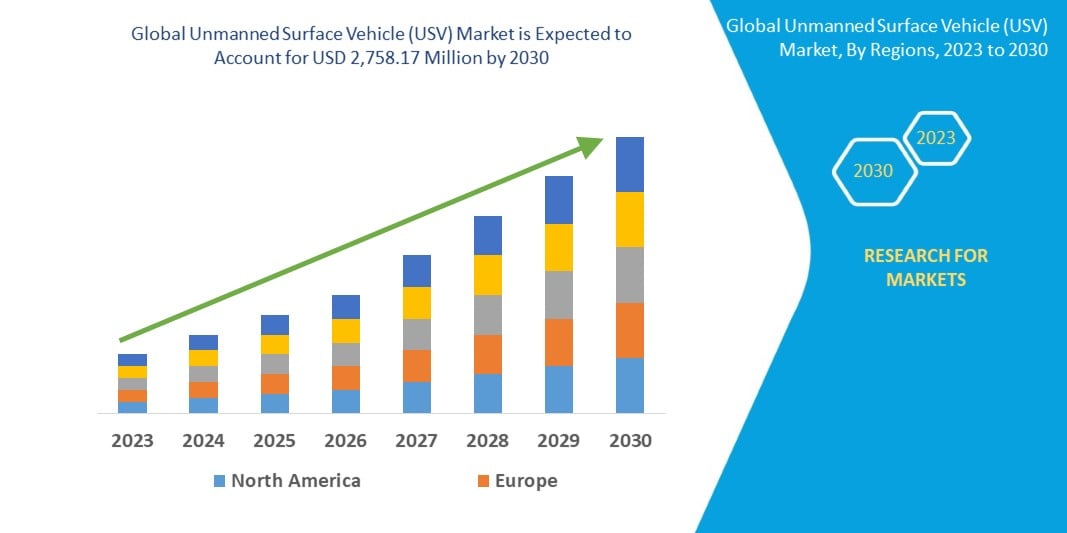
Unmanned Surface Vehicle (USV) Market Market Analysis and Size
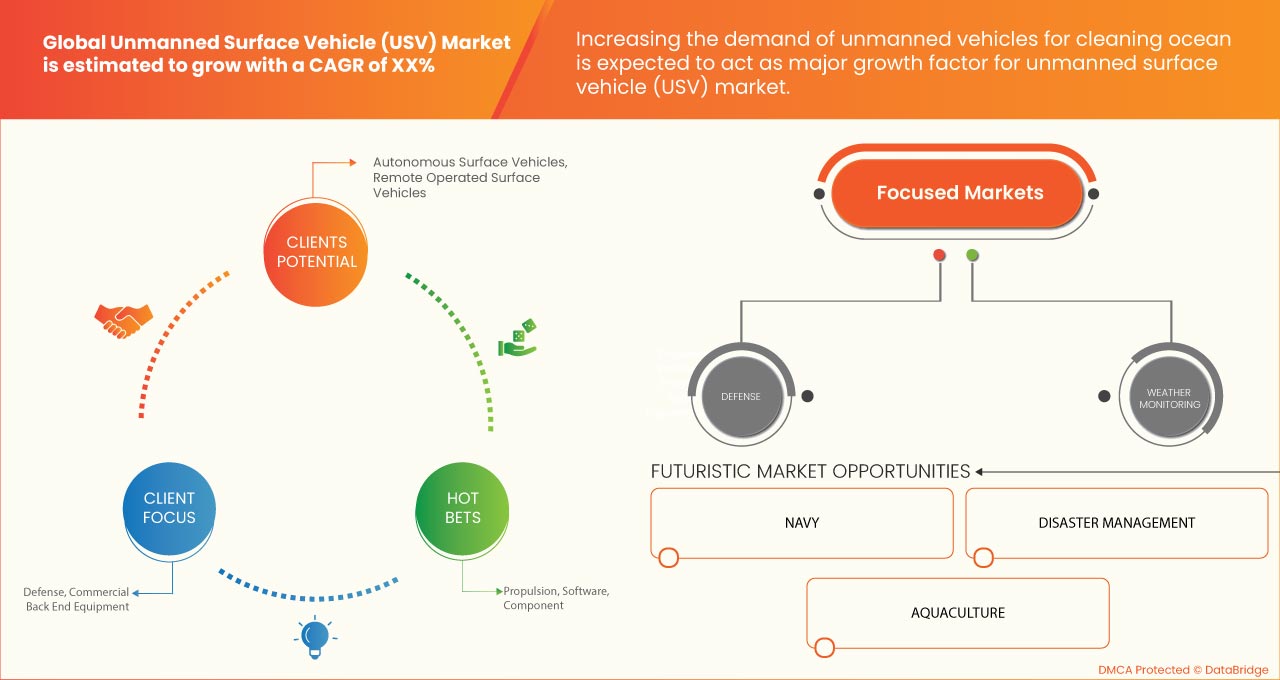
The increasing use of solar batteries to power the autonomous surface vehicle (ASV) is accelerating the growth of unmanned surface vehicles (USV). The growing demand for water quality monitoring due to increased levels of pollution and ocean data mapping, which allows scientists to study past climatic conditions, is boosting the growth of unmanned surface vehicles (USV). In addition, rising maritime security threats are prompting global navies to induce autonomous surface vehicles (ASV) in their fleet, giving them an edge, and further accelerating the global unmanned surface vehicle (USV) market growth. Their diversifying uses in disaster management services especially in search and rescue and preventive maintenance, for protecting the integrity of territorial and enclosed water areas. The rapid adoption in the aquaculture industry, which allows them for real-time monitoring to cater to the growing demand for worldwide fishery products, is expected to create strong opportunities for the global unmanned surface vehicle (USV) market. However, nascent collision detection technologies and further technological complexities associated with making them truly autonomous pose a challenge to the growth of the global unmanned surface vehicle (USV) market.
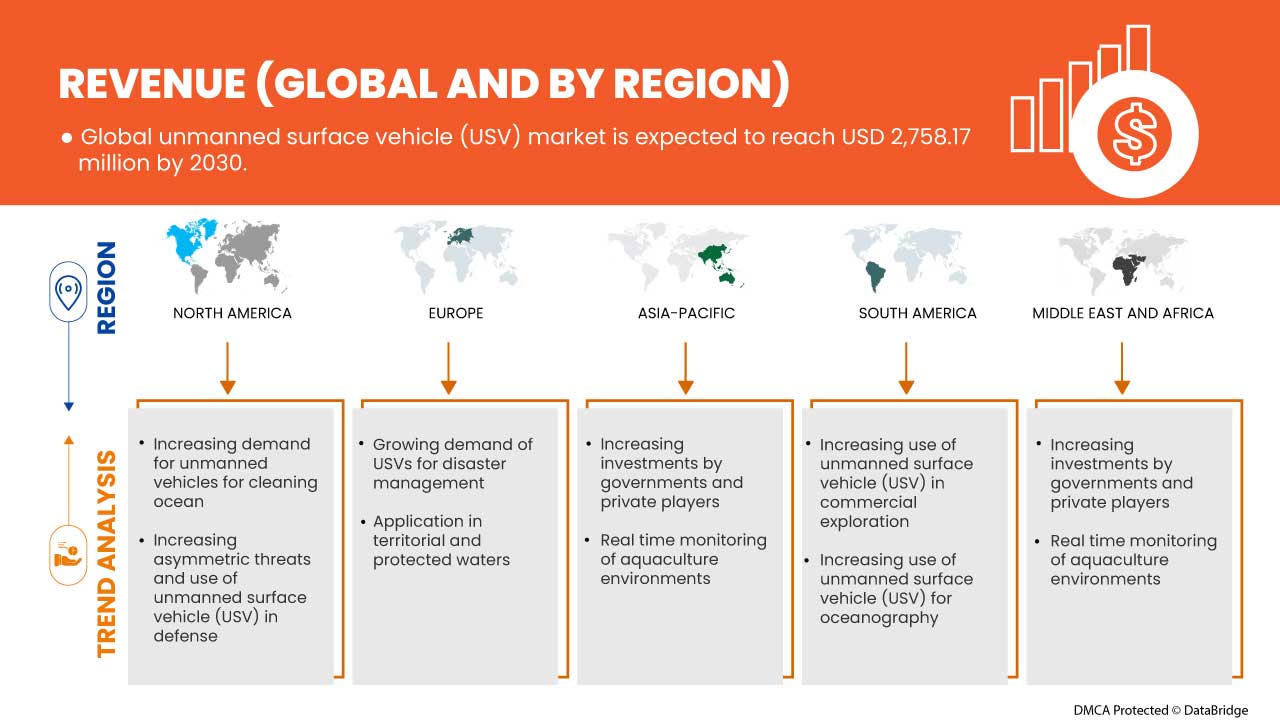
Data Bridge Market Research analyses that the global unmanned surface vehicle (USV) market is expected to reach the value of USD 2,758.17 million by 2030, at a CAGR of 13.7% during the forecast period. The unmanned surface vehicle (USV) market report also covers pricing analysis, patent analysis, and technological advancements in depth.
|
Report Metric |
Details |
|
Forecast Period |
2023 to 2030 |
|
Base Year |
2022 |
|
Historic Years |
2021 (Customizable to 2020 - 2016) |
|
Quantitative Units |
Revenue in USD Million, Pricing in USD |
|
Segments Covered |
By Type (Surface and Sub-Surface), Application (Defense, Commercial, Scientific Research, and Others), Endurance (100-500 Hours, <100 Hours, 500-1000 Hours, and >1000 Hours), Operation (Remote Operated Surface Vehicle and Autonomous Surface Vehicle), System (Propulsion, Chassis Material, Payload, Component, Software, and Communication), Hull Type (Catamaran (Twin Hulls), Kayak (Single Hull), Trimaran (Triple Hulls), and Rigid Inflatable Hull), Size (Medium (4 to 8 M), Small (Less than 4 M), Large (8 to 12 M), and Extra-Large (Above 12 M)). |
|
Countries Covered |
U.S., Canada, and Mexico in North America, Germany, France, U.K., Netherlands, Switzerland, Belgium, Russia, Italy, Spain, Turkey, Rest of Europe in Europe, China, Japan, India, South Korea, Singapore, Malaysia, Australia, Thailand, Indonesia, Philippines, Rest of Asia-Pacific (APAC) in the Asia-Pacific (APAC), Saudi Arabia, South Africa, Egypt, Israel, Rest of Middle East and Africa (MEA) as a part of Middle East and Africa (MEA), Brazil, Argentina and Rest of South America as part of South America. |
|
Market Players Covered |
Maritime Robotics AS, Elbit Systems Ltd., Rafael Advanced Defense Systems Ltd., Boeing, Utek, Seafloor Systems, Inc., SeaRobotics Corporation, Saildrone Inc., Deep Ocean Engineering, Inc., Zhuhai Yunzhou Intelligent Technology Co., Ltd., Kongsberg Maritime, Tecnologies, Inc., OCIUS, ATLAS ELEKTRONIK GmbH, Clearpath Robotics Inc., Teledyne Technologies Incorporated, Textron Inc., ECA GROUP and 5G Maritime. |
Market Definition
The unmanned surface vehicle (USV) is a water-borne vessel that can operate without the requirement of human onboard operators. They can be either remotely operated by an operator or are pre-programmed to be able to run on their own. It is usually powered by rapidly rechargeable lithium-ion batteries or solar energy and is mainly used for ocean exploration and maritime purposes.
The unmanned surface vehicle offers various advantages, which can be used for different kinds of applications such as commercial and research, defense purposes, search and rescue, and many more. Its adoption is steadily growing across various industry verticals, such as aquaculture, and has a huge potential to be an ideal vehicle that can be used for disaster management purposes.
Global Unmanned Surface Vehicle (USV) Market Dynamics
This section deals with understanding the market drivers, advantages, opportunities, restraints, and challenges. All of this is discussed in detail as below:
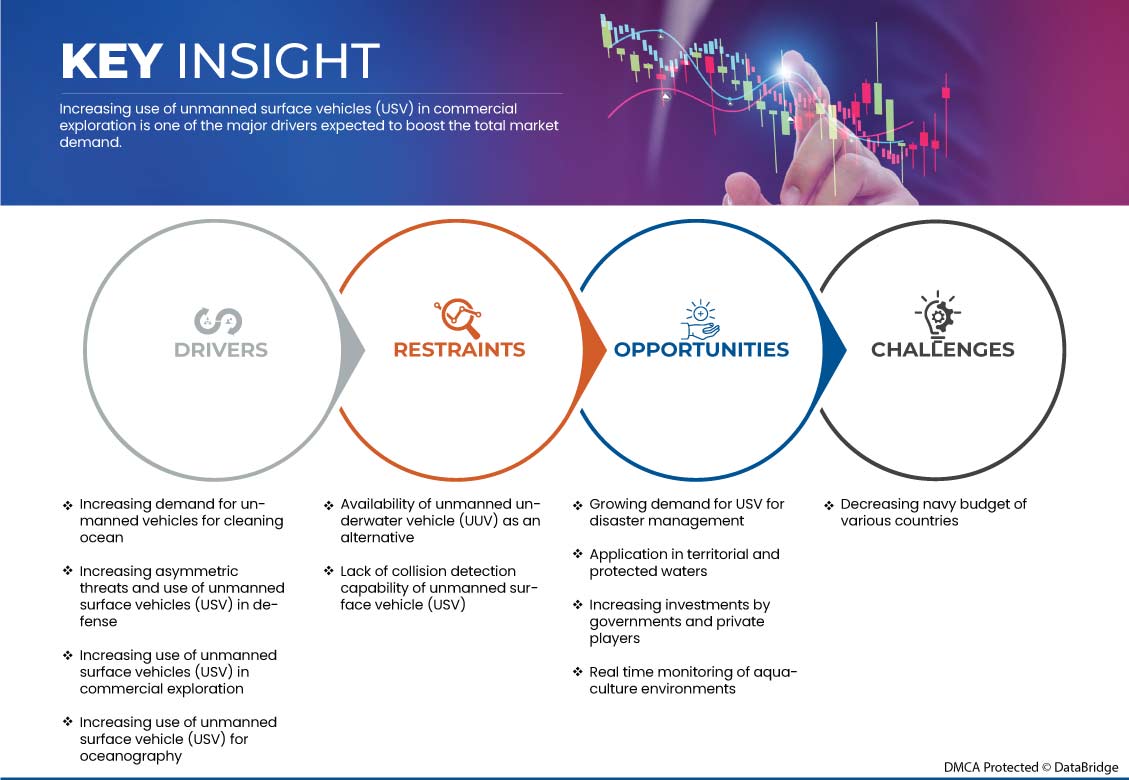
Drivers
- Increasing demand for unmanned vehicles for cleaning oceans
Marine pollution, or the contamination of oceans, has been growing over the years. Moreover, about 75% of Earth's surface has been covered by water, of which 97.5% is occupied by the ocean and 2.5% by fresh water. The rapidly increasing population has led to a growing need for fresh water for drinking and other purposes.
Although, the growth in industrialization and globalization has led to a surge in water pollution. A huge amount of plastic waste is being deployed in the ocean which is contaminating the water. In addition, the history of oil and gas exploration and transportation has witnessed several oil spills which have destroyed the aquatic life and quality of water. Along with this, chemical contamination is concerning for health, environmental, and economic reasons which have led to the demand for cleaning such water resources.
- Increasing asymmetric threats and use of unmanned surface vehicle (USV) in defense
Unmanned surface vehicles are being revolutionized for naval purposes for the past few years. These vehicles have been evolving from tools to carry out many tasks to systems capable of operating with a high degree of autonomy. Moreover, most countries are facing asymmetric warfare because of different strategies framed by different defense departments.
However, asymmetric warfare can describe conflicts. Such conflicts often involve strategies and tactics of unconventional warfare. The resources of asymmetric threats can be referred to as the attack by individuals, organizations, or nations to target any government, military or some valuable asset in order to acquire the asset or destroy the state. These attacks need to be continuously monitored by countries in order to protect them from any form of attack or any other type of applications such as illegal drug trafficking, air crash, maritime search investigations, payload delivery, and many others.
Opportunities
- Growing demand for USV for disaster management
Disasters, whether natural or man-made, have ruthless consequences for human lives, environments, and also artificial constructions. Man-made disasters can range from oil spills to heavy metals to forest fires, namely the deep water horizon oil spill (2010), Chernobyl disaster (1986), and the California wildfires (2018) among others.
The awareness has been growing regarding disasters over the years, and even though the ground, aerial and underwater robots have been used for disaster management (DM), surface vehicles are only starting to gain popularity. Although they are predominantly used for search and rescue purposes, they can be used for the detection of crustal deformation with the help of onboard seismometers and other seaboard pressure sensors.
Restraints/Challenges
- Lack of collision detection capability of unmanned surface vehicle (USV)
The usage of unmanned surface vehicle (USV) is increasing with its wide range of commercial, military, and research applications. These vehicles can work on their own and be fully autonomous, or an operator can control them to navigate their course and control their functioning.
Autonomous vehicles are facing the technological complexity of collision detection. As these vehicles can easily collide with any other marine vehicle, the lack of any proper collision system in the vehicle is acting as a major restraint for the market.
- Increasing investments by governments and private players
More than half a century ago, wars were fought by show of force as countries focused on full-force attacks. However, as times progressed and technologies advanced, various economies developed simultaneously, and they relied more on other factors like reconnaissance and surveillance. Thus, Global leaders have shifted their focus to Autonomous Surface Vehicles (ASV) to make them more efficient. They can be generally used to accompany large warships and battleships as well as detect underwater mines and traps.
It is becoming essential to increase investment in unmanned platforms with an impenetrable command network. USVs have the potential to become the centerpiece for various maritime operations. This is further propelled by rising skirmishes between various economies resulting in trade wars, illegal land captures, and surveillance. As a result, rising investments by Global naval forces to strengthen their capability, as well as investments by private entities is the factor that will create an opportunity for growth of the market.
Post-COVID-19 Impact on Global Unmanned Surface Vehicle (USV) Market
COVID-19 created a negative impact on the unmanned surface vehicle (USV) market owing to the rapid shutdown of manufacturing facilities across all industries.
The COVID-19 pandemic has impacted the unmanned surface vehicle (USV) market to an extent in a negative manner. Increasing adoption of USVs for ocean mapping has helped the market to grow after the pandemic. Also, it is expected that there will be considerable sectoral growth in the near future.
Manufacturers and solution providers are making various strategic decisions to enhance their offerings in the post-COVID-19 scenario. The players are conducting multiple research and development activities to improve the technology involved in the unmanned surface vehicle (USV). With this, the companies will bring advanced technologies to the market.
Recent Development
- In October 2022, ECA GROUP designed Critical Design Review to promote autonomous robotic systems in the 3rd generation MCM program. This product has helped the company to expand its product portfolio and enhance the offerings to the customers
- In April 2019, KONGSBERG launched a brand-new unmanned surface vehicle (USV) and sounder USV System. The sounder USV system is a multipurpose platform that was designed to work across different market segments, including surveys. This has helped the company to enhance its product offerings and to grow in the market
Global Unmanned Surface Vehicle (USV) Market Scope
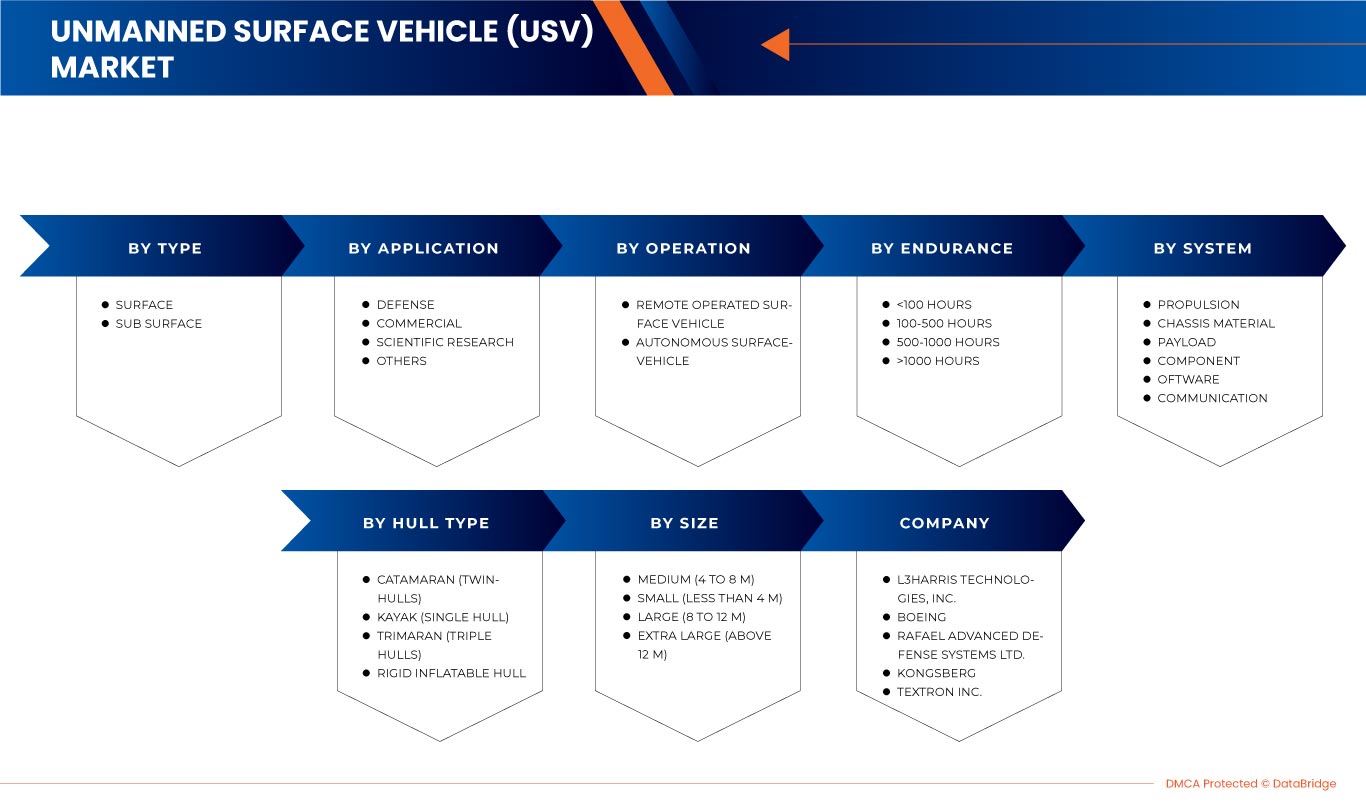
Global unmanned surface vehicle (USV) market is segmented into six notable segments, which are based on type, application, endurance, operation, system, hull type, and size. The growth amongst these segments will help you analyze meager growth segments in the industries and provide the users with a valuable market overview and market insights to help them make strategic decisions for identifying core market applications.
Type
- Surface
- Sub-Surface
On the basis of type, the global unmanned surface vehicle (USV) market is segmented into surface and sub-surface.
Application
- Defense
- Commercial
- Scientific Research
- Others
On the basis of application, the global unmanned surface vehicle (USV) market is segmented into defense, commercial, scientific research, and others.
Endurance
- 100-500 Hours
- <100 Hours
- 500-1000 Hours
- >1000 Hours
On the basis of endurance, the global unmanned surface vehicle (USV) market is segmented into 100-500 hours, <100 hours, 500-1000 hours, and >1000 hours.
Operation
- Remote Operated Surface Vehicle
- Autonomous Surface Vehicle
On the basis of operation, the global unmanned surface vehicle (USV) market is segmented into remote operated surface vehicle and autonomous surface vehicle.
System
- Propulsion
- Chassis Material
- Payload
- Component
- Software
- Communication
On the basis of the system, the global unmanned surface vehicle (USV) market is segmented into propulsion, chassis material, payload, component, software, and communication.
Hull Type
- Catamaran (Twin Hulls)
- Kayak (Single Hull)
- Trimaran (Triple Hulls)
- Rigid Inflatable Hull
On the basis of hull type, the global unmanned surface vehicle (USV) market is segmented into catamaran (twin hulls), kayak (single hull), trimaran (triple hulls), and rigid inflatable hull.
Size
- Medium (4 to 8 M)
- Small (Less than 4 M)
- Large (8 to 12 M)
- Extra-Large (Above 12 M)
On the basis of size, the global unmanned surface vehicle (USV) market is segmented into medium (4 to 8 m), small (less than 4 m), large (8 to 12 m), and extra-large (above 12 m).
Global Unmanned Surface Vehicle (USV) Market Regional Analysis/Insights
The global unmanned surface vehicle (USV) market is analyzed, and market size insights and trends are provided by country, type, application, endurance, operation, system, hull type, and size as referenced above.
The countries covered in the unmanned surface vehicle (USV) market report are U.S., Canada, and Mexico, Germany, France, U.K., Netherlands, Switzerland, Belgium, Russia, Italy, Spain, Turkey, rest of Europe, China, Japan, India, South Korea, Singapore, Malaysia, Australia, Thailand, Indonesia, Philippines, rest of Asia-Pacific, Saudi Arabia, South Africa, Egypt, Israel, rest of Middle East and Africa, Brazil, Argentina and rest of South America.
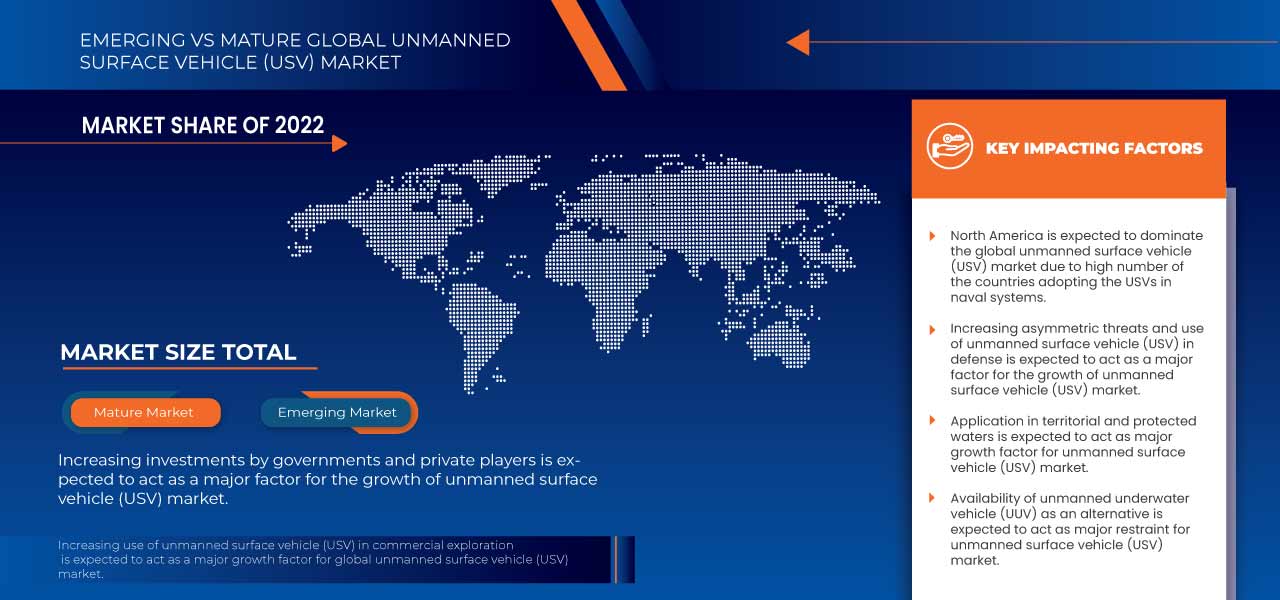
- In 2023, North America is expected to dominate the global unmanned surface vehicle (USV) market owing to the rising adoption of seafloor mapping, an inspection of water quality, and infrastructure such as bridges.
The U.S. is expected to dominate the North America region as it is home to many giant market players in the unmanned surface vehicle (USV) market. Germany expected to dominate in Europe region due to rising investment in research and development activities related to autonomous vehicles. China expected to dominate in the Asia-Pacific region due to increasing demand for large USVs for commercial and defense applications such as combat operations, cargo transportation and others.
The country section of the report also provides individual market impacting factors and changes in market regulation that impact the current and future trends of the market. Data points like down-stream and upstream value chain analysis, technical trends and porter's five forces analysis, case studies are some of the pointers used to forecast the market scenario for individual countries. Also, the presence and availability of global brands and their challenges faced due to large or scarce competition from local and domestic brands, the impact of domestic tariffs and trade routes are considered while providing forecast analysis of the country data.
Competitive Landscape and Global Unmanned Surface Vehicle (USV) Market Share Analysis
The global unmanned surface vehicle (USV) market competitive landscape provides details by competitor. Details included are company overview, company financials, revenue generated, market potential, investment in research and development, new market initiatives, global presence, production sites and facilities, production capacities, company strengths and weaknesses, product launch, product width and breadth, application dominance. The above data points provided are only related to the companies' focus related to unmanned surface vehicle (USV) market.
Some of the major players operating in global unmanned surface vehicle (USV) market are Maritime Robotics AS, Elbit Systems Ltd., Rafael Advanced Defense Systems Ltd., Boeing, Utek, Seafloor Systems, Inc., SeaRobotics Corporation, Saildrone Inc., Deep Ocean Engineering, Inc., Zhuhai Yunzhou Intelligent Technology Co., Ltd., Kongsberg Maritime, Tecnologies, Inc., OCIUS, ATLAS ELEKTRONIK GmbH, Clearpath Robotics Inc., Teledyne Technologies Incorporated, Textron Inc., ECA GROUP and 5G Maritime among others.
SKU-
Получите онлайн-доступ к отчету на первой в мире облачной платформе рыночной аналитики

- Интерактивная панель анализа данных
- Панель анализа компании для возможностей с высоким потенциалом роста
- Доступ аналитика-исследователя для настройки и запросов
- Анализ конкурентов с помощью интерактивной панели
- Последние новости, обновления и анализ тенденций
- Используйте возможности сравнительного анализа для комплексного отслеживания конкурентов
Методология исследования
Сбор данных и анализ базового года выполняются с использованием модулей сбора данных с большими размерами выборки. Этап включает получение рыночной информации или связанных данных из различных источников и стратегий. Он включает изучение и планирование всех данных, полученных из прошлого заранее. Он также охватывает изучение несоответствий информации, наблюдаемых в различных источниках информации. Рыночные данные анализируются и оцениваются с использованием статистических и последовательных моделей рынка. Кроме того, анализ доли рынка и анализ ключевых тенденций являются основными факторами успеха в отчете о рынке. Чтобы узнать больше, пожалуйста, запросите звонок аналитика или оставьте свой запрос.
Ключевой методологией исследования, используемой исследовательской группой DBMR, является триангуляция данных, которая включает в себя интеллектуальный анализ данных, анализ влияния переменных данных на рынок и первичную (отраслевую экспертную) проверку. Модели данных включают сетку позиционирования поставщиков, анализ временной линии рынка, обзор рынка и руководство, сетку позиционирования компании, патентный анализ, анализ цен, анализ доли рынка компании, стандарты измерения, глобальный и региональный анализ и анализ доли поставщика. Чтобы узнать больше о методологии исследования, отправьте запрос, чтобы поговорить с нашими отраслевыми экспертами.
Доступна настройка
Data Bridge Market Research является лидером в области передовых формативных исследований. Мы гордимся тем, что предоставляем нашим существующим и новым клиентам данные и анализ, которые соответствуют и подходят их целям. Отчет можно настроить, включив в него анализ ценовых тенденций целевых брендов, понимание рынка для дополнительных стран (запросите список стран), данные о результатах клинических испытаний, обзор литературы, обновленный анализ рынка и продуктовой базы. Анализ рынка целевых конкурентов можно проанализировать от анализа на основе технологий до стратегий портфеля рынка. Мы можем добавить столько конкурентов, о которых вам нужны данные в нужном вам формате и стиле данных. Наша команда аналитиков также может предоставить вам данные в сырых файлах Excel, сводных таблицах (книга фактов) или помочь вам в создании презентаций из наборов данных, доступных в отчете.











