Global Growth Hormone Deficiency Market, By Type (Pediatric Growth Hormone Deficiency, Adult Growth Hormone Deficiency), Route of Administration (Intravenous, Intramuscular, Others), Treatment (Pharmacological Therapy, Recombinant Human Growth Hormone, Human Pituitary Gland Extracts, Surgery), Diagnosis (Blood Tests, Imaging Tests, Others), End-Users (Hospitals, Homecare, Specialty Clinics, Others), Distribution Channel (Hospital Pharmacy, Online Pharmacy, Retail Pharmacy) – Industry Trends and Forecast to 2030.
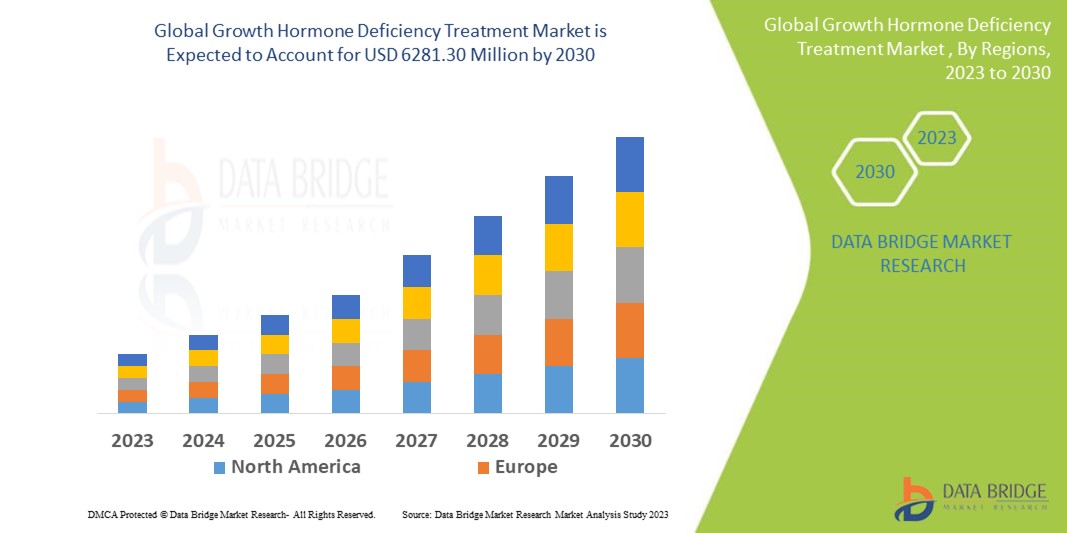
Growth Hormone Deficiency Treatment Market Analysis and Size
As per the American Academy of Pediatrics, growth hormone deficiency among humans occurs and affects around less than one in 3,000 to one in 10,000 children in U.S. Human growth hormone medications are widely available in today’s market-creating awareness about its health benefits which is thus the revenue generation of numerous manufacturing companies. The huge demand for such medication is growing the rate of growth hormone diseases.
Data Bridge Market Research analyses a growth rate in the growth hormone deficiency treatment market in the forecast period 2023-2030. The expected CAGR of growth hormone deficiency treatment market is tend to be around 5.2% in the mentioned forecast period. The market was valued at USD 4187.2 million in 2022, and it would grow upto USD 6281.30 million by 2030. In addition to the market insights such as market value, growth rate, market segments, geographical coverage, market players, and market scenario, the market report curated by the Data Bridge Market Research team also includes in-depth expert analysis, patient epidemiology, pipeline analysis, pricing analysis, and regulatory framework.
Growth Hormone Deficiency Treatment Market Scope and Segmentation
|
Report Metric |
Details |
|
Forecast Period |
2023 to 2030 |
|
Base Year |
2022 |
|
Historic Years |
2021 (Customizable to 2015 - 2020) |
|
Quantitative Units |
Revenue in USD Million, Volumes in Units, Pricing in USD |
|
Segments Covered |
Type (Pediatric Growth Hormone Deficiency, Adult Growth Hormone Deficiency), Route of Administration (Intravenous, Intramuscular, Others), Treatment (Pharmacological Therapy, Recombinant Human Growth Hormone, Human Pituitary Gland Extracts, Surgery), Diagnosis (Blood Tests, Imaging Tests, Others), End-Users (Hospitals, Homecare, Specialty Clinics, Others), Distribution Channel (Hospital Pharmacy, Online Pharmacy, Retail Pharmacy) |
|
Countries Covered |
U.S., Canada and Mexico in North America, Germany, France, U.K., Netherlands, Switzerland, Belgium, Russia, Italy, Spain, Turkey, Rest of Europe in Europe, China, Japan, India, South Korea, Singapore, Malaysia, Australia, Thailand, Indonesia, Philippines, Rest of Asia-Pacific (APAC) in the Asia-Pacific (APAC), Saudi Arabia, U.A.E, South Africa, Egypt, Israel, Rest of Middle East and Africa (MEA) as a part of Middle East and Africa (MEA), Brazil, Argentina and Rest of South America as part of South America |
|
Market Players Covered |
F. Hoffmann-La Roche Ltd. (Switzerland), Mylan N.V. (U.S.), Teva Pharmaceutical Industries Ltd. (Israel), Sanofi (France), Pfizer Inc. (U.S.), GSK plc (U.K.), Novartis AG (Switzerland), Zydus Group (India), AstraZeneca (U.K.), Bayer AG (Germany), Sun Pharmaceutical Industries Ltd. (India), Merck & Co., Inc. (U.S.), Bristol-Myers Squibb Company (U.S.), Lilly (U.S.), Cipla Inc. (U.S.), Ipsen Pharma (France), Novo Nordisk A/S (Denmark), Abbott (U.S.), Abbvie, Inc (U.S.) |
|
Market Opportunities |
|
Market Definition
Growth hormone deficiency (GHD), also called dwarfism or pituitary dwarfism, is a type of disorder that is caused by a lack of growth hormone in the body. Children with GHD have normal body proportions but are drastically short in stature. It can be congenital or develop over time. If the pituitary gland produces insufficient growth hormone, this disease occurs. Genetic problems, a serious brain injury, or being born without a pituitary gland, can cause it.
Growth Hormone Deficiency Treatment Market Dynamics
Drivers
- Increasing Trend of urban lifestyle
Urban lifestyles and declining food habits are expected to rise the demand for human growth hormone drugs and varied treatment facilities. There has been a rise in stress and sleeplessness due to the hectic life patterns of the citizens working in cities. This is leading to huge hormonal imbalance in the body. Thus, this factor leads to the deficiency in people.
- Increase in Growth Deficiencies
There has been a persistent increase in public understanding associated with the use of synthetic growth hormone therapy. The increasing industrial research for the causes of growth deficiencies, along with an improving occurrence of diagnosis, caused an increase in market growth. Numerous growth-related issues such as adult growth hormone deficiency, idiopathic low stature, pediatric growth hormone deficit, and hereditary illnesses such as Turner syndrome and Prader-Willi syndrome are causing enough to boost the market size. Worldwide, 1 in 3800 children suffers from a growth hormone deficit. Turner syndrome affects around 1 in every 2000 females, and Prader-Willi syndrome affects 1 in every 30,000 persons. Thus, it boosts the market growth.
Opportunities
- Increased Elderly Population
The increasing elderly population is projected to increase the market's expansion during the forecast period of 2023-2030. As per the World Health Organization, the worldwide elderly population, which was projected to be more than 524 million in 2010, is predicted to increase to almost 2 billion by 2050. Elderly people are more vulnerable to growth diseases because of their compromised immune systems, further estimated to enhance the market’s growth rate.
- Rising Government Initiatives
The numerous initiatives taken by many government and private organizations to spread awareness about growth hormone deficiencies and human growth hormone treatment are expected to drive the market.
Restraints/Challenges
- High Cost of Treatment
The increased expenditure related with these drugs impede the market growth. The growth hormone deficiency drugs cost much and thus sometimes becomes less affordable for the lower economic groups.
This growth hormone deficiency treatment market report provides details of new recent developments, trade regulations, import-export analysis, production analysis, value chain optimization, market share, impact of domestic and localized market players, analyses opportunities in terms of emerging revenue pockets, changes in market regulations, strategic market growth analysis, market size, category market growths, application niches and dominance, product approvals, product launches, geographic expansions, technological innovations in the market. To gain more info on the growth hormone deficiency treatment market contact Data Bridge Market Research for an Analyst Brief, our team will help you take an informed market decision to achieve market growth.
Recent Developments:
- In 2021, the U.S. Food and Drug Administration approved the first once-weekly injection for pediatric growth hormone deficiency. Lonapegsomatropin-tcgd injection is approved for children weighing at least 11.5 kg who are facing growth failure because of insufficient endogenous growth hormone secretion.
Global Growth Hormone Deficiency Treatment Market Scope
The growth hormone deficiency treatment market is segmented on the basis of type, treatment, diagnosis, route of administration, end-users and distribution channel. The growth amongst these segments will help you analyze meagre growth segments in the industries and provide the users with a valuable market overview and market insights to help them make strategic decisions for identifying core market applications.
Type
- Pediatric Growth Hormone Deficiency
- Adult Growth Hormone Deficiency
Diagnosis
- Blood Tests
- Imaging Tests
- Computerized tomography (CT) scans
- Magnetic resonance imaging (MRI)
- Others
Treatment
- Pharmacological Therapy
- Recombinant Human Growth Hormone
- Human Pituitary Gland Extracts
- Surgery
Route of Administration
- Intravenous
- Intramuscular
- Others
End User
- Hospitals
- Homecare
- Specialty Clinics
- Others
Distribution Channel
- Hospital Pharmacy
- Online Pharmacy
- Retail Pharmacy
Growth Hormone Deficiency Treatment Market Regional Analysis/Insights
The growth hormone deficiency treatment market is analyzed and market size insights and trends are provided type, treatment, diagnosis, route of administration, end-users and distribution channelas referenced above.
The major countries covered in the growth hormone deficiency treatment market report are the U.S., Canada and Mexico in North America, Germany, France, U.K., Netherlands, Switzerland, Belgium, Russia, Italy, Spain, Turkey, Rest of Europe in Europe, China, Japan, India, South Korea, Singapore, Malaysia, Australia, Thailand, Indonesia, Philippines, Rest of Asia-Pacific (APAC) in the Asia-Pacific (APAC), Saudi Arabia, U.A.E, South Africa, Egypt, Israel, Rest of Middle East and Africa (MEA) as a part of Middle East and Africa (MEA), Brazil, Argentina and Rest of South America as part of South America.
North America has been witnessing a positive growth for global growth hormone deficiency treatment market throughout the forecast period due to the increasing number of research activities in this region. Moreover, growing healthcare expenditure and the presence of major key players will further propel the market’s growth rate in this region.
Asia-Pacific dominates the market because of the growing cases of growth hormone deficiency in this region. Additionally, the major development of healthcare infrastructure and the increasing elderly population will further boost the market’s growth rate in this region.
The country section of the report also provides individual market impacting factors and changes in regulation in the market domestically that impacts the current and future trends of the market. Also, the presence and availability of global brands and their challenges faced due to large or scarce competition from local and domestic brands, impact of domestic tariffs and trade routes are considered while providing forecast analysis of the country data.
Competitive Landscape and Global Growth Hormone Deficiency Treatment Market Share Analysis
The growth hormone deficiency treatment market competitive landscape provides details by competitor. Details included are company overview, company financials, revenue generated, market potential, investment in research and development, new market initiatives, global presence, production sites and facilities, production capacities, company strengths and weaknesses, product launch, product width and breadth, application dominance. The above data points provided are only related to the companies' focus related to growth hormone deficiency treatment market
Key players operating in the growth hormone deficiency treatment market market include:
- F. Hoffmann-La Roche Ltd. (Switzerland)
- Mylan N.V. (U.S.)
- Teva Pharmaceutical Industries Ltd. (Israel)
- Sanofi (France)
- Pfizer Inc. (U.S.)
- GSK plc (U.K.)
- Novartis AG (Switzerland)
- Zydus Group (India)
- AstraZeneca (U.K.)
- Bayer AG (Germany)
- Sun Pharmaceutical Industries Ltd. (India)
- Merck & Co., Inc. (U.S.)
- Bristol-Myers Squibb Company (U.S.)
- Lilly (U.S.)
- Cipla Inc. (U.S.)
- Ipsen Pharma (France)
- Novo Nordisk A/S (Denmark)
- Abbott (U.S.)
- Abbvie, Inc (U.S.)
SKU-
研究方法
数据收集和基准年分析是使用具有大样本量的数据收集模块完成的。该阶段包括通过各种来源和策略获取市场信息或相关数据。它包括提前检查和规划从过去获得的所有数据。它同样包括检查不同信息源中出现的信息不一致。使用市场统计和连贯模型分析和估计市场数据。此外,市场份额分析和关键趋势分析是市场报告中的主要成功因素。要了解更多信息,请请求分析师致电或下拉您的询问。
DBMR 研究团队使用的关键研究方法是数据三角测量,其中包括数据挖掘、数据变量对市场影响的分析和主要(行业专家)验证。数据模型包括供应商定位网格、市场时间线分析、市场概览和指南、公司定位网格、专利分析、定价分析、公司市场份额分析、测量标准、全球与区域和供应商份额分析。要了解有关研究方法的更多信息,请向我们的行业专家咨询。
可定制
Data Bridge Market Research 是高级形成性研究领域的领导者。我们为向现有和新客户提供符合其目标的数据和分析而感到自豪。报告可定制,包括目标品牌的价格趋势分析、了解其他国家的市场(索取国家列表)、临床试验结果数据、文献综述、翻新市场和产品基础分析。目标竞争对手的市场分析可以从基于技术的分析到市场组合策略进行分析。我们可以按照您所需的格式和数据样式添加您需要的任意数量的竞争对手数据。我们的分析师团队还可以为您提供原始 Excel 文件数据透视表(事实手册)中的数据,或者可以帮助您根据报告中的数据集创建演示文稿。