



Global Intracranial Stents Market Segmentation, By Product Type (Self-Expanding Intracranial Stents and Embolization Coil Support Intracranial Stents), Disease Indication (Brain Aneurysm and Intracranial Stenosis), End-User (Hospitals and Ambulatory Surgical Centers) - Industry Trends and Forecast to 2033
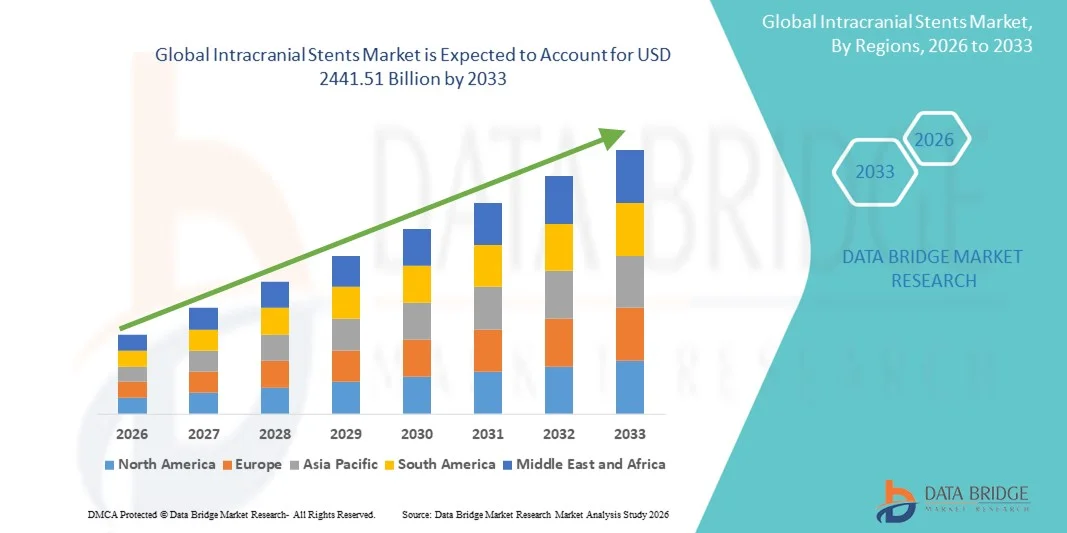
Intracranial Stents Market Size
- The global Intracranial Stents market size was valued at USD 1189.06 billion in 2025 and is expected to reach USD 2441.51 billion by 2033, at a CAGR of 9.41% during the forecast period
- The market growth is largely driven by the rising prevalence of intracranial aneurysms and ischemic stroke, along with continuous technological advancements in neurovascular devices, which are enhancing the safety, efficacy, and clinical outcomes of intracranial stent procedures across hospitals and specialized neurological centers
- Furthermore, increasing adoption of minimally invasive endovascular treatments, growing awareness among clinicians about early intervention, and expanding access to advanced neurointerventional care are accelerating the uptake of intracranial stents, thereby significantly boosting the overall growth of the Intracranial Stents market
Intracranial Stents Market Analysis
- Intracranial stents, used in the treatment of cerebral aneurysms and ischemic stroke, are increasingly becoming essential devices in modern neurointerventional care due to their role in enabling minimally invasive procedures, improving cerebral blood flow, and reducing long-term neurological complications
- The demand for intracranial stents is driven by the rising global burden of stroke and intracranial aneurysms, growing preference for endovascular therapies over conventional surgery, and continuous advancements in stent technologies such as flow diverters, braided stents, and next-generation self-expanding designs
- North America dominated the intracranial stents market with a revenue share of approximately 35.4% in 2025, supported by advanced neurovascular treatment infrastructure, high adoption of innovative stent technologies, favorable reimbursement policies, and a strong presence of leading medical device manufacturers, particularly in the United States
- Asia-Pacific is projected to be the fastest growing region in the intracranial stents market during the forecast period, with an estimated CAGR of around 8.7%, driven by a rapidly expanding patient pool, increasing incidence of stroke, improving access to specialized neurointerventional care, and rising healthcare investments across China, India, and Southeast Asia
Report Scope and Intracranial Stents Market Segmentation
|
Attributes |
Intracranial Stents Key Market Insights |
|
Segments Covered |
|
|
Countries Covered |
North America
Europe
Asia-Pacific
Middle East and Africa
South America
|
|
Key Market Players |
|
|
Market Opportunities |
|
|
Value Added Data Infosets |
In addition to the insights on market scenarios such as market value, growth rate, segmentation, geographical coverage, and major players, the market reports curated by the Data Bridge Market Research also include in-depth expert analysis, patient epidemiology, pipeline analysis, pricing analysis, and regulatory framework. |
Intracranial Stents Market Trends
Advancements in Minimally Invasive Neurovascular Treatment Technologies
- A significant and accelerating trend in the global Intracranial Stents market is the increasing adoption of minimally invasive neurovascular interventions for the treatment of intracranial aneurysms and complex cerebrovascular diseases
- These procedures offer reduced surgical trauma, shorter hospital stays, and improved patient recovery outcomes compared to traditional open surgical methods
- For instance, advanced self-expanding and flow-diverting intracranial stents are increasingly being adopted in neurointerventional centers across North America, Europe, and parts of Asia to treat wide-neck and complex aneurysms with higher precision and safety
- Ongoing innovations in stent materials, including nitinol-based alloys and bio-compatible coatings, are enhancing flexibility, durability, and long-term vessel compatibility, improving clinical outcomes
- The growing availability of hybrid stent systems that combine support with flow diversion capabilities is expanding the range of treatable neurovascular conditions
- Globally, increasing investments in neurovascular research and improvements in imaging and catheter-based delivery technologies are further supporting the evolution and adoption of next-generation intracranial stents
Intracranial Stents Market Dynamics
Driver
Rising Prevalence of Cerebrovascular Disorders and Aging Population
- The increasing incidence of cerebrovascular diseases such as intracranial aneurysms, ischemic strokes, and arterial stenosis is a major driver for the growth of the Intracranial Stents market worldwide
- For instance, in 2024, several tertiary care hospitals in the United States and Europe expanded their neurointerventional programs to accommodate the growing number of patients requiring endovascular treatment using intracranial stents
- The global aging population is particularly susceptible to neurovascular conditions, leading to higher demand for effective and less invasive treatment options
- Furthermore, improved awareness, early diagnosis, and advancements in neuroimaging technologies are enabling timely intervention, increasing the adoption of intracranial stent-based procedures
- Supportive reimbursement policies in developed regions and the expansion of specialized stroke and neurovascular centers are further accelerating market growth across both developed and emerging economies
Restraint/Challenge
High Procedure Costs and Technical Complexity of Neurointerventional Procedures
- The high cost associated with intracranial stent devices and related neurointerventional procedures remains a significant challenge, particularly in low- and middle-income countries. Expenses related to advanced imaging, specialized equipment, and skilled clinical expertise can limit accessibility
- For instance, hospitals in certain regions of Asia-Pacific and Latin America face challenges in adopting advanced intracranial stent technologies due to budget constraints and limited reimbursement coverage
- The technical complexity of intracranial stent placement requires highly trained neurointerventional specialists, and the shortage of skilled professionals can restrict market growth
- Strict regulatory requirements and lengthy approval processes for neurovascular devices can delay product commercialization and increase development costs for manufacturers
- Addressing these challenges through cost-optimized device designs, expanded physician training programs, and improved healthcare infrastructure will be essential for the sustained growth of the global Intracranial Stents market
Intracranial Stents Market Scope
The market is segmented on the basis of product type, disease indication, and end-user.
- By Product Type
On the basis of product type, the Intracranial Stents market is segmented into self-expanding intracranial stents and embolization coil support intracranial stents. The self-expanding intracranial stents segment dominated the largest market revenue share of approximately 61.4% in 2025, driven by their superior flexibility, adaptability to complex cerebral vasculature, and widespread use in neurointerventional procedures. These stents are extensively adopted in the treatment of intracranial stenosis and wide-neck aneurysms due to their ability to maintain vessel patency while minimizing trauma. Their compatibility with minimally invasive procedures, high clinical success rates, and continuous technological advancements further support dominance. Growing preference among neurovascular surgeons, increasing stroke prevalence, and rising adoption in tertiary care hospitals also contribute significantly. In addition, favorable reimbursement policies in developed markets and strong clinical evidence validating safety and efficacy continue to reinforce market leadership.
The embolization coil support intracranial stents segment is expected to witness the fastest growth, registering a CAGR of around 9.2% from 2026 to 2033, driven by increasing adoption in complex aneurysm treatments. These stents provide enhanced stability for coil placement in wide-neck and bifurcation aneurysms, reducing the risk of coil migration. Rising demand for advanced aneurysm management solutions, growing neurointerventional procedure volumes, and technological innovations in stent-assisted coiling are key growth drivers. Increased awareness among clinicians, expanding use in emerging economies, and improving patient outcomes further accelerate growth. In addition, expanding product pipelines and regulatory approvals support rapid market expansion.
- By Disease Indication
On the basis of disease indication, the Intracranial Stents market is segmented into brain aneurysm and intracranial stenosis. The brain aneurysm segment accounted for the largest revenue share of approximately 58.9% in 2025, driven by the rising global incidence of cerebral aneurysms and increasing detection through advanced imaging technologies. Growing preference for endovascular treatment over open surgical procedures has significantly boosted intracranial stent adoption. The segment benefits from increasing use of stent-assisted coiling techniques, improved procedural safety, and shorter hospital stays. Advancements in flow-diverter and self-expanding stents further strengthen demand. Rising healthcare expenditure, expanding neurovascular centers, and favorable clinical outcomes continue to support segment dominance across developed and emerging markets.
The intracranial stenosis segment is projected to grow at the fastest CAGR of approximately 8.7% from 2026 to 2033, driven by the increasing prevalence of ischemic stroke and atherosclerotic disease. Growing awareness regarding early intervention, expanding geriatric population, and improvements in minimally invasive neurovascular procedures are key contributors. Enhanced stent designs offering better radial strength and reduced restenosis rates further drive adoption. Increasing investments in stroke care infrastructure and rising screening programs in developing regions also support accelerated growth.
- By End-User
On the basis of end-user, the Intracranial Stents market is segmented into hospitals and ambulatory surgical centers. The hospitals segment dominated the market with a revenue share of approximately 69.6% in 2025, supported by the availability of advanced neurointerventional facilities and skilled neurosurgeons. Hospitals serve as primary centers for complex intracranial procedures, including aneurysm repair and stroke management. Higher patient inflow, access to advanced imaging systems, and the ability to manage post-procedural complications strengthen dominance. In addition, favorable reimbursement structures and government investments in hospital infrastructure further contribute to sustained leadership.
The ambulatory surgical centers segment is expected to witness the fastest growth, registering a CAGR of nearly 9.5% from 2026 to 2033, driven by the shift toward minimally invasive procedures and cost-effective care settings. Improvements in procedural efficiency, reduced hospitalization time, and advancements in outpatient neurointerventional techniques are fueling adoption. Growing patient preference for shorter recovery times and expanding ASC capabilities in developed regions further accelerate growth. Increasing regulatory approvals and investments in outpatient neurovascular services also support rapid expansion.
Intracranial Stents Market Regional Analysis
- North America dominated the intracranial stents market with a revenue share of approximately 35.4% in 2025, supported by a well-established neurovascular treatment infrastructure, widespread adoption of advanced intracranial stent technologies, and strong clinical expertise across hospitals and specialized stroke centers
- The region benefits from early access to innovative stent designs, including flow diverters and self-expanding stents, which are widely used in the treatment of complex intracranial aneurysms and cerebrovascular disorders
- Favorable reimbursement frameworks, high healthcare expenditure, and a strong presence of leading medical device manufacturers, particularly in the United States, further reinforce North America’s leading position in the global Intracranial Stents market
U.S. Intracranial Stents Market Insight
The U.S. intracranial stents market accounted for the largest share within North America in 2025, driven by a high prevalence of stroke and intracranial aneurysms, advanced neurointerventional capabilities, and the presence of specialized comprehensive stroke centers. Strong regulatory support for innovation, extensive clinical research activity, and rapid adoption of next-generation stent technologies continue to fuel market growth. Additionally, well-defined reimbursement policies and a high level of physician awareness contribute significantly to the expansion of the intracranial stents industry in the country.
Europe Intracranial Stents Market Insight
The Europe intracranial stents market is expected to grow at a steady CAGR during the forecast period, supported by increasing awareness of minimally invasive neurovascular treatments and a rising burden of cerebrovascular diseases. Countries across Western and Northern Europe are witnessing greater adoption of intracranial stents due to improved access to specialized neurointerventional care, supportive healthcare policies, and advancements in medical imaging technologies.
U.K. Intracranial Stents Market Insight
The U.K. intracranial stents market is projected to grow at a notable pace, driven by the expansion of stroke care programs, rising diagnosis rates of intracranial aneurysms, and increasing preference for endovascular treatment approaches. Ongoing investments in public healthcare infrastructure and the growing availability of trained neurointerventional specialists are further supporting market growth.
Germany Intracranial Stents Market Insight
The Germany intracranial stents market is anticipated to expand at a considerable CAGR over the forecast period, supported by the country’s strong medical technology ecosystem and high standards of neurological care. Germany’s focus on innovation, clinical research, and adoption of advanced minimally invasive procedures contributes to the increasing utilization of intracranial stents in both public and private healthcare settings.
Asia-Pacific Intracranial Stents Market Insight
The Asia-Pacific intracranial stents market is projected to be the fastest-growing region, registering an estimated CAGR of around 8.7% during the forecast period, driven by a rapidly expanding patient population and a rising incidence of stroke and other cerebrovascular disorders. Improving healthcare infrastructure, increasing availability of specialized neurointerventional centers, and rising healthcare expenditure across emerging economies are key growth drivers in the region.
China Intracranial Stents Market Insight
China intracranial stents market accounted for the largest revenue share within the Asia-Pacific Intracranial Stents market in 2025, attributed to its large population base, increasing prevalence of stroke, and expanding access to advanced neurovascular treatments. Government initiatives aimed at strengthening healthcare infrastructure, coupled with the presence of domestic and international medical device manufacturers, are accelerating the adoption of intracranial stents across major hospitals.
Japan Intracranial Stents Market Insight
The Japan intracranial stents market is witnessing steady growth due to the country’s aging population and high incidence of cerebrovascular diseases. Japan’s advanced healthcare system, strong emphasis on minimally invasive treatments, and continuous technological innovation are driving the adoption of intracranial stents in both acute and preventive neurovascular care settings.
Intracranial Stents Market Share
The Intracranial Stents industry is primarily led by well-established companies, including:
- Medtronic (Ireland)
- Stryker Corporation (U.S.)
- Terumo Corporation (Japan)
- Johnson & Johnson (U.S.)
- Penumbra, Inc. (U.S.)
- Balt Extrusion (France)
- Phenox GmbH (Germany)
- Acandis GmbH (Germany)
- Rapid Medical (Israel)
- Merit Medical Systems (U.S.)
- Lepu Medical Technology (China)
- Shanghai MicroPort NeuroTech (China)
- Nanjing Wallaby Medical (China)
- Integer Holdings Corporation (U.S.)
Latest Developments in Global Intracranial Stents Market
- In February 2023, Medtronic launched a new Intracranial Stent System designed to treat intracranial aneurysms with enhanced flexibility and patient outcomes, marking a significant advancement in neurovascular interventions
- In April 2023, Abbott Laboratories completed the acquisition of the neurovascular division of Cardiovascular Systems Inc., expanding its portfolio in intracranial intervention devices and strengthening its position in stent technologies for complex neurovascular applications
- In November 2024, Medtronic announced FDA approval for its next-generation Pipeline Vantage Embolization Device, featuring enhanced deliverability and fluoroscopic visibility for aneurysm treatment, enhancing clinical utility in the U.S. market
- In May 2025, MicroVention launched the LVIS EVO Stent in Europe following CE Mark clearance. This device offers improved fluoroscopic visibility and navigation in difficult vessel anatomies, supporting stent-assisted coiling treatments
SKU-

研究方法
数据收集和基准年分析是使用具有大样本量的数据收集模块完成的。该阶段包括通过各种来源和策略获取市场信息或相关数据。它包括提前检查和规划从过去获得的所有数据。它同样包括检查不同信息源中出现的信息不一致。使用市场统计和连贯模型分析和估计市场数据。此外,市场份额分析和关键趋势分析是市场报告中的主要成功因素。要了解更多信息,请请求分析师致电或下拉您的询问。
DBMR 研究团队使用的关键研究方法是数据三角测量,其中包括数据挖掘、数据变量对市场影响的分析和主要(行业专家)验证。数据模型包括供应商定位网格、市场时间线分析、市场概览和指南、公司定位网格、专利分析、定价分析、公司市场份额分析、测量标准、全球与区域和供应商份额分析。要了解有关研究方法的更多信息,请向我们的行业专家咨询。
可定制
Data Bridge Market Research 是高级形成性研究领域的领导者。我们为向现有和新客户提供符合其目标的数据和分析而感到自豪。报告可定制,包括目标品牌的价格趋势分析、了解其他国家的市场(索取国家列表)、临床试验结果数据、文献综述、翻新市场和产品基础分析。目标竞争对手的市场分析可以从基于技术的分析到市场组合策略进行分析。我们可以按照您所需的格式和数据样式添加您需要的任意数量的竞争对手数据。我们的分析师团队还可以为您提供原始 Excel 文件数据透视表(事实手册)中的数据,或者可以帮助您根据报告中的数据集创建演示文稿。











